Why “One Gun” or “Three Guns” for TSHTF Is a Bad Idea
 We’ve all been part of these discussions, and we’ve all read a ton of them on forums and blogs over the years: “if you could have only one gun for TEOTWAWKI, what would it be?” A more enlightened-seeming variant on this same theme are discussions that start with, “if you could pick only three guns for TSHTF…”
Here’s what’s wrong with so many of these discussions: no matter what flavor of civilization-ending apocalypse you contemplate — meteor strike, supervolcano, global pandemic , EMP blast, etc. — a SHTF scenario is likely to play out in phases, and for each phase you’re going to need a different skill set and a different load-out — not just a gun, but a complement of tools and skills.
Below is my brief attempt to sketch out the three phases that society would go through in a total collapse, and to think about some load-out options for each. Sure, you could read this and then pick three guns — one gun per phase — but by the end you’ll see that this attitude is putting the cart before the horse. The smarter thing to do is to put together a set of load-outs that will give you multiple options for dealing with each phase. You may still end up with three guns, but the point is that “which three guns… ” is not the question that you start with. Instead, the right question is “what mix of weapons and accessories are the best fit for each of the scenarios I’m envisioning?”
Phase 1: martial law and trigger-happy authorities
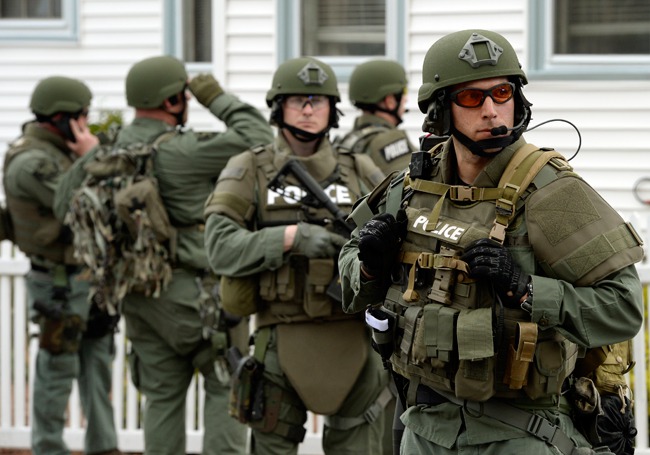
In the initial phase of a catastrophe, a phase that admittedly may last only a day or two depending on the swiftness and severity of the cataclysm, there will be some attempt by authorities to maintain law and order. During this phase, if you’re walking around with an AR or AK strapped to your back, you’re likely to be taken for a looter and shot on sight.
This is the red dot or reflex sight + polymer frame pistol phase. Mobile, concealable, accurate, quiet, and 100% reliable are what you’re looking for. Don’t worry about how long the batteries will last in your Aimpoint right now — you just have to get through this phase without getting arrested or shot.
If you think you’re going to get through this phase with a bow or a crossbow, then all I can say is that I’ll be glad to use your bow in phase 3 when I stumble across your corpse clutching it.
My personal fantasy load-out for this phase would be a suppressed Glock 17 paired with something like the Daniel Defense ISR-300 (a short-barreled rifle chambered in .300 Blackout with an integrally attached suppressor).
 Why the focus on stealth? Because if you do have to shoot someone or something during this phase, there’s a good chance that you may not want the whole neighborhood to know that shots were fired at your house. The authorities will be dealing with mass chaos and won’t have time to sort out who shot first, so if they show up at your house and you’re armed to the teeth and standing over a pile of corpses, then it may not go well for you. So a suppressed short-barreled rifle is your best bet for home defense here, because at least you have the option of not involving an organized gang of heavily armed, yet frightened and confused people (i.e. the police or whoever is trying to maintain order) who may decide that you’re a threat.
Note that now is the time for you to either start your NFA paperwork, or obtain the theoretical know-how to build a homemade can. I’m not saying go out and build a silencer, because that’s illegal. But maybe download the info and print it out, and store it as part of your bug-out gear. Do not under any circumstances attempt to actually make a homemade silencer, though, because that’s a felony. You do it, you get caught, you go to jail — end of story. I’m not winking or smiling here — do not do it, and in fact don’t even gather the materials for it because you don’t want to be guilty of constructive possession of such a thing.
Experienced pistol shooters (which does not describe me) will no doubt be fine skipping the CQB personal defense weapon (PDW) and using a suppressed semi-auto pistol for this phase. This is great, because as I mentioned above, you’ll need a pistol anyway.
So get your phase 1 load-out together, and learn to shoot and move with it. And for God’s sake just pick the best tools for the immediate job at hand, without worrying about whether or not the batteries will last another 20 years. You’ll need every technological advantage, no matter how fragile and/or short-lived that technology may seem, to fight your way through this temporary phase. If you can afford some good night-vision equipment, then by all means add it to your phase 1 load-out, and quit worrying about whether your grandchildren will still be able to use it to defend the homestead.
Phase 2: lawlessness and die-off
This is the open-carry assault rifle phase. Very few people are going to make it past this phase, but if you do, it’s because you have reliable long gun, plenty of ammo, a good optic, some training, and a few capable allies at your side.
The people who have survived phase 1 are not going to be happy campers. They’ll be hungry, justifiably terrified, and aggressive. They’ll also be gathered together in groups and gangs, which is exactly how you should plan to roll during this phase. More allies with guns means a better chance for you and yours to survive, which is why the training that you do for this phase should involve learning to shoot and move as part of a group.
You’ll want carbine and shotgun options — the pistol that got you through phase 1 will probably become a rarely used backup weapon, and your long guns will become your primary weapons. My personal pick for phase 2 is an AR-15 with a Trijicon ACOG, but that’s because I know the AR platform pretty well. Others will choose the AK. There’s also the Tavor, SCAR, and numerous other options. I won’t wade into this debate, because this is what most people are thinking of when they post “what gun and optic should I get for SHTF?” in various forums.
Phase 3: long-term survival
At some point your optics will run out of batteries, and depending on your stockpiles you may run out of ammo even before then. When this happens, it’s all about trapping and snares, fishing, farming, and finding ways to harvest a few thousand calories per day per family member.
Note that taking wild game of any kind is difficult, and it involves a lifetime of practice. Depending on the terrain you’re in and your skill set, hunting for food will range from very difficult to downright impossible. Farming is an order of magnitude easier and more predictable, so if you really want to be prepared then you should learn to grow your own food.
Of course, you will still do some shooting — this is the phase where you get to bust out that double-barreled shotgun with the multi-caliber barrel inserts, and go scavenging for ammo. If that shotgun was your phase 1 weapon, then you probably didn’t make it this far, but it will make a fine phase 3 hunting and home/farm defense gun.
This is the phase where a lot of people plan to rely on archery to take game. Please. Bowhunting is hard. Trapping isn’t a cakewalk, but it’s a vastly easier and more reliable way to get protein that stalking around in the woods with a bow; it also relies far less on expensive consumables (i.e arrowheads and strings) that you’d need to stockpile.
I personally think that .once-again-cheap 22LR ammo is the best thing to stock up on for this phase, and judging by the recent shortage, plenty of people agree with me.
Conclusion
Many of you will disagree with some, or even all, of my recommendations. But I hope if you take away anything from this article, it’s the idea that any catastrophe will unfold in series of distinct phases or stages, and you’ll need to prepare for each one. The tools and skills that will get you through the initial phase won’t necessarily be the best suited for the next phase, and so on. So the answer is to have specialized load-outs for different types of situations. You want to have options, so that you can improvise, adapt, and overcome. Don’t think in terms of “one gun” or “three guns” — think in terms of scenarios and loadouts.
This is actually how US Special Forces operate. They have different load-outs that fit different mission profiles; sometimes this involves selecting different weapons and tools, and sometimes it involves reconfiguring the same weapon or tool. But the main thing is that they have options, and they adapt their load-out to fit their situation.
What types of scenarios do you imagine that you’ll face in a catastrophe, and what type of load-out (gun, optic, ammo, clothing, tools) would be the best fit for each scenario? Don’t get sucked into the game of trying to put together one single loadout that will fit every scenario, because I promise you, when you’re watching the chaos unfold and you’re wetting your pants, you’re going to wish dearly that you hadn’t tied yourself to a one-size-fits-all, jack-of-all-trades-master-of-none solution. You’re going to want to reach for the very best tool for the job that is immediately staring you in the face, and you won’t be happy if you’re stuck with the second- or third-best tool for wide a range of jobs that you may or may not encounter.