Dec 17, 2014 | 2020 Relevant, Enlightened Influences, Whistleblowers & Dissidents
Huey Percy Newton was an African-American political and urban activist who, along with Bobby Seale, co-founded the Black Panther Party in 1966. Many well educated activists would argue this group was ultimately undermined by FBI tactics and COINTELPRO, to destroy their image decrease effectiveness within the community.
Newton earned a Ph.D. in history of consciousness at the University of California at Santa Cruz in 1980. His doctoral dissertation was entitled War Against the Panthers: A Study of Repression in America.
Later, Newton’s widow, Frederika Newton, would discuss her husband’s often-ignored academic leanings on C-SPAN‘s “American Perspectives” program on February 18, 2006.
On August 22, 1989, Newton was fatally shot on Center Street in the Lower Bottoms neighborhood of West Oakland by 24-year-old BGF member and drug dealer Tyrone Robinson, in what some say was a ‘setup’ involving the FBI.
Newton’s last words, as he stood facing his killer, were, “You can kill my body, and you can take my life but you can never kill my soul. My soul will live forever!”
Huey Percy Newton was an African-American political and urban activist who, along with Bobby Seale, co-founded the Black Panther Party in 1966. Many well educated activists would argue this group was ultimately undermined by FBI tactics and COINTELPRO, to destroy their image decrease effectiveness within the community.
Newton earned a Ph.D. in history of consciousness at the University of California at Santa Cruz in 1980. His doctoral dissertation was entitled War Against the Panthers: A Study of Repression in America.
Later, Newton’s widow, Frederika Newton, would discuss her husband’s often-ignored academic leanings on C-SPAN‘s “American Perspectives” program on February 18, 2006.
On August 22, 1989, Newton was fatally shot on Center Street in the Lower Bottoms neighborhood of West Oakland by 24-year-old BGF member and drug dealer Tyrone Robinson, in what some say was a ‘setup’ involving the FBI.
Newton’s last words, as he stood facing his killer, were, “You can kill my body, and you can take my life but you can never kill my soul. My soul will live forever!”
Huey Percy Newton was an African-American political and urban activist who, along with Bobby Seale, co-founded the Black Panther Party in 1966. Many well educated activists would argue this group was ultimately undermined by FBI tactics and COINTELPRO, to destroy their image decrease effectiveness within the community.
Newton earned a Ph.D. in history of consciousness at the University of California at Santa Cruz in 1980. His doctoral dissertation was entitled War Against the Panthers: A Study of Repression in America.
Later, Newton’s widow, Frederika Newton, would discuss her husband’s often-ignored academic leanings on C-SPAN‘s “American Perspectives” program on February 18, 2006.
On August 22, 1989, Newton was fatally shot on Center Street in the Lower Bottoms neighborhood of West Oakland by 24-year-old BGF member and drug dealer Tyrone Robinson, in what some say was a ‘setup’ involving the FBI.
Newton’s last words, as he stood facing his killer, were, “You can kill my body, and you can take my life but you can never kill my soul. My soul will live forever!”
Dec 9, 2013 | Government Agenda, Leaks, News
This story has been reported in partnership between The New York Times, the Guardian and ProPublica based on documents obtained by The Guardian.
Not limiting their activities to the earthly realm, American and British spies have infiltrated the fantasy worlds of World of Warcraft and Second Life, conducting surveillance and scooping up data in the online games played by millions of people across the globe, according to newly disclosed classified documents.
Fearing that terrorist or criminal networks could use the games to communicate secretly, move money or plot attacks, the documents show, intelligence operatives have entered terrain populated by digital avatars that include elves, gnomes and supermodels.
The spies have created make-believe characters to snoop and to try to recruit informers, while also collecting data and contents of communications between players, according to the documents, disclosed by the former National Security Agency contractor Edward J. Snowden. Because militants often rely on features common to video games — fake identities, voice and text chats, a way to conduct financial transactions — American and British intelligence agencies worried that they might be operating there, according to the papers.
Takeaways: How Spy Agencies Operate In Virtual Worlds
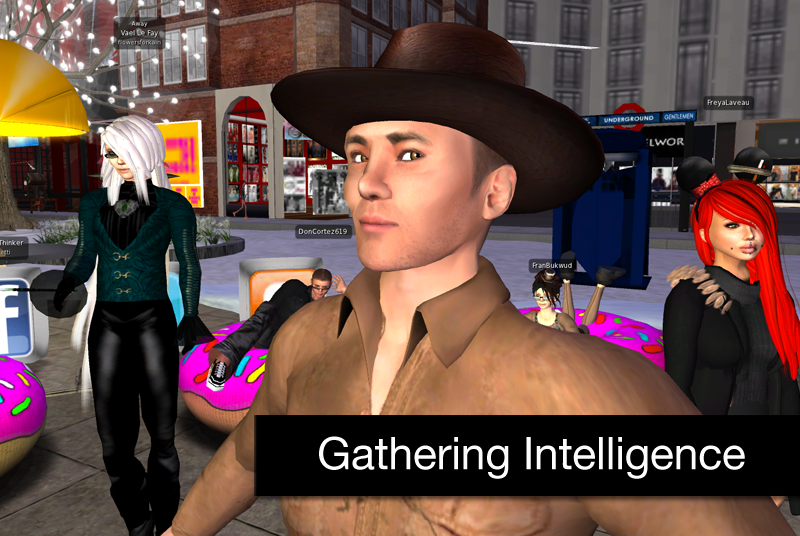
GATHERING INTELLIGENCE: U.S. and British intelligence agencies — including the Central Intelligence Agency, Defense intelligence agency and Britain’s Government Communications Headquarters — . For example, according to Snowden documents, the U.S. has conducted spy operations in Second Life (pictured), where players create human avatars to socialize, buy and sell goods and explore exotic virtual destinations. (Second Life image via Linden Lab)
Online games might seem innocuous, a top-secret 2008 NSA document warned, but they had the potential to be a “target-rich communication network” allowing intelligence suspects “a way to hide in plain sight.” Virtual games “are an opportunity!,” another 2008 NSA document declared.
But for all their enthusiasm — so many CIA, FBI and Pentagon spies were hunting around in Second Life, the document noted, that a “deconfliction” group was needed to avoid collisions — the intelligence agencies may have inflated the threat.
The documents do not cite any counterterrorism successes from the effort, and former American intelligence officials, current and former gaming company employees and outside experts said in interviews that they knew of little evidence that terrorist groups viewed the games as havens to communicate and plot operations.
(Transcript: What are intelligence agencies doing in virtual worlds?)
Games “are built and operated by companies looking to make money, so the players’ identity and activity is tracked,” said Peter W. Singer of the Brookings Institution, an author of “Cybersecurity and Cyberwar: What Everyone Needs to Know.” “For terror groups looking to keep their communications secret, there are far more effective and easier ways to do so than putting on a troll avatar.”
The surveillance, which also included Microsoft’s Xbox Live, could raise privacy concerns. It is not clear exactly how the agencies got access to gamers’ data or communications, how many players may have been monitored or whether Americans’ communications or activities were captured.
One American company, the maker of World of Warcraft, said that neither the NSA nor its British counterpart, the Government Communications Headquarters, had gotten permission to gather intelligence in its game. Many players are Americans, who can be targeted for surveillance only with approval from the nation’s secret intelligence court. The spy agencies, though, face far fewer restrictions on collecting certain data or communications overseas.
“We are unaware of any surveillance taking place,” said a spokesman for Blizzard Entertainment, based in Irvine, Calif., which makes World of Warcraft. “If it was, it would have been done without our knowledge or permission.”
A spokeswoman for Microsoft declined to comment. Philip Rosedale, the founder of Second Life and a former chief executive officer of Linden Lab, the game’s maker, declined to comment on the spying revelations. Current Linden executives did not respond to requests for comment.
A Government Communications Headquarters spokesman would neither confirm nor deny any involvement by that agency in gaming surveillance, but said that its work is conducted under “a strict legal and policy framework” with rigorous oversight. An NSA spokeswoman declined to comment.
Intelligence and law enforcement officials became interested in games after some became enormously popular, drawing tens of millions of people worldwide, from preteens to retirees. The games rely on lifelike graphics, virtual currencies and the ability to speak to other players in real time. Some gamers merge the virtual and real worlds by spending long hours playing and making close online friends.
In World of Warcraft, players share the same fantasy universe — walking around and killing computer-controlled monsters or the avatars of other players, including elves, animals or creatures known as orcs. In Second Life, players create customized human avatars that can resemble themselves or take on other personas — supermodels and bodybuilders are popular — who can socialize, buy and sell virtual goods, and go places like beaches, cities, art galleries and strip clubs. In Microsoft’s Xbox Live service, subscribers connect online in games that can involve activities like playing soccer or shooting at each other in space.
According to American officials and documents that Mr. Snowden provided to The Guardian, which shared them with The New York Times and ProPublica, spy agencies grew worried that terrorist groups might take to the virtual worlds to establish safe communications channels.
In 2007, as the NSA and other intelligence agencies were beginning to explore virtual games, NSA officials met with the chief technology officer for the manufacturer of Second Life, the San Francisco-based Linden Lab. The executive, Cory Ondrejka, was a former Navy officer who had worked at the NSA with a top-secret security clearance.
He visited the agency’s headquarters at Fort Meade, Md., in May 2007 to speak to staff members over a brown bag lunch, according to an internal agency announcement. “Second Life has proven that virtual worlds of social networking are a reality: come hear Cory tell you why!” said the announcement. It added that virtual worlds gave the government the opportunity “to understand the motivation, context and consequent behaviors of non-Americans through observation, without leaving U.S. soil.”
Ondrejka, now the director of mobile engineering at Facebook, said through a representative that the NSA presentation was similar to others he gave in that period, and declined to comment further.
Even with spies already monitoring games, the NSA thought it needed to step up the effort.
“The Sigint Enterprise needs to begin taking action now to plan for collection, processing, presentation and analysis of these communications,” said one April 2008 NSA document, referring to “signals intelligence.” The document added, “With a few exceptions, NSA can’t even recognize the traffic,” meaning that the agency could not distinguish gaming data from other Internet traffic.
By the end of 2008, according to one document, the British spy agency, known as GCHQ, had set up its “first operational deployment into Second Life” and had helped the police in London in cracking down on a crime ring that had moved into virtual worlds to sell stolen credit card information. The British spies running the effort, which was code-named “Operation Galician,” were aided by an informer using a digital avatar “who helpfully volunteered information on the target group’s latest activities.”
Though the games might appear to be unregulated digital bazaars, the companies running them reserve the right to police the communications of players and store the chat dialogues in servers that can be searched later. The transactions conducted with the virtual money common in the games, used in World of Warcraft to buy weapons and potions to slay monsters, are also monitored by the companies to prevent illicit financial dealings.
In the 2008 NSA document, titled “Exploiting Terrorist Use of Games & Virtual Environments,” the agency said that “terrorist target selectors” — which could be a computer’s Internet Protocol address or an email account — “have been found associated with Xbox Live, Second Life, World of Warcraft” and other games. But that document does not present evidence that terrorists were participating in the games.
Still, the intelligence agencies found other benefits in infiltrating these online worlds. According to the minutes of a January 2009 meeting, GCHQ’s “network gaming exploitation team” had identified engineers, embassy drivers, scientists and other foreign intelligence operatives to be World of Warcraft players — potential targets for recruitment as agents.
At Menwith Hill, a Royal Air Force base in the Yorkshire countryside that the NSA has long used as an outpost to intercept global communications, American and British intelligence operatives started an effort in 2008 to begin collecting data from World of Warcraft.
One NSA document said that the World of Warcraft monitoring “continues to uncover potential Sigint value by identifying accounts, characters and guilds related to Islamic extremist groups, nuclear proliferation and arms dealing.” In other words, targets of interest appeared to be playing the fantasy game, though the document does not indicate that they were doing so for any nefarious purposes. A British document from later that year said that GCHQ had “successfully been able to get the discussions between different game players on Xbox Live.”
By 2009, the collection was extensive. One document says that while GCHQ was testing its ability to spy on Second Life in real time, British intelligence officers vacuumed up three days’ worth of Second Life chat, instant message and financial transaction data, totaling 176,677 lines of data, which included the content of the communications.
For their part, players have openly worried that the NSA might be watching them.
In one World of Warcraft discussion thread, begun just days after the first Snowden revelations appeared in the news media in June, a human death knight with the user name “Crrassus” asked whether the NSA might be reading game chat logs.
“If they ever read these forums,” wrote a goblin priest with the user name “Diaya,” “they would realize they were wasting” their time.
Even before the American government began spying in virtual worlds, the Pentagon had identified the potential intelligence value of video games. The Pentagon’s Special Operations Command in 2006 and 2007 worked with several foreign companies — including an obscure digital media business based in Prague — to build games that could be downloaded to mobile phones., according to people involved in the effort. They said the games, which were not identified as creations of the Pentagon, were then used as vehicles for intelligence agencies to collect information about the users.
Eager to cash in on the government’s growing interest in virtual worlds, several large private contractors have spent years pitching their services to American intelligence agencies. In one 66-page document from 2007, part of the cache released by Mr. Snowden, the contracting giant SAIC promoted its ability to support “intelligence collection in the game space,” and warned that online games could be used by militant groups to recruit followers and could provide “terrorist organizations with a powerful platform to reach core target audiences.”
It is unclear whether SAIC received a contract based on this proposal, but one former SAIC employee said that the company at one point had a lucrative contract with the CIA for work that included monitoring the Internet for militant activity. An SAIC spokeswoman declined to comment.
In spring 2009, academics and defense contractors gathered at the Marriott at Washington Dulles International Airport to present proposals for a government study about how players’ behavior in a game like World of Warcraft might be linked to their real-world identities. “We were told it was highly likely that persons of interest were using virtual spaces to communicate or coordinate,” said Dmitri Williams, a professor at the University of Southern California who received grant money as part of the program.
After the conference, both SAIC and Lockheed Martin won contracts worth several million dollars, administered by an office within the intelligence community that finances research projects.
It is not clear how useful such research might be. A group at the Palo Alto Research Center, for example, produced a government-funded study of World of Warcraft that found “younger players and male players preferring competitive, hack-and-slash activities, and older and female players preferring noncombat activities,” such as exploring the virtual world. A group from the nonprofit SRI International, meanwhile, found that players under age 18 often used all capital letters both in chat messages and in their avatar names.
Those involved in the project were told little by their government patrons. According to Nick Yee, a Palo Alto researcher who worked on the effort, “We were specifically asked not to speculate on the government’s motivations and goals.”
Andrew W. Lehren contributed reporting.
Transcript: What are intelligence agencies doing in virtual worlds? ProPublica reporter Justin Elliott, New York Times reporter Mark Mazzetti and The Guardian’s James Ball discussed #SpyGames with our readers. Like this story? Get more great ProPublica journalism by signing up for our email newsletter.
via ProPublica
Sep 14, 2012 | Government Agenda, Taboo Terminology
I’ve been hearing rumours for a few months now that Godlike Productions has a “banned words” list that will result in you being blocked from reading the website should you decide to use one.
While I fully expect certain keywords to result in you unable to make a posting on the site, but I have never heard of a site that bans you 100% for using said words.
As well, there are only 2 keywords that I know that are blocked… “Alex Jones” and “Tavistock”. Thinking this may just be an urban legend, I wanted to put it to the test.
I opened up my browser and headed over to Godlike Productions. To ensure that I wasn’t already banned (which does happen sometimes) I commented on a few posts.
Then I spy a post from the form administrator. The admin goes by the name “Trinity” and is one of the 2 main administrators. The post was entitled “A Heart Felt Thank You To All Participants On This Website!” where Trinity thanks the visitors of GLP.
Thinking that this would be a perfect place to test my theory, I typed in the following comment:
“I never knew it would be so much fun hanging with the guys from Tavistock”
And then hit the submit button. The screen flashed and suddenly I was greeted with the following message:
SORRY – YOUR IP ADDRESS <REMOVED FOR PRIVACY> HAS BEEN BANNED FROM VIEWING THIS WEBSITE
If you have an upgraded account you are immune to bans while logged in. Please log in now to browse the site.
If you have a free account you may also log in now and upgrade your account to get immunity from bans.
If you still don’t have an account you may create an account now and then upgrade it to get past bans (and get access to other exclusive features).
Thank you for not stalking!
So why would GLP be banning people for using the words Tavistock? Mind control and culture creation are big subjects in the alternative media and Tavistock is at the head of those operations.
Is this just a way for GLP to create buzz in the community? If you ban certain words, like Tavistock, the visitors of the forums will spread that all around the Internet while calling you disinformation.
Unfortunately, Google doesn’t see “truth or false”. They only see that links are being feed back into GLP, thus GLP must be popular. Now Google will rank GLP pages higher because they have more “authority” due to the back-links.
Thinking this was all a bit strange, I decided to see if I could find out who owns GLP and then I could maybe gauge if they are brilliant marketers or full on COINTELPRO.

A Dark Rabbit Hole full of Vipers
As I’ve done with most of my investigations, I started this one without a conclusion in my head. I really wanted to believe that this was just some smart viral marketing campaign by GLP to help bring in hits and advertising dollars. But what I found made me really nervous.
So nervous, in fact, that I’m considering not publishing this article as I write it. Sticking your nose at Intelligence Operations can make you ended up hanging yourself with your hands tied behind your back, but I must continue on. The people have the right to know.
After some digging, and lots and lots of web-speculation, I believe I may have the answer on who actually owns GLP.
Come to find out Trinity’s real name is Jason Lucas and is located in Shalimar, Florida. Jason is one of the principal people behind a company known as “C2 Media” which is a spyware company. This was proven by the following documents submitted to the FTC on a presentation by Mr. Lucas regarding spyware.
FTC Public Workshop: “Monitoring Software On Your PC: Spyware, Adware, And Other Software” April 19, 2004
Not long after, it seems Mr. Lucas was drafted by the US intelligence community and became Deputy Director of a “data mining” for the Department of Defense’s Joint Task force.
In fact, the more you dig on Mr. Lucas and his business partner, Alex Shamash, you can see they are involved in all the “dirty” technologies on the Internet (aka Spyware, Adware, Malware, etc).
You can trace C2 Media (and their offset company Lop.com, who is well known for their massive spyware campaigns) by just searching through older computer magazines online.
If you want to know more about Jason Lucas and Alex Shamash, please read this article.
The Dark Conclusion
It is the users choice on what sites they visit, but they should be informed of what those sites are monitoring.
In fact, here at Conspiracy HQ, you can easily see our “Privacy Policy” by clicking the link in the top menu bar. We do use cookies to help personalize the users experience, but everything tracked is 100% anonymous.
GLP on the other hand immediately does a port scan of your computer when you connect to their website. This gives the operators plenty of information about you, your computer and what software or holes in security you may have.
Why would a site that is so entrenched in the alternative media track your moves, scan your computer and know exactly who you are when you connect to their site?
COINTELPRO… that is the only reason.
by Rob Daven, ConspiracyHQ.com
Oh and then there’s this little gem… via http://pastebin.com/yDNuBEzC
Hello all:
I am Jason Anthony Lucas, and am the owner and administrator of a website: godlikeproductions.com
I was born April 10, 1974. Roughly a decade or so ago, I used a business model that installed spyware on hundreds of thousands, perhaps millions, of computers around the world. It was extremely difficult for the average user to get rid of this software, and many people, including well-known computing magazines deemed my software as malware.
By selling the information the software gleaned from unsuspecting individual’s computers, I and my partners made a lot of money. I became rich by most standards, and was able to retire in my early 30’s. Fearing that the spyware might face legal challenges, I sent letters to the Federal Trade Commission, attempting to delineate the software, from spyware/malware. It was clear that the software was indeed spyware/malware, in that it transmitted information from people’s computers without their knowledge to my clients – and I was paid handsomely. Of course, I atempted to convince the FTC otherwise.
Around this time I was looking for ways to spend some of my money, so I bought a website, now commonly known as GLP. I played on peoples’ fears and desires – fears of conspiracies, and desires to be part of a community, as millions of people disassociate from the real world and interpersonal relationships, and are only able to function in a detached, virtual world. By marketing my product toward these two demographics (I’m good at marketing), I have now turned my website into a money making venture, by convincing otherwise intelligent people, to pay me money to have an avatar on my forum, and thereby obtain a “personality” of sorts – something they are unable to do successfully in the real world.
In 2006, my girlfriend at that time, graduated from Cooley law school on January 22. Though still single, we together purchased her childhood home from her parents. On January 30, 2006 her parents provided us a warranty deed to the property, and we signed a mortgage for $535,920 on the same day. I paid off the mortgage in full 13 months later, on March 12, 2007.
We did not marry until March 31, 2007. She put up with my shenanigans such as business dealings with pornographic websites and GLP, as it supplied a steady income stream, in addition to my already acquired wealth. Quite honestly though, things fell apart quite rapidly as my now wife was already pregnant with our daughter when we married. I’m sure my wife expected a “normal” life for us and especially her daughter-to-be; but I’ll admit that my shortcomings proved too much for the relationship. By August 20, 2007, I was kicked out of the house, divorce proceedings had begun, and I legally relinquished the house back to my soon-to-be ex-wife, as I already had another home in my possession; this is still the house I live in to this day. As you can see, my marriage lasted only a few months. My ex-wife was, by this time, living with her parents and the baby. The house I bought back in 2006 (from her parents, and near the ocean) was put up for sale some years ago, and is unoccupied and still for sale to this day. I invested ~ $300,000 of custom work in the house. This means I have roughly $835,000 into the house, but my current asking price is only $585,500.
As part of the divorce legal settlement, my ex-wife deeded the house I bought from her parents, back to me on February 9, 2008. I immediately had the house placed in the Jason A. Lucas Revocable Trust on February 28, 2008. My Successor Trustee is my sister, and I added another trustee, but will not name him yet, as he and I have some business dealings which may put our freedom in jeopardy. My divorce was finalized (recorded) on July 3, 2008.
I’m writing this as an introspective – a catharsis of the mind. Looking back, I’ve been quite an asshole much of my life. My parents divorced when I was 14, and in a little unusual move, my mom had my sister and my surnames changed from my father’s name, back to her maiden name. I am no stranger to the legal system – I have been to court for writing bad checks, my divorce, I sued my next door neighbor and lost (my attorney actually quit on me while in court!), and of course, my various business dealings.
Now that you know some of my history, I’ll open up as to how I feel about myself. I would rather liken my failed life resulting from a Napoleonic Complex (literally). I am of short stature, my parents divorced while I was an early teenager, and found I could use my marketing skills to install spyware onto perhaps millions of computers, and made a lot of money early in life.
With money comes some degree of a feeling of power. I grew up, and remain in the Fort Walton/Shalimar/Freeport area. I devolved into a small little world of hatred and mistrust, all-the-while using my money as influence and threats (mainly lawsuits) against anyone I fear who might enter my encampment of personal failure. I am a known alcoholic, but beat my breast with bravado because I have money. However, possessions, money, and alcohol are all I really have now, along with some degree of notoriety because of my website, but also fueled by the myths bestowed upon me by an unknowing and foolish public. They have built me up to be this figure of intrigue and allure, with all the stories of government spying/psy-ops, etc. None of this is true, of course.
I know I am a pathetic 38 year old tiny man (literally), who has money, no friends (other than the virtual variety), and am a failure as a husband and father. I could make better use of my time, i.e., instead of devoting untold hours and energy to a website, bravado, and alcohol… if I instead heaped all that energy on my daughter, she might actually have a more normal life of two loving, yet separate parents. By way of default, I’d have to say I am more of a hands-off dad, thinking that money and possessions will make my daughter happy.
Imagine having a father with enough monetary wealth to retire in his mid-thirties, and has the ability to spend much of his free time with you, playing, going to parks, museums, the beach, telling bedtime stories, taking you to school, helping with homework, etc.; yet he chooses instead to be on a computer playing macho-man, and drinking. Kind of sad for her… and me.
Which is why, I think, that all the attention I get from the interwebz just goes to feed my insatiable desire to feel powerful, all the while recognizing that in fact, I am a failure as a human.
The public, however, continues my mythical status, and assures a steady stream of income by paying me to have avatars on my website, and buying me (through “donations”) a telescope costing more than $35,000 (that’s just the instrument and mount).
One could assert that my alcohol-driven rants and lifestyle lends itself to being an unfit father, and generally loathsome human. I have turned to alcohol to drown my sorrows, and I currently have no desire to refrain from imbibing. My ego cannot let go.
I have had professional therapists say I need to disconnect from the virtual world in which I live. I’ll agree with that, and as a result, I’d like to request the following by those who care about me and GLP:
I am wealthy, and do not need additional money. For this reason, I am requesting that all of you, paying members or donators, stop sending money or donations. This will only enable my self-destructing lifestyle, and I need to heal before causing my ultimate demise.
So please, STOP sending me money. I’ll still be around, and maybe someday, can turn my life around.
Sincerely,
Jason Anthony Lucas
4571 State Highway 20 East
Freeport, Florida 32439
(private road is Plantation Lane)
If you’d like to see the telescope on the property, just copy/paste the following into Google Earth:
30 29 00 N 86 03 39 W
http://www.imagebam.com/image/abe729222041835.jpg
http://www.imagebam.com/image/98bdc6222041836.jpg
http://www.imagebam.com/image/3dcab7222041837.jpg
http://www.imagebam.com/image/526121222042273.jpg
http://www.ftc.gov/os/comments/spyware/040312lucas.pdf
http://www.ftc.gov/os/comments/spyware/040414lucas2.pdf
Divorce announcement:
http://www.pcnh-d.net/archives/2008/DailyNews/2008_Jul_4/c3.pdf
Since I’m coming clean, I will soon be giving an explanation of my involvement in spyware/malware, how I tried to pass it off legally as adware, along with the business model and business partners and their connections to me.
May 13, 2012 | Government Agenda
Strong, credible allegations of high-level criminal activity can bring down a government. When the government lacks an effective, fact-based defense, other techniques must be employed. The success of these techniques depends heavily upon a cooperative, compliant press and a mere token opposition party.
1. Dummy up. If it’s not reported, if it’s not news, it didn’t happen.
2. Wax indignant. This is also known as the “How dare you?” gambit.
3. Characterize the charges as “rumors” or, better yet, “wild rumors.” If, in spite of the news blackout, the public is still able to learn about the suspicious facts, it can only be through “rumors.” (If they tend to believe the “rumors” it must be because they are simply “paranoid” or “hysterical.”)
4. Knock down straw men. Deal only with the weakest aspects of the weakest charges. Even better, create your own straw men. Make up wild rumors (or plant false stories) and give them lead play when you appear to debunk all the charges, real and fanciful alike.
5. Call the skeptics names like “conspiracy theorist,” “nutcase,” “ranter,” “kook,” “crackpot,” and, of course, “rumor monger.” Be sure, too, to use heavily loaded verbs and adjectives when characterizing their charges and defending the “more reasonable” government and its defenders. You must then carefully avoid fair and open debate with any of the people you have thus maligned. For insurance, set up your own “skeptics” to shoot down.
6. Impugn motives. Attempt to marginalize the critics by suggesting strongly that they are not really interested in the truth but are simply pursuing a partisan political agenda or are out to make money (compared to over-compensated adherents to the government line who, presumably, are not).
7. Invoke authority. Here the controlled press and the sham opposition can be very useful.
8. Dismiss the charges as “old news.”
9. Come half-clean. This is also known as “confession and avoidance” or “taking the limited hangout route.” This way, you create the impression of candor and honesty while you admit only to relatively harmless, less-than-criminal “mistakes.” This stratagem often requires the embrace of a fall-back position quite different from the one originally taken. With effective damage control, the fall-back position need only be peddled by stooge skeptics to carefully limited markets.
10. Characterize the crimes as impossibly complex and the truth as ultimately unknowable.
11. Reason backward, using the deductive method with a vengeance. With thoroughly rigorous deduction, troublesome evidence is irrelevant. E.g. We have a completely free press. If evidence exists that the Vince Foster “suicide” note was forged, they would have reported it. They haven’t reported it so there is no such evidence. Another variation on this theme involves the likelihood of a conspiracy leaker and a press who would report the leak.
12. Require the skeptics to solve the crime completely. E.g. If Foster was murdered, who did it and why?
13. Change the subject. This technique includes creating and/or publicizing distractions.
14. Lightly report incriminating facts, and then make nothing of them. This is sometimes referred to as “bump and run” reporting.
15. Boldly and brazenly lie. A favorite way of doing this is to attribute the “facts” furnished the public to a plausible-sounding, but anonymous, source.
16. Expanding further on numbers 4 and 5, have your own stooges “expose” scandals and champion popular causes. Their job is to pre-empt real opponents and to play 99-yard football. A variation is to pay rich people for the job who will pretend to spend their own money.
17. Flood the Internet with agents. This is the answer to the question, “What could possibly motivate a person to spend hour upon hour on Internet news groups defending the government and/or the press and harassing genuine critics?” Don t the authorities have defenders enough in all the newspapers, magazines, radio, and television? One would think refusing to print critical letters and screening out serious callers or dumping them from radio talk shows would be control enough, but, obviously, it is not.
Apr 13, 2012 | Government Agenda
One way to neutralize a potential activist is to get them to be in a group that does all the wrong things. Why?
1) The message doesn’t get out.
2) A lot of time is wasted
3) The activist is frustrated and discouraged
4) Nothing good is accomplished.
FBI and Police Informers and Infiltrators will infest any group and they have phoney activist organizations established.
Their purpose is to prevent any real movement for justice or eco-peace from developing in this country.
Agents come in small, medium or large. They can be of any ethnic background. They can be male or female.
The actual size of the group or movement being infiltrated is irrelevant. It is the potential the movement has for becoming large which brings on the spies and saboteurs.
This booklet lists tactics agents use to slow things down, foul things up, destroy the movement and keep tabs on activists.
It is the agent’s job to keep the activist from quitting such a group, thus keeping him/her under control.
In some situations, to get control, the agent will tell the activist:
“You’re dividing the movement.”
[Here, I have added the psychological reasons as to WHY this maneuver works to control people]
This invites guilty feelings. Many people can be controlled by guilt. The agents begin relationships with activists behind a well-developed mask of “dedication to the cause.” Because of their often declared dedication, (and actions designed to prove this), when they criticize the activist, he or she – being truly dedicated to the movement – becomes convinced that somehow, any issues are THEIR fault. This is because a truly dedicated person tends to believe that everyone has a conscience and that nobody would dissimulate and lie like that “on purpose.” It’s amazing how far agents can go in manipulating an activist because the activist will constantly make excuses for the agent who regularly declares their dedication to the cause. Even if they do, occasionally, suspect the agent, they will pull the wool over their own eyes by rationalizing: “they did that unconsciously… they didn’t really mean it… I can help them by being forgiving and accepting ” and so on and so forth.
The agent will tell the activist:
“You’re a leader!”
This is designed to enhance the activist’s self-esteem. His or her narcissistic admiration of his/her own activist/altruistic intentions increase as he or she identifies with and consciously admires the altruistic declarations of the agent which are deliberately set up to mirror those of the activist.
This is “malignant pseudoidentification.” It is the process by which the agent consciously imitates or simulates a certain behavior to foster the activist’s identification with him/her, thus increasing the activist’s vulnerability to exploitation. The agent will simulate the more subtle self-concepts of the activist.
Activists and those who have altruistic self-concepts are most vulnerable to malignant pseudoidentification especially during work with the agent when the interaction includes matter relating to their competency, autonomy, or knowledge.
The goal of the agent is to increase the activist’s general empathy for the agent through pseudo-identification with the activist’s self-concepts.
The most common example of this is the agent who will compliment the activist for his competency or knowledge or value to the movement. On a more subtle level, the agent will simulate affects and mannerisms of the activist which promotes identification via mirroring and feelings of “twinship”. It is not unheard of for activists, enamored by the perceived helpfulness and competence of a good agent, to find themselves considering ethical violations and perhaps, even illegal behavior, in the service of their agent/handler.
The activist’s “felt quality of perfection” [self-concept] is enhanced, and a strong empathic bond is developed with the agent through his/her imitation and simulation of the victim’s own narcissistic investments. [self-concepts] That is, if the activist knows, deep inside, their own dedication to the cause, they will project that onto the agent who is “mirroring” them.
The activist will be deluded into thinking that the agent shares this feeling of identification and bonding. In an activist/social movement setting, the adversarial roles that activists naturally play vis a vis the establishment/government, fosters ongoing processes of intrapsychic splitting so that “twinship alliances” between activist and agent may render whole sectors or reality testing unavailable to the activist. They literally “lose touch with reality.”
Activists who deny their own narcissistic investments [do not have a good idea of their own self-concepts and that they ARE concepts] and consciously perceive themselves (accurately, as it were) to be “helpers” endowed with a special amount of altruism are exceedingly vulnerable to the affective (emotional) simulation of the accomplished agent.
Empathy is fostered in the activist through the expression of quite visible affects. The presentation of tearfulness, sadness, longing, fear, remorse, and guilt, may induce in the helper-oriented activist a strong sense of compassion, while unconsciously enhancing the activist’s narcissistic investment in self as the embodiment of goodness.
The agent’s expresssion of such simulated affects may be quite compelling to the observer and difficult to distinguish from deep emotion.
It can usually be identified by two events, however:
First, the activist who has analyzed his/her own narcissistic roots and is aware of his/her own potential for being “emotionally hooked,” will be able to remain cool and unaffected by such emotional outpourings by the agent.
As a result of this unaffected, cool, attitude, the Second event will occur: The agent will recompensate much too quickly following such an affective expression leaving the activist with the impression that “the play has ended, the curtain has fallen,” and the imposture, for the moment, has finished. The agent will then move quickly to another activist/victim.
The fact is, the movement doesn’t need leaders, it needs MOVERS. “Follow the leader” is a waste of time.
A good agent will want to meet as often as possible. He or she will talk a lot and say little. One can expect an onslaught of long, unresolved discussions.
Some agents take on a pushy, arrogant, or defensive manner:
1) To disrupt the agenda
2) To side-track the discussion
3) To interrupt repeatedly
4) To feign ignorance
5) To make an unfounded accusation against a person.
Calling someone a racist, for example. This tactic is used to discredit a person in the eyes of all other group members.
Saboteurs
Some saboteurs pretend to be activists. She or he will ….
1) Write encyclopedic flyers (in the present day, websites)
2) Print flyers in English only.
3) Have demonstrations in places where no one cares.
4) Solicit funding from rich people instead of grass roots support
5) Display banners with too many words that are confusing.
6) Confuse issues.
7) Make the wrong demands.
Cool Compromise the goal.
9) Have endless discussions that waste everyone’s time. The agent may accompany the endless discussions with drinking, pot smoking or other amusement to slow down the activist’s work.
Provocateurs
1) Want to establish “leaders” to set them up for a fall in order to stop the movement.
2) Suggest doing foolish, illegal things to get the activists in trouble.
3) Encourage militancy.
4) Want to taunt the authorities.
5) Attempt to make the activist compromise their values.
6) Attempt to instigate violence. Activisim ought to always be non-violent.
7) Attempt to provoke revolt among people who are ill-prepared to deal with the reaction of the authorities to such violence.
Informants
1) Want everyone to sign up and sing in and sign everything.
2) Ask a lot of questions (gathering data).
3) Want to know what events the activist is planning to attend.
4) Attempt to make the activist defend him or herself to identify his or her beliefs, goals, and level of committment.
Recruiting
Legitimate activists do not subject people to hours of persuasive dialog. Their actions, beliefs, and goals speak for themselves.
Groups that DO recruit are missionaries, military, and fake political parties or movements set up by agents.
Surveillance
ALWAYS assume that you are under surveillance.
At this point, if you are NOT under surveillance, you are not a very good activist!
Scare Tactics
They use them.
Such tactics include slander, defamation, threats, getting close to disaffected or minimally committed fellow activists to persuade them (via psychological tactics described above) to turn against the movement and give false testimony against their former compatriots. They will plant illegal substances on the activist and set up an arrest; they will plant false information and set up “exposure,” they will send incriminating letters [emails] in the name of the activist; and more; they will do whatever society will allow.
This booklet in no way covers all the ways agents use to sabotage the lives of sincere an dedicated activists.
If an agent is “exposed,” he or she will be transferred or replaced.
COINTELPRO is still in operation today under a different code name. It is no longer placed on paper where it can be discovered through the freedom of information act.
The FBI counterintelligence program’s stated purpose: To expose, disrupt, misdirect, discredit, and otherwise neutralize individuals who the FBI categorize as opposed to the National Interests. “National Security” means the FBI’s security from the people ever finding out the vicious things it does in violation of people’s civil liberties.