11 Secret Documents Americans Deserve to See

Many documents produced by the U.S. government are confidential and not released to the public for legitimate reasons of national security. Others, however, are kept secret for more questionable reasons. The fact that presidents and other government officials have the power to deem materials classified provides them with an opportunity to use national security as an excuse to suppress documents and reports that would reveal embarrassing or illegal activities.
I’ve been collecting the stories of unreleased documents for several years. Now I have chosen 11 examples that were created—and buried—by both Democratic and Republican administrations and which cover assassinations, spying, torture, 50-year-old historical events, presidential directives with classified titles and…trade negotiations.
1. Obama Memo Allowing the Assassination of U.S. Citizens
When the administration of George W. Bush was confronted with cases of Americans fighting against their own country, it responded in a variety of ways. John Walker Lindh, captured while fighting with the Taliban in December 2001, was indicted by a federal grand jury and sentenced to 20 years in prison. José Padilla was arrested in Chicago in May 2002 and held as an “enemy combatant” until 2006 when he was transferred to civilian authority and, in August 2007, sentenced to 17 years in prison for conspiring to support terrorism. Adam Gadahn, who has made propaganda videos for al-Qaeda, was indicted for treason in 2006 and remains at large.
After he took over the presidency, Barack Obama did away with such traditional legal niceties and decided to just kill some Americans who would previously have been accused of treason or terrorism. His victims have included three American citizens killed in Yemen in 2011 by missiles fired from drones: U.S.-born anti-American cleric Anwar al-Awlaki, Samir Khan, an al-Qaeda propagandist from North Carolina, and Awlaki’s 16-year-old son, Abdulrahman al-Awlaki.
Obama justified his breach of U.S. and international law with a 50-page memorandum prepared by the Justice Department’s Office of Legal Counsel. Attorney General Eric Holder argued that the killing of Awlaki was legal because he was a wartime enemy and he could not be captured, but the legal justification for this argument is impossible to confirm because the Obama administration has refused to release the memo.
2. The Obama Interpretation of Section 215 of the Patriot Act
Section 215 of the Patriot Act allows the FBI, in pursuit of spies and terrorists, to order any person or entity to turn over “any tangible things” without having to justify its demands by demonstrating probable cause. For example, a library can be forced to reveal who borrowed a book or visited a web site. According to Section 215, the library is prohibited from telling anyone what it has turned over to the FBI.
The Obama administration has created a secret interpretation of Section 215 that goes beyond the direct wording of the law to include other information that can be collected. Democratic Senator Ron Wyden of Oregon, who, as a member of the Senate Intelligence Committee, was briefed about this secret interpretation, urged the president to make it public. “I want to deliver a warning this afternoon,” he said. “When the American people find out how their government has secretly interpreted the Patriot Act, they will be stunned and they will be angry.”
Wyden and Sen. Mark Udall of Colorado, also a Democrat, have implied that the Obama administration has expanded the use of Section 215 to activities other than espionage and terrorism. In a letter to Attorney General Eric Holder, Wyden and Udall wrote that “there is now a significant gap between what most Americans think the law allows and what the government secretly claims the law allows. This is a problem, because it is impossible to have an informed public debate about what the law should say when the public doesn’t know what its government thinks the law says.”
3. 30-page Summary of 9/11 Commission Interview with Bush and Cheney
You would have thought that, in the interests of the nation, the Bush administration would have demanded a thorough investigation of the terrorist attacks of September 11, 2001, the deadliest assault ever on U.S. soil. Instead, they fought tooth and nail against an independent investigation. Public pressure finally forced President George W. Bush to appoint a bipartisan commission that came to be known as the 9/11 Commission. It was eventually given a budget of $15 million…compared to the $39 million spent on the Monica Lewinsky/Bill Clinton investigation. When the commission completed its work in August 2004, the commissioners turned over all their records to the National Archives with the stipulation that the material was to be released to the public starting on January 2, 2009. However, most of the material remains classified. Among the more tantalizing still-secret documents are daily briefings given to President Bush that reportedly described increasingly worried warnings of a possible attack by operatives of Osama bin Laden.
Another secret document that the American people deserve to see is the 30-page summary of the interview of President Bush and Vice-President Dick Cheney conducted by all ten commissioners on April 29, 2004. Bush and Cheney refused to be interviewed unless they were together. They would not testify under oath and they refused to allow the interview to be recorded or transcribed. Instead the commission was allowed to bring with them a note taker. It is the summary based on this person’s notes that remains sealed.
4. Memos from President George W. Bush to the CIA Authorizing Waterboarding and other Torture Techniques
Four days after the terrorist attacks of September 11, 2001, President George W. Bush signed a “memorandum of notification” (still secret) that authorized the CIA to do what it needed to fight al-Qaeda. However the memo did not address what interrogation and torture techniques could be used on captured suspects. By June 2003, Director George Tenet and others at the CIA were becoming worried that if their seemingly illegal tactics became known to the public, the White House would deny responsibility and hang the CIA out to dry. After much discussion, Bush’s executive office handed over two memos, one in 2003 and another in 2004, confirming White House approval of the CIA interrogation methods, thus giving the CIA “top cover.” It is not known if President Bush himself signed the memos.
5. 1,171 CIA Documents Related to the Assassination of President Kennedy
It’s been 49 years since President John F. Kennedy was shot to death in Dallas, yet the National Archives and Records Administration (NARA) insists that more than one thousand documents relating to the case should not be released to the public until NARA is legally required to do so in 2017…unless the president at that time decides to extend the ban. It would appear that some of the blocked material deals with the late CIA agent David Phillips, who is thought to have dealt with Lee Harvey Oswald in Mexico City six weeks before the assassination.
6. Volume 5 of the CIA’s History of the Bay of Pigs Fiasco
In the late 1970s and early 1980s, CIA historian Dr. Jack B. Pfeiffer compiled a multi-volume history of the failed US attempt to invade Cuba in April 1961. In August 2005, the National Security Archive at George Washington University, citing the Freedom of Information Act, requested access to this history. The CIA finally released the information almost six years later, in July 2011. However it refused to release Volume V, which is titled “CIA’s Internal Investigation of the Bay of Pigs Operations.” Although more than 50 years have passed since the invasion, the U.S. District Court for the District of Columbia ruled that Volume V is exempt from the Freedom of Information Act because it “is covered by the deliberative process privilege” which “covers documents reflecting advisory opinions, recommendations and deliberations comprising part of a process by which governmental decisions and policies are formulated.”
7. National Security Decision Directives with Classified Titles
The day before he left the White House on January 20, 1993, President George H. W. Bush issued National Security Directive (NSD) #79, a document so secret that even its title remains classified almost 20 years later. The same goes for National Security Directive #77, issued a few days earlier, as well as four others issued in 1989 (#11, 13a, 19a and 25a). If the “a”s are any indication of the subjects, it is worth noting that NSD 13 dealt with countering cocaine trafficking in Peru; NSD 19 dealt with Libya and NSD 25 with an election in Nicaragua.
President Ronald Reagan also issued six NSDs with classified titles, and President Bill Clinton issued 29. President George W. Bush issued two such NSDs, presumably shortly after the terrorist attacks of September 11, 2001. President Barack Obama has issued at least seven Presidential Policy Directives with classified titles.
8. Major General Douglas Stone’s 700-Page Report on Prisoners Held in Afghanistan
Marine Corps General Douglas Stone earned positive reviews for his revamping of detention operations in Iraq, where he determined that most of the prisoners held by the United States were not actually militants and could be taught trades and rehabilitated. Based on his success in Iraq, Stone was given the task of making an evaluation of detainee facilities in Afghanistan. His findings, conclusions and recommendations were included in a 700-page report that he submitted to the U.S. Central Command in August 2009. According to some accounts of the report, Stone determined that two-thirds of the Afghan prisoners were not a threat and should be released. However, three years after he completed it, Stone’s report remains classified.
9. Detainee Assessment Briefs for Abdullah Tabarak and Abdurahman Khadr
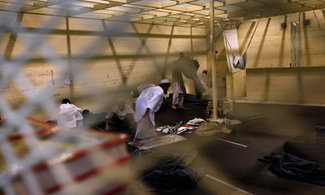
In 2011, WikiLeaks released U.S. military files known as Detainee Assessment Briefs (DABs), which describe the cases of 765 prisoners held at Guantánamo Bay. However, there were actually 779 prisoners. So what happened to the files for the other fourteen? Andy Worthington, author of The Guantanamo Files, has noted that two of the fourteen missing stories are especially suspicious: those of Abdullah Tabarak and Abdurahman Khadr.
Tabarak, a Moroccan, was allegedly one of Osama bin Laden’s long-time bodyguards, and took over bin Laden’s satellite phone in order to draw U.S. fire to himself instead of to bin Laden when U.S. forces were chasing the al-Qaeda leader in the Tora Bora mountains in December 2001. Captured and sent to Guantánamo, Tabarak was mysteriously released, sent back to Morocco in July 2003, and set free shortly thereafter.
Abdurahman Khadr, the self-described “black sheep” of a militant family from Canada, was 20 years old when he was captured in Afghanistan and turned over to American forces. He has said that he was recruited by the CIA to become an informant at Guantánamo and then in Bosnia. When the CIA tried to send him to Iraq, he refused and returned to Canada. His younger brother, Omar, was 15 years old when he was captured in Afghanistan and accused of killing an American soldier, Sergeant First Class Christopher Speer, during a firefight. He was incarcerated at Guantánamo for almost ten years until he was finally released to Canadian custody on September 29, 2012.
10. FBI Guidelines for Using GPS Devices to Track Suspects
On January 23, 2012, in the case of United States v. Jones, the Supreme Court ruled unanimously that attaching a GPS device to a car to track its movements constitutes a “search” and is thus covered by the Fourth Amendment protecting Americans against “unreasonable searches and seizures.” But it did not address the question of whether the FBI and other law enforcement agencies must obtain a warrant to attach a GPS device or whether it is enough for an agent to believe that such a search would turn up evidence of wrongdoing.
A month later, at a symposium at the University of San Francisco, FBI lawyer Andrew Weissman announced that the FBI was issuing two memoranda to its agents to clarify how the agency would interpret the Supreme Court decision. One memo dealt with the use of GPS devices, including whether they could be attached to boats and airplanes and used at international borders. The second addressed how the ruling applied to non-GPS techniques used by the FBI.
The ACLU, citing the Freedom of Information Act, has requested publication of the two memos because they “will shape not only the conduct of its own agents but also the policies, practices and procedures of other law enforcement agencies—and, consequently, the privacy rights of Americans.”
11. U.S. Paper on Negotiating Position on the Free Trade Agreement of the Americas
The subject of international trade negotiations is one that makes most people’s eyes glaze over. So why is the Obama administration fighting so hard to keep secret a one-page document that relates to early negotiations regarding the Free Trade Agreement of the Americas (FTAA), an accord that was proposed 18 years ago and about which public negotiations ended in 2005? All we know is that the document “sets forth the United States’ initial proposed position on the meaning of the phrase ‘in like circumstances.’” This phrase “helps clarify when a country must treat foreign investors as favorably as local or other foreign investors.”
Responding to a Freedom of Information Act lawsuit filed by The Center for International Environmental Law, DC District Judge Richard W. Roberts ordered the Office of the United States Trade Representative (USTR) to release the document, but the Obama administration has refused, claiming that disclosure “reasonably could be expected to result in damage to the national security” because all the nations involved in the failed negotiations agreed to keep all documents secret until December 31, 2013…“unless a country were to object to the release of one of its own documents at that time.” Judge Roberts ruled that the USTR has failed to present any evidence that release of the document would damage national security.
Most likely, the Obama administration is afraid that release of the document would set a precedent that could impede another secret trade negotiation, the Trans-Pacific Partnership (TPP), also known as the Trans-Pacific Strategic Economic Partnership Agreement, which seeks to establish a free trade zone among the U.S., New Zealand, Chile, Singapore, Brunei, Australia, Peru, Vietnam, Malaysia and possibly Canada, Mexico and Japan.