Aug 7, 2012 | Activism, Central Banking Elite
 Rampant silver manipulation? Rampant gold manipulation? Rampant LIBOR manipulation? Hiding MF Global client assets? These are all happening at JP Morgan according to an open letter reportedly written by an anonymous employee of the firm. The whistleblower also warns of a “cascading credit event being triggered” by derivatives related to Greek government debt. Unlike Greg Smith at Goldman Sachs, this whistleblower has chosen to remain anonymous for now. According to the letter, the whistleblower is still an employee of JP Morgan and has not resigned. But that does make it much more difficult to confirm what he is saying. With Greg Smith, we know exactly who he is and what he was doing at Goldman. As far as this anonymous whistleblower is concerned, all we have is this letter. So we must take it with a grain of salt. However, the information in this letter does agree with what whistleblowers such as Andrew Maguire have said in the past about silver manipulation by JP Morgan. And this letter does mention Greg Smith’s resignation from Goldman, so we know that it must have been written in the past few days. Hopefully this letter will cause authorities to take a much closer look at the crazy things that are going on over at JP Morgan and the other big Wall Street banks.
This anonymous letter was addressed to the CFTC, but unfortunately it looks like the CFTC has already chosen to ignore it.
The original letter from this anonymous whistleblower has already been taken down from the CFTC website. When you go there now, all you get is this message….
“The Comment Cannot Be Found. Please Return to the Previous Page and Try Again.”
Fortunately, there are many in the alternative media that copied this entire letter from the CFTC website.
The following is a copy of the original letter that the anonymous whistleblower from JP Morgan submitted to the CFTC….
———-
Dear CFTC Staff,
Hello, I am a current JPMorgan Chase employee. This is an open letter to all commissioners and regulators. I am emailing you today b/c I know of insider information that will be damning at best for JPMorgan Chase. I have decided to play the role of whistleblower b/c I no longer have faith and belief that what we are doing for society is bringing value to people. I am now under the opinion that we are actually putting hard working Americans unaware of what lays ahead at extreme market risk. This risk is unnecessary and will lead to wide-scale market collapse if not handled properly. With the release of Mr. Smith’s open letter to Goldman, I too would like to set the record straight for JPM as well. I have seen the disruptive behavior of superiors and no longer can say that I look up to employees at the ED/MD level here at JPM. Their smug exuberance and arrogance permeates the air just as pungently as rotting vegetables. They all know too well of the backdoor crony connections they share intimately with elected officials and with other institutions. It is apparent in everything they do, from the meager attempts to manipulate LIBOR, therefore controlling how almost all derivatives are priced to the inherit and fraudulent commodities manipulation. They too may have one day stood for something in the past in the client-employee relationship. Does anyone in today’s market really care about the protection of their client? From the ruthless and scandalous treatment of MF Global client asset funds to the excessive bonuses paid by companies with burgeoning liabilities. Yes, we at JPMorgan that are in the know are fearful of a cascading credit event being triggered in Greece as they have hidden derivatives in excess of $1 Trillion USD. We at JPMorgan own enough of these through counterparty risk and outright prop trading that our entire IB EDG space could be annihilated within a few short days. The last ten years has been market by inflexion point after inflexion point with the most notable coming in 2008 after the acquisition of Bear.
I wish to remain anonymous as of now as fear of termination mounts from what I am about to reveal. Robert Gottlieb is not my real name; however he is a trader that is involved in a lawsuit for manipulative trading while working with JPMorgan Chase. He was acquired during our Bear Stearns acquisition and is known to be the notorious person shorting in the silver future market from his trading space, along with Blythe Masters, his IB Global boss. However, with that said, we are manipulating the silver futures market and playing a smaller (but still massively manipulative) role in manipulating the gold futures market. We have a little over a 25% (give or take a percentage) position in the short market for silver futures and by your definition this denotes a larger position than for speculative purposes or for hedging and is beyond the line of manipulation.
On a side note, I do not work directly with accounts that would have been directly impacted by the MF Global fiasco but I have heard through other colleagues that we have involvement in the hiding of client assets from MF Global. This is another fraudulent effort on our part and constitutes theft. I urge you to forward that part of the investigation on to the respective authorities.
There is something else that you may find strange. During month-end December, we were all told by our managers that this was going to be a dismal year in terms of earnings and that we should not expect any bonuses or pay raises. Then come mid-late January it is made known that everyone received a pay raise and/or bonus, which is interesting b/c just a few weeks ago we were told that this was not likely and expected to be paid nothing in addition to base salary. January is right around the time we started increasing our short positions quite significantly again and this most recent crash in gold and silver during Bernanke’s speech on February 29th is of notable importance, as we along with 4 other major institutions, orchestrated the violent $100 drop in Gold and subsequent drops in silver.
As regulators of the free people of this country, I ask you to uphold the most important job in the world right now. That job is judge and overseer of all that is justice in the most sensitive of commodity markets. There are many middle-income people that invest in the physical assets of silver, gold, as well as mining stocks that are being financially impacted in a negative way b/c of our unscrupulous shorts in the precious metals commodity sector. If you read the COT with intent you will find that commercials (even though we have no business being in the commercial sector, which should be reserved for companies that truly produce the metal) are net short by a long shot in not only silver, but gold.
It is rather surprising that what should be well known liabilities on our balance sheet have not erupted into wider scale scrutinization. I call all honest and courageous JPMorgan employees to step up and fight the cronyism and wide-scale manipulation by reporting the truth. We are only helping reality come to light therefore allowing a real valuation of our banking industry which will give investors a chance to properly adjust without being totally wiped out. I will be contacting a lawyer shortly about this matter, as I believe no other whistleblower at JPMorgan has come forward yet. Our deepest secrets lie within the hands of honest employees and can be revealed through honest regulators that are willing to take a look inside one of America’s best kept secrets. Please do not allow this to turn into another Enron.
Kind Regards,
-The 1st Whistleblower of Many
———-
Another Enron?
If what this letter says is true, then the problems facing our financial system are more serious than most of us thought.
And the allegations of corruption at JP Morgan are absolutely shocking.
But this is not the first whistleblower to come forward to the CFTC with charges of rampant market manipulation by JP Morgan.
Back in 2010 I wrote about the stunning allegations that a former silver trader named Andrew Maguire presented to the CFTC. The following is an extended excerpt from that article….
———-
Back in November 2009, Andrew Maguire, a former Goldman Sachs silver trader in Goldman’s London office, contacted the CFTC’s Enforcement Division and reported the illegal manipulation of the silver market by traders at JPMorgan Chase.
Maguire told the CFTC how silver traders at JPMorgan Chase openly bragged about their exploits – including how they sent a signal to the market in advance so that other traders could make a profit during price suppression episodes.
Traders would recognize these signals and would make money shorting precious metals alongside JPMorgan Chase. Maguire explained to the CFTC how there would routinely be market manipulations at the time of option expiries, during non-farm payroll data releases, during commodities exchange contract rollovers, as well as at other times if it was deemed necessary.
On February 3rd, Maguire gave the CFTC a two day warning of a market manipulation event by email to Eliud Ramirez, who is a senior investigator for the CFTC’s Enforcement Division.
Maguire warned Ramirez that the price of precious metals would be suppressed upon the release of non-farm payroll data on February 5th. As the manipulation of the precious metals markets was unfolding on February 5th, Maguire sent additional emails to Ramirez explaining exactly what was going on.
And it wasn’t just that Maguire predicted that the price would be forced down. It was the level of precision that he was able to communicate to the CFTC that was the most stunning. He warned the CFTC that the price of silver was to be taken down regardless of what happened to the employment numbers and that the price of silver would end up below $15 per ounce. Over the next couple of days, the price of silver was indeed taken down from $16.17 per ounce down to a low of $14.62 per ounce.
Because of Maguire’s warning, the CFTC was able to watch a crime unfold, right in front of their eyes, in real time.
So what did the CFTC do about it?
Nothing.
Absolutely nothing.
———-
You can read the rest of that article right here.
So will the CFTC do anything about all of this?
Based on past history, probably not.
Basically, the CFTC is a government agency that appears to do next to nothing.
Another scandal involving JP Morgan has come out in recent days as well.
This one involves their credit card division. If you have a moments, you should really read the recent American Banker expose of credit card debt collection practices at JPMorgan Chase. It exposes some things that will absolutely blow your mind.
Linda Almonte, a former executive at JPMorgan Chase’s Credit Card Litigation Support Group, has revealed some incredible stuff regarding the debt collection practices at the company. Almonte says that she was shocked at what she saw when she began examining the details of a $200 million package of debt collection judgments to an outside debt collection agency….
Nearly half of the files her team sampled were missing proofs of judgment or other essential information, she wrote to colleagues. Even more worrisome, she alleged in her wrongful-termination suit, nearly a quarter of the files misstated how much the borrower owed.
In the “vast majority” of those instances, the actual debt was “lower that what Chase was representing,” her suit stated.
Almonte says that she warned that this sale of debt collection judgments must be stopped, but that a company executive told her that “she had better go along with the plan to sell the misrepresented asset“.
Almonte refused to go along, and she was fired on November 30th, 2009.
You are probably thinking that this sounds very much like the “robo-signing” foreclosure scandal and you would be right.
The more we dig into these giant financial companies the more corruption we find.
It really is shocking.
And remember, JPMorgan Chase is also the company that makes more money whenever the number of Americans on food stamps goes up.
JPMorgan Chase issues food stamp debit cards in 26 U.S. states and the District of Columbia, and they actually want more Americans to go on food stamps so that they can make bigger profits from the division that issues them.
So now are you starting to understand why so many Americans are upset about the corruption on Wall Street?
This isn’t a “conservative issue” or a “liberal issue” – it is an American issue and the outrageous behavior of these firms has brought our financial system once again to the edge of disaster.
Over the past six months, more than 350 prominent executives have resigned from major banks and financial institutions all over the globe.
Is this a sign that the rats are fleeing a sinking ship?
Do they know something that we don’t?
What we do know is that the financial crisis in Greece is far from over and the European financial system is getting closer to a complete meltdown with each passing day.
Very few of the things that caused the financial crisis of 2008 were ever corrected and our financial system is even more vulnerable today than it was back then.
In the end, this entire pyramid of debt, leverage and corruption is going to come crashing down really hard, and the consequences are going to be absolutely catastrophic.

Source: TheEconomicBlog
Jul 14, 2012 | Central Banking Elite
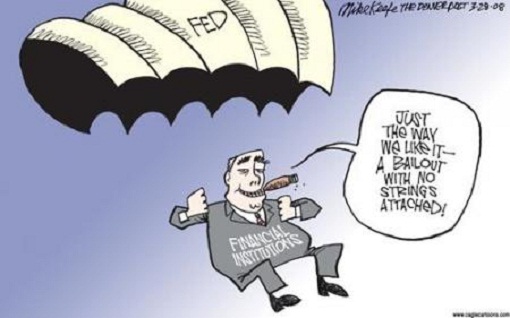
More than $4 trillion in near zero-interest Federal Reserve loans and other financial assistance went to the banks and businesses of at least 18 current and former Federal Reserve regional bank directors in the aftermath of the 2008 financial collapse, according to Government Accountability Office records made public for the first time today by Sen. Bernie Sanders.
On the eve of Senate testimony by JPMorgan Chase CEO Jamie Dimon, Sanders (I-Vt.) released the detailed findings on Dimon and other Fed board members whose banks and businesses benefited from Fed actions.
A Sanders provision in the Dodd-Frank Wall Street Reform Act required the Government Accountability Office to investigate potential conflicts of interest. The Oct. 19, 2011 report by the non-partisan investigative arm of Congress laid out the findings, but did not name names. Sanders today released the names.

“This report reveals the inherent conflicts of interest that exist at the Federal Reserve. At a time when small businesses could not get affordable loans to create jobs, the Fed was providing trillions in secret loans to some of the largest banks and corporations in America that were well represented on the boards of the Federal Reserve Banks. These conflicts must end,” Sanders said.
The GAO study found that allowing members of the banking industry to both elect and serve on the Federal Reserve’s board of directors creates “an appearance of a conflict of interest” and poses “reputational risks” to the Federal Reserve System.
In Dimon’s case, JPMorgan received some $391 billion of the $4 trillion in emergency Fed funds at the same time his bank was used by the Fed as a clearinghouse for emergency lending programs. In March of 2008, the Fed provided JPMorgan with $29 billion in financing to acquire Bear Stearns. Dimon also got the Fed to provide JPMorgan Chase with an 18-month exemption from risk-based leverage and capital requirements. And he convinced the Fed to take risky mortgage-related assets off of Bear Stearns balance sheet before JP Morgan Chase acquired the troubled investment bank.
Another high-profile conflict involved Stephen Friedman, the former chairman of the New York Fed’s board of directors. Late in 2008, the New York Fed approved an application from Goldman Sachs to become a bank holding company giving it access to cheap loans from the Federal Reserve. During that period, Friedman sat on the Goldman Sachs board. He also owned Goldman stock, something that was prohibited by Federal Reserve conflict of interest regulations. Although it was not publicly disclosed at the time, Friedman received a waiver from the Fed’s conflict of interest rules in late 2008. Unbeknownst to the Fed, Friedman continued to purchase shares in Goldman from November 2008 through January of 2009, according to the GAO.
In another case, General Electric CEO Jeffrey Immelt was a New York Fed board member at the same time GE helped create a Commercial Paper Funding Facility during the financial crisis. The Fed later provided $16 billion in financing to GE under this emergency lending program.
Sanders on May 22 introduced legislation to prohibit banking industry and business executives from serving as directors of the 12 Federal Reserve regional banks.
To read a report summarizing the new GAO information, click here.
Jamie Dimon Is Not Alone
During the financial crisis, at least 18 former and current directors from Federal Reserve Banks worked in banks and corporations that collectively received over $4 trillion in low-interest loans from the Federal Reserve.
US Senator Bernard Sanders (I-Vt.)
Washington, DC
June 12, 2012
- Jamie Dimon, the Chairman and CEO of JP Morgan Chase, has served on the Board of Directors at the Federal Reserve Bank of New York since 2007. During the financial crisis, the Fed provided JP Morgan Chase with $391 billion in total financial assistance. JP Morgan Chase was also used by the Fed as a clearinghouse for the Fed’s emergency lending programs.In March of 2008, the Fed provided JP Morgan Chase with $29 billion in financing to acquire Bear Stearns. During the financial crisis, the Fed provided JP Morgan Chase with an 18-month exemption from risk-based leverage and capital requirements. The Fed also agreed to take risky mortgage-related assets off of Bear Stearns balance sheet before JP Morgan Chase acquired this troubled investment bank.
- Jeffrey Immelt, the CEO of General Electric, served on the New York Fed’s Board of Directors from 2006-2011. General Electric received $16 billion in low-interest financing from the Federal Reserve’s Commercial Paper Funding Facility during this time period.
- Stephen Friedman. In 2008, the New York Fed approved an application from Goldman Sachs to become a bank holding company giving it access to cheap Fed loans. During the same period, Friedman, who was chairman of the New York Fed at the time, sat on the Goldman Sachs board of directors and owned Goldman stock, something the Fed’s rules prohibited. He received a waiver in late 2008 that was not made public. After Friedman received the waiver, he continued to purchase stock in Goldman from November 2008 through January of 2009 unbeknownst to the Fed, according to the GAO. During the financial crisis, Goldman Sachs received $814 billion in total financial assistance from the Fed.
- Sanford Weill, the former CEO of Citigroup, served on the Fed’s Board of Directors in New York in 2006. During the financial crisis, Citigroup received over $2.5 trillion in total financial assistance from the Fed.
- Richard Fuld, Jr, the former CEO of Lehman Brothers, served on the Fed’s Board of Directors in New York from 2006 to 2008. During the financial crisis, the Fed provided $183 billion in total financial assistance to Lehman before it collapsed.
- James M. Wells, the Chairman and CEO of SunTrust Banks, has served on the Board of Directors at the Federal Reserve Bank in Atlanta since 2008. During the financial crisis, SunTrust received $7.5 billion in total financial assistance from the Fed.
- Richard Carrion, the head of Popular Inc. in Puerto Rico, has served on the Board of Directors of the Federal Reserve Bank of New York since 2008. Popular received $1.2 billion in total financing from the Fed’s Term Auction Facility during the financial crisis.
- James Smith, the Chairman and CEO of Webster Bank, served on the Federal Reserve’s Board of Directors in Boston from 2008-2010. Webster Bank received $550 million in total financing from the Federal Reserve’s Term Auction Facility during the financial crisis.
- Ted Cecala, the former Chairman and CEO of Wilmington Trust, served on the Fed’s Board of Directors in Philadelphia from 2008-2010. Wilmington Trust received $3.2 billion in total financial assistance from the Federal Reserve during the financial crisis.
- Robert Jones, the President and CEO of Old National Bancorp, has served on the Fed’s Board of Directors in St. Louis since 2008. Old National Bancorp received a total of $550 million in low-interest loans from the Federal Reserve’s Term Auction Facility during the financial crisis.
- James Rohr, the Chairman and CEO of PNC Financial Services Group, served on the Fed’s Board of Directors in Cleveland from 2008-2010. PNC received $6.5 billion in low-interest loans from the Federal Reserve during the financial crisis.
- George Fisk, the CEO of LegacyTexas Group, was a director at the Dallas Federal Reserve in 2009. During the financial crisis, his firm received a $5 million low-interest loan from the Federal Reserve’s Term Auction Facility.
- Dennis Kuester, the former CEO of Marshall & Ilsley, served as a board director on the Chicago Federal Reserve from 2007-2008. During the financial crisis, his bank received over $21 billion in low-interest loans from the Fed.
- George Jones, Jr., the CEO of Texas Capital Bank, has served as a board director at the Dallas Federal Reserve since 2009. During the financial crisis, his bank received $2.3 billion in total financing from the Fed’s Term Auction Facility.
- Douglas Morrison, was the Chief Financial Officer at CitiBank in Sioux Falls, South Dakota, while he served as a board director at the Minneapolis Federal Reserve Bank in 2006. During the financial crisis, CitiBank in Sioux Falls, South Dakota received over $21 billion in total financing from the Federal Reserve.
- L. Phillip Humann, the former CEO of SunTrust Banks, served on the Board of Directors at the Federal Reserve Bank in Atlanta from 2006-2008. During the financial crisis, SunTrust received $7.5 billion in total financial assistance from the Fed.
- Henry Meyer, III, the former CEO of KeyCorp, served on the Board of Directors at the Federal Reserve Bank in Cleveland from 2006-2007. During the financial crisis, KeyBank (owned by KeyCorp) received over $40 billion in total financing from the Federal Reserve.
- Ronald Logue, the former CEO of State Street Corporation, served as a board member of the Boston Federal Reserve Bank from 2006-2007. During the financial crisis, State Street Corporation received a total of $42 billion in financing from the Federal Reserve.
SOURCE: ReaderSupportedNews.org
Feb 23, 2012 | Events & Assassinations
 “The perfunctory trials of the Titanic, a pale imitation of the Olympic’s, were followed by an outbreak of fire in bunker number ten. It could have been dealt with at Southampton, with all a great port’s fire-fighting facilities and without affecting sailing time; instead, an extra twelve firemen were specially signed on to deal with it at sea. The blaze, . . . was concealed from [Captain Maurice Harvey] Clarke, the Board of Trade inspector. Why did Smith not have the fire put out as soon as possible? Why did he hide it? Come to that, why did his ship consistently show a slight list to port in a calm sea before the collision, as noted by several aboard? Was there some undeclared damage to account for this—a leak in the weakened stern, for example? Why after the collision did Smith run the engines slow ahead for some minutes, as attested by witnesses, a move which would have exacerbated the flooding the forward compartments? Why was counter- flooding not attempted as a means of keeping the ship on an even keel for longer? Why did Dr. [Robert D.] Ballard find a bulkhead not on his plan of the Titanic when exploring the wreck? . . .
Neither Dr. Ballard nor anyone else who has visited the wreck for pictorial or plundering purposes has produced a single object or photograph of anything showing the name “Titanic”—except on the bow and on one luggage–tag. The name is shown on nothing else both built into the ship and recovered or recorded so far. We found this sufficiently remarkable to invite every likely source to settle the matter once and for all by furnishing proof that the wreck was the Titanic. Reactions ranged from amusement via irritation to ridicule and shock that anyone would raise such a question.
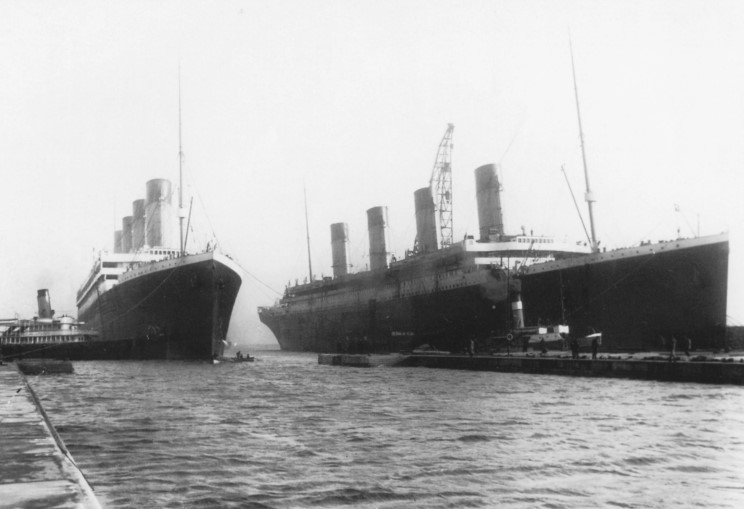
Our difficulty was that a substitution, far-fetched or no, looked like a promising explanation for so many puzzles [the author inferring that White Star’s severely damaged Olympic was marginally repaired and sent to sea as the “Titanic;” that the real Titanic, renamed “Olympic,” went on to be used in World War I; and that J. P. Morgan benefited from the wreck] . . . .
But in terms of interest and importance, J. P. Morgan, the real owner of the ill-fated ship, is the outstanding absentee, topping the unusually lengthy list of fifty-five passengers known to have cancelled their bookings at the eleventh hour [including Morgan’s business partner and the outgoing Ambassador to Paris Robert Bacon, American steel baron Henry C. Frick, railroad and shipping tycoon George W. Vanderbilt; America’s chocolate king Milton Hershey, New York finance magnate Horace J. Harding and Rev. J. Stuart Holden, rector of St. Paul’s Anglican Cathedral in London]. He was too ill to sail on the world’s most lavish liner, but well enough to reunite with his mistress in Aix-les-Bains, where he was found ‘in excellent health’ by a reporter ‘just after the ship went down.’ Asked about the disaster, he ‘indicated extreme distress.’ He had arrived at the French resort after a Nile cruise and visits to Rome and Florence [having conferred with his masters in the Vatican and Borgo Santo Spirito]; the news confirming the disaster broke on his seventy-fifth birthday, 17 April [imparting to this murderous, financial tyrant a most enjoyable birthday!]. Fortunately a large part of his art collection, kept in Europe to avoid American import duty (happily eased just as Britain introduced death duties), happened to miss the ship ‘because of last-minute hold-ups in crating.’ The ultimate owner of the lost ship was thus twice blessed: to him that hath shall be given.” {3}
Robin Gardiner & Dan van der Vat, 1995 English Maritime Historians The Titanic Conspiracy
“House Party At the Harcourts’ Nuneham Park, 1907
Seated in the center is King Edward VII (1901-1910), the Black Pope’s most
powerful Freemason over his British Empire. Standing on the stairs, fourth
from the top, is John P. Morgan, the Black Pope’s most powerful Freemason in
his “Holy Roman” Fourteenth Amendment American Empire. Both men were
beholden to the dictation of the Company, English Jesuit Bernard Vaughan being
one of several. The King and Morgan were intimate friends and mutually
ruthless; Edward (while the Prince of Wales), covering for the murders of artist
Walter Sickert (alias “Jack the Ripper”); and Morgan, having caused the four
major US financial crises from 1873 to 1893. In 1907 both men, in ruling their
national banking empires, caused America’s greatest financial panic leading to
the secret drafting of the Federal Reserve Act at Georgia’s Jekyll Island by
Morgan agent Henry P. Davison. Aware of the conspiracy to monopolize the
nation’s credit into the hand of James Cardinal Gibbons’ Morgan-ruled empire,
Jewish Freemason John Jacob Astor and others resisted the plot. The remedy
was to send Astor to his grave on the Titanic (or possibly the damaged Olympic),
the ensuing American and British investigations to serve as mere cover-ups.
Neither Edward VII nor Morgan lived to see the creation of the Order’s Federal
Reserve Bank, which, with the Pope’s Masonic Bank of England, financed WWI.
Morgan: American Financier, Jean Strouse, (New York: Random House, 1999).
“ ‘Why was the true role of J. Pierpont Morgan, the banker and tycoon who was the real owner of the Titanic, covered up at the American inquiry? How did the Attorney-General [Sir Rufus Isaacs], who dominated the British inquiry, get away with insider-trading in shares of the Marconi Company at the very moment its value was boosted by the key role of wireless in the rescue?’ . . . Were two of the surviving crewman who were on watch at or near the bridge of the Titanic when she struck her iceberg bribed by White Star to keep their mouths shut, both at the inquiries and long afterwards? What guilty secret did they share? Did the officer of the watch ignore three earlier warnings of ice from the crow’s nest?’ . . .
‘Why did Captain Smith accelerate into an exceptionally large and southerly ice field of which he had been warned repeatedly, both before and during his last voyage?’
See More ….

