
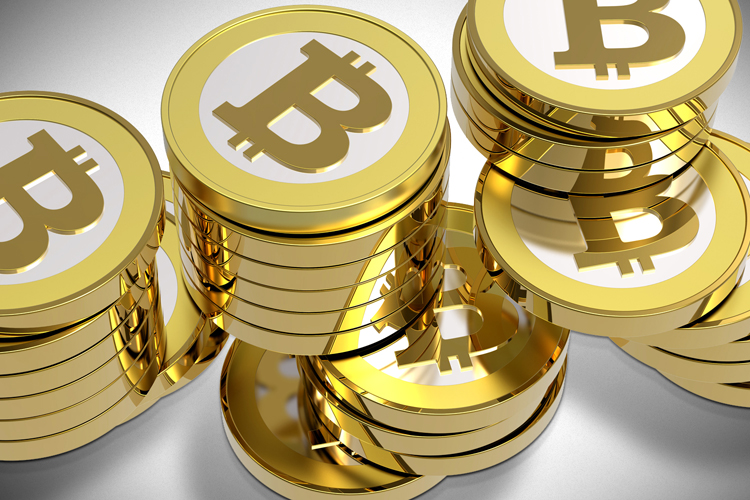
Bitcoins: A Fully-Compliant Currency The Government Can Love

Bitcoins: A Fully-Compliant Currency The Government Can Love

bitcoinsI’m finishing up a novel, a piece of speculative fiction in a genre you could call “economic-thriller”.

The Mark of the Beast?

In the book, the dollar crashes in a hyperinflationary fire (natch), replaced by a new currency called the american. The exchange rate at the time of the changeover is $1,000 equals ₳1. To illustrate its purchasing power, ₳1 buys you a candy bar. 

However, americans don’t exist as physical currency. There are no “american bills” like there are dollar bills, and no coins either. Instead, americans are a fully digital currency: They exist in the ether. You need a card—be it a credit card, debit card, or EBT card—to spend americans. And to receive americans, either from employers, customers, government, etc., you need a “central account” which is tethered to your Social Security number. 

The rationale for these measures is convenience—but the implication is, no one can earn, save or spend money without the government being aware of exactly what you are doing. 

Since the government can easily access all your spending and earning of americans, no one can launder money, or evade taxes, or even so much as fail to pay all their bills on time. Law-makers and politicians and pundits say it’s no big deal that the government will know everything about the citizen’s finances, because, “If you’re not doing anything wrong, you’ve got nothing to hide! If you’re paying all your bills and your taxes and your loans, you got nothing to worry about!

Another feature of this virtual currency: With americans, you can never again be late with your bills. Payments you have to make are automatically deducted from your central account. And if you take out a loan for whatever purpose, not only is that information in your central account, but your ability to spend money is automatically prioritized: Taxes get paid first, followed by private loans, then bills, then food, then “etc.” 

In the novel, law-makers use this compulsory “compliance” as a selling point for the american. “Think of the convenience! No more worrying about paying your bills—your bills are all paid for you!

However, if you don’t have enough money for “etc.”—entertainment, booze, an ice-cream sundae with the kids, what have you—you don’t get any. And if after paying off your loans and bills there isn’t enough left over for food—then no food for you. Ditto with bills: No money for electricity, or water, or heat? Then no electricity, or water, or heat for you. And if perchance you can’t fully pay off your loans, then you are declared in “non-compliance”. And if you can’t pay off your taxes, then you are charged as being in “criminal non-compliance”—and then woe is you. 

In the language of the novel, it is a “fully-compliant currency”—and it forces the people to be “fully-compliant citizens” of the dictates of the government and the banksters. 

This is of course a fiction I invented for my upcoming novel—but I couldn’t help notice how lawmakers and banks are all of a sudden getting on the bitcoin bandwagon. 

For something that was supposed to be a threat to the established order, which is what bitcoin and the other cryptocurrencies promised to be, the established order sure seems to be happy with it: The U.S. Senate hearings on bitcoins were pretty much of a success for bitcoins, and banks are starting to throw nothing but love in bitcoin’s direction. The mainstream media isn’t putting down bitcoins, as it did a few years back. 

In short, and unlike what a lot of cryptocurrency proselytizers have been saying—that the powers that be would be against bitcoins—the establishment seems to be fully in favor—or at least accepting—of bitcoins. 

Makes you go Hmm . . ., now doesn’t it?

Me, I’ve already explained here and here why I think that bitcoins are in a bubble, and why bitcoins and other cryptocurrencies will never be currencies per se, only an asset class. My thinking is, cryptocurrencies represent a new class of assets whose value is highly unstable so long as they are not actually tethered to some good or service people both need to buy and have to sell. Until that day happens, cryptocurrencies are nothing but speculative investments that can plummet to zero at a moment’s notice. 

However, thinking about cryptocurrencies from the point of view of the Federal Reserve, or a senator on the Banking Committee, or a trader at a bank’s prop desk, cryptocurrencies such as bitcoin have a lot of advantages—they’re not something to be dismissed out of hand. 

All of bitcoin’s benefits to the establishment revolve around its blockchain. 

In simple terms, a blockchain is a registry of all transactions carried out in bitcoins. Thus is resolved the problem of double-spending one particular bitcoin: It can’t be done (at least in theory) due to the blockchain. 

But the blockchain is in fact a register—a trail—of bitcoins. So it’s a relative cinch to piece together each and every transaction of any particular wallet in the bitcoin universe. And since exchanges need detailed personal information about a bitcoin user in order to comply with money-laundering laws before issuing a new user with a wallet, the government or other interested parties could determine what any one particular person has been doing in the bitcoin marketplace. 

In other words: Imagine that the government knew each and every cent you earned and spent, without a single exception. 

That cannot be done with dollars, at least not easily. The dollar’s inefficiencies when compared to bitcoin or any other cryptocurrency are exactly what make tracking dollar transactions so hard. That’s why money-laundering in fact exists: Criminals are taking advantage of inefficiencies in the dollar to hide their profits and thus not get caught.

But with bitcoins as they currently exist, it is a snap to keep people compliant. Once some simple baseline limitations are imposed on users of bitcoins—such as the rules implemented by exchanges so as to comply with money-laundering laws—a user’s transactions are as transparent as glass. 

Which is what a government would want, in order to get every bit of tax revenue it wants. Which is what a bank would want, in order to properly gauge the risk of a loan it is extending, and thereby maximize its profits. 

Not only that, being able to track people’s spending completely, in real time, as can be done with bitcoin and conceivably every cryptocurrency, the government could easily rescind someone’s ability to earn money. 

Witness how the government shut off WikiLeaks’ source of funding—took them less than a week. WikiLeaks depended exclusively on donations made via credit card payments—so by “encouraging” the credit card companies, Visa and Mastercard, to refuse to process donations to the organization, the U.S. government shut down Wikileaks just days after the first big document leaks of 2010. 

With bitcoin or some similar cryptocurrency, the government wouldn’t even need to take the step of contacting credi card companies to “encourage them to do the right thing”: The government could simply make any payment to a targeted group invalid. (And perhaps get a notice of whoever it was who donated to the targeted group?)

All this is to say, bitcoins and other cryptocurrencies are potentially a great step forward for a government looking to impose a Panopticon society on the American people. We can’t travel without TSA’s approval, so why not extend that power to people’s ability to interact in the economy as well? Due to the fact that, with bitcoins, there is a trail from people to their bitcoin wallet to their bitcoin usage, a trail that is relatively easy to read, the government could have this power over each and every citizen—the power to monitor and control our interactions with the economy. 

Which is why bitcoin—far from being a threat—might just prove to be the fully-compliant currency the U.S. government can come to love. A currency that will let it have unfettered access to each and every financial transaction you carry out. 

Is that something that we as a people want? More power to the government? Because that’s the promise of bitcoin.


via Gonzalo Lira

Willard “Mitt” Romney: Drug Money Launderer Extraordinaire

Willard “Mitt” Romney: Drug Money Launderer Extraordinaire

Why Has Not Only Corporate Media, but also Obama’s Opposition Research Let Romney Slide on his Criminal Associations?

Back in July, the Los Angeles Times – not VT, Infowars or Truth Jihad Radio – broke the story that Mitt Romney is a drug money launderer. How did we all miss this story? (Until John Hankey and then Gordon Duff picked it up.)

Maybe it’s because the Times story never comes right out and says “drug money laundering.” It doesn’t have to.

What the Times article does say translates directly and unambiguously as DRUG MONEY LAUNDERING, in caps, exclamation point.

According to the Los Angeles Times, Romney’s company, Bain Capital, “paid out a stunning 173% in average annual returns over a decade.” “Stunning” is not the word. “Criminal” is more like it.

Bernie Madoff was arrested and went to jail because he was paying 10% annual returns. That’s how it came to light that he was running a criminal enterprise. You just cannot possibly pay 10% returns consistently, year in and year out, with legitimate investments. Never happened, never will.

Ponzi schemes sometimes pay as high as 20% – and soon collapse, and the perps go to jail. But a 173% annual return is far beyond the range of the craziest, most short-lived ponzi scheme.

Romney wasn’t running a ponzi scheme. He was running a drug money laundry. His clients, the Times explains, were shady characters from Panama. Here’s how it works:

A druglord hands Romney, a.k.a. Bain Capital, ten million dollars in cash. Romney puts it on his books as a one million dollar investment in Bain Capital.

At 173% interest, it only takes Romney a few years (officially) to return ten million laundered dollars to the druglord.

When the druglord is asked where he got his ten million dollars, he explains that he made a lucky investment with Bain Capital. And he has the papers to prove it.

Getting caught paying out an average 173% interest over ten years is like getting caught with a hundred pounds of cocaine. If you’re busted with a hundred pounds of cocaine, the presumption is that you’re dealing. If you’re caught paying 173% interest, the presumption is that you’re laundering drug money.

Romney, you are SO BUSTED.

by  Kevin Barrett

Romney’s secrecy in business is detailed, and revealed; as well as his role as a drug money launderer for GHW Bush; his connection, through Bush, to CIA death squads in Central America; his role in 9-11; in the murder of US ambassador to Libya, Christopher Stevens; and the significance of his endorsement of and by Cheney.


The Bush Family’s Project HAMMER

The Bush Family’s Project HAMMER

Hammering the USSR’s Economy

In 1989 President George H. W. Bush began the multi-billion dollar Project Hammer program using an investment strategy to bring about the economic destruction of the Soviet Union including the theft of the Soviet treasury, the destabilization of the ruble, funding a KGB coup against Gorbachev in August 1991 and the seizure of major energy and munitions industries in the Soviet Union. Those resources would subsequently be turned over to international bankers and corporations. On November 1, 2001, the second operative in the Bush regime, President George W. Bush, issued Executive Order 13233 on the basis of “national security” and concealed the records of past presidents, especially his father’s spurious activities during 1990 and 1991. Consequently, those records are no longer accessible to the public. [1] The Russian coup plot was discussed in June 1991 when Yeltsin visited with Bush in conjunction with his visit to the United States. On that same visit, Yeltsin met discreetly with Gerald Corrigan, the chairman of the New York Federal Reserve. [2]

Because of numerous Presidential Executive Orders, the ethically questionable Project Hammer was deemed legal. Of course, even Hitler’s acts were “lawful,” as he had manipulated the laws to accommodate his actions. Many of Reagan’s executive orders were actually authored by Vice President Bush or his legal associates, and it is possible that Project Hammer was created by Reagan’s CIA Director, William Casey, who had directed OSS operations through Alan Dulles in Europe during World War II. Prior to his OSS affiliation, Casey worked for the Board of Economic Warfare which allegedly targeted “Hitler’s economic jugular.” [3] Allen Dulles, brother of John Foster Dulles, was the Director of the CIA from 1953 to 1961. He was a senior partner at the Wall Street firm of Sullivan and Cromwell, which represented the Rockefeller Empire and other mammoth trusts, corporations and cartels.

Project Hammer was staffed with CIA operatives and others associated with the National Security apparatus. Covert channels were already in place as a result of other illegal Bush activities. Thus, it was a given (1) that the project would use secret, illegal funds for unapproved covert operations, and (2) that the American public and Congress would not be informed about the illegal actions perpetrated in foreign countries. The first objective was allegedly to crush Communism, a growing political philosophy and social movement that was initially funded by the usual group of international bankers who now supported their demise. To this end, the “Vulcans,” under George H. W. Bush, waged war against the Soviet Union. [4]

The Return of the Vulcans

In their reincarnation in the administration of George W. Bush, the Vulcans functioned as a supposedly benign group, led by Council of Foreign Relations (CFR) member Condoleezza Rice, who attempted to augment and compensate for the Bush’s lack of experience and education concerning foreign policy during his presidential campaign. Rice had been President George H. W. Bush’s Soviet and East European Affairs Advisor in the National Security Council during the Soviet Union’s dissolution and during the German reunification (July 1, 1990). The resurrected Vulcan group included Richard Armitage, Robert Blackwill, Stephen Hadley, Richard Perle, Rabbi Dov S. Zakheim, Robert Zoellick and Paul Wolfowitz. Other key campaign figures included Dick Cheney, George P. Shultz and Colin Powell, all influential but not actually a part of the Vulcan Group. All of these people, associated with the George H. W. Bush administration, returned to powerful, strategic positions in George W. Bush’s administration.

Richard Perle and Paul Wolfowitz have been accused of being agents for the Israeli government. Investigations by Congress and the FBI have substantiated those allegations. Zakheim and his family were heavily involved in Yeshivat Sha’alvim, an educational organization in which students are taught to render absolute commitment to the State of Israel. [5]

Many of these individuals were also members of the Project for a New American Century (PNAC) which was established in the spring of 1997 with the intention of promoting American Global leadership at any cost. The chairman and co-founder was William Kristol, son of Irving Kristol (CFR), considered the godfather of neo-conservatism which promotes the ideas of Max Shachtman and Leo Strauss, a noted Zionist and professor of political science at the University of Chicago. Kristol’s co-founder was Robert W. Kagan (CFR). Kristol is also the editor and co-founder, along with John Podhoretz, of the Weekly Standard Magazine, established September 17, 1995 and owned by Rupert Murdoch until August 2009. This “conservative” magazine is edited by William Kristol and Fred Barnes and promotes Middle East warfare and a huge military budget, a mentality that infects the most popular “conservative” talk show radio hosts. Kristol is a trustee for the Manhattan Institute which was founded by CIA Director William Casey and was staffed with former CIA officers.

The Vulcans had almost limitless financing from a cache known by several names — the Black Eagle Trust, the Marcos gold, Yamashita’s Gold, the Golden Lily Treasure, or the Durham Trust. Japan, under Emperor Hirohito, appointed a brother, Prince Chichibu, to head Golden Lily, established in November 1937 before Japan’s infamous Rape of Nanking, to accompany and follow the military. The Golden Lily operation carried out massive plunder throughout Asia and included an army of jewelers, financial experts and smelters. [6] While the Nazis also engaged in plundering the countries they invaded, they were not as organized and methodical as the Japanese. After the Allied blockade, Golden Lily headquarters were moved from Singapore to Manila where 175 storage sites were built by slave laborers and POWs. Billions of dollars worth of gold and other plundered treasures were stockpiled in these underground caverns, some of which were discovered by the notorious Cold Warrior, Edward G. Lansdale who directed the recovery of some of the vaults. Truman and subsequent presidents, without congressional knowledge, have used those resources to finance the CIA’s chaotic clandestine activities throughout the world. Much of the Middle East chaos is financed by those pillaged funds. A tiny portion of that treasure was the source of Ferdinand Marcos’ vast wealth. Marcos worked with the CIA for decades using Golden Lily funds to bribe nations to support the Vietnam War. In return, Marcos was allowed to sell over $1 trillion in gold through Australian brokers. [7]

In July 1944, the leaders of forty-four nations met at Bretton Woods, New Hampshire to plan the post-war economy and to discuss organizing a global political action fund which would use the Black Eagle Trust ostensibly to fight communism, bribe political leaders, enhance the treasuries of U.S. allies, and manipulate elections in foreign countries and other unconstitutional covert operations. Certainly, those politicos who managed the funds also received financial benefits. This trust was headed by Secretary of War Henry Stimson, assisted by John J. McCloy (later head of the World Bank) and Robert Lovett (later Secretary of Defense) and consultant Robert B. Anderson (later Secretary of the Treasury). [8] Anderson later operated the Commercial Exchange Bank of Anguilla in the British West Indies and was convicted of running illegal offshore banking operations and tax evasion. Investors lost about $4.4 million. Consequently, he was sent to prison for a token amount of time, one month. He was also under house arrest for five years. He could have received a ten-year sentence but Judge Palmieri considered Anderson’s “distinguished service” to the country in the “top levels of Government.” [9]

Between 1945 and 1947 huge quantities of gold and platinum were deposited in prominent banks throughout the world. These deposits came to be known as the Black Eagle Trust. Swiss banks, because of their neutrality, were pivotal in maintaining these funds. These funds were allocated to fighting communism and paying bribes and fixing elections in places like Italy, Greece, and Japan. [10] Stimson and McCloy, both retired from government service, continued their involvement in the management of the Black Eagle Trust. Robert B. Anderson, who toured the treasure sites with Douglas MacArthur, set up the Black Eagle Trust and later became a member of Eisenhower’s cabinet. [11] In order to maintain secrecy about the Trust, Washington officials insisted that the Japanese did not plunder the countries they invaded. Japanese officials who wanted to divulge the facts were imprisoned or murdered in a way that made it look like suicide, a common CIA tactic. [12] The Germans paid reparations to thousands of victims while the Japanese paid next to nothing. Military leaders who opposed foreign policies that embraced exploitation of third world countries were suicided or died from mysterious causes, which includes individuals such as George S. Patton, Smedley D. Butler and James V. Forrestal.

The Vulcan’s effort to crush Communism and end the Cold War was largely funded by that Japanese plunder. The Vulcans were resurrected when George W. Bush was installed as president in 2000, facilitated by election maneuvers, probably lots of payoffs, and Jeb Bush’s purge of Florida voters. They conducted other illegal operations, like securities fraud and money laundering. This entailed murder and false imprisonment to prevent penitent participants from divulging the activities of the group. During the process of accomplishing the main objective of destroying the Soviet Union, the operatives made massive profits. In September 1991, George H. W. Bush and Alan Greenspan, both Pilgrims Society members, financed $240 billion in illegal bonds to economically decimate the Soviet Union and bring Soviet oil and gas resources under the control of Western investors, backed by the Black Eagle Trust and supported later by Putin who for the right price purged certain oligarchs. The $240 billion in illegal bonds were apparently replaced with Treasury notes backed by U.S. taxpayers. [13] To conceal the clearance of $240 billion in securities, the Federal Reserve, within two months, increased the money supply to pre-9/11 numbers which resulted in the American taxpayer refinancing the $240 billion. [14]

The Takeover of Russia’s Oil Industry

BP Amoco became the largest foreign direct investor in Russia in 1997 when it paid a half-billion dollars to buy a 10 percent stake in the Russian oil conglomerate Sidanko. Then in 1999, Tyumen Oil bought Sidanko’s prize unit, Chernogorneft which allegedly made BP Amoco’s investment worthless. Tyumen offered to cooperate with BP Amoco on the development of Chernogorneft but BP Amoco was not interested. [15] In October 1998, Halliburton Energy Services had entered into an agreement with Moscow-based Tyumen Oil Company (TNK). Their efforts were focused on the four western Siberia fields, the first one being the Samotlorskoye field. [16] TNK has proven oil reserves of 4.3 billion barrels and possibly as many as 6.1 billion barrels, with crude oil production and refining capabilities of 420,000 barrels/day and 230,000 barrels/day, respectively. TNK markets gasoline through 400 retail outlets. [17] In 2002 Halliburton and Sibneft, Russia’s fifth largest crude oil producer, signed an agreement. Sibneft will use Halliburton’s new technologies to improve well construction and processing while Halliburton directs all project management. [18]

Tyumenskaya Neftyanaya Kompaniya (Tyumen Oil Company) was established in 1995 by government decree. It is now TNK-BP, the leading Russian oil company and ranks among the top ten privately owned oil companies worldwide in terms of crude oil production. The company, formed in 2003, resulted from the merger of BP’s Russian oil and gas assets and the oil and gas assets of Alfa, Access/Renova group (AAR). BP and AAR each own fifty percent of TNK-BP. The shareholders of TNK-BP own almost fifty percent of Slavneft, a vertically integrated Russian oil company. [19] This transaction was the biggest in Russian corporate history and was managed by Vladimir Lechtman, the Moscow partner for Jones Day, a global law firm with thirty offices and 2,200 lawyers worldwide. TNK-BP, Russia’s second-largest oil company employs almost 100,000 people and operates in Samotlor. [20]

Putin was financially rewarded by the collaborators and was happy to purge some annoying industrialists who stood in the way. Mikhail Khodorkovsky was the manager of Yukos, the company that he built into Russia’s second-largest oil company after acquiring it for $168 million when his Bank MENATEP, the first privately owned but notoriously corrupt bank since 1917 and wiped out in August 1998, purchased it through a controversial government privatization auction in 1995. MENATEP was named as a defendant in the Avisma lawsuit which was filed on August 19, 1999. [21] The bank may have facilitated the large-scale theft of Soviet Treasury funds before and following the USSR’s collapse in 1991. [22] His company had borrowed hundreds of millions of dollars from western banks. [23] He was arrested on October 25, 2003 and sentenced in June 2005 to eight years on fraud and tax evasion charges. He was allegedly targeted as a political enemy by President Vladimir Putin who went after other big business owners who apparently made money by acquiring states assets. Yukos was sold piecemeal to pay off $28 billion in back tax charges. Yukos was seized and given to Rosneft. [24]

When Khodorkovsky was arrested, his secretive business arrangement with the Rothschild family was exposed as Jacob Rothschild assumed Khodorkovsky’s 26% control of Yukos while Khodorkovsky’s directorial seat on the Yukos board went to Edgar Ortiz, a former Halliburton vice president during Dick Cheney’s reign as CEO at Halliburton. Cheney, as President and CEO of Halliburton, automatically had an association with the State Oil Company of Azerbaijan Republic (SOCAR). [25] In November 1997, Dick Chaney, in anticipation of imminent events, had appointed Edgar Ortiz as president of Halliburton Energy Services, their global division. [26]

The Yukos Oil Company merged with the smaller Sibneft Oil Company on October 3, 2003 which created Russia’s largest oil and gas business and the world’s fourth-largest private oil company. [27] On May 11, 2007 Halliburton announced they had made an agreement with the Tyumen State Oil and Gas University to open a new employee-training center in Russia to grow their business in that country and in the surrounding region. They are currently training students from five countries, Kazakhstan, the Netherlands, Norway, Russia and the United Kingdom. [28] Halliburton was awarded a $33 million contract by TNK-BP to provide oil field services to develop the Ust-Vakh field in Western Siberia. [29]

September 11 — Black Op Cover-up

Three top securities brokers had offices in the World Trade Center, Cantor Fitzgerald, Euro Brokers and Garbon Inter Capital. Flight 11 struck just under the floors where Cantor Fitzgerald was located. Cantor Fitzgerald, with possible connections to the U.S. Intelligence apparatus, was America’s biggest securities broker and apparently the main target. Within minutes, an explosion in the North Tower’s vacant 23rd floor, right under the offices of the FBI and Garbon Inter Capital on the 25th floor caused a huge fire from the 22nd through the 25th floors. At the same time, there was an explosion in the basement of the North Tower. [30] A vault in the North Tower basement held less than $1 billion in gold, much of which was reportedly moved before 9/11. However, the government had hundreds of billions of dollars of securities which were summarily destroyed. The Federal Reserve, untouched by the crisis at its downtown offices (as they had everything backed up to a remote location), assumed emergency powers that afternoon. The $240 billion in securities were electronically cleared. [31] Then, at 9:03, Flight 175 slammed into the 78th floor of the South Tower just below the 84th floor where Euro Brokers were located. [32] Brian Clark, the manager at Euro Brokers, heard numerous explosions, apparently unrelated to what he referred to as the oxygen-starved fire caused by the plane crash.

The September 11 attacks related to the financial improprieties during the preceding ten years which spurred at least nine federal investigations which were initiated in 1997-1998, about the same time that Osama bin Laden, after twenty years as a CIA asset, announced a fatwa against the U.S. The records of many of those investigations were held in the Buildings Six and Seven and on the 23rd floor of the North Tower. Those investigations were sure to reveal the black Eagle Trust shenanigans. [33] Building Seven, not hit by a plane, collapsed at 5:20:33 p.m. but was vacated as early as 9:00 when evacuees claimed to see dead bodies and sporadic fires within the building.

By 2008 and even earlier the covert securities were worth trillions. The securities used to decimate the Soviets and end the Cold War were stored in certain broker’s vaults in the World Trade Center where they were destroyed on September 11, 2001. They would have come due for settlement and clearing on September 12, 2001. [34] The federal agency investigating these bonds, the Office of Naval Intelligence was in the section of the Pentagon that was destroyed on September 11. Renovations at the Pentagon were due to be completed on September 16, 2001. However, the Office of Naval Intelligence (ONI), the entity that often monitors war games, was hurriedly moved. If they were monitoring the simultaneous war games that morning, they would have realized that the games were used as a distraction from the actual assault. Whatever hit the pentagon struck the Navy Command Center and the offices of the Chief of Naval Operations Intelligence Plot (CNO-IP). [35] There were 125 fatalities in the Pentagon; thirty-one percent of them were people who worked in the Naval Command Center, the location of the Office of Naval Intelligence. Thirty-nine of the forty people who worked in the Office of Naval Intelligence died. [36]

On September 10, 2001 Rumsfeld announced that the Pentagon couldn’t account for $2.3 trillion, “We are, as they say, tangled in our anchor chain. Our financial systems are decades old. According to some estimates, we cannot track $2.3 trillion in transactions. We cannot share information from floor to floor in this building because it’s stored on dozens of technological systems that are inaccessible or incompatible.” [37] It was forgotten the following morning. Accountants, bookkeepers and budget analysts who were in the section of the Pentagon being renovated met their unexpected deaths. The destruction of accounting facts and figures will prevent discovery of where that money went. I am quite certain someone knows where it is. Certainly this is not merely gross incompetence but private seizure of public funds. [38] At the time Rabbi Dov Zakheim was chief-financial officer for the Department of Defense. [39] In 1993, Zakheim worked for SPS International, part of System Planning Corporation, a defense contractor. His firm’s subsidiary, Tridata Corporation directed the investigation of the first “terrorist” attack on the World Trade Center in 1993. [40]

Certain National Security officials who had participated in the Cold War victory in 1991 thus comprised the collateral damage of the Cold War. They, along with hundreds of innocent people were in the World Trade Center towers and the Pentagon. Their deaths were presumably required to conceal the existence of the Black Eagle Trust, along with the numerous illegal activities it had funded for over 50 years. This massive destruction, and the lost lives, constitutes a massive cover-up and continued lawlessness by the brotherhood of death, Skull and Bones, and their accomplices, the Enterprise. [41] The Enterprise was established in the 1980s as a covert fascist Cold Warriors faction working with other groups like Halliburton’s private security forces and the Moonies. Citibank is connected to the Enterprise, along with all the CIA front banks, Nugen Hand and BCCI.

Double Dipping

Alvin B. “Buzzy” Krongard was elected Chief Executive Officer of Alexander Brown and Sons in 1991 and Chairman of the Board in 1994. Bankers Trust purchased Alexander Brown and Sons in 1997 to form BT Alex Brown. Krongard relinquished his investments in Alex Brown to Banker’s Trust as part of the merger. He became Vice Chairman of Banker’s Trust where he personally interacted with wealthy clients who were intimately linked to drug money laundering. After a year of possible networking, Krongard joined (or as Michael Ruppert suggests, rejoined) the CIA in 1998 where his friend, Director George Tenet, concentrated his skills on private banking ventures within the elite moneyed community. Senate investigations verify that private banking firms frequently engage in money laundering from illicit drugs and corporate crime operations. [42] On January 28, 2000 the Reginald Howe and GATA Lawsuit was filed which accused certain U.S. bullion banks of illegally dumping U.S. Treasury gold on the market. The lawsuit named Deutsche bank Alex Brown, the U.S. Treasury, Alan Greenspan, the Federal Reserve, and Citibank, Chase, as defendants. Gerald Corrigan was accused of having private knowledge of the scheme. [43] Krongard became the Executive Director of the CIA, essentially the Chief Operating Officer, and the number three man on March 16, 2001. Krongard, while at the CIA, arranged for Blackwater’s Erik Prince to get his first contract with the U.S. government, and later joined its board.

Richard Wagner, a data retrieval expert, estimated that more than $100 million in illegal transactions appeared to have rushed through the WTC computers before and during the disaster on September 11, 2001. A Deutsche Bank employee verified that approximately five minutes before the first plane hit the tower that the Deutsche Bank computer system in their WTC office was seized by an outside, unknown entity. Every single file was swiftly uploaded to an unidentified locality. This employee escaped from the building, but lost many of his friends. He knew, from his position in the company, that Alex Brown, the Deutsche Bank subsidiary participated in insider trading. Senator Carl Levin claimed that Alex Brown was just one of twenty prominent U.S. banks associated with money laundering. [44]

Andreas von Bülow, a Social Democratic Party member of the German parliament (1969-1994), was on the parliamentary committee on intelligence services, a group that has access to classified information. Von Bülow was also a member of the Schalck-Golodkowski investigation committee which investigates white-collar crime. He has estimated that inside trader profits surrounding 9/11 totaled approximately $15 billion. Von Bülow told The Daily Telegraph “If what I say is right, the whole US government should end up behind bars.” Further, he said, “They have hidden behind a veil of secrecy and destroyed the evidence…they invented the story of 19 Muslims working within Osama bin Laden’s al Qaeda in order to hide the truth of their own covert operation.” He also said, “I’m convinced that the US apparatus must have played a role and my theory is backed up by the [Washington] government’s refusal to present any proof whatsoever of what happened.” [45]

On September 26, CBS reported that the amount was more than $100 million and that seven countries were investigating the irregular trades. Two newspapers, Reuters and the New York Times, and other mainstream media reported that the CIA regularly monitors extraordinary trades and economic irregularities to ascertain possible criminal activities or financial assaults. In fact, the CIA uses specialized software, PROMIS, to scrutinize trades. [46]

Numerous researchers believe, with justification, that the transactions in the financial markets are indicative of foreknowledge of the events of 9/11, the attacks on the twin towers and the pentagon. One of the trades, for $2.5 million, a pittance compared to the total, went unclaimed. Alex Brown, once managed by Krongard, was the firm that placed the put options on United Airlines stock. President Bush awarded Krongard by appointing him as CIA Executive Director in 2004. [47]

Between September 6 and 7, 2001, the Chicago Board Options Exchange received purchases of 4,744 put options on United Airlines and only 396 call options. If 4,000 of those options were purchased by people with foreknowledge, they would have accrued about $5 million. On September 10, the Chicago exchange received 4,516 put options on American Airlines compared to 748 calls. The implications are that some insiders might profit by about $4 million. These two incidents were wholly irregular and at least six times higher than normal. [48]

Morgan Stanley Dean Witter & Company, who occupied floors 43-46, 56, 59-74 of the World Trade Center, Tower 2, saw 2,157 of its October $45 put options bought in the three trading days before Black Tuesday. This compares to an average of 27 contracts per day before September 6. Morgan Stanley’s share price fell from $48.90 to $42.50 in the aftermath of the attacks. Assuming that 2,000 of these options contracts were bought based upon knowledge of the approaching attacks, their purchasers could have profited by at least $1.2 million. The U.S. government never again mentioned the trade irregularities after October 12, 2001. [49] Catastrophic events serve two purposes for the top criminal element in society — the perpetrators seize resources while their legislative accomplices impose burdensome restrictions on the citizens to make them more submissive and silent.

NOTES:

[1]  Collateral Damage: U.S. Covert Operations and the Terrorist Attacks on September 11, 2001 by E.P. Heidner, pp. 4-5


[2]  Ibid, p. 20


[3]  Ibid, pp. 4-5


[4]  Ibid


[5]  September 11 Commission Report by E. P. Heidner, 2008, p. 108


[6]  Gold Warriors, America’s Secret Recovery of Yamashita’s Gold by Sterling and Peggy Seagrave, Verso Publishing, 2003, pp. 32-43


[7]  Ibid, pp. 318


[8]  Ibid, pp. 14-15


[9]  Ex-Treasury Chief Gets 1-Month Term in Bank Fraud Case by Frank J. Prial, New York Times, June 28, 1987


[10]  Gold Warriors, America’s Secret Recovery of Yamashita’s Gold by Sterling and Peggy Seagrave, Verso Publishing, 2003, p. 5


[11]  Ibid, p. 98


[12]  Ibid, p. 102


[13]  Collateral Damage: U.S. Covert Operations and the Terrorist Attacks on September 11, 2001 by E.P. Heidner, pp. 4-6


[14]  Ibid, p. 29


[15]  Tyumen Oil of Russia Seeks Links to Old Foes After Winning Fight By Neela Banerjee, New York Times, December 2, 1999


[16]  Halliburton Energy Services Enters Into Alliance Agreement With Tyumen Oil Company, Press Release, October 15, 1998, http://www.halliburton.com/news/archive/1998/hesnws_101598.jsp


[17]  Ibid


[18]  Halliburton Press Release, Halliburton And Russian Oil Company Sibneft Sign Framework Agreement, February 7, 2002, http://www.halliburton.com/news/archive/2002/corpnws_020702.jsp


[19]  TNK-BP, Our company, http://www.tnk-bp.com/company/


[20]  Russia’s largest field is far from depleted By Jerome R. Corsi, Word Net Daily, November 04, 2005, http://www.worldnetdaily.com/news/article.asp?ARTICLE_ID=47219


[21]  Collateral Damage: U.S. Covert Operations and the Terrorist Attacks on September 11, 2001 by E.P. Heidner, p. 28


[22]  Mikhail B. Khodorkovsky, Source Watch, http://www.sourcewatch.org/index.php?title=Mikhail_B._Khodorkovsky


[23]  Russia’s Ruling Robbers by Mark Ames, Consortium News, March 11, 1999, http://www.consortiumnews.com/1999/c031199a.html


[24]  “Sovest” Group Campaign for Granting Political Prisoner Status to Mikhail Khodorkovsky, February 7, 2008


[25]  Halliburton Man to Sub for Khodorkovsky, Simon Ostrovsky, Moscow Times, April 30, 2004 as noted in the September 11 Commission Report, p. 233; See also Arrested Oil Tycoon Passed Shares to Banker, Washington Times, November 2, 2003


[26]  Halliburton Press Release, Ortiz Named President Of Halliburton Energy Services, November 19, 1997, http://www.halliburton.com/news/archive/1997/hesnws_111997.jsp


[27]  Russia: Yukos-Sibneft union forms world’s No. 4 oil producer, Global Finance, Jun 2003, http://mikhail_khodorkovsky_society.blogspot.com/


[28]  Halliburton Opens Russia Training Center, International Business Times, May 11, 2007, http://www.ibtimes.com/articles/20070511/halliburton-training.htm


[29]  Halliburton gets Russia work, Oil Daily, January 26, 2006, http://goliath.ecnext.com/coms2/summary_0199-5579583_ITM


[30]  Collateral Damage: U.S. Covert Operations and the Terrorist Attacks on September 11, 2001 by E.P. Heidner, p. 2


[31]  Ibid, p. 29


[32]  Ibid, pp. 2


[33]  Ibid, p. 28-29


[34]  “Sioux City, Iowa, July 25, 2005 TomFlocco.com , According to leaked documents from an intelligence file obtained through a military source in the Office of Naval Intelligence (ONI), on or about September 12, 1991 non-performing and unauthorized gold-backed debt instruments were used to purchase ten-year “Brady” bonds. The bonds in turn were illegally employed as collateral to borrow $240 billion — 120 in Japanese Yen and 120 in Deutsch Marks — exchanged for U.S. currency under false pretenses; or counterfeit and unlawful conversion of collateral against which an unlimited amount of money could be created in derivatives and debt instruments…” from Cash payoffs, bonds and murder linked to White House 9/11 finance, Tom Flocco, tomflocco.com


[35]  Collateral Damage: U.S. Covert Operations and the Terrorist Attacks on September 11, 2001 by E.P. Heidner, p. 45


[36]  Ibid, p. 2


[37]  Rumsfeld’s comments were on the Department of defense web site but have been understandably removed, http://www.defenselink.mil/speeches/2001/s20010910-secdef.ht


[38]  The War On Waste Defense Department Cannot Account For 25% Of Funds — $2.3 Trillion, http://www.cbsnews.com/stories/2002/01/29/eveningnews/main325985.shtml


[39]  September 11 Commission Report by E. P. Heidner, 2008, p. 108


[40]  Following Zakheim and Pentagon Trillions to Israel and 9-11By Jerry Mazza, July 31, 2006, http://www.rense.com/general75/latest.htm


[41]  Collateral Damage: U.S. Covert Operations and the Terrorist Attacks on September 11, 2001 by E.P. Heidner, p. 6


[42]  Crossing the Rubicon, the Decline of the American Empire at the End of the Age of Oil by Michael C. Ruppert, New Society Publishers, Canada, 2004, p. 56


[43]  Collateral Damage: U.S. Covert Operations and the Terrorist Attacks on September 11, 2001 by E.P. Heidner, p. 28


[44]  Crossing the Rubicon, the Decline of the American Empire at the End of the Age of Oil by Michael C. Ruppert, New Society Publishers, Canada, 2004, pp. 243-247


[45]  USA staged 9/11 Attacks, German best-seller by Kate Connolly, National Post & London Telegraph, November 20, 2003


[46]  Crossing the Rubicon, the Decline of the American Empire at the End of the Age of Oil by Michael C. Ruppert, New Society Publishers, Canada, 2004, pp. 243-247


[47]  Ibid, pp. 243-247


[48]  Ibid, pp. 243-247


[49]  Ibid, pp. 243-247

By Deanna Spingola

SOURCE: http://www.renewamerica.com/columns/spingola/100208

How a big US bank laundered billions from Mexico’s murderous drug gangs

How a big US bank laundered billions from Mexico’s murderous drug gangs

As the violence spread, billions of dollars of cartel cash began to seep into the global financial system. But a special investigation by the Observer reveals how the increasingly frantic warnings of one London whistleblower were ignored


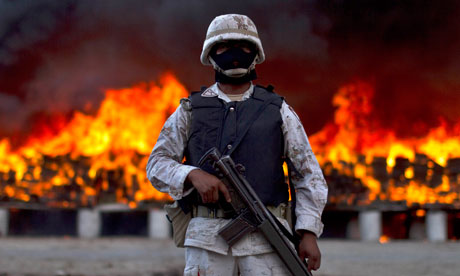
A soldier guards marijuana that is being incinerated in Tijuana, Mexico. Photograph: Guillermo Arias/AP

On 10 April 2006, a DC-9 jet landed in the port city of Ciudad del Carmen, on the Gulf of Mexico, as the sun was setting. Mexican soldiers, waiting to intercept it, found 128 cases packed with 5.7 tons of cocaine, valued at $100m. But something else – more important and far-reaching – was discovered in the paper trail behind the purchase of the plane by the Sinaloa narco-trafficking cartel.

During a 22-month investigation by agents from the US Drug Enforcement Administration, the Internal Revenue Service and others, it emerged that the cocaine smugglers had bought the plane with money they had laundered through one of the biggest banks in the United States: Wachovia, now part of the giant Wells Fargo.

The authorities uncovered billions of dollars in wire transfers, traveller’s cheques and cash shipments through Mexican exchanges into Wachovia accounts. Wachovia was put under immediate investigation for failing to maintain an effective anti-money laundering programme. Of special significance was that the period concerned began in 2004, which coincided with the first escalation of violence along the US-Mexico border that ignited the current drugs war.

Criminal proceedings were brought against Wachovia, though not against any individual, but the case never came to court. In March 2010, Wachovia settled the biggest action brought under the US bank secrecy act, through the US district court in Miami. Now that the year’s “deferred prosecution” has expired, the bank is in effect in the clear. It paid federal authorities $110m in forfeiture, for allowing transactions later proved to be connected to drug smuggling, and incurred a $50m fine for failing to monitor cash used to ship 22 tons of cocaine.

More shocking, and more important, the bank was sanctioned for failing to apply the proper anti-laundering strictures to the transfer of $378.4bn – a sum equivalent to one-third of Mexico’s gross national product – into dollar accounts from so-called casas de cambio (CDCs) in Mexico, currency exchange houses with which the bank did business.

“Wachovia’s blatant disregard for our banking laws gave international cocaine cartels a virtual carte blanche to finance their operations,” said Jeffrey Sloman, the federal prosecutor. Yet the total fine was less than 2% of the bank’s $12.3bn profit for 2009. On 24 March 2010, Wells Fargo stock traded at $30.86 – up 1% on the week of the court settlement.

The conclusion to the case was only the tip of an iceberg, demonstrating the role of the “legal” banking sector in swilling hundreds of billions of dollars – the blood money from the murderous drug trade in Mexico and other places in the world – around their global operations, now bailed out by the taxpayer.

At the height of the 2008 banking crisis, Antonio Maria Costa, then head of the United Nations office on drugs and crime, said he had evidence to suggest the proceeds from drugs and crime were “the only liquid investment capital” available to banks on the brink of collapse. “Inter-bank loans were funded by money that originated from the drugs trade,” he said. “There were signs that some banks were rescued that way.”

Wachovia was acquired by Wells Fargo during the 2008 crash, just as Wells Fargo became a beneficiary of $25bn in taxpayers’ money. Wachovia’s prosecutors were clear, however, that there was no suggestion Wells Fargo had behaved improperly; it had co-operated fully with the investigation. Mexico is the US’s third largest international trading partner and Wachovia was understandably interested in this volume of legitimate trade.

José Luis Marmolejo, who prosecuted those running one of the casas de cambio at the Mexican end, said: “Wachovia handled all the transfers. They never reported any as suspicious.”

“As early as 2004, Wachovia understood the risk,” the bank admitted in the statement of settlement with the federal government, but, “despite these warnings, Wachovia remained in the business”. There is, of course, the legitimate use of CDCs as a way into the Hispanic market. In 2005 the World Bank said that Mexico was receiving $8.1bn in remittances.

During research into the Wachovia Mexican case, the Observer obtained documents previously provided to financial regulators. It emerged that the alarm that was ignored came from, among other places, London, as a result of the diligence of one of the most important whistleblowers of our time. A man who, in a series of interviews with the Observer, adds detail to the documents, laying bare the story of how Wachovia was at the centre of one of the world’s biggest money-laundering operations.

Martin Woods, a Liverpudlian in his mid-40s, joined the London office of Wachovia Bank in February 2005 as a senior anti-money laundering officer. He had previously served with the Metropolitan police drug squad. As a detective he joined the money-laundering investigation team of the National Crime Squad, where he worked on the British end of the Bank of New York money-laundering scandal in the late 1990s.

Woods talks like a police officer – in the best sense of the word: punctilious, exact, with a roguish humour, but moral at the core. He was an ideal appointment for any bank eager to operate a diligent and effective risk management policy against the lucrative scourge of high finance: laundering, knowing or otherwise, the vast proceeds of criminality, tax-evasion, and dealing in arms and drugs.

Woods had a police officer’s eye and a police officer’s instincts – not those of a banker. And this influenced not only his methods, but his mentality. “I think that a lot of things matter more than money – and that marks you out in a culture which appears to prevail in many of the banks in the world,” he says.

Woods was set apart by his modus operandi. His speciality, he explains, was his application of a “know your client”, or KYC, policing strategy to identifying dirty money. “KYC is a fundamental approach to anti-money laundering, going after tax evasion or counter-terrorist financing. Who are your clients? Is the documentation right? Good, responsible banking involved always knowing your customer and it still does.”

When he looked at Wachovia, the first thing Woods noticed was a deficiency in KYC information. And among his first reports to his superiors at the bank’s headquarters in Charlotte, North Carolina, were observations on a shortfall in KYC at Wachovia’s operation in London, which he set about correcting, while at the same time implementing what was known as an enhanced transaction monitoring programme, gathering more information on clients whose money came through the bank’s offices in the City, in sterling or euros. By August 2006, Woods had identified a number of suspicious transactions relating to casas de cambio customers in Mexico.

Primarily, these involved deposits of traveller’s cheques in euros. They had sequential numbers and deposited larger amounts of money than any innocent travelling person would need, with inadequate or no KYC information on them and what seemed to a trained eye to be dubious signatures. “It was basic work,” he says. “They didn’t answer the obvious questions: ‘Is the transaction real, or does it look synthetic? Does the traveller’s cheque meet the protocols? Is it all there, and if not, why not?'”

Woods discussed the matter with Wachovia’s global head of anti-money laundering for correspondent banking, who believed the cheques could signify tax evasion. He then undertook what banks call a “look back” at previous transactions and saw fit to submit a series of SARs, or suspicious activity reports, to the authorities in the UK and his superiors in Charlotte, urging the blocking of named parties and large series of sequentially numbered traveller’s cheques from Mexico. He issued a number of SARs in 2006, of which 50 related to the casas de cambio in Mexico. To his amazement, the response from Wachovia’s Miami office, the centre for Latin American business, was anything but supportive – he felt it was quite the reverse.

As it turned out, however, Woods was on the right track. Wachovia’s business in Mexico was coming under closer and closer scrutiny by US federal law enforcement. Wachovia was issued with a number of subpoenas for information on its Mexican operation. Woods has subsequently been informed that Wachovia had six or seven thousand subpoenas. He says this was “An absurd number. So at what point does someone at the highest level not get the feeling that something is very, very wrong?”

In April and May 2007, Wachovia – as a result of increasing interest and pressure from the US attorney’s office – began to close its relationship with some of the casas de cambio. But rather than launch an internal investigation into Woods’s alerts over Mexico, Woods claims Wachovia hung its own money-laundering expert out to dry. The records show that during 2007 Woods “continued to submit more SARs related to the casas de cambio“.

In July 2007, all of Wachovia’s remaining 10 Mexican casa de cambio clients operating through London suddenly stopped doing so. Later in 2007, after the investigation of Wachovia was reported in the US financial media, the bank decided to end its remaining relationships with the Mexican casas de cambio globally. By this time, Woods says, he found his personal situation within the bank untenable; while the bank acted on one level to protect itself from the federal investigation into its shortcomings, on another, it rounded on the man who had been among the first to spot them.

On 16 June Woods was told by Wachovia’s head of compliance that his latest SAR need not have been filed, that he had no legal requirement to investigate an overseas case and no right of access to documents held overseas from Britain, even if they were held by Wachovia.

Woods’s life went into freefall. He went to hospital with a prolapsed disc, reported sick and was told by the bank that he not done so in the appropriate manner, as directed by the employees’ handbook. He was off work for three weeks, returning in August 2007 to find a letter from the bank’s compliance managing director, which was unrelenting in its tone and words of warning.

The letter addressed itself to what the manager called “specific examples of your failure to perform at an acceptable standard”. Woods, on the edge of a breakdown, was put on sick leave by his GP; he was later given psychiatric treatment, enrolled on a stress management course and put on medication.

Late in 2007, Woods attended a function at Scotland Yard where colleagues from the US were being entertained. There, he sought out a representative of the Drug Enforcement Administration and told him about the casas de cambio, the SARs and his employer’s reaction. The Federal Reserve and officials of the office of comptroller of currency in Washington DC then “spent a lot of time examining the SARs” that had been sent by Woods to Charlotte from London.

“They got back in touch with me a while afterwards and we began to put the pieces of the jigsaw together,” says Woods. What they found was – as Costa says – the tip of the iceberg of what was happening to drug money in the banking industry, but at least it was visible and it had a name: Wachovia.

In June 2005, the DEA, the criminal division of the Internal Revenue Service and the US attorney’s office in southern Florida began investigating wire transfers from Mexico to the US. They were traced back to correspondent bank accounts held by casas de cambio at Wachovia. The CDC accounts were supervised and managed by a business unit of Wachovia in the bank’s Miami offices.

“Through CDCs,” said the court document, “persons in Mexico can use hard currency and … wire transfer the value of that currency to US bank accounts to purchase items in the United States or other countries. The nature of the CDC business allows money launderers the opportunity to move drug dollars that are in Mexico into CDCs and ultimately into the US banking system.

“On numerous occasions,” say the court papers, “monies were deposited into a CDC by a drug-trafficking organisation. Using false identities, the CDC then wired that money through its Wachovia correspondent bank accounts for the purchase of airplanes for drug-trafficking organisations.” The court settlement of 2010 would detail that “nearly $13m went through correspondent bank accounts at Wachovia for the purchase of aircraft to be used in the illegal narcotics trade. From these aircraft, more than 20,000kg of cocaine were seized.”

All this occurred despite the fact that Wachovia’s office was in Miami, designated by the US government as a “high-intensity money laundering and related financial crime area”, and a “high-intensity drug trafficking area”. Since the drug cartel war began in 2005, Mexico had been designated a high-risk source of money laundering.

“As early as 2004,” the court settlement would read, “Wachovia understood the risk that was associated with doing business with the Mexican CDCs. Wachovia was aware of the general industry warnings. As early as July 2005, Wachovia was aware that other large US banks were exiting the CDC business based on [anti-money laundering] concerns … despite these warnings, Wachovia remained in business.”

On 16 March 2010, Douglas Edwards, senior vice-president of Wachovia Bank, put his signature to page 10 of a 25-page settlement, in which the bank admitted its role as outlined by the prosecutors. On page 11, he signed again, as senior vice-president of Wells Fargo. The documents show Wachovia providing three services to 22 CDCs in Mexico: wire transfers, a “bulk cash service” and a “pouch deposit service”, to accept “deposit items drawn on US banks, eg cheques and traveller’s cheques”, as spotted by Woods.

“For the time period of 1 May 2004 through 31 May 2007, Wachovia processed at least $$373.6bn in CDCs, $4.7bn in bulk cash” – a total of more than $378.3bn, a sum that dwarfs the budgets debated by US state and UK local authorities to provide services to citizens.

The document gives a fascinating insight into how the laundering of drug money works. It details how investigators “found readily identifiable evidence of red flags of large-scale money laundering”. There were “structured wire transfers” whereby “it was commonplace in the CDC accounts for round-number wire transfers to be made on the same day or in close succession, by the same wire senders, for the … same account”.

Over two days, 10 wire transfers by four individuals “went though Wachovia for deposit into an aircraft broker’s account. All of the transfers were in round numbers. None of the individuals of business that wired money had any connection to the aircraft or the entity that allegedly owned the aircraft. The investigation has further revealed that the identities of the individuals who sent the money were false and that the business was a shell entity. That plane was subsequently seized with approximately 2,000kg of cocaine on board.”

Many of the sequentially numbered traveller’s cheques, of the kind dealt with by Woods, contained “unusual markings” or “lacked any legible signature”. Also, “many of the CDCs that used Wachovia’s bulk cash service sent significantly more cash to Wachovia than what Wachovia had expected. More specifically, many of the CDCs exceeded their monthly activity by at least 50%.”

Recognising these “red flags”, the US attorney’s office in Miami, the IRS and the DEA began investigating Wachovia, later joined by FinCEN, one of the US Treasury’s agencies to fight money laundering, while the office of the comptroller of the currency carried out a parallel investigation. The violations they found were, says the document, “serious and systemic and allowed certain Wachovia customers to launder millions of dollars of proceeds from the sale of illegal narcotics through Wachovia accounts over an extended time period. The investigation has identified that at least $110m in drug proceeds were funnelled through the CDC accounts held at Wachovia.”

The settlement concludes by discussing Wachovia’s “considerable co-operation and remedial actions” since the prosecution was initiated, after the bank was bought by Wells Fargo. “In consideration of Wachovia’s remedial actions,” concludes the prosecutor, “the United States shall recommend to the court … that prosecution of Wachovia on the information filed … be deferred for a period of 12 months.”

But while the federal prosecution proceeded, Woods had remained out in the cold. On Christmas Eve 2008, his lawyers filed tribunal proceedings against Wachovia for bullying and detrimental treatment of a whistleblower. The case was settled in May 2009, by which time Woods felt as though he was “the most toxic person in the bank”. Wachovia agreed to pay an undisclosed amount, in return for which Woods left the bank and said he would not make public the terms of the settlement.

After years of tribulation, Woods was finally formally vindicated, though not by Wachovia: a letter arrived from John Dugan, the comptroller of the currency in Washington DC, dated 19 March 2010 – three days after the settlement in Miami. Dugan said he was “writing to personally recognise and express my appreciation for the role you played in the actions brought against Wachovia Bank for violations of the bank secrecy act … Not only did the information that you provided facilitate our investigation, but you demonstrated great personal courage and integrity by speaking up. Without the efforts of individuals like you, actions such as the one taken against Wachovia would not be possible.”

The so-called “deferred prosecution” detailed in the Miami document is a form of probation whereby if the bank abides by the law for a year, charges are dropped. So this March the bank was in the clear. The week that the deferred prosecution expired, a spokeswoman for Wells Fargo said the parent bank had no comment to make on the documentation pertaining to Woods’s case, or his allegations. She added that there was no comment on Sloman’s remarks to the court; a provision in the settlement stipulated Wachovia was not allowed to issue public statements that contradicted it.

But the settlement leaves a sour taste in many mouths – and certainly in Woods’s. The deferred prosecution is part of this “cop-out all round”, he says. “The regulatory authorities do not have to spend any more time on it, and they don’t have to push it as far as a criminal trial. They just issue criminal proceedings, and settle. The law enforcement people do what they are supposed to do, but what’s the point? All those people dealing with all that money from drug-trafficking and murder, and no one goes to jail?”

One of the foremost figures in the training of anti-money laundering officers is Robert Mazur, lead infiltrator for US law enforcement of the Colombian Medellín cartel during the epic prosecution and collapse of the BCCI banking business in 1991 (his story was made famous by his memoir, The Infiltrator, which became a movie).

Mazur, whose firm Chase and Associates works closely with law enforcement agencies and trains officers for bank anti-money laundering, cast a keen eye over the case against Wachovia, and he says now that “the only thing that will make the banks properly vigilant to what is happening is when they hear the rattle of handcuffs in the boardroom”.

Mazur said that “a lot of the law enforcement people were disappointed to see a settlement” between the administration and Wachovia. “But I know there were external circumstances that worked to Wachovia’s benefit, not least that the US banking system was on the edge of collapse.”

What concerns Mazur is that what law enforcement agencies and politicians hope to achieve against the cartels is limited, and falls short of the obvious attack the US could make in its war on drugs: go after the money. “We’re thinking way too small,” Mazur says. “I train law enforcement officers, thousands of them every year, and they say to me that if they tried to do half of what I did, they’d be arrested. But I tell them: ‘You got to think big. The headlines you will be reading in seven years’ time will be the result of the work you begin now.’ With BCCI, we had to spend two years setting it up, two years doing undercover work, and another two years getting it to trial. If they want to do something big, like go after the money, that’s how long it takes.”

But Mazur warns: “If you look at the career ladders of law enforcement, there’s no incentive to go after the big money. People move every two to three years. The DEA is focused on drug trafficking rather than money laundering. You get a quicker result that way – they want to get the traffickers and seize their assets. But this is like treating a sick plant by cutting off a few branches – it just grows new ones. Going after the big money is cutting down the plant – it’s a harder door to knock on, it’s a longer haul, and it won’t get you the short-term riches.”


The office of the comptroller of the currency is still examining whether individuals in Wachovia are criminally liable. Sources at FinCEN say that a so-called “look-back” is in process, as directed by the settlement and agreed to by Wachovia, into the $378.4bn that was not directly associated with the aircraft purchases and cocaine hauls, but neither was it subject to the proper anti-laundering checks. A FinCEN source says that $20bn already examined appears to have “suspicious origins”. But this is just the beginning.

Antonio Maria Costa, who was executive director of the UN’s office on drugs and crime from May 2002 to August 2010, charts the history of the contamination of the global banking industry by drug and criminal money since his first initiatives to try to curb it from the European commission during the 1990s. “The connection between organised crime and financial institutions started in the late 1970s, early 1980s,” he says, “when the mafia became globalised.”

Until then, criminal money had circulated largely in cash, with the authorities making the occasional, spectacular “sting” or haul. During Costa’s time as director for economics and finance at the EC in Brussels, from 1987, inroads were made against penetration of banks by criminal laundering, and “criminal money started moving back to cash, out of the financial institutions and banks. Then two things happened: the financial crisis in Russia, after the emergence of the Russian mafia, and the crises of 2003 and 2007-08.

“With these crises,” says Costa, “the banking sector was short of liquidity, the banks exposed themselves to the criminal syndicates, who had cash in hand.”

Costa questions the readiness of governments and their regulatory structures to challenge this large-scale corruption of the global economy: “Government regulators showed what they were capable of when the issue suddenly changed to laundering money for terrorism – on that, they suddenly became serious and changed their attitude.”

Hardly surprising, then, that Wachovia does not appear to be the end of the line. In August 2010, it emerged in quarterly disclosures by HSBC that the US justice department was seeking to fine it for anti-money laundering compliance problems reported to include dealings with Mexico.


“Wachovia had my résumé, they knew who I was,” says Woods. “But they did not want to know – their attitude was, ‘Why are you doing this?’ They should have been on my side, because they were compliance people, not commercial people. But really they were commercial people all along. We’re talking about hundreds of millions of dollars. This is the biggest money-laundering scandal of our time.

“These are the proceeds of murder and misery in Mexico, and of drugs sold around the world,” he says. “All the law enforcement people wanted to see this come to trial. But no one goes to jail. “What does the settlement do to fight the cartels? Nothing – it doesn’t make the job of law enforcement easier and it encourages the cartels and anyone who wants to make money by laundering their blood dollars. Where’s the risk? There is none.

“Is it in the interest of the American people to encourage both the drug cartels and the banks in this way? Is it in the interest of the Mexican people? It’s simple: if you don’t see the correlation between the money laundering by banks and the 30,000 people killed in Mexico, you’re missing the point.”

Woods feels unable to rest on his laurels. He tours the world for a consultancy he now runs, Hermes Forensic Solutions, counselling and speaking to banks on the dangers of laundering criminal money, and how to spot and stop it. “New York and London,” says Woods, “have become the world’s two biggest laundries of criminal and drug money, and offshore tax havens. Not the Cayman Islands, not the Isle of Man or Jersey. The big laundering is right through the City of London and Wall Street.

“After the Wachovia case, no one in the regulatory community has sat down with me and asked, ‘What happened?’ or ‘What can we do to avoid this happening to other banks?’ They are not interested. They are the same people who attack the whistleblowers and this is a position the [British] Financial Services Authority at least has adopted on legal advice: it has been advised that the confidentiality of banking and bankers takes primacy over the public information disclosure act. That is how the priorities work: secrecy first, public interest second.

“Meanwhile, the drug industry has two products: money and suffering. On one hand, you have massive profits and enrichment. On the other, you have massive suffering, misery and death. You cannot separate one from the other.

“What happened at Wachovia was symptomatic of the failure of the entire regulatory system to apply the kind of proper governance and adequate risk management which would have prevented not just the laundering of blood money, but the global crisis.”

http://www.guardian.co.uk/world/2011/apr/03/us-bank-mexico-drug-gangs