Jul 2, 2014 | Globalist Corporations, News, WAR: By Design
 Even the mightiest have their come-uppance when their internal logic spews out destructiveness returning on the self—“blowback” in a way perhaps not seen before. I refer to James Risen’s extraordinary article in the New York Times, “Before Shooting in Iraq, a Warning on Blackwater,” (June 30), in which the customary meaning of “blowback” refers to policies, e.g., the invasions of Iraq and Afghanistan, the confrontation with Russia over Ukraine, the “pivot” of military power to the Pacific intent on the encirclement, containment, isolation of China, produce unintended, or if intended, still unwelcome, consequences for the initiator of the policy or action.
Thus: Iraq, out-of-control (from the US standpoint, a raging civil war negating massive intervention and alerting the world to America’s hegemonic purposes); Afghanistan, original support of the Taliban against the Soviet Union, resulting in their material strengthening now turned against the US, endangering its power-position in the region; use of Ukraine as a basis for bringing NATO forces to the Russian border, now an overreach which may disrupt the EU and weaken US dominance over it; and blatant confrontation with China, both military and trade, with potential for war leading to nuclear annihilation. The status and role of world policeman is losing its blackjack, its reputation as global bully being challenged through the rise of multiple power-centers and industrial-commercial-financial patterns no longer defined, supervised, indeed controlled, by American global interests and military implementation.
That is blowback in its familiar guise. Less so, the self-chosen instruments of repression spilling out of behemoth’s mouth because America’s dependence on repression to secure its aims makes it dependent as well on the executors of repression, in this case, given the extreme stress on privatization (the core of the monster’s functional existence), Blackwater at your service, a private army on hire to USG for pursuit of the dirty work, deemed necessary, yet, delegated to official forces, the cause of embarrassment and shame. Browbeating indigenous populations, with an overwhelming swagger and display in the grand tradition of conquerors, in addition to protecting representatives of the conquerors, is a mission worthy, as here, of billion dollar contracts to the private militias (euphemism: “security guards”) as insurance the military victory and occupation will hold.
Here Blackwater is, and is treated as, inseparable from the intervention (read: conquest) itself, at times assisting in the fighting on an informal basis—it has not yet been invited to join NATO(!)—but more to the point, the intimidating presence in the post-military phase, as though instilling the message: You Iraqis think the military is bad, well don’t mess around, for far worse awaits you, we former Navy SEALS know nothing can touch us. Our motto might as well be, A Law Unto Ourselves, even USG—beyond the status-of-forces agreement it forced your government to sign—afraid of us. Blowback: the cancer in the bowels of behemoth rapidly spreading to the extremities, spinal column, brain. Soon we shall all be made over in the image of Blackwater, or rather, as Blackwater would like to see, as its actions show, America become, a nation subservient to its thugs, extolling martial glory for its own sake and for the sake of global dominance. Authoritarianism once off the ground knows no limits and demands the complete adherence of its subjects. America has lived with CIA for decades; Blackwater is icing on the cake.
***
Before turning to the evidence contained in James Risen’s article, it is important to see how events from the past are converging on the present. His credentials as a whistleblower are borne out by his previous record (exposure of CIA dirty tricks, in his book State of War, with respect to Iran’s nuclear program) and current circumstances (he faces a possible jail sentence for refusing to disclose, from that account, the identity of an anonymous source). In the Bush doghouse for exposing the use of warrantless wire taps in 2005, and now, Obama contemplating more serious action, jail time for not complying with a DOJ subpoena, possibly leading to an Espionage Act prosecution, for which Obama excels over all of his predecessors combined (liberals, of course, furiously denying the sordid record), Risen not only stares down his persecutors, Obama, Holder, DOJ, but here presents an exposure in some ways more damning of US baseness from the top down, nurturing a murderous nest in the structure of government.
As for the administration hounding, Jonathan Mahler’s New York Times article, “Reporter’s Case Poses Dilemma for Justice Dept.,” (June 27), implies that Risen’s refusal to be intimidated is causing Obama and Holder second thoughts about pushing for his imprisonment. According to John Rizzo, CIA’s acting general counsel, Bush people wanted State of War kept off the market—too late, however. Risen then was subpoenaed to testify against the suspected leaker—and refused. “More than six years of legal wrangling,” in what Mahler terms “the most serious confrontation between the government and the press in recent history,” is coming to a head. Risen “is now out of challenges. Early this month, the Supreme Court declined to review his case, a decision that allows prosecutors to compel his testimony.”
But The Times, in defending its own man, cannot strongly protest, lest it antagonize the White House. Yes, Obama appears to be in a bind: “Though the court’s decision looked like a major victory for the government, it has forced the Obama administration to confront a hard choice. Should it demand Mr. Risen’s testimony and be responsible for a reporter’s being sent to jail? Or reverse course and stand down, losing credibility with an intelligence community that has pushed for the aggressive prosecution of leaks?” If Obama and USG were truly democratic (small “d”), there should not be a choice but only one course of action, moreover reigning in the “intelligence community” serving under their control.
The reporter, I believe reflecting the paper’s view, however, credits the Obama administration with actually weighing alternatives and being capable of making moral choices: “The dilemma comes at a critical moment for an administration that has struggled to find a balance between aggressively enforcing laws against leaking and demonstrating concern for civil liberties and government transparency.” What balance? What concern? Everything points the other way, on both civil liberties (e.g., due process and habeas corpus rights for detainees) and government transparency (simply, a thick protective shield in place, symbolized by the high art of redaction—and, as with Blackwater’s killing sprees, the refusal or half-heartedness about prosecution). Its reporter’s back against the wall, NYT ignores the Espionage Act prosecutions of whistleblowers.
Mahler succinctly describes the reporting: “The failed C.I.A. action at the heart of Mr. Risen’s reporting was intended to sabotage Iran’s nuclear weapons program. Intelligence officials assigned a former Russian scientist who had defected to the United States to deliver a set of faulty blueprints for a nuclear device to an Iranian scientist. But the Russian scientist became nervous and informed the Iranians that the plans were flawed.” One readily appreciates the dangers to the National Security State, especially revelations of the stupidity and dangerousness of its crown jewel, CIA, posed by investigative journalism. The Times, to its everlasting shame, bowed to Coldoleezza Rice’s request to withhold publication of the article. As a Times spokesperson later declared, “We weighed the government’s concerns and the usual editorial considerations and decided not to run the story.” Hence, James Risen—enemy of National Security; he “broke the story” later in State of War. Yet Bush is not the only culprit in this story; Obama ordered two additional subpoenas to force Risen to testify, his DOJ going after him hammer-and-tongs: “After a trial court largely quashed his third subpoena [the first under Bush] in late 2010, the Justice Department successfully challenged the ruling in a federal appeals court, arguing that the First Amendment does not afford any special protections to journalists.” Enough said about the dedication to civil liberties and freedom of the press: “The administration then urged the Supreme Court not to review Mr. Risen’s case.”
***
 I have already discussed the mass killings in Nisour Square, Baghdad, in a previous article. Now we learn that this was part of a pattern in Blackwater’s behavior—again, Risen’s reporting. Even for one who is a seasoned critic, it is painful for me to write about. Organized thuggery knows no limits particularly when working for the highest authority, immunity from punishment worn as a badge of honor, as meanwhile government officials hide their eyes. Risen writes, “Just weeks before Blackwater guards fatally shot 17 civilians in Baghdad’s Nisour Square in 2007, the State Department began investigating the security contractor’s operations in Iraq. But the inquiry was abandoned after Blackwater’s top manager there issued a threat: ‘that he could kill’ the government’s chief investigator and ‘no one could or would do anything about it as we were in Iraq,’ according to department reports.” A private contractor threatens the life of a State Department investigator! No reprisal, punishment, cancellation of the contract, not even disclosure of the threat—yet Blackwater still in place years later, as part of the silence on atrocities in the Obama-Hillary era.
Those 17 killed are on America’s hands, bloody hands. There was a clear warning about what to expect: “After returning to Washington, the chief investigator wrote a scathing report to State Department officials documenting misconduct by Blackwater employees and warning that lax oversight of the company, which had a contract worth more than $1 billion to protect American diplomats, had created ‘an environment full of liability and negligence.’” Even more outrageous, Risen notes, the investigators become the criminals gumming up the security works: “American Embassy officials in Baghdad sided with Blackwater rather than the State Department investigators as a dispute over the probe escalated in August 2007, the previously undisclosed documents show. The officials told the investigators that they had disrupted the embassy’s relationship with the security contractor and ordered them to leave the country, according to the reports.”
Jean Richter, lead investigator, wrote, in a memo to the State Department only weeks prior to Nisour Square: “’The management structures in place to manage and monitor our contracts in Iraq have become subservient to the contractors themselves. Blackwater contractors saw themselves as above the law…. ‘hands off’ [management meant that] the contractors, instead of Department officials, are in command and in control.’” Now, nearly seven years later, four Blackwater guards are on trial, facing, if ever convicted, watered down charges, this being “ the government’s second attempt to prosecute the case in an American court [I wonder how serious the effort under Holder and Obama] after previous charges against five guards were dismissed in 2009.” Much of the time this is on Obama’s watch, yet, “despite a series of investigations in the wake of Nisour Square, the back story of what happened with Blackwater and the embassy in Baghdad before the fateful shooting has never been fully told.”
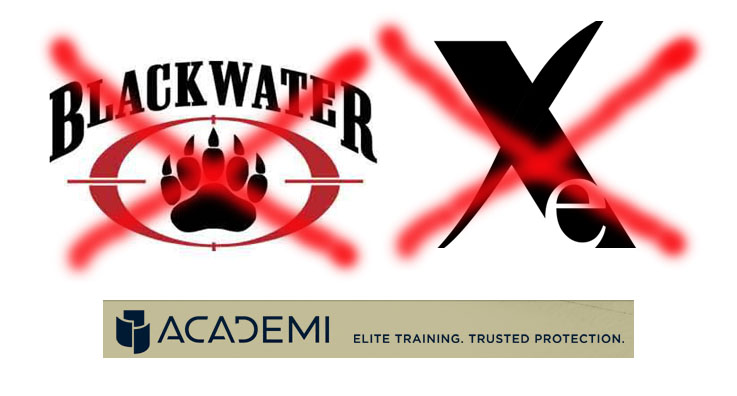
So much for transparency, civil liberties, and prosecuting the crimes of a predecessor (the cardinal rule of presidents, at least this one, cover-up WAR CRIMES past and present, a solemn command of the National Security State). Silence and deniability, in all matters large and small, characterize the responses of USG and private principals: “The State Department declined to comment on the aborted investigation. A spokesman for Erik Prince, the founder and former chief executive of Blackwater, who sold the company in2010, said Mr. Prince had never been told about the matter.” The $1B contract itself testifies to the fusion of patriotism, secrecy, repression, and yes, corporate profit: “After Mr. Prince sold the company, the new owners named it Academi. In early June, it merged with Triple Canopy, one of its rivals for government and commercial contracts to provide private security. The new firm is called Constellis Holdings.” Like war, private security stands to make a killing (pardon the pun), no doubt in flight from the original name for damage-control and public-relations purposes.
Previous to Nisour Square (Sept. 16, 2007) Blackwater guards “acquired a reputation…for swagger and recklessness,” but complaints “about practices ranging from running cars off the road to shooting wildly in the streets and even killing civilians typically did not result in serious action by the United States or the Iraqi government.” After firing in the Square, there was closer scrutiny, the Blackwater claim that they were fired on even US military officials denied, and “[f]ederal prosecutors later said Blackwater personnel had shot indiscriminately with automatic weapons, heavy machine guns and grenade launchers.” To no avail, given the symbiotic relationship between the company and the government. In fact, Blackwater had itself been run by Prince as a nation in microcosm, its people shortly before Nisour Square gathered by him at company headquarters in Moyock, North Carolina and made to “swear an oath of allegiance” like the one required of enlistees in the US military. They were handed copies of the oath, which, after reciting the words, were told to sign.
The State Department investigation into Blackwater in Iraq, which began Aug. 1, 2007 and was slated for one month, led early to the “volatile” situation (including the death threat), our knowledge coming from “internal State Department documents” furnished “to plaintiffs in a lawsuit against Blackwater that was unrelated to the Nisour Square shootings,” seemingly by accident then and fleshed out by Risen. In that month—or that part of it before being forced to leave– the investigators discovered “a long list of contract violations by Blackwater,” staffing changes of security details “without State Department approval,” reducing the number of guards on details, “storing automatic weapons and ammunition in their private rooms, where they were drinking heavily and partying with frequent female visitors,” and, for many, failing “to regularly qualify on their weapons” or “carrying weapons on which they had never been certified” nor “authorized to use.” Extravagance for mayhem abroad, less than peanuts for critical needs at home, education, health care, employment, beyond the means or reach of Imperial grandeur as the national obsession.
In addition to “overbilling the State Department by manipulating its personnel records, using guards assigned to the State Department contract for other work and falsifying other staffing data on the contract,” (no wonder the investigators’ poor reception by Blackwater’s resident head in Iraq), one of its affiliates forced “third country nationals” who did the dirty work at low wages “to live in squalid conditions, sometimes three to a cramped room with no bed,” according to the investigators’ report. Their conclusion: “Blackwater was getting away with such conduct because embassy personnel had gotten too close to the contractor.”
Ah, the denouement; we have a name to go with the face of the project manager who threatened Richter’s life, Daniel Carroll, who said he could kill him without anything happening to himself “as we were in Iraq” (this was witnessed by Donald Thomas, the other investigator), and Richter, in his memo to the Department stated: “I took Mr. Carroll’s threat seriously. We were in a combat zone where things can happen unexpectedly, especially when issues involve potentially negative impacts on a lucrative security contract.” Nicely put, and corroborated by Thomas, who wrote in a separate memo that “others in Baghdad had told the two investigators to be ‘very careful,’ considering that their review could jeopardize job security for Blackwater personnel.” The wonder perhaps is that Richter and Thomas were not prosecuted under the Espionage Act for spoiling the show. It didn’t matter. No one at State listened.
The two men were ordered to leave (Aug 23), and “cut short their inquiry and returned to Washington the next day.” Finally, on Oct. 5, after the Nisour Square scandal, State Department officials responded to Richter’s “August warning,” and took statements from him and Thomas about “their accusations of a threat by Mr. Carroll, but took no further action.” A special panel convened by Rice on Nisour Square “never interviewed Mr. Richter or Mr. Thomas.” The official who led the panel “told reporters on Oct. 23, 2007, that the panel had not found any communications from the embassy in Baghdad before the Nisour Square shooting that raised concerns about contractor conduct.” Voila, vanished in thin air. This State Department officer deserves the last word: “We interviewed a large number of individuals. We did not find any, I think, significant pattern of incidents that had not—that the embassy had suppressed in any way.” And my last word: fascism. Beyond all structural-cultural-societal considerations about wealth-concentration, industrial-financial consolidation, foreign expansion through preponderant power and the spirit of militarism, the rampaging privatization with government consent witnessed here, which has wreaked havoc on another people, only to be covered over by the state, aka, the National Security State, disregarding its Constitutional protections to the individual, as in sponsoring massive surveillance, is enough for me to satisfy the working definition of that single word.
via Norman Pollack has written on Populism. His interests are social theory and the structural analysis of capitalism and fascism. He can be reached at [email protected].
Apr 9, 2013 | Events & Assassinations

New details have emerged that shed light on the chaos that embroiled the Benghazi mission on 9/11/2012 that led to the murder of Ambassador Christopher Stevens and three other Americans at the hands of the very anti-Qaddafi rebels that Stevens formally liaised with for the CIA.
It wasn’t a secret that Ambassador Christopher Stevens played a key role in Libya’s “Arab Spring.” During the course of the revolution that ultimately toppled Muammar Qaddafi, Stevens’ built a relationship with the Libyan rebels and it’s this experience that made him the frontrunner for the Libyan ambassadorship. Stevens’ history of working with Libyan radicals provided the perfect opportunity for the Obama administration to covertly move newly purchased weapons from Libya’s freedom fighters to Syrian insurgents via ships through Turkey.
In March 2011 Stevens became the official U.S. liaison to the al-Qaeda-linked “Libyan opposition, working directly with Abdelhakim Belhadj of the Libyan Islamic Fighting Group—a group that has now disbanded, with some fighters reportedly participating in the attack that took Stevens’ life.”
Former CIA officer Clare Lopez said, “That means Stevens was authorized by the U.S. Department of State and the Obama administration to aid and abet individuals and groups that were, at a minimum, allied ideologically with al-Qaeda, the jihadist terrorist organization that attacked the homeland on the first 9/11, the one that’s not supposed to exist anymore after the killing of its leader, Osama bin Laden, on May 2, 2011.”
Obama’s weapon buyback program in Libya
Couple this with the weapon buyback program offered by the Obama administration and there’s a recipe for catastrophe.
Shortly after the October 2011 death of Qaddafi, Secretary of State Hillary Clinton announced in Tripoli that the U.S. was committing $40 million to help Libya “secure and recover its weapons stockpiles.” Department of State Assistant Secretary Andrew Shapiro confirms DOS had a weapons buy-back program in Libya that was also supported by the UK who gave $1.5 million, the Netherlands gave $1.2 million, Germany gave about $1 million and our neighbor to the north, Canada gave $1.6 million to purchase the deadly arsenal that went missing after the fall of Qaddafi.
The State Department was specifically looking to acquire the 20,000 MANPADS (they are commonly known as man-portable air shoulder-fire missiles) that went missing once Qaddafi was killed.
State Department Assistant Secretary, for Political-Military affairs, Andrew Shapiro said, they did not know how many MANPADs remained missing, but admitted it was a significant number.
“Many militia groups remain reluctant to relinquish them,” Shapiro said. He did say that the U.S. has recovered about 5,000 MANPADs earlier this year.
Repeated calls and emails went unanswered to the State Department and Shapiro regarding an update on the weapon buyback program as well as what the State Department did with the weapons they purchased.
Russia and China complained of U.S. arms trafficking in Syria
Another curious piece to this puzzle is Russia. Did they have a part to play inside Benghazi and was presidential contender, Mitt Romney right that Russia remains a threat to the U.S.? (Story by this reporter here)
The Russian response, under former KGB Cold War foe Valdimir Putin, who was visibly incensed last fall when a jubilant crowd of rebels murdered his ally, Muammar Qaddafi, has described the event as “repulsive and disgusting.”
Shortly after the death of U.S. ambassador in Libya, numerous Russian commentators used social media to describe their position on the destabilization in Libya.
“The democratized residents of Libya thanked the staff of the American Embassy for its support,” one Tweet read. “This is what you call exporting democracy, it seems. America gives Libya a revolution, and Libyans, in return, kill the ambassador.”
Aleksei K. Pushkov, the head of Russia’s parliamentary Foreign Affairs Committee, wrote via Twitter: “Under Qaddafi they didn’t kill diplomats. Obama and Clinton are in shock? What did they expect – ‘Democracy?’ Even bigger surprises await them in Syria,” aNew York Times story read in September.
It is no secret that Putin disagreed with the West’s view of Syrian ruler Assad. When Putin was Prime Minister, he delivered a scathing criticism of the Libya bombing by NATO and left the impression that under his leadership it would have never happened.
It’s also worth pointing out that Russia and China have consistently opposed any military intervention in Syria. Russia and its allies have repeatedly warned the West that efforts to aid Syrian rebels would only bring more bloodshed to an already embattled region. Also, the Russians have been demanding a cessation of U.S. aid to the Syrian rebels fighting President Assad, again noting that any military aid would destabilizes the entire region, and could have serious economic consequences for Russia.
Even Russian Foreign Minister Sergei Lavrov cautioned the West against arming the Syrian rebels. However, theArab Times news agency said, “Western officials say that Russia’s vetoes have abetted the Syrian violence by encouraging Assad to pursue an offensive with his Russian-supplied armed forces to crush the popular revolt. Saudi Arabia and Qatar are believed to have funded arms shipments.”
Case in point, in late August Russia said there was increasing evidence that Syrian rebels were procuring large numbers of Western-made weapons. They even suggested that America and other EU countries were spurring the violence in Syria.
So was Benghazi a message delivered by the Russians to end U.S. gun-running by executing Ambassador Stevens, the kingpin between the armed groups, the Libya stockpiles, and the shipments to Turkey?
Reports are abundant and U.S. acknowledged guns went to Al Qaeda
Despite evidence to the contrary, a State Department spokeswoman rejected the idea of arms trafficking, saying Ambassador Stevens was in Benghazi for diplomatic meetings, and the opening of a new cultural center.
The State Department response rings hollow, however, since the Times of London reported that a Libyan Al Entisar ship was found carrying at least 400 tons of cargo. “Some of it was humanitarian, but also reportedly weapons, described by the report as the largest consignment of weapons headed for Syria’s rebels on the frontlines.”
Middle East expert, Walid Phares confirmed the ship was carrying “a lot of weapons.”
Also former CIA Director Porter Goss told Fox News that some of the weapons from the Libya uprising are making their way to Syria. Goss claimed that the U.S. intelligence is aware of the networking given their presence in Benghazi and throughout the region.
“I think there’s no question that there’s a lot of networking going on. And … of course we know it,” he said. Unfortunately, many of those weapons shipped through Turkey to Syria ended up in the hands of al-Qaeda.
Not so long ago, America armed the Taliban with shoulder-fire missiles to fight a proxy war against the Russians only to find those weapons being used to kill Americans during the “war on terror.” This illustrates once again that arming enemies is never a good idea.
Middle East experts contend the Muslim Brotherhood and its proxy, Libyan Islamic Fighting Group (LIFG) leader Abdulhakim Belhadj, were in direct contact with Stevens and provided information as to which rebel groups in Libya and Syria deserved American trust and more importantly, weapons.
Proof comes from the 2010 classified cablefrom Stevens that read in part: “Development Foundation brokered talks with imprisoned members of the Libyan Islamic Fighting Group (LIFG) that led to the release earlier this year of about 130 former LIFG members. The GOL (Government of Libya) considers the program an important means to signal willingness to reconcile with former enemies, a significant feature of Libya’s tribal culture.”
The Business Insider wrote a story focusing on the export of fighters. “If the new Libyan government was sending seasoned Islamic fighters and 400 tons of heavy weapons to Syria through a port in southern Turkey—a deal brokered by Stevens’ primary Libyan contact during the Libyan revolution—then the governments of Turkey and the U.S. surely knew about it.
Another portion of the 2010 classified cable says, “Libya also cooperates closely with Syria, particularly on foreign fighter flows. Syria has transferred over 100 Libyan foreign fighters to the GOL’s custody over the past two years, including a tranche of 27 in late 2007. Our assessment is that the flow of foreign fighters from Libya to Iraq and the reverse flow of veterans to Libya has diminished due to the GOL’s cooperation with other states and new procedures. Counter-terrorism cooperation is a key pillar of the U.S.-LIBYA bilateral relationship and a shared strategic interest.”
Crowds outside Benghazi mission were presumed buy-back customers
It’s been months since the 9/11 Benghazi attack and no official conclusions have been released. After last week’s Congressional closed-door intelligence briefing, many lawmakers emerged wondering why Ambassador Stevens was not more concerned with the growing boisterous rebel crowd outside the mission’s gates shortly before the attack that would kill him?
Retired Army Lieutenant Colonel and Defense Intelligence Agency operative Anthony Shaffer says he knows the answer. “The Ambassador was expecting a weapon buyback deal shortly before the attack. That knowledge played a role in the slow response and created the initial confusion in Benghazi.”
U.S. rendered no aid to Stevens despite President’s “render all aid” order
While there was no shortage of second-guessing in the White House Situation Room, military leaders in charge of quick response teams a half-a-world away sprang into action upon receipt of the consulate’s 911 call and readied the troops for a real-world rescue.
“As the events were unfolding, the Pentagon began to move special operations forces from Europe to Sigonella Naval Air Station in Sicily. U.S. aircraft routinely fly in and out of Sigonella and there are also fighter jets based in Aviano, Italy. But while the U.S. military was at a heightened state of alert because of 9/11, there were no American forces poised and ready to move immediately into Benghazi when the attack began,” the Military Timesreported.
It’s also been reported that on the fateful day in Libya, CIA/SEALs had a laser target trained on the enemy firing mortar rounds at the compound. The Pentagon has listed numerous explanations as to why the trained SEALs would use the lasers. However, they conveniently omitted the key component—the expectation that U.S. help was seconds away. The “fog of spin” from the Obama administration, no matter how creative, cannot conceal the truth. If fighter aircraft were dispatched to assist Ambassador Chris Stevens and other consulate personnel, a former Naval pilot says, “The paper trail would be a mile long. Not only do the pilots have to file logbook reports, but the ground crew, the crew arming the jets with appropriate weapons and the Italian air controllers would have exhaustive records.”
The President told a KUSA Denver reporter that the minute he found out about the Benghazi attack he directed all available diplomatic and military resources to secure American consular personnel.
Unfortunately for the CIA/SEALs fighting off the Ansar al-Shariah terrorists, the jets would never arrive. The fact, CIA/SEALs were painting their lasers on the enemy targets shortly after midnight, five hours before their eventual deaths, indicates they were expecting air support. And why would they be waiting for air support? Because the trained SEALs knew the oplans (operations plans) and military protocol for this exact operation once they requested the assistance.
U.S. did not undertake an immediate FBI investigation as in USS Cole attack
“There is clear precedence for conducting an investigation into this type of terrorist attack – we faced similar circumstance with the terrorist attack on the USS Cole in October of 2000 in Aden, Yemen,” Shaffer described. “We had to work rapidly to put a qualified team on the ground to investigate one of the most severe acts of terror in the pre-9/11 era. Many of the perpetrators of this attack were eventually killed, captured or eliminated via Predator drone strikes… but in the case of the Benghazi attack there HAS NOT been a rapid or expansive effort made by this White House to establish a clear path forward and begin the hard work of bringing justice to those who died and those who attacked and looted the weapons from the CIA annex -weapons that include Surface to Air missiles that can be used to down civilian airliners.”
The FBI’s own press information concerning the response to the USS Cole bombing in 2000 highlights some key differences between the Benghazi incident and Yemen.
“We quickly sent to Yemen more than 100 agents from our Counterterrorism Division, the FBI Laboratory, and various field offices. Director Louis Freeh arrived soon after to assess the situation and to meet with the President of Yemen. On November 29, a guidance document was signed between the U.S. State Department and the Yemeni government setting protocols for questioning witnesses and suspects. FBI and Yemeni investigators proceeded with interviews, and a large amount of physical evidence was shipped back to the FBI Laboratory for examination.”
So what is the difference between the attack in Yemen against the USS Cole and the terror attack in Benghazi? Shaffer says, “CIA.”
“The CIA and State Department worked to keep FBI out of Benghazi because they knew as soon as the FBI showed up, an aggressive investigation would reveal the details of the CIA mistakes and wrongdoings.”
Was Ambassador Stevens still a CIA agent?
Speculation is nothing new inside the beltway, but several questions surround Ambassador Chris Stevens real/past employer. If he were working as a CIA agent he would be in violation of international diplomatic protocols by running an arms trafficking program under diplomatic cover.
Judge Napolitano offered this scenario to the Washington Times. “Now we can connect some dots. If Stevens was a CIA agent, he was in violation of international law by acting as the U.S. ambassador. And if he and his colleagues were intelligence officials, they are not typically protected by Marines, because they ought to have been able to take care of themselves.”
Further ties to the intelligence world comes from a 2010 leaked Wikileaks classified cable that highlights the topics Mr. Stevens would be discussing to assist Libyans full reintegration to the international community.
The main issues include; Internal political issues, bilateral relations, human rights, counter-terrorism cooperation, Sub-Saharan Africa, regional issues including Iraq and Iran, and energy sector and commercial opportunities.
In the classified cable Stevens describes Libya as a “strong partner in the war against terrorism and cooperation in liaison channels is excellent…Worried that fighters returning from Afghanistan and Iraq could destabilize the regime, the GOL has aggressively pursued operations to disrupt foreign fighter flows, including more stringent monitoring of air/land ports of entry, an blunt the ideological appeal of radical Islam.”
However, since this explanation lends itself to possible criminal actions requiring jail time, and since the CIA doesn’t post a roster of their agents, American’s will undoubtedly remain in the dark.
Congressional hearings have produced no info on the Benghazi attack
Compelling evidence names the Benghazi’s mission as the headquarters for another U.S. arms trafficking business deal gone wrong. The mission is also the scene where U.S. Ambassador Chris Stevens, two former SEALs and one State Department Information Officer were murdered.
Keeping that statement in mind, the Benghazi disaster takes a new angle, one that could have derailed President Obama’s reelection.
Normally international gun trafficking is a punishable crime, but sadly, not only is Benghazi, Libya another U.S. sanctioned-weapons buyback program paying jihadist large sums of money to turn in their stolen arsenal, but it appears that Ambassador Stevens acted as a point man to move those newly-repurchased weapons into the hands of Syrian rebels, many of whom are affiliated with al-Qaeda.
This made for Hollywood movie script includes all the action, violence and drama required for today’s bloodthirsty audience—except it is real. The State Department provided the Benghazi mission with the diplomatic cover, or the comprehensive alibi, required for the Central Intelligence Agency to operate covertly in the jihadi-rich North African region.
If this is true, one could conclude that the attack on the Benghazi mission was a counterinsurgency operation launched by terrorists that opposed another American-installed government in the Middle East.
Conclusion
Other than closed-door hearing leaks from members of Congress, American citizens are still no closer to learning what exactly happened in Benghazi. Nor are they privy to “why” the terrorist organization that worked with the U.S., specifically Ambassador Stevens, would turn their weapons on the mission.
Perhaps Secretary of State Hillary Clinton will provide more details when she testifies before the House and Senate later this month. However most politicos agree she will provide more “fog of spin” the Obama administration is standing by.
The only new update is the arrest of a suspected terrorist this weekend in Egypt.
Most major media outlets reported that Egyptians detained Muhammad Jamal Abu Ahmad, a former Egyptian jihad member that was released from prison in 2011. It’s alleged that he is the leader of Jamal network that operates terror-training camps in Egypt and Libya and who wanted to set up al-Qaeda inside Egypt. But like everything connected to Benghazi, U.S. officials haven’t been cleared to interrogate convicted terrorist who may be responsible for the death of four Americans.
For more Libya stories: http://www.examiner.com/article/barack-you-re-no-ronald-reagan-and-benghazi-is-proof
http://www.washingtonguardian.com/benghazi-predictable
For more stories: http://www.examiner.com/homeland-security-in-national/kimberly-dvorak
© Copyright 2012 Kimberly Dvorak All Rights Reserved.

 Even the mightiest have their come-uppance when their internal logic spews out destructiveness returning on the self—“blowback” in a way perhaps not seen before. I refer to James Risen’s extraordinary article in the New York Times, “Before Shooting in Iraq, a Warning on Blackwater,” (June 30), in which the customary meaning of “blowback” refers to policies, e.g., the invasions of Iraq and Afghanistan, the confrontation with Russia over Ukraine, the “pivot” of military power to the Pacific intent on the encirclement, containment, isolation of China, produce unintended, or if intended, still unwelcome, consequences for the initiator of the policy or action.
 I have already discussed the mass killings in Nisour Square, Baghdad, in a previous article. Now we learn that this was part of a pattern in Blackwater’s behavior—again, Risen’s reporting. Even for one who is a seasoned critic, it is painful for me to write about. Organized thuggery knows no limits particularly when working for the highest authority, immunity from punishment worn as a badge of honor, as meanwhile government officials hide their eyes. Risen writes, “Just weeks before Blackwater guards fatally shot 17 civilians in Baghdad’s Nisour Square in 2007, the State Department began investigating the security contractor’s operations in Iraq. But the inquiry was abandoned after Blackwater’s top manager there issued a threat: ‘that he could kill’ the government’s chief investigator and ‘no one could or would do anything about it as we were in Iraq,’ according to department reports.” A private contractor threatens the life of a State Department investigator! No reprisal, punishment, cancellation of the contract, not even disclosure of the threat—yet Blackwater still in place years later, as part of the silence on atrocities in the Obama-Hillary era.
