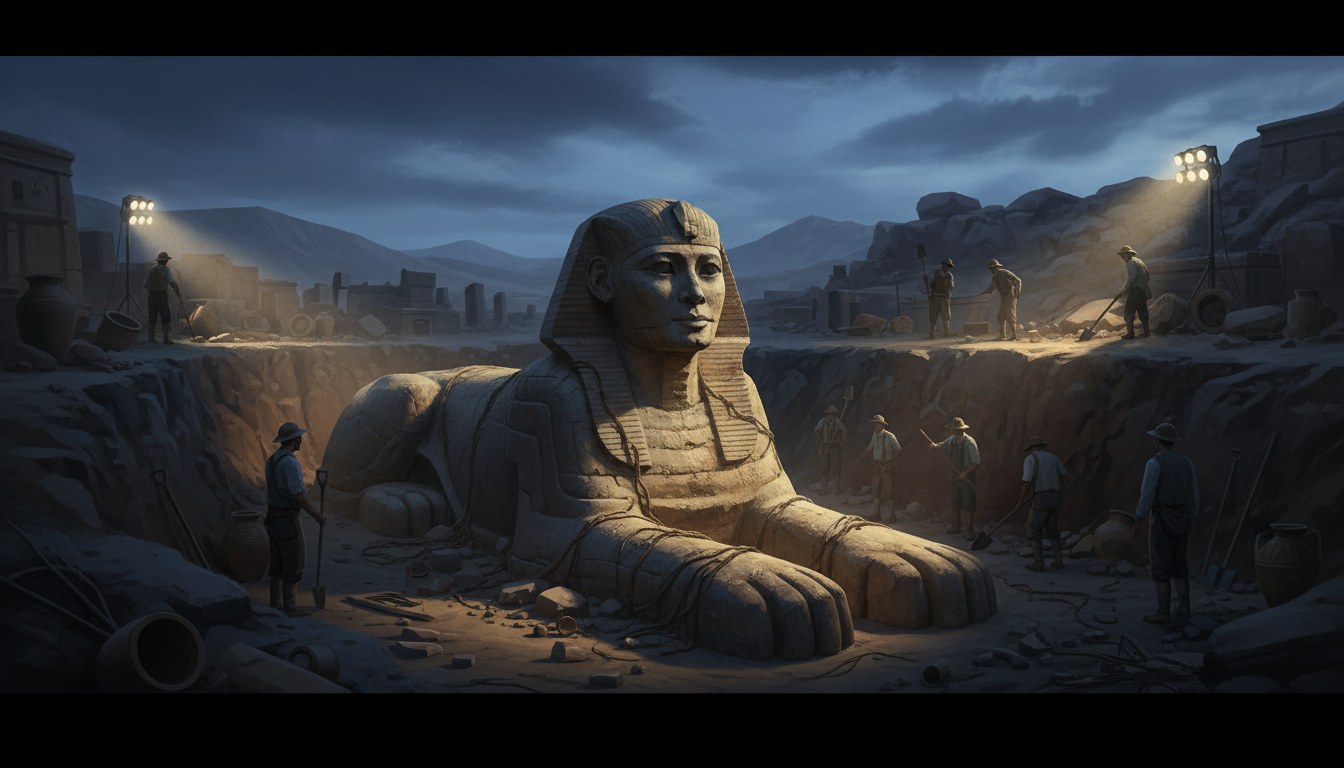
In the ruins of Tel Hazor, an ancient Canaanite city in northern Israel, archaeologists uncovered something that had no obvious reason to be there: the paws and inscribed base of a 4,000-year-old Egyptian sphinx bearing the name of Pharaoh Mycerinus, the ruler who commissioned the smallest of the three Great Pyramids at Giza. The discovery raised immediate questions about ancient trade networks, diplomatic relationships, and the movement of monumental art across the ancient Near East.
The Discovery at Tel Hazor
Tel Hazor, located in the Upper Galilee region, was once the largest and most important Canaanite city in the southern Levant. Biblical and archaeological sources identify it as a major urban center that controlled trade routes connecting Egypt, Mesopotamia, and Anatolia during the Bronze Age. Excavations at the site have been ongoing since the 1950s, producing a steady stream of artifacts that illuminate the city’s role as a crossroads of ancient civilizations.
The sphinx fragment was remarkable for several reasons. It represented the only known statue of Mycerinus — also known as Menkaure — found outside of Egypt. As a monumental piece of royal Egyptian sculpture discovered in the Levant, it stood alone in the archaeological record. The hieroglyphic inscription on the base left no doubt about its royal provenance, connecting it directly to one of the Old Kingdom’s most significant building projects.
The fragment consisted of the statue’s forepaws resting on a carved base, suggesting that the complete sphinx would have been a substantial piece of sculpture. While sphinxes were common in Egyptian royal art — typically depicting the pharaoh as a lion with a human head to symbolize divine power — finding one dedicated to a specific Fourth Dynasty ruler hundreds of miles from its place of origin was unprecedented.
How Did an Egyptian Sphinx Reach Canaan?
The central mystery surrounding the discovery was the question of how and why a royal Egyptian sphinx ended up at Tel Hazor. Several theories emerged, each reflecting different understandings of ancient geopolitics and cultural exchange.
One possibility was that the sphinx arrived as a diplomatic gift. Egyptian pharaohs routinely exchanged luxury goods and royal objects with allied rulers to cement political relationships. The Amarna Letters, a collection of diplomatic correspondence from the 14th century BCE, document extensive gift exchanges between Egypt and Canaanite city-states, suggesting that such transfers of prestige objects were standard diplomatic practice.
However, the sphinx dated to the Old Kingdom period — roughly 2500 BCE — while Tel Hazor’s peak as a major city came during the Middle and Late Bronze Ages, roughly a thousand years later. This chronological gap suggested that the sphinx may have been an ancient artifact even when it arrived at Hazor, perhaps looted from an Egyptian site or acquired through intermediary trade networks that moved objects across vast distances and long time spans.
A third theory proposed that the sphinx was brought to Hazor during one of the periods of Egyptian imperial control over Canaan. Egypt’s military campaigns into the Levant during the New Kingdom placed many Canaanite cities under direct or indirect Egyptian authority, and the movement of Egyptian religious and royal objects into conquered territories was well-documented.
Tel Hazor’s Role in Ancient Trade Networks
The presence of Egyptian royal sculpture at Tel Hazor underscored the city’s importance as a hub of international commerce and diplomacy. Archaeological evidence from the site includes Mesopotamian cuneiform tablets, Cypriot pottery, Mycenaean imports, and now Egyptian monumental art — a diversity of material culture that few other Bronze Age sites in the region can match.
Hazor’s strategic position along the Via Maris, the ancient coastal trade route linking Egypt to the northern empires, made it a natural collection point for goods and cultural influences from across the known world. The city’s estimated population of 20,000 or more during its peak made it larger than many contemporary cities in Egypt and Mesopotamia, reflecting the wealth generated by its position at the intersection of major trade arteries.
The sphinx discovery added another dimension to this picture, suggesting that Hazor’s connections to Egypt extended beyond trade goods to include objects of the highest political and religious significance. Royal sphinxes were not commercial commodities — they were expressions of divine kingship. Their presence outside Egypt implied a relationship between Hazor and the Egyptian court that went beyond ordinary commercial exchange.
What the Sphinx Reveals About Cultural Exchange
Beyond the specific questions of provenance and transport, the Hazor sphinx illuminates broader patterns of cultural interaction in the ancient world. The movement of monumental art across political and cultural boundaries challenges simplistic models of ancient civilizations as isolated entities with clearly defined borders.
Egyptian influence in Canaan was extensive and multidirectional. Canaanite cities adopted Egyptian artistic conventions, religious practices, and administrative techniques, while Egypt incorporated Canaanite deities, linguistic elements, and trade goods into its own culture. The sphinx at Hazor was a physical manifestation of this interconnection — a piece of one civilization’s most sacred royal iconography found embedded in the ruins of another.
The discovery also highlighted the limitations of the archaeological record. If a unique royal sphinx could remain buried at Tel Hazor for millennia, what other evidence of ancient international relationships lies undiscovered beneath sites across the Near East? Each unexpected find serves as a reminder that our understanding of the ancient world remains fragmentary, shaped as much by the accidents of preservation and discovery as by the actual patterns of historical activity.
Ongoing Questions and Future Research
The Hazor sphinx remains an open puzzle. Without additional inscriptions or associated artifacts that could establish a precise context for its arrival, the question of how it reached northern Israel may never be definitively answered. What it confirms, however, is that the ancient Near East was a far more interconnected and dynamic region than traditional narratives of isolated civilizations suggest.
Continued excavation at Tel Hazor and comparative analysis with Egyptian sites may eventually narrow the range of plausible explanations. Until then, the sphinx of Mycerinus stands as one of archaeology’s most intriguing displaced objects — a fragment of Egyptian royal power found far from the Nile, testifying to connections between ancient peoples that transcended the boundaries of kingdom, language, and time.