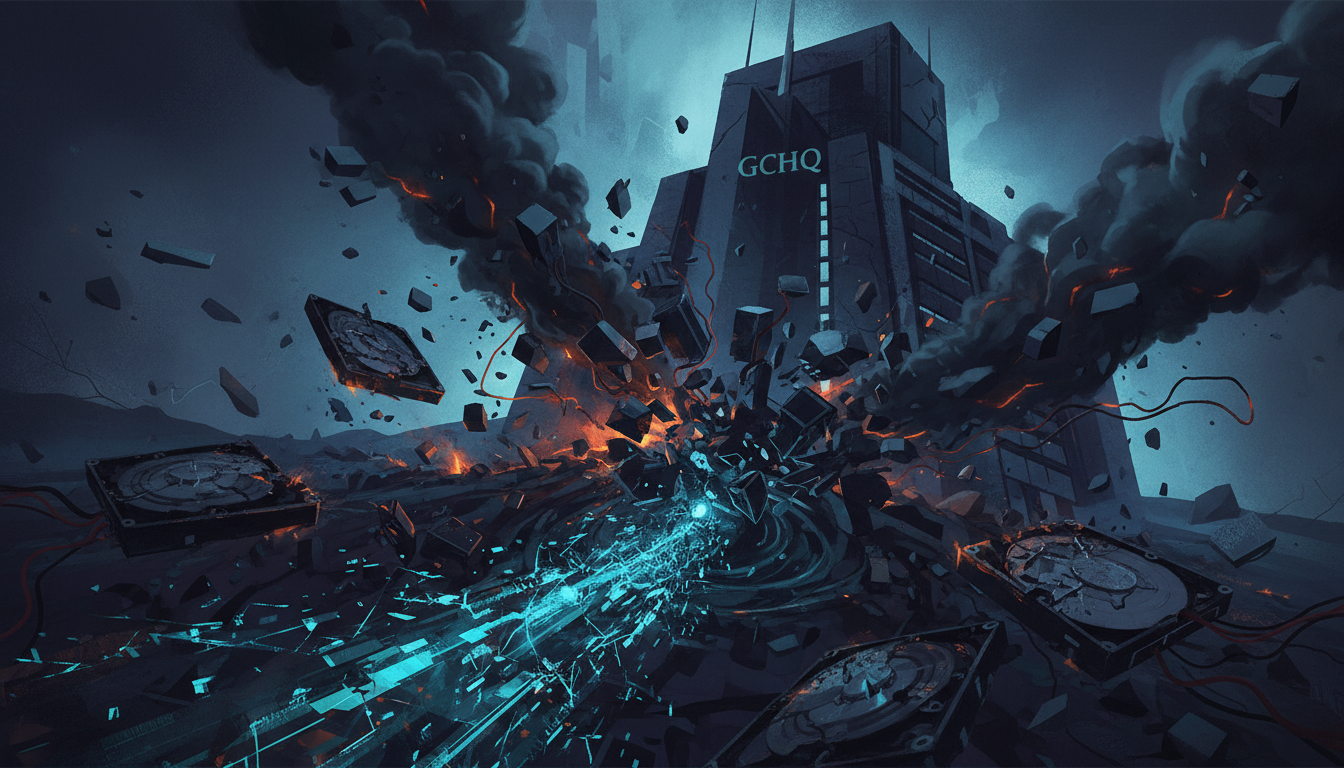
When British intelligence officials supervised the physical destruction of computer hard drives in the Guardian newspaper basement, they inadvertently created one of the most powerful illustrations of government overreach in the digital era. The episode revealed not only the lengths to which the state would go to suppress inconvenient journalism, but also a fundamental misunderstanding of how information moves in a connected world.
The Government Ultimatum
The confrontation began weeks after the Guardian published its first stories based on documents provided by Edward Snowden, the former NSA contractor whose disclosures revealed the vast scope of Anglo-American surveillance operations. GCHQ, the British signals intelligence agency, dispatched officials to meet with Guardian editor Alan Rusbridger with a clear demand: surrender the classified material or destroy it.
Unlike the United States, where the First Amendment provides robust protections against prior restraint — the government blocking publication before it occurs — British law offers no equivalent constitutional guarantee. The Official Secrets Act gave the government a credible legal avenue to seek an injunction preventing further reporting. Faced with the prospect of a court order that could shut down the Guardian investigation entirely, Rusbridger chose what he considered the least damaging option: allow the physical destruction of the London copies.
The calculation was straightforward. The Guardian had already distributed copies of the Snowden archive to partner news organizations in the United States and elsewhere. Destroying hardware in London would not eliminate a single document from existence. It would, however, prevent the government from obtaining a broader injunction that might have complicated the newspaper ability to coordinate its international reporting.
The Basement Scene
The destruction itself became an almost absurdist tableau. In the Guardian basement, GCHQ technicians watched as journalists used angle grinders and drills to reduce laptops and hard drives to fragments. The intelligence officials took notes and photographs, documenting the destruction as though it represented a meaningful security operation. When the work was done, one GCHQ officer reportedly joked that they could now “call off the black helicopters.”
The dark humor underscored the futility of the exercise. Everyone in the room understood that the information survived on servers and hard drives in New York, Rio de Janeiro, Berlin, and other locations beyond British jurisdiction. The Guardian editorial operation for Snowden stories had already shifted primarily to its New York office. Glenn Greenwald, the journalist who had received the original documents from Snowden, was based in Brazil. No amount of destroyed hardware in London would affect their ability to continue publishing.
The Miranda Detention
The hard drive destruction occurred in the context of a broader campaign of pressure. Days later, David Miranda, the partner of journalist Glenn Greenwald, was detained for nine hours at Heathrow Airport under Schedule 7 of the Terrorism Act. This provision, designed for questioning suspected terrorists at ports and borders, was repurposed to target an individual connected to journalism about surveillance.
Authorities confiscated Miranda laptop, phone, hard drives, and camera. The detention required no suspicion of criminal activity and stripped Miranda of the legal protections normally available to individuals on British soil. The message to journalists and their networks was unmistakable: associating with reporting on classified material carried personal consequences, even for those not directly involved in journalism.
The international response was sharply critical. Press freedom organizations condemned the detention as an abuse of anti-terrorism powers. Legal scholars questioned whether Schedule 7 had been applied in a manner consistent with its legislative intent. The incident drew comparisons to tactics associated with authoritarian governments rather than established democracies.
What the Episode Revealed
The Guardian hard drive saga exposed several uncomfortable realities about the relationship between government power and press freedom in modern democracies. First, it demonstrated that even governments with strong democratic traditions will resort to intimidation when they perceive their surveillance capabilities as threatened. The British government was willing to send intelligence agents into a newsroom and supervise the destruction of journalistic materials — an act that would have been almost unimaginable a generation earlier.
Second, the episode revealed a persistent gap between the government understanding of digital information and its actual nature. The assumption that destroying physical hardware could contain a digital information leak reflected thinking rooted in an earlier technological era. Documents that exist as encrypted digital files can be copied, distributed, and stored across multiple jurisdictions almost instantaneously. Physical destruction of any single copy is meaningless as an information security measure.
Third, the affair highlighted the importance of journalistic planning in the face of state pressure. Rusbridger decision to distribute the Snowden archive across multiple international partners before the government could act proved decisive. By the time GCHQ arrived with its demands, the information was already beyond the reach of any single government. This model of distributed, cross-border journalism has since become a template for handling sensitive leaked materials.
The Lasting Implications
The destruction of the Guardian hard drives remains a landmark episode in the ongoing negotiation between state secrecy and public accountability. It demonstrated that governments will act to suppress journalism they find threatening, even when such actions are transparently ineffective. It showed that legal frameworks designed for national security can be bent toward the suppression of legitimate reporting. And it illustrated that in the digital age, the most effective defense of press freedom may be technological and organizational rather than legal — distributing information so widely that no single act of coercion can suppress it.