Massive Tunnel Boring Machines and Classified Construction Projects
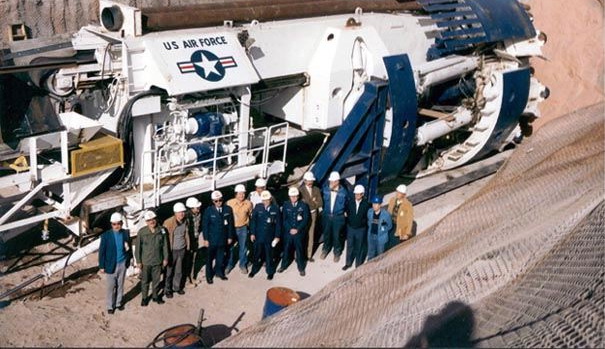
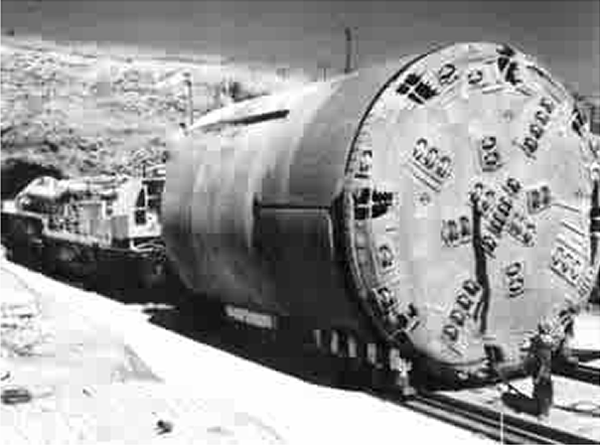
The photograph above shows a United States Air Force tunnel boring machine stationed at Little Skull Mountain, Nevada, captured in December 1982. This image, sourced from the U.S. Department of Energy, provides tangible evidence that the military possesses and operates large-scale underground excavation equipment.
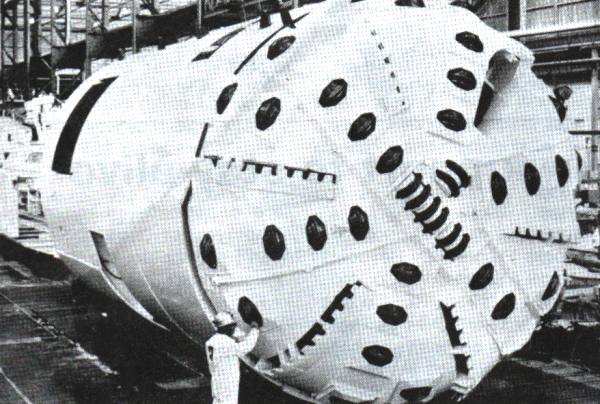
Pictured here is a $13 million tunnel boring machine (TBM) deployed at the Nevada Test Site — the same sprawling complex that encompasses Area 51. Government agencies employ numerous variations of these machines, including models rumored to be powered by nuclear reactors capable of melting solid rock and leaving behind smooth, glass-like tunnel walls.
Deep Underground Military Bases Across the United States
The bulk of subterranean construction takes place beneath military installations, with virtually all details classified at the highest levels. Over the years, former employees from these facilities have come forward describing enormous underground complexes at locations including Area 51, the Northrop facility in Antelope Valley, California — alleged to contain 42 separate levels — and the Lockheed installation near Edwards Air Force Base, California.
According to accounts from individuals who claim direct involvement, the classified or “black budget” consumes approximately $1.25 trillion annually, with a substantial portion directed toward deep underground military bases (DUMBs). By some estimates, 129 such installations exist beneath United States soil. Construction reportedly began in the early 1940s and has continued around the clock ever since, with some facilities predating even that era.
These underground installations are described as self-contained cities, each occupying between 2.66 and 4.25 cubic miles of excavated space at average depths exceeding one mile. They are allegedly connected by high-speed magnetic levitation rail systems capable of reaching Mach 2. Among the deepest is said to be the facility beneath Dulce, New Mexico, which reportedly extends seven levels down and more than 2.5 miles below the surface.
Laser-equipped drilling machines reportedly in use can bore through seven miles of rock in a single day — a pace that dwarfs conventional tunneling capabilities.
Additional Tunnel Boring Equipment Photography
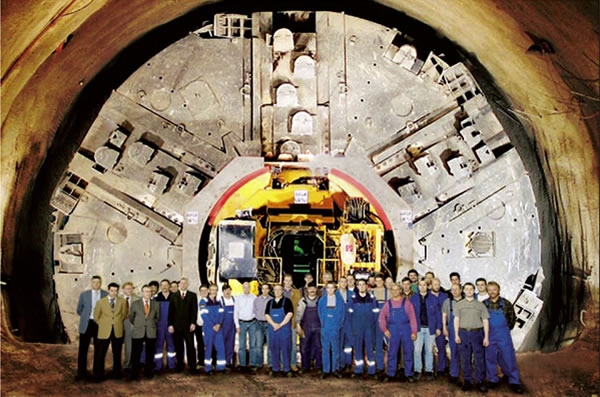
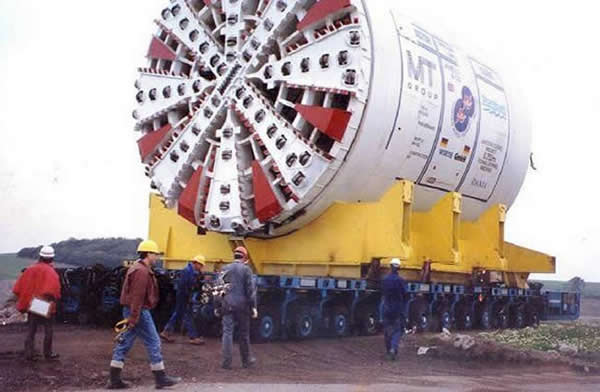
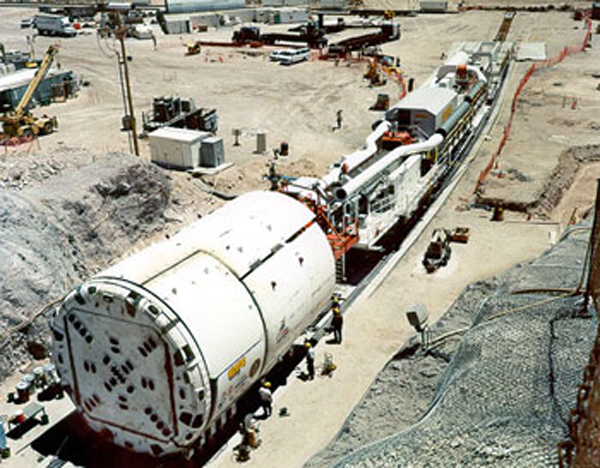

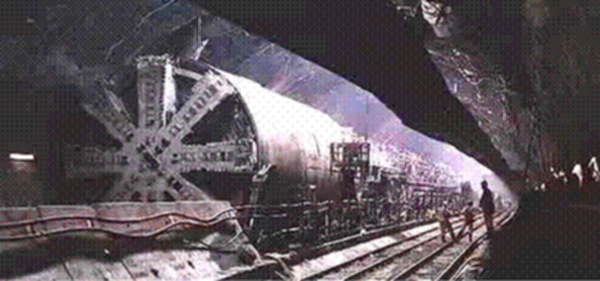
Claims of Advanced Nuclear-Powered Tunneling Technology
Accounts from individuals familiar with these programs describe tunneling machines operating in the mid-1990s that could cut through solid rock at seven miles per day. These devices allegedly used high-energy impact lasers to pulverize rock into nano-sized particles, leaving zero debris while forming an obsidian-like tunnel core. The finished tunnels reportedly served as tracks for unidirectional magnetic levitation trains traveling at speeds between Mach 2 and Mach 2.8 underground.
By some accounts, the number of deep underground military bases had grown to 132, each averaging between 5.36 and 7.24 cubic miles in volume, constructed at depths ranging from 1.5 to 4.5 miles beneath the surface. Most were deliberately sited away from known geotectonic fault zones.
The motivation behind this alleged construction frenzy, according to these sources, was preparation for anticipated catastrophic events. The funding reportedly comes not from official defense appropriations but from illicit drug revenues — estimated at between $250 billion and $500 billion annually within the United States alone — with 90 to 95 percent allegedly channeled directly into DUMB construction.
Nuclear Subterrene Patents from Los Alamos National Laboratory
Separate from eyewitness testimony, documented evidence exists in the form of patents filed by scientists at Los Alamos National Laboratory in New Mexico. These patents describe what is called a “nuclear subterrene” — a tunneling machine that melts through rock using heat from a compact nuclear reactor, vitrifying the material as it advances and leaving behind a smooth, glass-lined tunnel.
The system circulates liquid lithium from the reactor core to the tunnel face, where it melts rock on contact. After transferring its heat, the lithium flows back along the machine’s exterior to cool the newly vitrified walls before returning to the reactor to repeat the cycle. The result is a nuclear-powered boring device operating at approximately 2,000 degrees Fahrenheit (1,100 degrees Celsius) that slices through the earth like a subterranean worm.
The first patent for this technology, U.S. Patent No. 3,693,731, was issued on September 26, 1972 to the U.S. Atomic Energy Commission. The patent text explicitly notes that melted rock serves dual purposes — lining the bore hole and filling cracks in surrounding rock through hydrostatic pressure — thereby eliminating the conventional problem of debris removal while simultaneously creating a casing-type liner.
Subsequent Patents and Cost Feasibility Studies
A follow-up patent in May 1975 described a machine designed to excavate tunnels 12 meters (approximately 40 feet) or more in diameter. This device would thermally melt a circular boundary — called a kerf — into the tunnel face while simultaneously deflecting molten material against the excavation walls to form a continuous glass liner upon solidification. Mechanical equipment would then break up and remove the detached rock core.
Just 21 days later, the United States Energy Research and Development Administration received yet another patent for a strikingly similar device that achieved the same glass-lined result through thermal stress fracturing rather than mechanical removal of the tunnel core.
A 1973 Los Alamos study titled “Systems and Cost Analysis for a Nuclear Subterrene Tunneling Machine: A Preliminary Study” concluded that nuclear subterrene tunneling machines (NSTMs) offered compelling economic advantages, particularly in difficult geological conditions. The study projected potential savings of $850 million (in 1969 dollars) through 1990, against an estimated prototype development cost of $100 million over eight years — yielding a benefit-to-cost ratio of 8.5.
In 1975, the National Science Foundation commissioned the A.A. Mathews Construction and Engineering Company of Rockville, Maryland to conduct a more detailed cost analysis. The resulting report, spanning over 560 pages across two appendices, evaluated tunnel construction costs in Southern California for three diameters: 3.05 meters (10 feet), 4.73 meters (15.5 feet), and 6.25 meters (20.5 feet).
The Mathews study found that NSTMs offered 12 percent savings for the 15.5-foot tunnel and 6 percent savings for the 20.5-foot tunnel compared to conventional methods, though the 10-foot tunnel carried a 30 percent cost penalty. The advantages stemmed from NSTMs being capital-intensive rather than labor-intensive, and from their ability to form both initial support and final tunnel lining during the excavation process itself.
Unanswered Questions About Operational Deployment
The fact that the U.S. government commissioned extensive, multi-hundred-page feasibility studies on nuclear subterrene economics — and that the cost analysis specifically targeted Southern California, a region long associated with rumors of secret tunnel networks — raises legitimate questions about whether these machines progressed beyond the patent stage into actual operation.
Nearly all of the named inventors on these patents were based at Los Alamos, a facility that is itself the subject of persistent reports involving underground chambers and classified activities. Whether nuclear subterrenes were ever constructed and deployed remains unconfirmed, but the documented trail of patents, feasibility analyses, and cost studies suggests the technology was far more than a theoretical exercise.
This article examines publicly available U.S. patents for nuclear-powered tunneling machines and documented accounts of deep underground military base construction. Patent documents referenced are part of the public record through the United States Patent and Trademark Office.