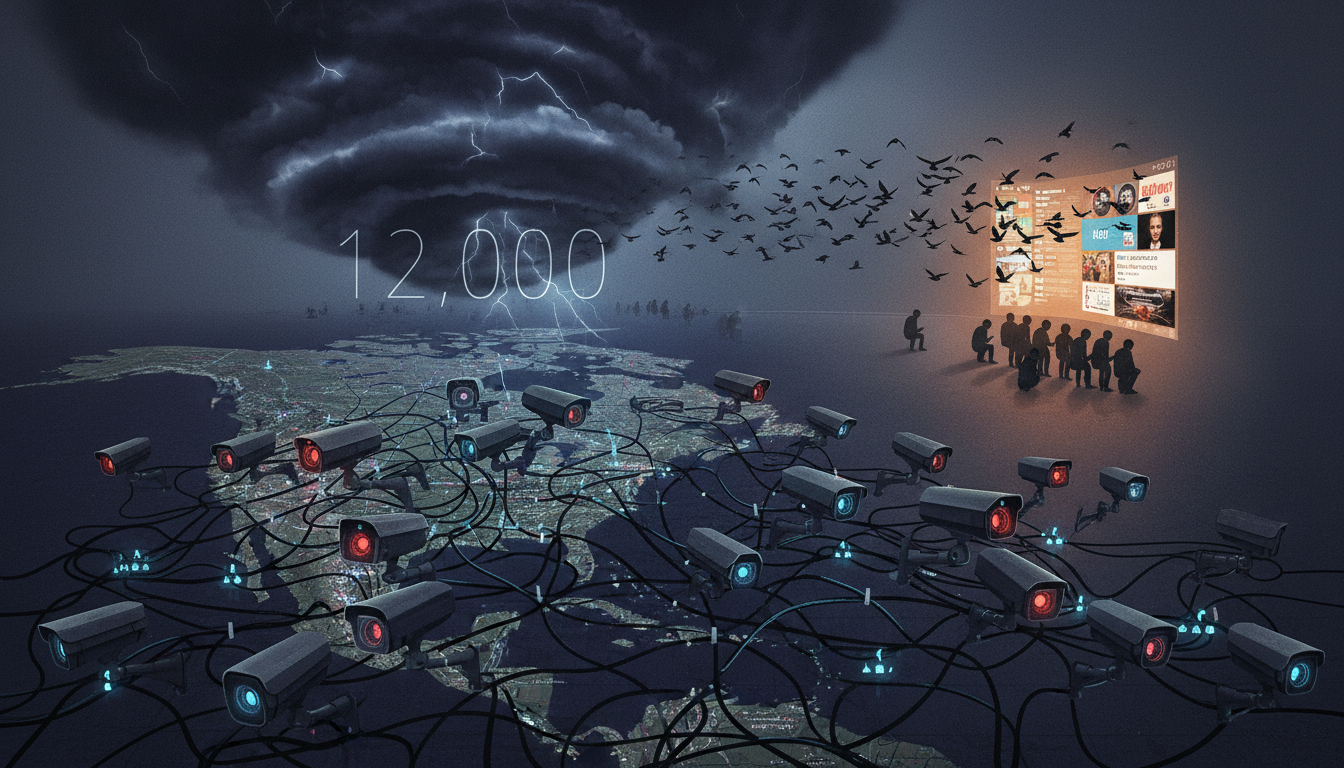
While the news cycle churns through an endless rotation of partisan spectacle, a private surveillance company called Flock Safety has quietly embedded its automated license plate reader network into more than 12,000 communities across the United States. The cameras are solar-powered, LTE-connected, and increasingly difficult to miss — yet the infrastructure they are building, and what it enables, receives far less scrutiny than it deserves.
What Flock Safety Actually Does
Flock Safety markets itself as an evidence-based public safety technology company. Its license plate reader cameras, deployed in neighborhoods, business districts, and along public roadways, do considerably more than photograph a plate number. According to the company’s own published materials, the system captures vehicle make, model, color, body style, damage, roof racks, bumper stickers, and other distinguishing characteristics — all time-stamped and location-tagged, stored in a searchable database.
By Flock’s own account, the platform supported more than one million cases in 2025 and helped locate more than 10,000 missing people. The company frames its technology around crime deterrence and investigative efficiency, noting that nearly 660,000 vehicles were reported stolen in the United States in 2025, according to the National Insurance Crime Bureau — an average of one every 48 seconds.
On the surface, those are compelling public safety arguments. But civil liberties attorneys and constitutional scholars have raised a different set of questions: not whether the cameras can solve crimes, but what else they can do — and to whom.
The Role of Artificial Intelligence
The camera itself is only one component. The more consequential element is the AI-powered platform behind it.
As documented by the Rutherford Institute and published through Activist Post, Flock’s artificial intelligence layer transforms photographic data into something far more powerful. The system can identify and categorize vehicles, compare observations against stored records, generate automated alerts, identify connections between sightings across locations and time, and help law enforcement reconstruct a vehicle’s movement history.
This means a law enforcement query does not need to begin with a known license plate number. An officer can search for, as one documented example describes, every red pickup truck with a ladder rack observed near a specific location during a specific time window. The system retrieves all matching records from across its network — including sightings from cameras operated by private homeowners’ associations and businesses that have opted into law enforcement data-sharing arrangements.
Flock’s own platform documentation confirms that private customers — HOAs, businesses, apartment communities — have the option to share their LPR data with local law enforcement. When a customer activates that sharing setting, the system can send real-time alerts to designated law enforcement partners when a flagged vehicle is detected.
The Public-Private Surveillance Architecture
This public-private partnership structure is a significant part of what concerns civil liberties organizations. The American Civil Liberties Union of Massachusetts published a detailed analysis in February 2026 describing how AI-powered surveillance systems are contributing to what it characterizes as a digital police state — one that extends well beyond any single technology company or administration.
The ACLU’s report notes that under the current federal administration, companies including Palantir and Babel Street have been empowered to aggregate Americans’ personal data into large government databases, including precise location information that allows tracking of individuals at protests and during other constitutionally protected activities. The report further documents that machine learning algorithms are applied to this aggregated data to identify patterns, flag so-called suspicious activity, and automate profiling.
While Flock Safety operates in a different market segment than Palantir, the underlying architecture follows a similar logic: data collected by private entities flows into systems accessible to law enforcement, enabling the reconstruction of movement histories that no single camera could produce on its own.
Flock’s platform documentation describes this capability explicitly as a feature, noting cross-agency visibility that allows evidence sharing when incidents cross jurisdictional boundaries, with every search logged and reviewable for audit purposes. That audit trail is presented as a privacy protection — and it may function as one in some contexts — but it also means a permanent record exists of every query law enforcement has run against the system.
Ordinary Movement as Potential Evidence
The Rutherford Institute’s analysis of Flock’s capabilities, published through Activist Post, identifies a structural consequence of this technology that deserves careful consideration: once a sufficiently dense network of license plate readers exists, every driver within that network becomes a data point. Every data point can be assembled into a pattern. And patterns, in an investigative context, can become the basis for suspicion.
This dynamic does not require any malicious intent on the part of Flock Safety or any individual law enforcement agency to materialize. It is an inherent property of a system designed to record, store, and cross-reference the movements of vehicles over time and across geographic areas.
The Rutherford Institute specifically notes that the system enables searches not just for vehicles associated with known crimes, but for vehicles that appeared near a protest, repeatedly visited a particular medical office, or were observed at a political rally. None of those activities constitute criminal conduct. All of them are constitutionally protected. All of them can now be documented and retrieved.
Who Is Watching, and Under What Rules
One of the persistent challenges with surveillance infrastructure of this kind is that its governing rules — what data is retained, for how long, who can access it, under what legal standard, and subject to what oversight — vary considerably depending on the jurisdiction and the specific contractual arrangements in place.
Flock Safety’s published materials state that local control is built into the system and that communities decide how it is used. The company also states that its platform is designed with privacy as a foundational principle, and that data sharing settings are controlled by the customer. Those are meaningful design choices. They do not, however, resolve the question of what standards govern law enforcement access once data-sharing agreements are activated, or what happens to stored data across the network when federal agencies seek access.
The ACLU of Massachusetts has documented that the current federal government has sought to leverage private data brokers and technology partnerships to access location and behavioral data about Americans, including activists, immigrants, and others engaged in protected speech and assembly. The legal landscape governing how platforms like Flock’s interact with those federal requests remains unsettled.
The Incremental Construction of Surveillance Infrastructure
What makes this moment worth examining carefully is not that any single camera or database represents a definitive rupture with constitutional norms. It is that the cumulative effect of thousands of individually justifiable installations creates an infrastructure whose aggregate capabilities exceed what any democratic deliberation has explicitly authorized.
The Rutherford Institute’s framing is direct: this is how freedom erodes in the digital age — not through dramatic declarations, but through the gradual construction of a technological network so comprehensive that privacy becomes functionally impossible and anonymity becomes, by definition, anomalous.
Flock Safety operates legally. Its cameras are installed with the consent of the communities and businesses that deploy them. Law enforcement agencies that use the platform operate under existing legal frameworks. None of that changes the underlying reality that 12,000 communities now have interconnected vehicle surveillance infrastructure feeding data into a shared, AI-searchable system — and that number continues to grow.
The questions worth asking are not whether this technology can help solve crimes. It demonstrably can. The questions are: who controls the data, under what circumstances can it be accessed, what protections exist for people who have done nothing wrong, and whether the public has had a genuine opportunity to evaluate those tradeoffs before the infrastructure became too embedded to reconsider.
Those conversations are happening in some state legislatures. They are not happening at a scale that matches the pace of deployment.
This article draws on reporting from Activist Post / The Rutherford Institute, the ACLU of Massachusetts, and Flock Safety’s published platform documentation.