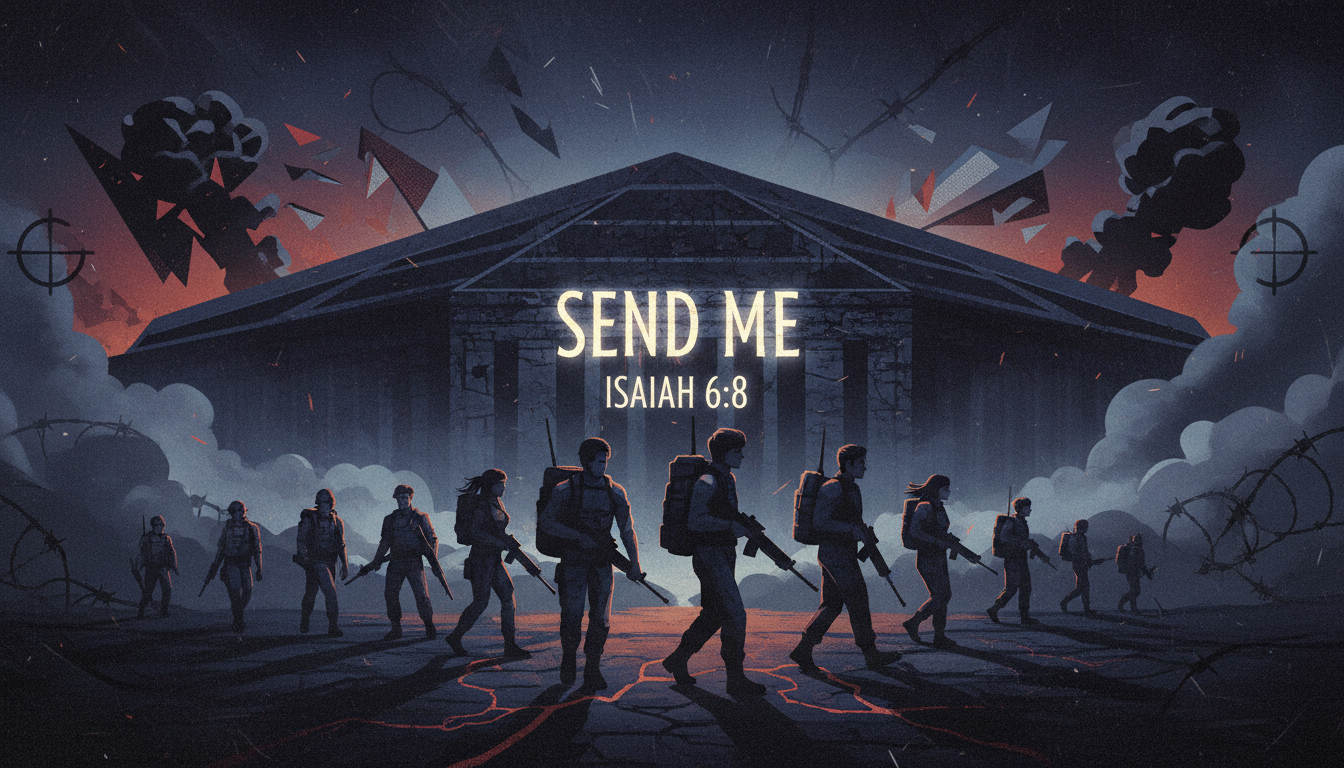
As senior military leaders were privately warning that the ongoing war with Iran was depleting key missile defenses, straining U.S. forces, and leaving the military without sufficient naval resources to continue protecting Israel, the Pentagon’s official social media accounts were doing something unusual: posting cryptic Christian scripture. The phrase “SEND ME” — drawn from Isaiah 6:8 — appeared on official Department of Defense accounts on August 1, 2026, raising pointed questions about the role of religious messaging in U.S. military communications at a moment of significant geopolitical strain.
What the Pentagon Posted — and When
On August 1, 2026, two Department of Defense accounts on X published images overlaid with the words “SEND ME.” The agency’s Rapid Response account published the phrase on a picture of a service member watching a helicopter above an aircraft carrier. Chief Pentagon spokesperson Sean Parnell explicitly quoted Isaiah 6:8 in a separate post and paired it with an image of a soldier silhouetted in darkness. The Department of War’s official account then amplified both posts.
The timing was not incidental. According to reporting from The Intercept, the posts appeared while senior military leaders were privately sounding alarms about the Iran conflict — warning that U.S. air defenses were being depleted and that the military lacked sufficient forces to maintain its commitments in the region. The Washington Post reported that a general had warned the Pentagon he lacked sufficient forces to protect Israel. Against that backdrop, the Pentagon’s social media team chose to invoke Old Testament prophecy.
What Isaiah 6:8 Actually Says
Isaiah 6:8 appears in both the Hebrew Bible and the Christian Old Testament. In the passage, the prophet Isaiah hears God ask, “Whom shall I send?” and responds, “Here am I. Send me.” The verse is widely used across many Christian traditions as an expression of answering God’s call to divine service.
But what follows in the chapter is rarely quoted alongside it. The verses after Isaiah 6:8 describe God sending Isaiah to proclaim a message of judgment — one that culminates in cities “without inhabitant,” houses emptied of people, and the land left “utterly desolate” before a promised restoration. The full context of the passage is, at minimum, more complex than a motivational recruiting image might suggest.
Jewish and Christian clergy, scholars, and laity were quick to note what they characterized as a theological misapplication. Brian Kaylor, author of the “A Public Witness” Substack and a recognized voice on the intersection of faith and public life, explained the issue directly: “Isaiah 6 is not about joining the U.S. military. It’s not even about joining any military. The chapter is a mystical call of the prophet Isaiah by God to serve God and proclaim messages from God. And these messages include a rebuke of Isaiah’s own nation and warnings of judgment to come, including military defeat by another nation.”
A Pattern, Not an Incident
The August 1 posts were not the first time this scriptural reference had been deployed by the current Defense Department leadership. Secretary of Defense Pete Hegseth has made Isaiah 6:8 a recurring fixture of his public appearances and official communications.
On May 23, 2026, Hegseth opened his commencement address at the U.S. Military Academy at West Point by quoting the passage directly: “Then I heard the voice of the Lord saying, ‘Whom shall I send and who will go for us?’ And I said, ‘Here I am. Send me.'” He then framed the cadets’ oath of service as their personal answer to that divine call — equating swearing allegiance to the U.S. Constitution with answering the voice of God.
In June 2026, while in France for the 82nd anniversary of D-Day, Hegseth quoted the scripture again, applying it to World War II soldiers: “It was men like you, soldiers like all of you who despite the odds and despite the nature of the enemy, said as is written in Isaiah, ‘Send me.'” The Pentagon subsequently released a video of Hegseth’s D-Day participation titled “The Boys of D-Day Said: ‘Send Me,'” which included his Isaiah quotation alongside what was described by The Hill as an anti-immigrant screed.
According to reporting from Baptist News Global, the pattern of using Isaiah 6:8 in official government communications actually predates Hegseth’s tenure at the Pentagon. Brian Kaylor documented that the misuse began in June 2025, when the Department of Homeland Security published a social media video connecting the Isaiah passage with images of militarized agents conducting immigration enforcement operations.
The Crusader Ideology Question
Critics who have tracked this messaging pattern argue it reflects something more deliberate than a passing rhetorical flourish. Kaylor described Hegseth’s use of Isaiah 6:8 as part of a broader “Crusader ideology” — one that, in his assessment, “appears to be closer to a Hollywood version of faith than what the Bible teaches.”
The concern among religious scholars is specific: framing U.S. military service as a response to a direct divine call does more than invoke shared cultural symbolism. It positions military action as sacred obligation — a framing with historically significant implications for how wars are justified, how soldiers understand their mission, and how dissent is received. When God is understood to be the one doing the sending, the question of whether a particular conflict is just, necessary, or strategically sound can be displaced by the more totalizing logic of divine mandate.
That this messaging is appearing in official government channels — not in a church, not in a private speech, but on verified Department of Defense accounts — makes the constitutional dimension of the question unavoidable. The First Amendment’s Establishment Clause has traditionally been understood to prohibit government endorsement of religion. Whether official military social media accounts explicitly linking military service to answering God’s voice crosses that line is a question legal scholars have begun to examine more seriously as the pattern of such messaging becomes harder to characterize as coincidental.
Scripture in Service of Policy
What makes the August 1 posts particularly notable is their context. They did not appear during a routine recruitment cycle or a peacetime commemoration. They appeared while the United States was actively engaged in a war with Iran — a conflict that, according to The Intercept’s reporting, was placing significant strain on military resources and generating private concern among senior commanders.
The decision to respond to that moment with a biblical image of divine calling — one drawn from a passage about accepting a mission of prophetic judgment — is a choice that warrants scrutiny independent of one’s religious views. Public communications from the Department of Defense are not liturgy. They are policy statements, recruitment tools, and signals to both domestic and international audiences about how the United States understands its role in the world.
Isaiah 6:8, stripped of its surrounding verses and applied to a contemporary military conflict, carries a message: that U.S. service members are answering not merely a national call but a sacred one. The verses that follow in the original text — describing desolation, emptied cities, and a land laid waste — are not included in the Pentagon’s imagery. Whether that omission is theologically naive or strategically deliberate is a question the Pentagon has not publicly addressed.
What Remains Unanswered
The Department of Defense has not offered a public explanation for why Isaiah 6:8 has become a recurring feature of its official communications, nor has it addressed the theological and constitutional concerns raised by religious scholars and civil liberties advocates. Sean Parnell’s office did not respond to The Intercept’s inquiry at the time of publication.
What is documented is a clear and repeated pattern: a sitting Secretary of Defense and his department’s official communications infrastructure have, on multiple occasions across multiple platforms, used a specific biblical passage to frame U.S. military service as a response to divine calling — doing so during active combat operations, at military academies, at international commemorations, and in domestic immigration enforcement contexts.
For those tracking the relationship between religious nationalism and U.S. military and security policy, the pattern is neither obscure nor ambiguous. It is, quite literally, posted on the official accounts of the Department of Defense for anyone to read.
This article draws on reporting from The Intercept and Baptist News Global.