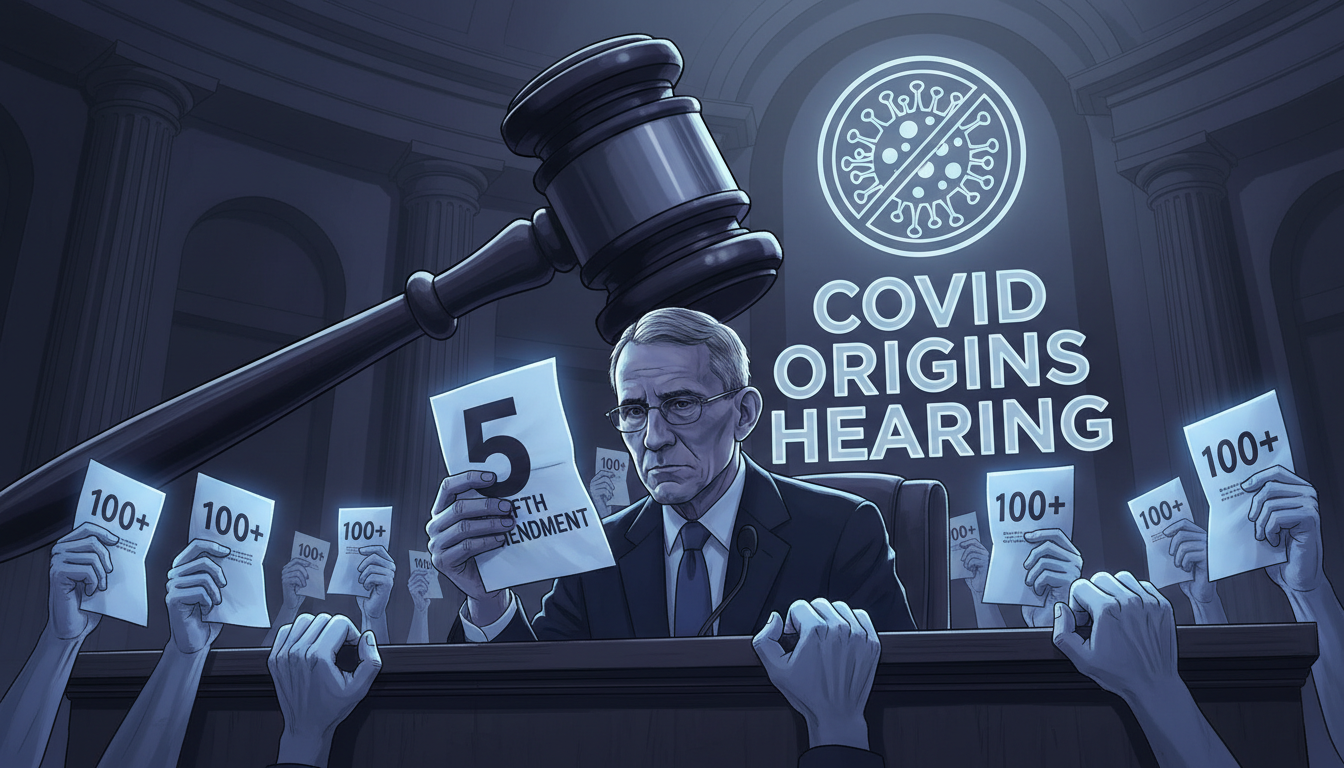
The Senate Homeland Security and Governmental Affairs Committee voted on August 6, 2026 to hold Dr. Anthony Fauci in contempt of Congress, one week after the former White House coronavirus czar appeared under subpoena and declined to answer questions about the origins of COVID-19. The 8-7 party-line vote, led by committee chairman Sen. Rand Paul (R-KY), sets in motion a referral to the Justice Department that could result in criminal prosecution — and potentially prison time — for the nation’s most recognized public health official of the pandemic era.
What Happened at the July 29 Hearing
Fauci appeared before the Senate Homeland Security and Governmental Affairs Committee on July 29, 2026, under a congressional subpoena after he declined to testify voluntarily. The hearing was convened to probe several overlapping questions: whether Fauci’s agency funded gain-of-function research at the Wuhan Institute of Virology in China, whether he possessed private knowledge suggesting COVID-19 originated in a laboratory while publicly promoting a natural-origin narrative, his interactions with U.S. intelligence agencies, and his advocacy for pandemic-era mandates and vaccines.
Rather than answer questions on the record, Fauci invoked his Fifth Amendment right against self-incrimination more than 100 times during the session. In his opening statement, Fauci described Paul’s years-long pursuit of him as an “unhinged obsession.” Democrats on the committee defended his decision, arguing that invoking the Fifth Amendment is a constitutionally protected right and not an admission of guilt — a position supported by legal scholars.
“Invoking the Fifth Amendment isn’t an admission of guilt,” said Frank Bowman, professor emeritus of law at the University of Missouri, as reported by PBS NewsHour. Bowman noted that the right is only valid when individuals reasonably believe their answers could be used to criminally prosecute them, and that it must be invoked on a question-by-question basis.
The Pardon Question: Why Republicans Argued the Fifth Did Not Apply
The legal tension at the center of this hearing stems from a preemptive pardon issued by former President Joe Biden before he left office. That pardon shielded Fauci from federal criminal prosecution for any offense committed between January 1, 2014 — the period during which the U.S. first outsourced gain-of-function research to China, according to Republican committee members — and January 20, 2025.
Republicans argued that because Fauci already held a pardon immunizing him from prosecution for the conduct in question, he had no legitimate basis to invoke the Fifth Amendment. The logic: if he cannot be prosecuted for those acts, his answers carry no self-incrimination risk, and the constitutional protection therefore does not apply.
Democrats pushed back sharply. Sen. Gary Peters (D-MI), the committee’s ranking member, warned that punishing a witness for asserting a constitutional protection would set a dangerous precedent. “If this committee now seeks to punish a witness for asserting their constitutionally protected Fifth Amendment rights,” Peters said, as reported by PBS NewsHour, “future witnesses will argue that appearing before Congress exposes them to punishment regardless of whether they comply with the subpoena and invoke a constitutional protection.”
Peters also objected to Paul’s decision to bypass standard Senate procedures and directly refer the contempt resolution to the Justice Department immediately after the vote.
The Contempt Vote and What Follows
When the committee convened on August 6, Democrats attempted to delay the proceedings, introducing five separate motions to postpone the vote. All five were defeated by the Republican majority. The final contempt resolution passed 8-7 along party lines.
Paul referred the matter to the Justice Department the same day. Should federal prosecutors choose to pursue the case, Fauci could face a fine of up to $100,000 and a prison sentence of up to 12 months. Contempt of Congress is a federal criminal offense — a point underscored by the recent prosecutorial history of two former Trump aides. Peter Navarro and Steve Bannon were both convicted of contempt of Congress by Biden’s Justice Department and each served four months in prison in 2024.
“Holding a witness in contempt is a serious thing, and it should be rare,” Paul said before the vote, according to PBS NewsHour. He added that referring the matter to the Justice Department was the appropriate next step.
Before the vote, Paul made a broader statement about the stakes he believes are embedded in this inquiry. “More than a million Americans died from Covid,” he said, as reported by RT. “Many of them died alone. Workers were forced to choose between a mandate and a job they needed. Businesses closed and never reopened. Americans lost the freedom to work, to worship, and to decide what went into their own bodies.” Paul continued: “Dr. Fauci faced no risk of federal prosecution. All he had to do was tell the truth.”
The Diary Release and the Lab Leak Question
Days before the July 29 hearing, Paul released a 1,141-page document containing Fauci’s pandemic-era diary entries. The release, reported by NPR, was intended to highlight what Republicans described as a discrepancy between Fauci’s private views and his public statements on COVID-19’s origins.
Paul and his allies contend that Fauci’s private writings indicate he was aware of substantial evidence pointing toward a laboratory origin for the virus, even as he publicly promoted the theory that COVID-19 emerged through animal-to-human transmission at a live animal market near the Wuhan lab. Several U.S. government agencies, including the Department of Energy and the CIA, have since assessed — with varying degrees of confidence — that a lab leak is the most likely origin. However, a 2023 intelligence assessment showed that key agencies remained divided on the question, according to PBS NewsHour.
Fauci served as director of the National Institute of Allergy and Infectious Diseases (NIAID) from 1984 to 2022, making him one of the longest-serving officials in that role in U.S. history. He also served as chief medical adviser to President Biden from 2021 until his retirement in 2022, during which time he became the public face of pandemic-era policies including mask mandates, vaccine requirements, and economic lockdowns.
Public Health Community Responds
Beyond the legal and political dimensions, health professionals have raised concerns about what this episode signals for the future of public health governance. Dr. Georges Benjamin, CEO of the American Public Health Association, told NPR that the contempt proceedings could have a chilling effect on the advice officials are willing to give in future emergencies.
“This will trickle down to the local level to where public health officials will not necessarily give you their best advice if they’re afraid that their best advice will be misused against them,” Benjamin said.
Critics of the investigation, including committee Democrats, have characterized the proceedings as politically motivated rather than a genuine pursuit of accountability. They argue the years-long campaign against Fauci has less to do with pandemic transparency and more to do with partisan score-settling.
What Comes Next
The decision now rests with the Justice Department. Federal prosecutors are under no obligation to act on a congressional contempt referral, and the department will make an independent determination about whether to pursue charges. The outcome will likely depend on how prosecutors assess the legal question at the heart of the dispute: whether a presidential pardon legally invalidates a witness’s Fifth Amendment privilege before Congress.
That question has not been definitively resolved in case law, and legal experts have offered differing views on the matter. What is clear is that the referral has been made, the contempt resolution is on the record, and the political and legal battle over accountability for the COVID-19 pandemic — now more than six years after its onset — is far from over.
This article draws on reporting from RT News, PBS NewsHour, NPR, and NPR’s coverage of the diary release.