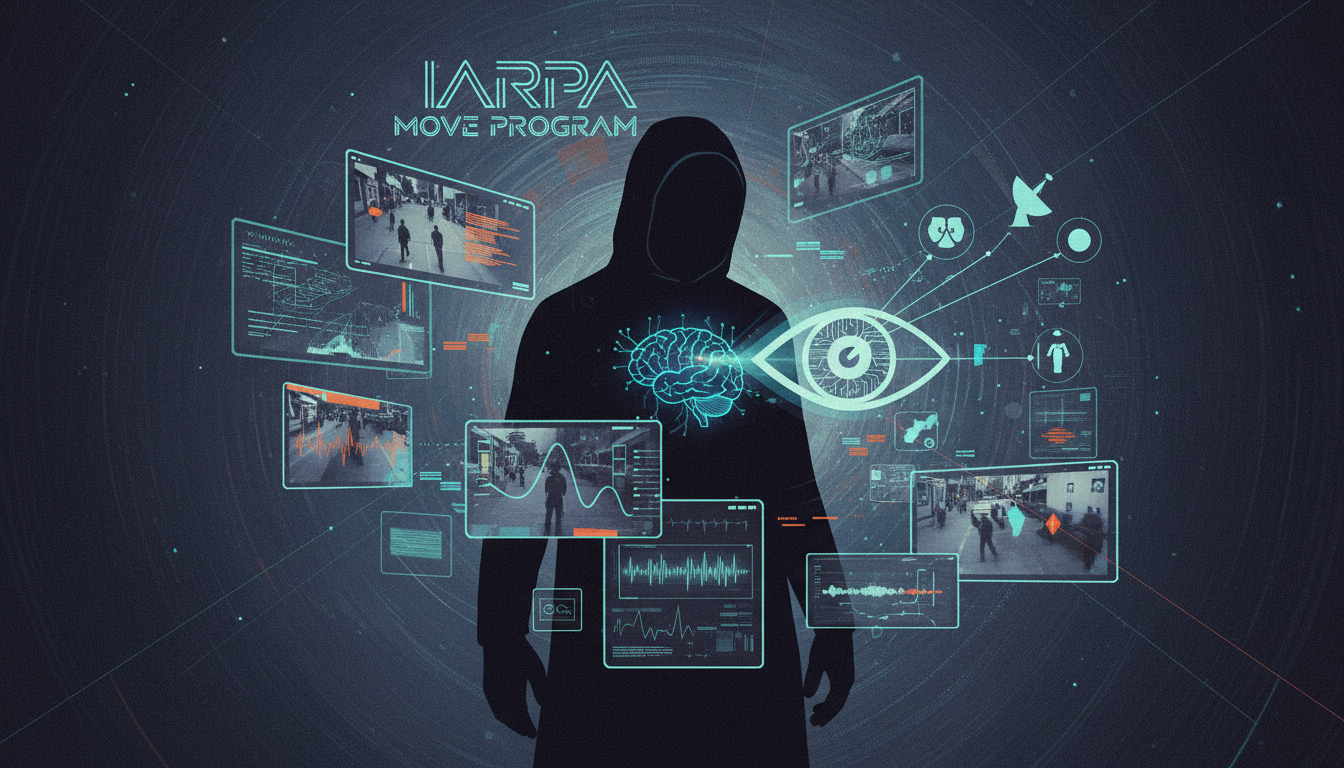
The U.S. Intelligence Advanced Research Projects Activity (IARPA), the research and development arm that serves America’s spy community, has announced a program designed to diagnose neurological conditions in individuals by analyzing how they move in open-source video footage. The program, launched in April 2026 and named the Movement Observation and Video-based Evaluation System (MOVES), raises significant questions about the boundaries between medical technology and intelligence surveillance.
What Is the MOVES Program?
According to IARPA’s official program announcement, MOVES aims to develop algorithms capable of identifying a specific set of neurological health conditions by examining video clips of how subjects move. The neurological conditions the program targets include:
- Parkinson’s Disease
- Huntington’s Disease
- Amyotrophic Lateral Sclerosis (ALS)
- Cerebellar Ataxia
- Essential Tremor
- Dystonia
The physical indicators the algorithms are designed to detect include shakes, tics, tremors, gait abnormalities, jerks, imbalances, and difficulties in walking, talking, swallowing, and breathing, all observable through video footage.
What makes the program technically ambitious, and contextually notable, is the nature of the video sources it is built to work with. According to IARPA’s own program documentation, the system is designed to function even when video quality is poor, angles are non-clinical, and subjects are fully clothed in items such as winter jackets, tunics, kurtas, headwear, or camouflage that might otherwise obscure movement.
IARPA’s program description states directly: “MOVES seeks to create algorithms that aid clinicians in making diagnoses of a small set of neurological conditions using less than ideal or challenging video that may be taken from non-clinical angles and which may also include obstructed views and fully clothed subjects.”
Healthcare Framing Meets Intelligence Architecture
The MOVES draft solicitation opens with language that positions the program within the context of digital healthcare expansion. The document begins: “With the increasing adoption of digital healthcare, it is essential that medical professionals have access to virtual tools that can augment or replace in-person health assessments.”
The program’s second stated objective, however, shifts the framing: “IARPA aims to develop algorithms that aid medical professionals in the use of open-source video for diagnosis.”
The critical distinction here is institutional. IARPA does not develop tools for hospitals or public health systems. As its own website makes clear, IARPA “sponsors cutting-edge research on a broad range of subjects to benefit and support the Intelligence Community.” Its research arms, the Office of Analysis and the Office of Collection, focus respectively on maximizing insights from data and developing new collection techniques targeting “previously inaccessible sources.”
The MOVES program sits within this intelligence architecture. Whatever clinical framing is applied at the front end, the technology being developed is intended to eventually serve the spy community’s operational needs.
Open-Source Video as a Surveillance Medium
The phrase “open-source video” is doing significant work in the MOVES program description. Open-source video encompasses an enormous range of publicly accessible footage: social media posts, news broadcasts, press conferences, protest recordings, conference presentations, and footage captured in public spaces. In an era of ubiquitous cameras and constant digital documentation, virtually anyone who has appeared in any video, knowingly or not, could theoretically be a subject of analysis.
The program’s explicit design to function under challenging conditions, poor resolution, non-standard camera angles, subjects wearing heavy or concealing clothing, suggests the algorithms are not being calibrated for controlled clinical environments. Clinical video is typically high-resolution, well-lit, and captured with the subject’s knowledge and consent. The conditions MOVES is designed to handle are more consistent with surveillance footage, candid recordings, or video obtained through collection operations.
IARPA’s existing research portfolio provides useful context. The agency’s BRIAR program, also listed on its research programs page, aims to give the U.S. Intelligence Community the ability to perform accurate biometric recognition of individuals at range. The HAYSTAC program aims to establish models of “normal” human movement across times, locations, and people. The MOVES program, when viewed alongside these parallel efforts, appears to be part of a broader initiative to extract increasingly granular personal data, including health data, from video of individuals who are likely unaware they are being analyzed.
Why Would Intelligence Agencies Want to Detect Neurological Conditions?
The question of operational motive is one that the program documentation does not directly address. However, several plausible intelligence applications present themselves when the technology is considered in context.
Intelligence agencies maintain significant interest in the health and capabilities of foreign leaders, military officials, diplomats, and other persons of interest. Knowing whether a target is exhibiting early signs of a degenerative neurological condition, detectable through public appearances, conference footage, or intercepted video, could inform assessments of their decision-making capacity, their likely tenure in a position of power, or potential vulnerabilities to exploitation.
The ability to make such assessments remotely, without physical access or human intelligence assets on the ground, and using only available open-source video, would represent a significant expansion of intelligence collection capabilities, one that operates entirely outside the subject’s awareness or consent.
A Pattern of Expanding Biometric and Health Surveillance
The MOVES program does not emerge in isolation. It is part of a documented and expanding effort by intelligence and law enforcement agencies globally to extract behavioral and biometric data from individuals using AI-powered analysis of video and other open-source information.
As reported by CNA in July 2026, protesters in India have already challenged alleged AI-powered biometric surveillance in court, with a petition before the Delhi High Court seeking the destruction of biometric data collected during demonstrations and a declaration that mass surveillance is unconstitutional. The intersection of AI, surveillance infrastructure, and individual medical or biometric data is an emerging legal and ethical battleground in multiple jurisdictions.
In the United States, IARPA’s programs represent the research frontier for what the intelligence community may deploy operationally in the years ahead. Technologies incubated at IARPA have historically transitioned to operational use across U.S. intelligence and law enforcement agencies once they reach sufficient maturity.
Consent, Privacy, and the Diagnostic Gaze
Medical diagnosis has historically required informed consent, clinical context, and the participation of the individual being assessed. The MOVES program, by design, seeks to remove these requirements entirely. Subjects of analysis under MOVES would not know they are being assessed, would not have consented to a medical evaluation, and would have no means of contesting or correcting a misdiagnosis, particularly one generated by an algorithm and used for intelligence purposes rather than clinical care.
The program’s focus on “less than ideal or challenging video” further compounds these concerns. Algorithmic misidentification of neurological symptoms in poor-quality footage could produce erroneous assessments with unknown consequences for the subjects involved, depending on how that information is ultimately used.
IARPA’s MOVES program makes explicit what has long been implicit in the expansion of AI-powered surveillance: that the human body itself, its movements, its irregularities, its signs of aging or illness, is increasingly being treated as an open-source intelligence asset, available for collection and analysis by those with the technical means to do so.
Whether that represents a legitimate extension of national security capabilities or a fundamental breach of medical privacy and human dignity is a question that public institutions, courts, and citizens will need to confront as this technology matures.
This article draws on reporting from Activist Post and HackerNoon / The Sociable, as well as official documentation from IARPA’s MOVES program page and IARPA’s Research Programs directory.