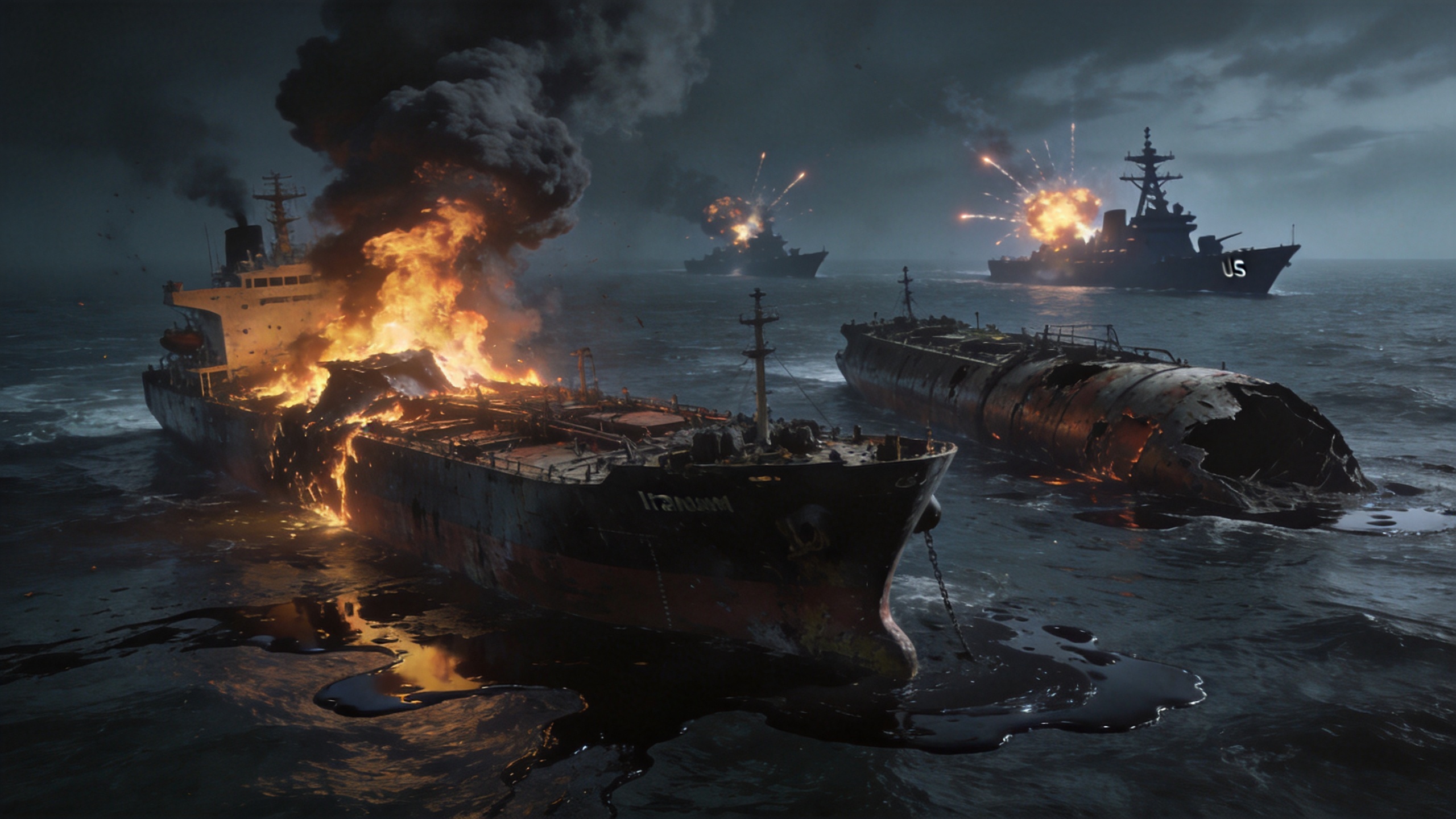
On September 5, 2026, U.S. Central Command announced it had struck three Iranian crude oil tankers in the Persian Gulf and Gulf of Oman, releasing footage of the attacks and framing them as a direct response to what it described as “unprovoked attacks” by Iran’s Islamic Revolutionary Guard Corps on an American aircraft carrier and a destroyer. The strikes mark one of the most significant escalations in a conflict that has disrupted global energy markets and placed the strategically vital Strait of Hormuz at the center of an intensifying confrontation between Washington and Tehran.
What CENTCOM Says Happened
According to a statement from U.S. Central Command, the three targeted vessels are described as part of what CENTCOM called “a multibillion-dollar shadow network” that finances the Islamic Revolutionary Guard Corps. The command identified two of the struck tankers as loaded carriers: the M/T Downy, targeted off Kharg Island in the Persian Gulf, the location of Iran’s primary oil export hub, and the M/T Kylo, struck off the city of Jask. A third vessel, also identified as M/T Kylo in CENTCOM’s statement, an empty oil carrier operating in the Gulf of Oman, was described as “completely destroyed” after sustaining multiple hits that produced a catastrophic detonation. CENTCOM stated that the crew of that vessel “was directed to abandon ship” before the final strikes were carried out.
The first two tankers were described as “permanently disabled” by precision strikes to their machine compartments. CENTCOM released video footage of all three strikes. CENTCOM commander Admiral Brad Cooper issued a pointed statement: “Let the message to the IRGC be clear: If you shoot at two of our ships, we will impose an even higher economic cost, taking out three of yours.”
The Broader Context: A Conflict That Began in Late February
The tanker strikes did not emerge in a vacuum. According to reporting by NPR and Reuters, the conflict between the United States and Iran escalated sharply beginning on February 28, 2026, when the U.S. and Israel launched military operations against Iran. In the months since, Iran has largely blocked the Strait of Hormuz, a chokepoint through which an estimated 20% of the world’s oil supply had previously transited, causing a significant spike in global fuel prices and rattling international markets.
The United States responded by imposing its own naval blockade on Iranian ports. According to Sky News, Iran had exported approximately 90% of its crude oil through Kharg Island before the conflict began, but those flows have been severely disrupted since mid-April when restrictions on Iranian oil exports took effect. U.S. forces had previously fired on and disabled Iranian tankers attempting to breach the American blockade, and had struck Iranian military facilities in and around the strait on multiple occasions.
A Pattern of Escalation and Ceasefire Collapse
The September 5 tanker strikes follow a documented pattern of mutual escalation punctuated by short-lived ceasefire agreements. Reuters reported that in late June, a U.S.-Iran ceasefire, referred to as a memorandum of understanding, was in effect when an Iranian drone struck a cargo ship in the Strait of Hormuz. The U.S. military responded by striking missile and drone storage facilities and coastal radar sites inside Iran. Vice President JD Vance stated at the time: “Iran signed a ceasefire agreement. We have honored it. If they have disagreements about how the MOU is being applied, they can pick up the phone. But violence will be met with violence.”
By early September, CENTCOM said the U.S. and Iran had again exchanged intensive strikes, with Washington resuming attacks on Tuesday, September 2, citing alleged Iranian attempts to target commercial shipping and U.S. military personnel in the region. Tehran retaliated with a missile and drone barrage against U.S. facilities in the Gulf. The tanker strikes on September 5 were the next documented step in that escalating exchange.
Iran’s Response: Counter-Strikes and Formal Warnings
Tehran did not absorb the tanker strikes without response. Iran’s Khatam al-Anbiya Central Headquarters warned that the United States would face “more severe” strikes against its military vessels in the region if it continued what Iran characterized as harassment of Iranian shipping and maintenance of a blockade on the country’s ports. Shortly after that warning, the IRGC announced it had attacked what it described as three “trespassing oil tankers” and an additional three U.S.-affiliated vessels in the Strait of Hormuz.
Iran’s navy also issued a broader alert, warning all vessels in “the Persian Gulf and near the Strait of Hormuz against suspicious movements,” according to Sky News. The IRGC framed its counter-strikes as a response to unauthorized transit routes, mirroring the language U.S. officials had used to justify strikes on Iranian tankers attempting to breach the American blockade.
Tehran has repeatedly warned that any direct strike on Kharg Island or any attempt by U.S. forces to seize the island would trigger attacks on the oil and gas infrastructure of American allies throughout the Gulf states. That warning remained operative as of the date of the tanker strikes.
The Economic and Geopolitical Stakes
The Strait of Hormuz remains the focal point of the conflict’s global economic consequences. Prior to the war, an estimated 20% of the world’s oil supply passed through the strait, according to Sky News. The mutual blockades imposed by the U.S. and Iran, combined with repeated military exchanges in and around the waterway, have kept shipping traffic well below pre-conflict averages, a fact confirmed by shipping data cited in Sky News reporting.
Secretary of State Marco Rubio stated in May that Washington was awaiting what he described as “a serious offer” from Iran to end the war, reopen the strait, and address Iran’s nuclear program. As of the September 5 strikes, no such agreement appeared to have been reached. The United Arab Emirates, a key American ally in the region, reported separate Iranian missile and drone attacks on its territory in May, in which three people were wounded after air defenses engaged two ballistic missiles and three drones launched by Iran.
Questions the Record Leaves Open
The sequence of events documented across multiple sources reveals a conflict in which each side characterizes its own actions as defensive responses to the other’s aggression. CENTCOM’s justification for the September 5 tanker strikes rests on Iran allegedly firing ballistic missiles at two U.S. Navy warships. Iran’s subsequent counter-strikes were framed as responses to those tanker attacks. Earlier ceasefire arrangements have collapsed under similar cycles of mutual accusation.
What the record also shows is that the targeting of oil infrastructure, tankers, storage facilities, radar sites, and the looming threat to Kharg Island itself, has become a central instrument of the conflict. The three tankers struck on September 5 were described by CENTCOM as financing the IRGC through a shadow network; Iran characterized U.S.-linked vessels as legitimate military targets. The line between economic warfare and armed conflict, already blurred before September 5, grew harder to locate with each successive strike.
As the conflict entered its seventh month, the Strait of Hormuz remained contested, global energy markets remained disrupted, and both sides continued to frame escalation as a form of deterrence.
This article draws on reporting from RT World News, NPR / The Associated Press, Reuters, and Sky News.