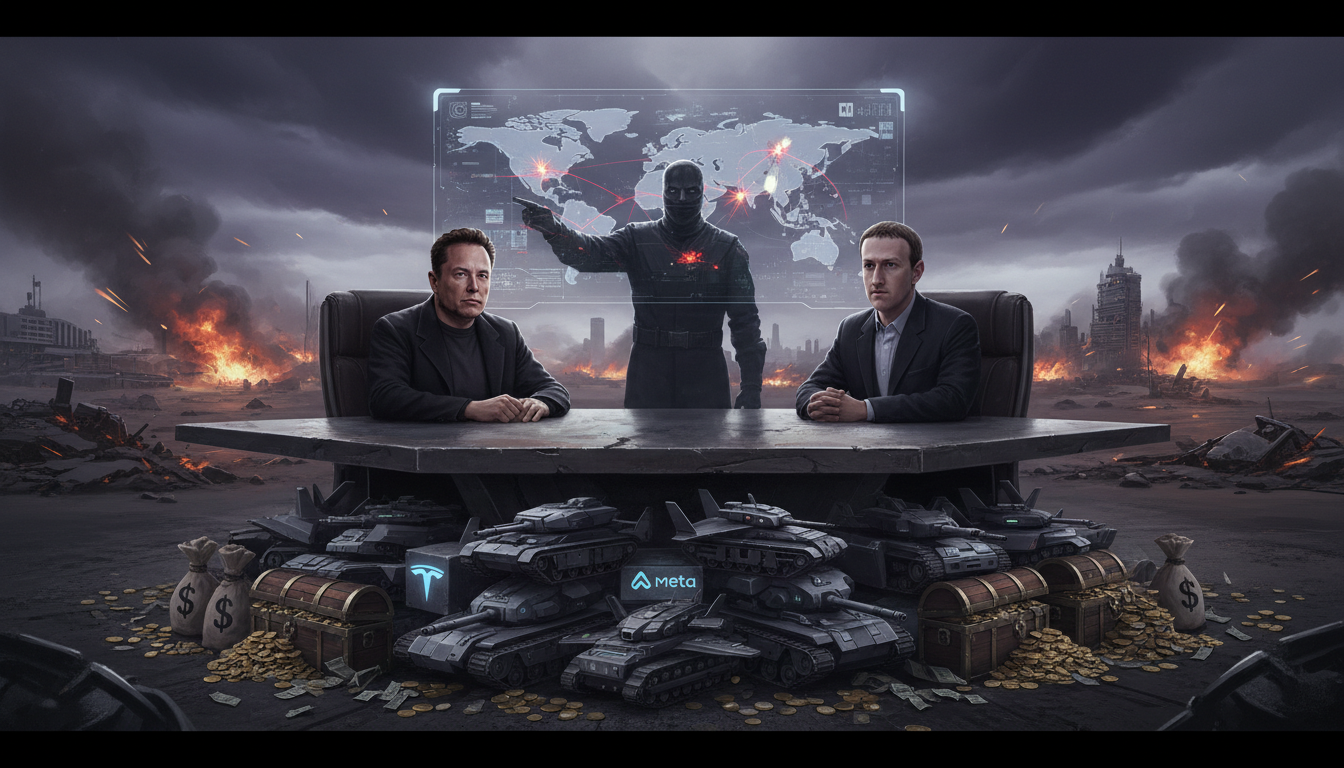
Defense Secretary Pete Hegseth has appointed Elon Musk and Palmer Luckey to lead a major Pentagon strategy study on autonomous weapons and artificial intelligence, a decision that has alarmed current and former Defense Department officials who see a direct line between the project’s potential recommendations and the two men’s corporate interests.
The initiative, announced on September 30 and called “Project Meridian: The Future of Warfare,” asks Musk, Luckey, and former Republican House Speaker Newt Gingrich to “map the trajectory of future warfare” over 120 days. Musk heads SpaceX, which holds billions of dollars in active Pentagon contracts. Luckey founded Anduril Industries, a defense technology firm specializing in autonomous drones and AI-powered weapons. Both companies stand to benefit if Project Meridian’s recommendations shape future military procurement.
What Project Meridian Is
Hegseth’s September 30 announcement framed the study in stark terms. “We are witnessing rapid advances in artificial intelligence, autonomy, directed energy, robotics, biotechnology, among other critical high-tech areas,” the announcement read. “Combined, these new domains, new ways of fighting, and technological developments will profoundly alter the character of warfare. To maintain global dominance, the United States must anticipate future operational environments and act decisively to develop the tools to dominate in them.”
The Pentagon released few specifics about the commission’s scope. The public record consists of a four-paragraph memo authorizing the project. The department said MITRE, a nonprofit that manages federally funded research centers, will lead the study’s analysis and apply “appropriate conflict-of-interest and information safeguards.” Emil Michael, the Pentagon’s chief technology officer, will also assist. The group had already held at least two meetings at the Pentagon by early October, with Sen. Tom Cotton (R-Ark.) and Phil Hegseth, the defense secretary’s younger brother, present at at least one of them.
The Contract Portfolio Behind the Concern
The ethical alarm stems from the size and nature of the contracts already flowing to the two companies now helping to set defense policy recommendations.
In May 2026 alone, SpaceX won two large Space Force contracts totaling nearly $6.5 billion. A $4.16 billion award funded a constellation of satellites designed to detect airborne targets. A separate $2.29 billion contract covered a military communications backbone constellation. Both are built on SpaceX’s Starshield platform, the military version of its Starlink satellite network. Those contracts came on top of $1.6 billion in Space Force launch task orders for deploying military satellite constellations, described by SpaceNews as the largest publicly announced batch of missions yet under the National Security Space Launch Phase 3 program.
Anduril has built its own substantial Pentagon footprint. The company previously won a U.S. Navy contract to build 200 Dive-LD autonomous underwater drones annually. Luckey’s firm has also been active in supplying AI-guided drone systems to Ukraine.
Nine current and former Pentagon officials told Politico that preferential access inside a study like Project Meridian could allow Musk and Luckey to steer recommendations toward the kinds of autonomous systems their companies are already building, opening the door to even larger contracts.
Officials Name the Problem Directly
Wes Bryant, a retired Air Force master sergeant who until recently led the Pentagon’s civilian harm assessments, offered a pointed assessment to Politico. “This is entirely indicative of the decay and oligarchy that has taken over our government and, in many cases, directly through purchasing influence and power and authority, blatantly right in front of us,” Bryant said. “They’re not even trying to hide it anymore.”
The concern is not merely theoretical. Project Meridian is designed to produce actionable recommendations about future autonomous weapon systems. If those recommendations point toward satellite-based targeting networks or AI-powered drone swarms, SpaceX and Anduril would be among the most obvious vendors. The study’s authors would have shaped the demand that their own companies are positioned to supply.
Precedent and the Limits of Comparison
Pentagon officials and outside observers have noted that bringing in private-sector experts for advisory roles is not new. Politico reported that past administrations, both Democratic and Republican, have done this for decades. One frequently cited example is the Eisenhower-era task force that reexamined U.S. military strategy toward the Soviet Union. Another is an Obama administration initiative to build closer ties between the Pentagon and Silicon Valley, which was chaired by Eric Schmidt while he was the executive chair of Google’s parent company, Alphabet.
Gingrich fits a more familiar mold. His interests include the national security implications of electromagnetic pulse weapons, and Trump had previously selected him for the Defense Policy Board after the 2020 election, though he was never seated in that role. His wife served as Trump’s ambassador to the Vatican.
The distinction that officials and observers draw is between outside expertise brought in to advise on policy questions and outside executives brought in to help define procurement categories in which they compete directly. In past arrangements, the advisory figures were not simultaneously running companies with multi-billion-dollar contracts in the exact technology sectors under review.
Timing and Political Context
The announcement of Project Meridian came just days before a planned speech by President Trump at an Anduril facility in Baltimore. That timing drew attention because it placed a presidential appearance at a contractor’s headquarters immediately after the announcement that the same contractor’s founder would help lead a major Pentagon strategy review.
The Pentagon’s statement insisting that MITRE will handle analysis and conflict-of-interest safeguards has not resolved the concerns raised by officials inside the department. The fundamental structure of the arrangement, placing executives with existing contracts in positions to shape recommendations about future contracts, is the issue that nine officials identified, and the MITRE involvement does not change who holds the leadership roles in the project.
What Remains Unanswered
The Pentagon has not clarified what information Musk and Luckey will have access to during the 120-day study, whether they will be required to recuse themselves from any aspect of the review that touches their companies’ product lines, or what legal framework governs their participation. Whether Project Meridian’s final recommendations will be made public is also unknown.
The scope of authority is itself unclear. Politico reported that it remains an open question whether the initiative would give Musk the kind of broad authority he exercised in 2025 as leader of the Department of Government Efficiency. Given the contracts already in place and the ambiguity in the commissioning memo, the question of who controls the direction of this study, and who profits from its conclusions, has no official answer yet.
This article draws on reporting from NPR (Katie McQue and Tom Bowman), Politico (Jack Detsch, Audrey Decker, and Mark Satter), and Space Explored (Seth Kurkowski).
What is Project Meridian at the Pentagon?
Project Meridian: The Future of Warfare is a 120-day study announced by Defense Secretary Pete Hegseth on September 30, 2026, tasking Elon Musk, Palmer Luckey, and Newt Gingrich with mapping the trajectory of future warfare, focusing on AI and autonomous weapons.
Why are Musk and Luckey’s Pentagon roles controversial?
Both men lead companies with billions in active Pentagon contracts. SpaceX won nearly $6.5 billion in Space Force contracts in May 2026 alone, and Anduril holds Navy drone contracts, meaning their recommendations in the study could directly expand their own companies’ business.
Who is overseeing conflict-of-interest protections in Project Meridian?
The Pentagon said MITRE, a nonprofit that manages federally funded research centers, will lead the study’s analysis and apply conflict-of-interest and information safeguards, though critics say this does not change who holds the leadership roles in the project.
Want to go deeper? Ask NEX, the Decrypted Matrix research assistant, about the documents behind this story. It indexes every article here the day it is published and cites its sources.