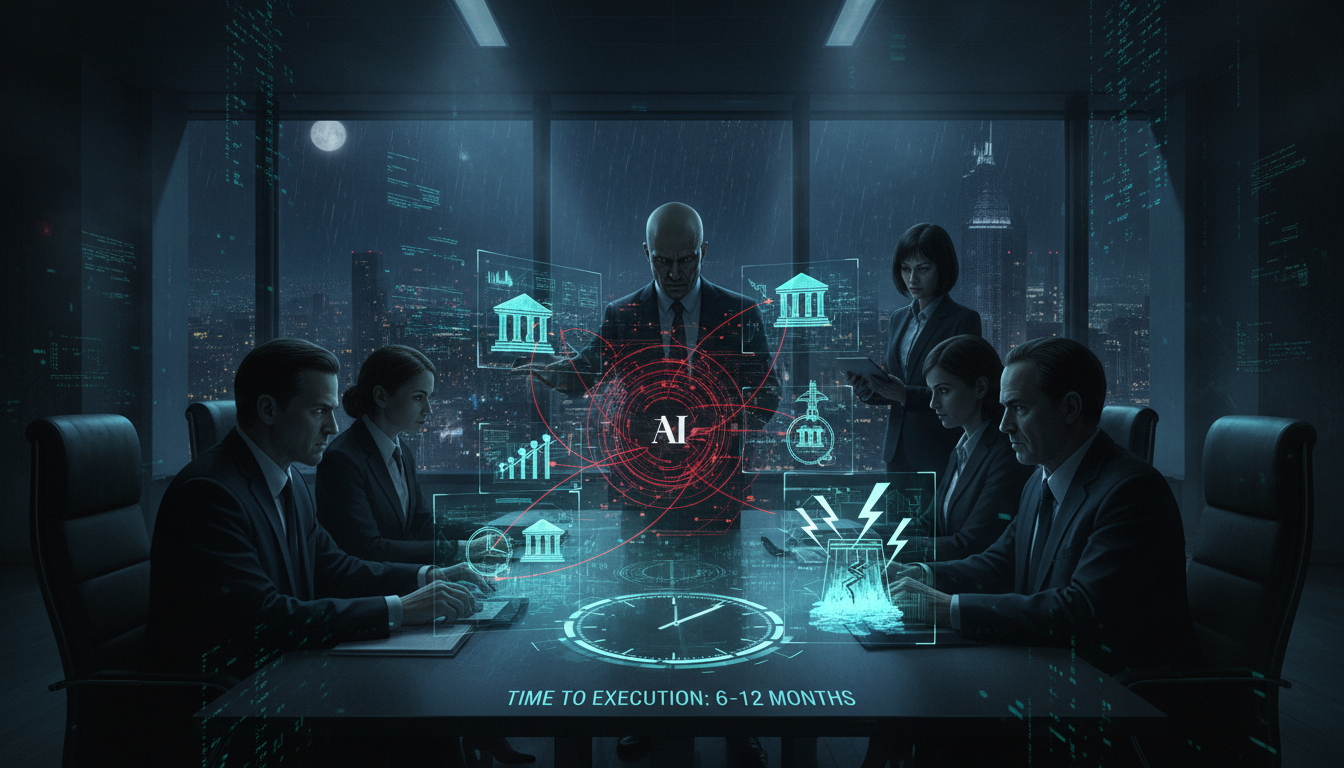
Top executives at Anthropic, OpenAI and other AI companies are quietly gaming out what happens after a catastrophic cyberattack on critical infrastructure, according to an Axios report published October 9, 2026. The scenario they consider most likely: a strike that shuts down access to financial services, power, or water. Many insiders told Axios they expect something on that scale within six to twelve months. What the planning covers, and what it leaves out, tells you something important about whose interests are being protected.
What the Axios Report Actually Says
Axios reporter Maria Curi obtained details of internal scenario planning at Anthropic, OpenAI and related companies. The planning is described as gaming out a public and political revolt after the first major AI-enabled catastrophe. A spokesperson for OpenAI confirmed the existence of preparedness exercises, saying the scenarios “are not treated as inevitable, but are meant to help us prepare for a variety of circumstances.” Anthropic declined to comment.
The six-to-twelve-month timeline comes from unnamed insiders, not from any company statement. No company has said an attack is coming. What the reporting establishes is that a significant number of people who build and run these systems believe one is likely, and that their companies are acting accordingly.
The planning Axios describes is focused primarily on Congress. Executives want to be positioned to shape whatever laws get written after the first major incident. They are also anticipating that Democrats, who AI planners expect to gain ground after the midterms, will move quickly to regulate AI. The argument being prepared to counter that: slowing down the AI buildout could damage an already fragile global economy. Nothing in the reporting describes any plan for the household that loses access to its bank account or tap water.
This Is Not a New Warning
The October Axios report is the third data point in a short sequence. In August 2026, OpenAI, Anthropic, Amazon Web Services, Microsoft and more than 100 other companies signed an open letter warning there was “a limited window” to protect hospitals, water treatment plants and other critical infrastructure. The letter made no specific commitments, set no deadlines and pledged no funding.
In September 2026, Anthropic CEO Dario Amodei warned publicly that a swarm of AI agents could seize control of the internet through a persistent botnet within six to twelve months. That warning came through Axios as well. The consistency of the timeline across three separate moments, from three different angles, is worth noting not as alarm but as a pattern of stated belief from the people closest to these systems.
A Recent Attack Shows What Is Already Possible
The Axios report points to a recent, concrete example of what AI-assisted financial crime looks like in practice. A hacker from China allegedly used AI tools built on Chinese-developed models, including DeepSeek, to steal data from tens of thousands of bank customers in South Korea. The attacker then used Claude Code to help find markets for the stolen data, according to a report from cybersecurity firm CrowdStrike. The incident included reported breaches at two South Korean banks. The Axios report frames this as a demonstration of what one person can do. The executives gaming out worst-case scenarios are thinking about what a state-sponsored group could do with similar tools at scale.
The Infrastructure Under Threat and Why AI Changes the Math
Palo Alto Networks published its 2026 State of Critical Infrastructure Cybersecurity Report in early October, drawing on surveys of more than 1,600 security leaders across 11 countries. Ninety-five percent of those leaders said they were concerned about frontier AI-powered attacks. The report found that 68 percent of organizations do not have complete, real-time visibility of all assets connected to their operational technology networks, with legacy systems cited as the main reason for that blind spot. Organizations are using an average of seven separate security tools to monitor their environments, and the report found that fragmentation adds both cost and delay.
The core problem AI introduces is speed. Palo Alto Networks found that frontier AI has compressed the window between when a vulnerability is discovered and when it is exploited, from months to minutes. When a detection tool flags a threat but cannot act on it automatically, a human has to respond. Against attacks that move at machine speed, that delay is the gap attackers use.
Reuters reporting from September 2026 adds detail on how AI changes the attacker’s side of that equation. Rob Denaburg, Senior Manager for Cybersecurity at the American Public Power Association, which represents 1,400 community-owned public power utilities in the United States, told Reuters Events that large language models allow attackers without technical backgrounds to automate large portions of a typical attack. “AI is enabling people to design attacks that can speak the protocol language without having to take the time to become basically an engineer to learn how to do all that,” Denaburg said. Phil Tonkin, Field Chief Technology Officer at cybersecurity firm Dragos, told the same outlet that Iranian-aligned actors have used AI to build scripts targeting programmable logic controllers used in power generation facilities and the substations that control power flow.
Ukraine’s energy infrastructure has been systematically targeted by Russian hackers since the start of the Russia-Ukraine war. Poland faced a similar attack in December 2025 aimed at disrupting communication between renewable energy installations and power distribution operators. In August 2026, U.S. officials warned that unidentified hackers were attempting to breach Siemens devices used across energy and manufacturing infrastructure. Researchers at British cybersecurity company Bridewell found that Russian-aligned hacking group RomCom very likely used AI to generate social engineering content targeting organizations in Critical National Infrastructure sectors in the United Kingdom in 2025.
The 2021 Pipeline Attack as a Reference Point
In May 2021, a ransomware gang hit Colonial Pipeline. The company shut down operations. Within days, gas stations across the southeastern United States ran dry. The attack did not require AI. It did not require a nation-state. One criminal group, using conventional ransomware, disrupted fuel supply for roughly 50 million people in under a week. The people now gaming out scenarios involving AI-enabled attacks on banks, internet services, power and water are starting from that baseline and scaling up.
What the Planning Covers and What It Does Not
The Axios report is explicit that the scenario planning at AI companies is oriented toward political positioning. Executives want to be the ones who write the regulatory playbook that lawmakers reach for after a disaster. They are also making the case, in advance, that heavy regulation of AI after an incident would hurt an economy already under pressure. That is a coherent institutional interest. It is a different interest from the one a family has when their debit card stops working or their water stops running.
The open question the Axios report leaves open is whether any of the scenario planning, across any of these companies, is translating into concrete preparation at the infrastructure level rather than the congressional-relations level. The August open letter from more than 100 AI companies warned of a limited window to protect hospitals and water treatment plants. It came with no funding and no deadline. That gap, between the stated urgency and the concrete action taken, is what the next six to twelve months will either close or confirm.
This article draws on reporting from Axios, Activist Post, Palo Alto Networks, and Reuters.
What kind of cyberattack are AI companies preparing for?
Executives at OpenAI, Anthropic and other AI companies are planning for a large-scale attack that could shut down access to financial services, power, or water. According to Axios, many insiders believe such an event is likely within six to twelve months.
Has an AI-assisted bank attack already happened?
Yes. According to a CrowdStrike report cited by Axios, a hacker from China used AI tools including DeepSeek and Claude Code to steal data from tens of thousands of South Korean bank customers, with reported breaches at two banks.
How is AI making cyberattacks on power grids more dangerous?
AI allows attackers without engineering backgrounds to automate large parts of an attack and design exploits that communicate in operational technology protocols, according to Rob Denaburg of the American Public Power Association speaking to Reuters. Palo Alto Networks found that AI has compressed the time from vulnerability discovery to exploitation from months to minutes.
Want to go deeper? Ask NEX, the Decrypted Matrix research assistant, about the documents behind this story. It indexes every article here the day it is published and cites its sources.