
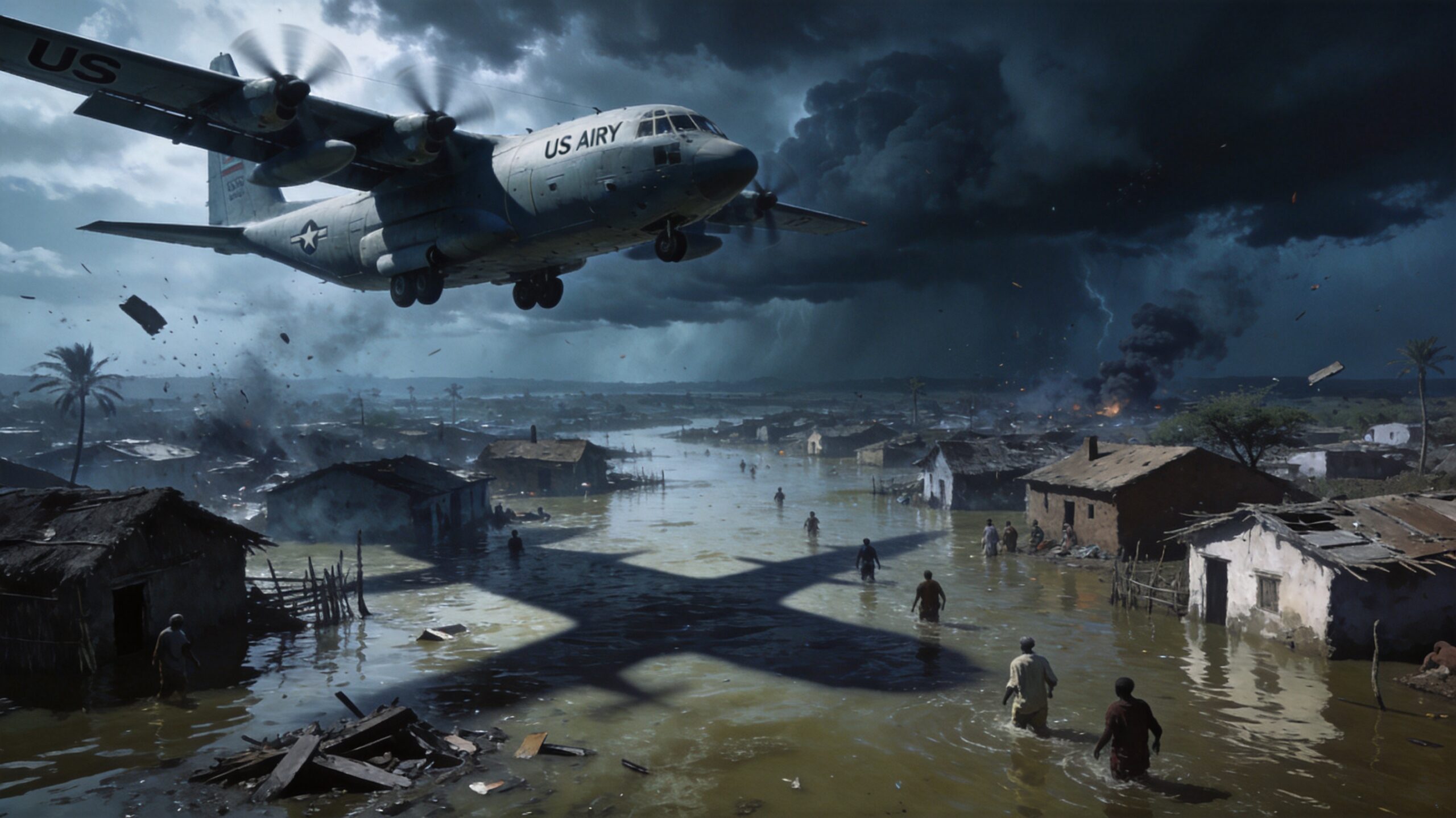
In southern Somalia, a 27-year-old mother of six named Cayni Ali stood in floodwater rising to her waist, her home five metres from the swollen River Juba, with nowhere to run. Her city of Jilib was under repeated aerial attack. The drones, she said, came constantly, killing animals and civilians alike. Destruction, she told the Guardian, was everywhere.
Ali’s account is one of several from residents inside Jilib, the de facto capital of al-Shabaab, the Islamist militant group that controls roughly 30 percent of Somalia. These testimonies point toward a disturbing possibility: that coordinated airstrikes are not simply targeting militant positions, but are corralling the civilian population onto the floodplain of the Juba River, directly into the projected path of a strengthening El Niño weather system.
A City Pinned to the River
Asho Omar, from the village of Malenda near Jilib, described airstrikes as constant and said they had forced people toward the Juba’s banks. “The airstrikes are everywhere; it is difficult to move. So many people have been killed,” she told the Guardian.
Residents describe bodies lying in the streets and a population that cannot move away from the river without entering territory being actively struck from the air. The people trapped there include large numbers of women and children.
A source monitoring the Juba floodplain told the Guardian: “The airstrikes are forcing people to go close to the river. It’s an extremely aggressive offensive, exploiting El Niño as a weapon of war to push the population into flood-prone areas.”
The River Juba has a documented history of catastrophic flooding during El Niño cycles. El Niño is forecast to intensify Somalia’s rainy season beginning this month, raising the prospect of large-scale civilian deaths in the weeks and months ahead.
What Africom Says and Does Not Say
The United States Africa Command, known as Africom, has declined to share what it calls “operational security” details about the campaign in the Jilib area. Africom’s public press releases confirm ongoing strikes targeting al-Shabaab across southern Somalia. On October 23, 2026, for example, Africom announced airstrikes “in the vicinity of Bulo Bashiir, approximately 7 km northeast of Janale,” providing no assessed death toll, according to tracking data compiled by New America.
New America’s database, which compiles data from press reporting, government statements, and NGO statements, records 218 strikes in Somalia during Donald Trump’s second term alone, with between 11 and 12 civilian deaths confirmed and between 178 and 463 militants killed. Since 2003, the United States has conducted 547 strikes in Somalia in total, with an estimated 1,930 to 2,742 total deaths.
The scale of the current campaign represents a significant acceleration. During Trump’s first term, the United States conducted 219 strikes, more than doubling the number carried out in any year under Barack Obama. The second term has already reached a comparable total, with the year not yet complete.
The Legal and Moral Questions
The conflict operates in what the Guardian describes as a “legally ambiguous, shadowy war” with little accountability for harm to Somali civilians. Al-Shabaab controls the territory, and outside journalists and monitors face severe restrictions on access. The result is that civilian casualty figures are difficult to verify independently, and the population inside Jilib has almost no channel through which to report conditions.
The accusation that a military campaign is deliberately exploiting a natural disaster to harm civilians would, if substantiated, represent a serious violation of international humanitarian law. The laws of armed conflict prohibit the use of methods that cause indiscriminate harm to civilians. Deliberately driving a civilian population into a flood zone during a forecast weather emergency would fall within that category under most legal frameworks.
Africom’s official line, according to sources cited by the Guardian, is that strikes target military positions and al-Shabaab infrastructure. The command has not addressed the specific allegation that the tactical pattern of airstrikes is channelling civilians toward flood-prone ground.
Al-Shabaab’s Own Record With Climate
The context of climate and conflict in Somalia is not straightforward. A December 2024 report by the International Crisis Group documented that during Somalia’s severe drought from 2020 to 2023, al-Shabaab itself imposed harsh restrictions on aid flowing into areas under its control and deliberately destroyed water infrastructure, fuelling clan resentment. That resentment helped drive a military campaign starting in 2022 that pushed al-Shabaab out of parts of central Somalia.
The Crisis Group report also noted that al-Shabaab uses access to water and natural resources to levy taxes on farmers and herders and to punish communities that resist its control. The group controls roughly 30 percent of Somali territory and has proven willing to use humanitarian conditions as leverage.
That record does not resolve the question of whether the current airstrike campaign is weaponising El Niño against the civilian population. It does illustrate that both parties to this conflict have, at different times, treated Somalia’s extreme weather conditions as a tool rather than a shared emergency.
A Population With No Exit
The people described in testimony from Jilib are not al-Shabaab fighters. They are residents of a city that has been under militant control, who lack the ability to leave freely and who now face airstrikes on one side and a rising river on the other.
Cayni Ali, standing in waist-deep water with six children, represents a situation that goes beyond the standard calculus of counterterrorism. The strategic logic of the campaign, whether intended or not, has placed civilians in a position where military pressure and natural disaster converge.
A formal accounting of who authorised the strike pattern over Jilib, and what assessment was made of the El Niño forecast and the civilian population’s ability to evacuate, has not been made public. Africom has not responded to specific questions about that assessment. The flood season over the Juba River is only beginning.
This article draws on reporting from The Guardian, strike tracking data from New America, press releases from US Africa Command, and the December 2024 report Fighting Climate Change in Somalia’s Conflict Zones by the International Crisis Group.
Why are US airstrikes in Somalia being called a weapon of climate war?
Sources monitoring the Juba River floodplain told the Guardian that coordinated US airstrikes around Jilib are pushing the civilian population toward the river’s banks, where a strengthening El Niño is forecast to cause severe flooding, potentially trapping thousands of civilians in the path of rising water.
How many US strikes have been carried out in Somalia under Trump?
According to New America’s database, the United States has conducted 218 strikes in Somalia during Donald Trump’s second term, with a total of 547 strikes recorded since 2003, resulting in an estimated 1,930 to 2,742 deaths overall.
What did Africom say about the civilian flooding allegations in Somalia?
Africom declined to share operational security details about the campaign near Jilib and has not publicly addressed the specific allegation that its airstrike pattern is channelling civilians toward flood-prone ground along the Juba River.
Want to go deeper? Ask NEX, the Decrypted Matrix research assistant, about the documents behind this story. It indexes every article here the day it is published and cites its sources.