The United States Agency for International Development was created to export American soft power abroad, funding democracy programs and development projects in foreign countries. Documents published on USAID’s own government website in November 2026, however, detail a different set of activities: a coordinated effort involving the agency, the White House, the Department of Homeland Security, and major technology companies to monitor and shape online content ahead of domestic American elections.
The Trump administration posted 1.1 gigabytes of internal files, including emails, recorded webinars, meeting agendas, and concept notes to USAID.gov, stating that the agency had been “weaponized” by previous administrations to “advance a radical agenda fundamentally at odds with American values.” Former USAID Administrator Samantha Power, who led the agency from May 2021 to January 2025, rejected that framing. She told Devex the files represented “cherry-picked” documents and contained “just evidence of USAID staff working diligently and transparently, as directed by Congress.”
The released records tell a more specific story. From the December 2022 meeting with Google’s Trust and Safety team to internal emails about avoiding leaks before the midterms, the documents show an agency that was acutely aware it was operating in legally and politically sensitive territory.
The December 2022 Meeting with Google
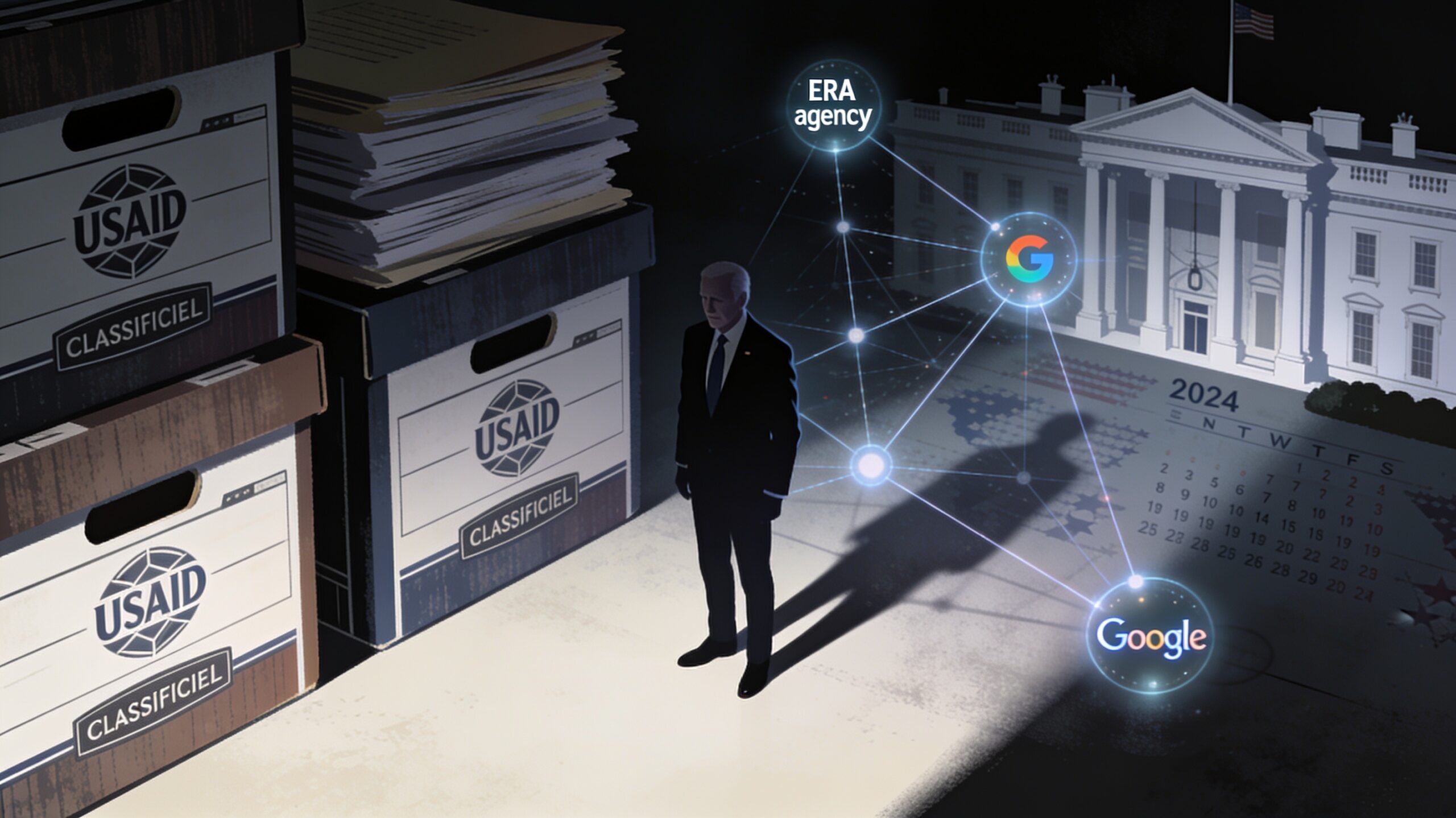
In December 2022, representatives from USAID, the State Department, and the Department of Homeland Security met with Google’s Trust and Safety team. According to documents published as part of the file release, Google executives told the government agencies that if X, the platform purchased by Elon Musk that year, refused to comply with content moderation requests, Google would “revisit” its inclusion in search results.
Google also told the agencies that it would use artificial intelligence to remove “disinformation or potentially harmful content before it goes viral” and that it would meet again with USAID to “get a plan of action in place” before the 2024 presidential election.
The meeting record raises questions that the published files do not fully answer: who set the agenda for that meeting, what specific content categories were discussed, and whether any subsequent plan was formalized. What the record does confirm is that a foreign-aid agency was present at a planning session about domestic election content moderation, alongside two cabinet-level security departments and the country’s dominant search engine.
Biweekly Calls with the White House National Security Council
A February 2023 memorandum in the release confirmed that USAID had participated in biweekly discussions with the White House National Security Council continuously since May 2021. The memo stated that “most of the discussion” on those calls focused on “the domestic threat and operational response efforts” to what the participants categorized as disinformation.
USAID’s statutory mandate covers foreign assistance. Its repeated appearance in domestic threat-response discussions with the National Security Council represents a documented departure from that mandate, one that the agency’s own legal team appears to have flagged.
The Surveillance Proposal That Was Shelved
By August of that year, USAID Chief Digital Democracy and Rights Officer Vera Zakem was seeking funding to hire social media analytics firms Logically AI and Zignal Labs. The stated purpose was to monitor what American internet users were saying about USAID’s own activities.
The proposal was not carried out. USAID’s legal counsel warned that “the privacy act prohibits the US government from collecting info about how US citizens exercise their 1st amendment rights without consent.” The proposal’s existence, and the fact that it required a legal intervention to stop it, is itself a detail the published files preserve in full.
The Midterm Emails and the Warning About Leaks
By October 2022, with midterm election campaigning underway, the documents show that officials were conscious of the political exposure their coordination created. A White House email to USAID warned that its own anti-disinformation projects were attracting “negative social media attention.”
In a subsequent exchange, USAID Democratic Resilience chief Meral Karan acknowledged that the agency was working with the White House on its content strategy. USAID’s Vera Zakem replied: “we need to get through the midterms without any leaks.”
That email is among the more direct records in the release. It documents a senior USAID official expressing concern not about the legality or appropriateness of the agency’s domestic activities, but about whether those activities would become public before an election.
What Power Said, and What She Did Not Address
Samantha Power’s public statement focused on the scope and framing of the release rather than the specific contents of the documents. She said the files showed staff “countering dangerous Chinese disinformation overseas and encouraging tech companies to combat the kinds of viral lies” and argued the release was for “partisan purposes.”
She did not address the December 2022 Google meeting, the biweekly NSC calls focused on domestic operations, the shelved surveillance proposal, or the email about avoiding leaks before the midterms. Power also noted, separately, that since Trump returned to office, 83 percent of USAID programs had been cut, with the remaining programs moved under the State Department, and that the “human cost” of those cuts had mounted over nearly two years.
The 1.1GB release covers a narrow slice of the agency’s operations. As Power pointed out, the administration has access to hundreds of thousands of files covering USAID’s work on disease prevention, poverty reduction, and humanitarian response. The released portion deals specifically with the agency’s disinformation programs, which were administered through its Bureau for Democracy, Human Rights, and Governance.
The Legal Boundary the Files Expose
The pattern across multiple documents is consistent: agency officials pursued domestic monitoring and coordination activities, were warned by legal counsel that those activities risked violating federal privacy law and First Amendment protections, and in at least one case expressed concern about public exposure rather than legal compliance.
The Smith-Mundt Modernization Act of 2012 permits the State Department and the Broadcasting Board of Governors to make their foreign-targeted content available to domestic audiences on request, but it does not authorize domestic propaganda campaigns by foreign-aid agencies. The USAID legal counsel’s warning about the Privacy Act reflects a known constraint. The documents do not show that constraint consistently stopping the activities it was meant to limit.
Open Questions from the Release
The published files establish coordination but leave the operational record incomplete. The 1.1GB release does not include records of what happened after the December 2022 Google meeting, whether a formal plan for 2024 was produced, or what the biweekly NSC calls produced in terms of actual agency action. It is not known whether Logically AI or Zignal Labs were eventually contracted through alternative channels or whether the social media monitoring was carried out through partner organizations rather than directly by USAID.
What the files do confirm is that an agency legally restricted to foreign operations was present in domestic election planning meetings, sought to monitor American citizens’ speech online, and was aware that public disclosure of its activities would be damaging. Whether the release of 1.1GB from a “hundreds of thousands” of files archive represents a full picture or a selection is a question the administration has not answered.
The files are currently hosted on USAID.gov, which was relaunched on November 25, 2026, specifically to house the document release.
This article draws on reporting from RT, Newsweek, and Devex.
What did the USAID files released in 2026 reveal?
The 1.1GB release published on USAID.gov contains emails and meeting records showing USAID coordinated with Google, DHS, and the White House National Security Council on domestic content moderation plans ahead of the 2024 presidential election.
Did Google threaten to remove X from search results over content moderation?
According to documents in the USAID file release, Google executives told government agencies in December 2022 that if X refused to comply with censorship requests, Google would revisit its inclusion in search results.
What did Samantha Power say about the USAID files?
Former USAID Administrator Samantha Power called the release cherry-picked documents used for partisan purposes, saying they showed staff working transparently on tasks like countering Chinese disinformation overseas, but she did not address the specific domestic coordination emails named in the files.
Want to go deeper? Ask NEX, the Decrypted Matrix research assistant, about the documents behind this story. It indexes every article here the day it is published and cites its sources.