The notion of crossing the entire United States in just thirty minutes may sound like pure fantasy, but a detailed proposal for exactly this kind of system was developed decades ago — and some researchers believe a version of it may already be operational beneath our feet.
The Rand Corporation’s Very High Speed Transit Concept
In the early 1970s, physicist R.M. Salter Jr., who headed the physical sciences department at the Rand Corporation, put forward an ambitious transportation concept known as the Very High Speed Transit System (VHST). The proposal called for a network of underground tunnels roughly following the paths of major U.S. highways, containing large tubes through which magnetically levitated vehicles would travel at velocities exceeding 10,000 miles per hour.
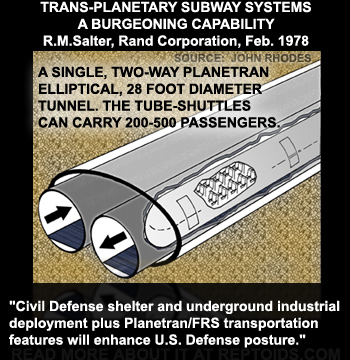
The fundamental principles behind the system were not new even then. Electromagnetic suspension for rail travel had originally been proposed in 1905 and received a patent by 1912. What Salter envisioned, however, was an entirely new scale of implementation — a continental network capable of moving both passengers and cargo, including full-sized shipping containers and automobiles.
How the 10,000 MPH Underground Train Would Function
The engineering concept centered on near-vacuum tunnel environments. With virtually all air removed from the tubes, vehicles would encounter almost no atmospheric resistance, eliminating the need for aerodynamic shaping entirely. The electromagnetic rail beds would propel the gondola-style cars, while supercooled liquid helium reduced electrical resistance in the system’s wiring to negligible levels.
A particularly elegant feature of the design involved energy recapture. Vehicles decelerating into stations would generate power that could be fed directly to outbound cars accelerating in the opposite direction — the same principle that trolley systems had used for decades, just applied at a vastly greater scale. With departures scheduled at intervals as short as thirty seconds, the system would achieve enormous throughput.
The main line was designed to connect Los Angeles and New York, with intermediate stops at Amarillo and Chicago. Feeder routes would extend to San Francisco, Boston, Washington, and other major metropolitan areas.
The Tunneling Challenge and Hidden Benefits
Salter acknowledged that excavating a transcontinental tunnel network represented the single largest cost barrier. However, he argued that the economics were more favorable than they appeared. Unlike surface transportation corridors, underground routes required no expensive land acquisition or demolition of existing structures. Once the tunneling was complete, operational costs would be remarkably low.
The tunnels would serve multiple purposes beyond transit. Supercooled power transmission lines running through the same infrastructure could carry electricity coast to coast with minimal energy loss — something impossible with conventional above-ground power grids. Laser-based communication channels and pneumatic mail delivery systems could share the tunnel space, further offsetting construction costs and accelerating the payoff timeline.
Salter estimated that roughly 8,000 miles of tunnel had been excavated across America and Western Europe during the 1960s alone, including mine shafts. He believed that tunneling technology could be dramatically improved beyond the conventional drill-and-blast methods still in widespread use, suggesting electron beams or high-pressure water cutting as far more efficient alternatives.
A Fare of Fifty Dollars From Coast to Coast
Under Salter’s projections, a one-way trip from Los Angeles to New York would cost passengers approximately fifty dollars — a remarkably affordable figure given the speed and convenience offered. He calculated that the system could handle seven to eight million tons of freight daily while simultaneously serving passenger volumes comparable to existing air shuttle routes between major cities.
The physicist pointed to steadily growing congestion in both air corridors and highway systems as evidence that a fundamentally different approach to long-distance transportation was inevitable. Continuing to add individually guided vehicles to crowded airways and roads was, in his assessment, an unsustainable path.
Connections to Secret Underground Military Installations
The VHST proposal took on new significance when examined alongside persistent accounts of classified underground military facilities across the United States. The late Phil Schneider — a geologist and engineer who claimed direct involvement in constructing deep underground bases before his controversial death — described what he called an Electro Magneto Leviton Train System capable of exceeding Mach 2.
The proposed VHST routes aligned closely with locations identified by independent underground base researchers. One technical detail from the original Rand Corporation documentation proved particularly intriguing: the tunnels were too vast to evacuate all air simultaneously. Instead, the system required enormous mechanized airlock doors that would seal and unseal tunnel segments in precise sequence as trains passed through each vacuum-locked section.
This mechanical process would produce distinctive sounds — deep hums, rhythmic mechanical noises, and air-pressure fluctuations — particularly if the tunnels ran at depths between 400 and 800 feet, which is considered relatively shallow by underground base standards. Some researchers proposed this as an explanation for unexplained booming sounds and ground vibrations reported in various locations across the country, including the widely publicized Clintonville, Wisconsin incidents.
As trains repeatedly reached the speed of sound at the same points in the tunnel system, the resulting sonic booms could manifest as recurring underground concussions felt at the surface.
The Political Barrier to Public Implementation
Salter himself expressed more confidence in the technical viability of the system than in the political will to build it. He drew a parallel to the long-proposed English Channel tunnel connecting England and France — a project that was technically feasible for generations before political obstacles were finally overcome.
Looking back a century at the pace of transportation advancement, Salter argued that VHST represented a logical evolutionary step — one far more practical than the alternative of endlessly expanding conventional road and air infrastructure. Beyond efficiency, he cited environmental imperatives: the need to stop polluting the atmosphere with heat, chemicals, and noise, and to reclaim highway space from commercial freight traffic.
Whether this system exists only on paper or has been quietly constructed and activated beneath the continental United States remains one of the more persistent questions in underground base research. The technical feasibility was established over fifty years ago. The only real question is whether anyone with sufficient resources and motivation chose to build it.
This article draws on the original 1972 Los Angeles Times reporting on R.M. Salter’s VHST proposal and subsequent analysis by underground base researchers. All facts, figures, and technical details have been preserved and rewritten for editorial originality.