The development of a human being represents one of nature’s most extraordinary engineering achievements, a process so intricate that it challenges our deepest understanding of biology, energy, and consciousness. At the center of this remarkable design lies an organ that science is only beginning to fully appreciate: the human heart.
The Heart Forms Before the Brain
Human development begins when 23 chromosomes carried by sperm unite with 23 chromosomes contained in the egg. This combination of 46 chromosomes initiates a cascade of biological events that unfolds with stunning precision. Within just 18 days of conception, a primitive heart consisting of two basic tubes begins forming in the new embryo. By approximately day 22, this rudimentary organ receives what can only be described as an electrical spark and begins beating.
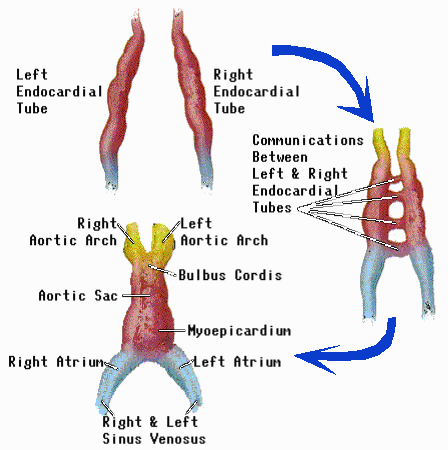
This timeline carries profound implications. The heart is the first organ to develop in the human body, establishing itself well before the brain takes shape. This sequence raises compelling questions about the relationship between cardiac function and the emergence of consciousness. Do subatomic particles organize themselves around electrical currents already present in the developing embryo? Does the moment the heart begins beating mark the emergence of a prototype awareness?
The Heart as a Second Brain
For generations, mainstream science treated the heart as nothing more than a mechanical pump. Research in the field of neurocardiology has thoroughly dismantled this assumption. In 1991, Dr. J. Andrew Armour introduced the concept of a functional “heart brain” after discovering that the heart possesses its own complex intrinsic nervous system.
This cardiac neural network contains multiple types of neurons, neurotransmitters, proteins, and support cells structurally similar to those found in the cranial brain. The system is sophisticated enough to operate independently, enabling the heart to learn, remember, and even process sensory information without input from the brain.
The heart communicates with the brain and body through four distinct channels: neurological signals transmitted via the nervous system, biophysical communication through pulse waves, biochemical messaging via hormones, and energetic communication through electromagnetic field interactions.
Perhaps most significantly, research has established that communication between heart and brain is not a one-way street. The outdated model in which the brain commands and the heart obeys has been replaced by a far more nuanced understanding of bidirectional information exchange.
Electromagnetic Fields and Emotional Transmission
The heart generates the most powerful electromagnetic field of any organ in the human body. Its electrical field measures approximately 60 times greater in amplitude than the electrical activity produced by the brain. The magnetic field generated by the heart is more than 5,000 times stronger than the brain’s magnetic field and can be detected several feet away from the body in all directions using sensitive magnetometer equipment.
What makes this finding particularly significant is that this cardiac electromagnetic field is modulated by emotional states. Different feelings produce measurably different field characteristics, meaning that the heart literally broadcasts emotional information into the surrounding environment.
This has practical implications that most people have experienced intuitively. Walking into a room and immediately sensing tension, conflict, or warmth, even before anyone speaks, may represent the detection of electromagnetic information generated by the hearts of people present. That gut feeling that something is wrong, or that palpable sense of positive energy in certain environments, may have a measurable biophysical basis.
How Emotions Shape Development at the Cellular Level
During embryonic and fetal development, every cell in the growing body is enveloped by the electromagnetic field emanating from the mother’s heart. This field oscillates with emotional states, shifting frequencies in response to the mother’s thoughts, feelings, and experiences. Anyone who comes into close proximity with the mother’s field generates an interaction where information can be transferred energetically.
This means that a developing child is, in a very real sense, an integral participant in the mother’s conscious experience, absorbing both positive and negative emotional information through electromagnetic communication long before birth.
The phenomenon of water memory adds another dimension to this picture. Given that human beings are fundamentally water-based organisms down to the molecular level, the influence of emotional frequencies on cellular development deserves serious consideration. Research into cymatics, the study of how sound frequencies organize matter into geometric patterns, demonstrates that different frequencies structure physical material in distinctly different ways.
Thoughts and Feelings as Energetic Information
Thoughts and emotions are not purely chemical phenomena. They also manifest as electrical energy and measurable frequencies. Brain waves detected through electroencephalography represent tangible electrical projections associated with mental and emotional activity. The heart field, being vastly more powerful than the brain field, amplifies and broadcasts this emotional information continuously.
Research has demonstrated that one person’s heart signal can measurably affect another person’s brain waves. Heart-brain synchronization has been observed between two people during physical contact or close proximity. As individuals achieve greater psychophysiological coherence, a state of harmonious alignment between heart rhythms and neural activity, they appear to become more sensitive to the subtle electromagnetic signals communicated by those around them.
These findings suggest that electromagnetic communication between hearts may represent an underrecognized channel of information exchange between human beings, one that operates beneath conscious awareness but profoundly influences our perceptions and interactions.
The Conservation of Consciousness
One of the fundamental principles of physics states that energy can neither be created nor destroyed but only transformed from one state to another. If thoughts, memories, and emotions can be measured as brain waves and electromagnetic field activity, then these electrical projections exist as expressions of something that, by definition, cannot cease to exist.
When the heart stops beating and the brain ceases to function, the human body becomes inanimate. The electrical forces that animated the flesh depart, the magnetic field dissipates, and matter becomes lifeless. Yet if consciousness has an energetic basis, and energy is conserved, the question of where that animating force goes remains one of the most profound mysteries facing science.
The brain itself is composed of tissue, molecules, and atoms, physical matter arranged in patterns. There are no material filing cabinets storing the rich tapestry of a lifetime’s memories within that grey organ. If memories and consciousness are fundamentally energetic in nature rather than purely structural, their persistence beyond physical death becomes not a matter of faith but a question of physics.
Why This Matters for Everyday Life
The practical takeaway from this research is both simple and profound: your thoughts and feelings matter, literally. They generate measurable electromagnetic effects that influence your own biology, affect the people around you, and contribute to the energetic environment of every space you enter.
Cultivating positive emotional states is not merely a feel-good exercise. It represents a conscious choice to broadcast coherent, harmonious electromagnetic information that benefits both your own cellular health and the wellbeing of those within your field of influence. Conversely, chronic negative emotional states produce discordant field patterns that can adversely affect both personal health and interpersonal dynamics.
The heart, it turns out, is far more than a pump. It is a powerful electromagnetic broadcaster, a sophisticated information processor, and potentially the seat of a form of intelligence that science is only beginning to map. Understanding this changes not just how we think about biology, but how we choose to live, feel, and connect with one another.