The Benghazi Attack Was No Spontaneous Protest
Anyone paying even minimal attention in September 2012 could see that the official narrative surrounding the Benghazi assault simply did not hold up. The notion that an angry crowd, enraged by a low-budget anti-Islamic film, spontaneously stormed a US diplomatic compound and killed Ambassador Chris Stevens was contradicted by virtually every piece of available evidence.
What the facts actually pointed toward was a carefully orchestrated military-style operation, one that appeared to be retribution for Central Intelligence Agency operations in the region. Stevens himself may not have been the intended target at all, but rather an unfortunate casualty who happened to be present during an attack aimed at something else entirely.
A Coordinated Military Operation, Not a Mob
The assault on the Benghazi compound bore none of the hallmarks of a spontaneous uprising. Reports indicated that as many as 125 armed fighters participated in the operation, employing rocket-propelled grenades and mortars in a coordinated multi-target strike. These are not weapons that civilians carry to an impromptu demonstration. Crew-served weapons such as mortars require training and planning to deploy effectively.
Adding to the suspicion, the Libyan security personnel assigned to protect the consulate either vanished at a conveniently timed moment or fled when they recognized the scale of what was coming. International media outlets covered these details extensively, though American news organizations were notably slower to report on them.
Stevens Was Not the Primary Objective
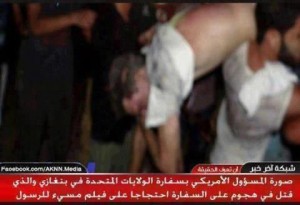
Perhaps the most telling detail was how the attackers treated the Ambassador. His body was only recovered from the wreckage of the compound by people who arrived after the initial assault. The crowd that found him showed no recognition of who he was and no particular interest in his identity. The assailants themselves had focused on seizing documents rather than targeting specific individuals. Stevens was, by all indications, collateral damage in an operation with different goals.
The Outsized CIA Presence in Benghazi
When American personnel were evacuated from Benghazi following the attack, a striking detail emerged: roughly half of them were CIA operatives. While intelligence agencies routinely station officers at diplomatic posts abroad, having Agency personnel constitute fifty percent of a mission’s staff was highly unusual.
The scope of American intelligence activity in Benghazi apparently caught even senior Libyan officials off guard. Deputy Prime Minister Mustafa Abushagour stated publicly that he only became aware of certain sensitive US operations in the city after the attack, largely because an unexpectedly large contingent of Americans arrived at the Benghazi airport seeking evacuation.
Major American newspapers acknowledged cooperating with Obama administration officials to withhold specific locations and operational details of CIA activities in the area, citing concerns about endangering personnel and future operations.
Stolen Documents Suggest the Real Motive
British media reported that the attackers left the compound carrying documents that contained names of Libyan nationals collaborating with American intelligence, along with materials related to oil contracts. This detail strongly suggested that the violent assault may have served primarily as cover for a document theft operation, making the Ambassador’s death an unintended consequence rather than the point of the attack. The organized force showed little interest in looting electronics or other valuables.
The Mystery of the Four American Deaths
A curious discrepancy emerged in how the casualties were reported. Media accounts consistently referenced four American deaths, yet Secretary of State Hillary Clinton initially acknowledged only two: Ambassador Stevens and information management officer Sean Smith. The reason for this selective disclosure became clear when the identities of the other two victims surfaced. They were former Navy SEALs working in contractor roles.
Even after their identities became public knowledge, Clinton addressed only one of their assignments, noting his role providing security for the Ambassador. The other former SEAL had been conducting intelligence work, specifically tracking and destroying MANPADS, which are shoulder-fired anti-aircraft missiles. The United States had effectively allowed these weapons to be used against Muammar Gaddafi’s forces and was now attempting to recover them before they could be turned against Western targets. That type of mission falls squarely within CIA jurisdiction, not State Department responsibility.
Security Contractor Confusion Raised More Questions
The State Department’s own statements about consulate security created additional contradictions. Spokesperson Victoria Nuland initially declared that no private security firm had been contracted in Libya. However, publicly accessible federal procurement records showed a contract for security guards and patrol services dated May 3, valued at $387,413.68, with an extension option bringing the total to $783,000. The contract listed only “foreign security awardees” as the recipient.
The State Department typically handles diplomatic security through its Worldwide Protective Services contract, under which a group of pre-approved firms compete for assignments. The company that received the Benghazi contract was not among the eight firms selected for the most recent version of that agreement. How or why the normal procurement process was bypassed for this particular installation was never adequately explained.
An Ever-Shifting Official Narrative
The US government’s inability to maintain a consistent account of events proved deeply revealing. UN Ambassador Susan Rice was dispatched to multiple television appearances where she insisted the attack was entirely spontaneous, even as White House officials were already distancing themselves from that characterization. Clinton’s selective disclosure of casualty identities and roles added another layer of inconsistency.
Even senior State Department official Patrick Kennedy, who served as Under-Secretary, stated at one point that he believed the assault had been planned, citing its extensive coordination and the heavy weaponry involved.
Media coverage noted that the initial explanations, particularly the claim that a protest outside the consulate at 10 PM preceded the attack, progressively fell apart under scrutiny. Reports indicated no such protest had occurred.
The adversarial relationship between State Department officials and journalists investigating the story further undermined the credibility of the official account. When CNN obtained and reported from Ambassador Stevens’ personal diary, a Clinton aide responded to press inquiries with open hostility rather than substantive answers.
Historical Parallels to Intelligence Document Theft
The apparent use of a violent distraction to facilitate document seizure had at least one notable historical precedent. In 1991, KGB operatives exploited a fire at the US Embassy in Moscow as cover to move through the building collecting sensitive materials.
What the Evidence Ultimately Suggests
When the truth is straightforward, telling it requires no revisions. The repeated shifts in the Benghazi narrative, from the video protest story to the reluctant acknowledgment of intelligence operations, suggested that officials were constructing explanations in real time rather than reporting established facts. The full story of what happened in Benghazi in September 2012 may not emerge for many years, but the available evidence pointed well beyond a simple protest that escalated out of control.
This article draws on reporting and analysis originally published by Peter Van Buren at WeMeantWell.com, with additional sourcing from The New York Times, The Independent, ABC News, BuzzFeed, and Wired.