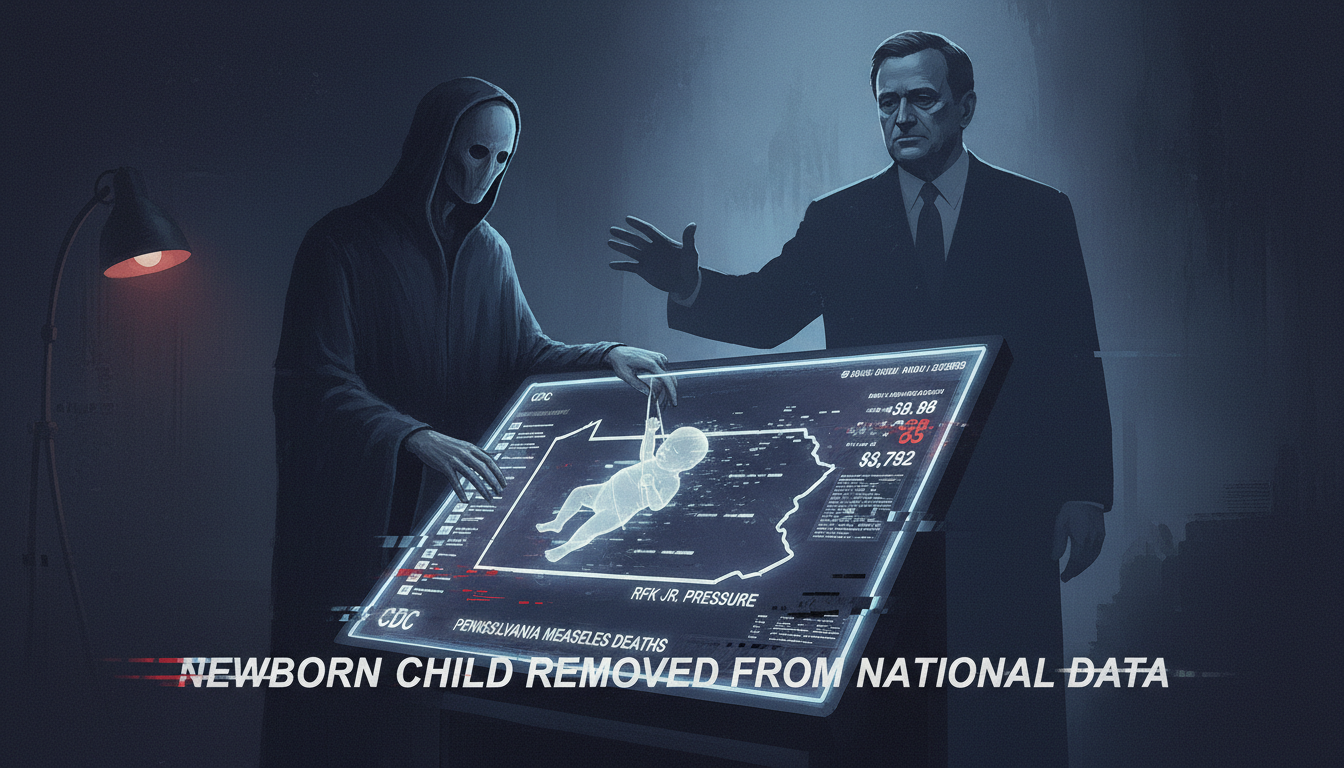
The Centers for Disease Control and Prevention has removed two measles-linked deaths reported by Pennsylvania health officials from its national surveillance data, in what public health experts are describing as an unprecedented break from established protocol. The two victims, a newborn and a child, both unvaccinated residents of Lancaster County, were confirmed dead by Pennsylvania state officials, but the CDC, under its newly installed director, is publicly questioning whether measles actually caused or contributed to their deaths. The sequence of events surrounding this data reversal raises serious questions about political influence over federal public health record-keeping.
What Pennsylvania Reported, and What the CDC Deleted
Pennsylvania health officials confirmed two measles-associated deaths in late August 2026, describing both individuals as unvaccinated residents of Lancaster County, where 185 of Pennsylvania’s 393 measles cases in 2026 had been recorded, according to the British Medical Journal. The state’s announcement marked what the BMJ characterized as the first measles fatalities in Pennsylvania in more than three decades, and the first measles deaths recorded in the United States in 2026. In 2025, there had been three measles-associated deaths, themselves the first since 2015.
State health officials initially declined to release identifying details about the deceased, citing privacy concerns. Details subsequently emerged through investigative reporting: one victim was a newborn, and the other was a child, according to reporting by The New York Times. Both were from Lancaster County and both were unvaccinated.
The CDC’s handling of this data then took a documented and unusual turn. According to reporting by The Washington Post, the agency’s measles surveillance webpage changed at least three times over a single weekend. On August 29, the site listed total measles deaths for 2026 as zero. By August 30 at 12:09 pm ET, the number had been updated to two, accompanied by a note stating that health departments make determinations about measles-associated deaths and share relevant information with the CDC. By 3:23 pm ET that same day, the two deaths had been deleted again, replaced with an asterisk linking to an unusual statement that read, in part: “At this time, available information does not establish whether measles caused or contributed to the deaths or whether the individuals died from other causes while infected with measles.”
The Newborn’s Story: What the Family Says
Investigative reporting by The Atlantic provided critical context about the newborn’s death that federal officials have not publicly addressed. The baby’s parents, who are Amish, were unaware their child’s death had become a subject of national political controversy. They stated without hesitation that they believed their baby died of measles.
According to that reporting, the mother contracted measles during the ongoing local outbreak after several of her other children had already fallen ill. She became severely ill, unable to speak above a whisper and, by her own account, without energy, as she went into labor. The baby boy was born with a pulse but was not breathing. Paramedics attempted resuscitation including oxygen and chest compressions. The newborn was declared dead less than thirty minutes after birth.
Testing confirmed the baby had been born infected with measles. Evidence of measles infection was found in the baby’s lung tissue. The mother had been severely ill with measles at the time of delivery.
The complication cited by the Lancaster County Coroner, Stephen Diamantoni, a ruptured spleen, is itself consistent with severe measles infection. As Ars Technica reported, measles can cause a baby’s spleen to enlarge and the fibrous tissue surrounding it to thin, making it vulnerable to rupture during the trauma of birth. The Coroner, a Republican first elected in 2007, stated that a pathologist determined the newborn died of a ruptured spleen and did not believe measles played a role, a conclusion that stands in tension with the medical understanding of how measles affects neonatal physiology.
The Political Backdrop: RFK Jr., Misinformation, and a Public Feud
The CDC’s data reversal did not occur in a vacuum. It followed a very public confrontation between Health Secretary Robert F. Kennedy Jr. and Pennsylvania Governor Josh Shapiro. After the Pennsylvania Department of Health announced the two deaths, Kennedy shared measles misinformation on social media. He subsequently suggested, without evidence, that the state may have “fabricated” the deaths, and accused the governor of announcing them with “giddy delight,” according to Ars Technica’s reporting.
The New York Times reported that CDC Director Erica Schwartz, less than a month into her tenure, was the person who ordered CDC staff to add the unusual disclaimer onto the agency’s measles surveillance page and to exclude the Pennsylvania deaths from the national count. The decision publicly challenges Pennsylvania’s death determinations, breaking with the established precedent that states, not the CDC, serve as the authoritative arbiters of case and death classification.
Outside medical experts, as noted by Ars Technica, have criticized the limited amount of information provided by health officials at both the state and federal levels. That information vacuum, they warned, creates conditions in which doubt and misinformation can flourish, precisely the environment in which the events of this episode unfolded.
The Scale of the Outbreak
The debate over these two deaths is unfolding against the backdrop of a significant and ongoing national measles resurgence. As of August 27, 2026, 2,903 confirmed measles cases had been reported across the United States in 2026, spread across 47 jurisdictions, according to the CDC’s own surveillance data. Of those, 94 percent, 2,737 cases, were outbreak-associated. Thirty-seven separate outbreaks had been reported in 2026 alone.
For context, 2025 saw 2,289 confirmed cases and 48 outbreaks. In 2024, by comparison, there were just 285 cases and 16 outbreaks. The trajectory represents a sharp upward acceleration across consecutive years.
Pennsylvania’s Lancaster County has been among the hardest-hit areas. The county’s Amish community, which has historically maintained lower vaccination rates, has been at the center of the local outbreak, the same outbreak that the baby’s mother contracted measles from before giving birth.
A Precedent-Breaking Decision with Unanswered Questions
What makes this episode particularly significant from a public health governance standpoint is the structural break it represents. The CDC has traditionally deferred to state health departments on case and death determinations. That division of authority is foundational to how the United States disease surveillance system operates. The CDC’s decision to publicly contradict Pennsylvania’s findings, and to do so in direct response to political pressure from a federal cabinet official who had already spread misinformation about those very deaths, marks a departure without clear precedent in recent public health history.
The sequence of events is documented in the public record: Kennedy questioned the deaths publicly, the CDC’s surveillance page fluctuated over a single weekend, and then a newly appointed CDC director, reportedly at her own direction, ordered those deaths struck from the national count. The baby’s parents, meanwhile, remain certain their son died of measles. The child’s family has not been identified publicly.
Whether the CDC’s unusual disclaimer reflects a legitimate scientific dispute, political accommodation, or something in between is a question that the agency has not publicly resolved. What is documented is that two deaths reported by a state health department have been removed from the federal record at a politically charged moment, and that the national measles death toll for 2026, as currently displayed on the CDC’s website, reads differently than Pennsylvania’s own official accounting.
This article draws on reporting from Ars Technica, the British Medical Journal, and the CDC Measles Cases and Outbreaks surveillance page, as well as referenced reporting from The New York Times, The Washington Post, and The Atlantic.