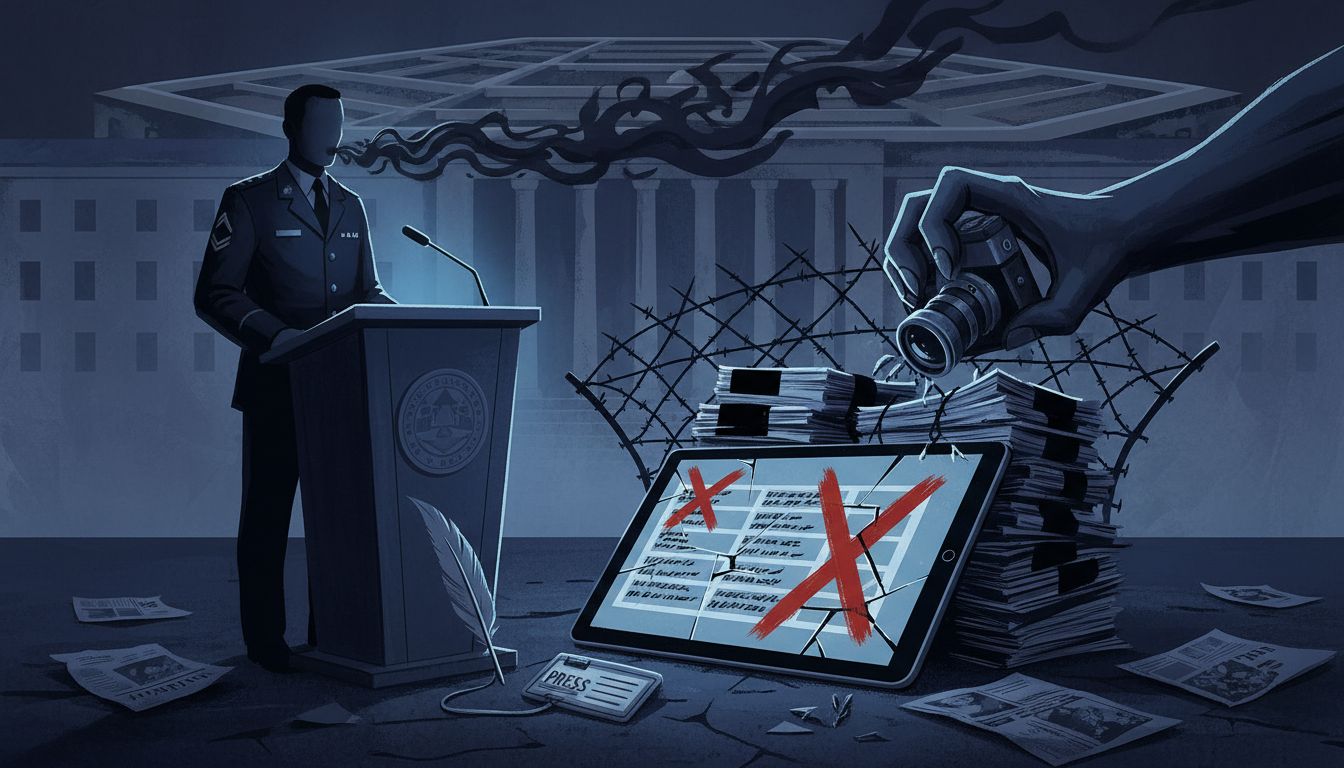
A U.S. Central Command public affairs official has openly confirmed the existence of a secret blacklist of journalists maintained by CENTCOM’s press office, a disclosure that lays bare the extent to which the Pentagon under Secretary Pete Hegseth has moved to systematically suppress independent war reporting. The admission, reported by The Intercept, did not come through a leak or a whistleblower. It came directly, and bluntly, from a CENTCOM official who threatened to add a reporter to the list for calling too many times.
The Blacklist Confirmed
Richard Allee, an executive assistant with CENTCOM public affairs, told an Intercept reporter: “You’ll be put on a list of people to disregard.” When asked to confirm, “You have a list of people to disregard?”, Allee replied with an emphatic “Yes.” When pressed for details on which reporters or outlets were currently on the list, he stated: “I’m not privy to give you that information.” He added that “it’s not a list that we publicize,” before ending the call.
The exchange occurred after the reporter had been left on hold for more than two hours following repeated refusals by CENTCOM’s media operations chief, Maj. Emma Thompson, to answer questions about Iranian attacks on U.S. bases across the Middle East, casualty count discrepancies, and medical evacuation flights. Thompson’s responses included “Nothing for you,” “Don’t have anything for you,” and “No comment,” before she hung up mid-question. After the reporter called back multiple times, Allee picked up and warned: “They’re not going to answer your call if you just keep calling and calling.”
Allee also instructed the reporter to adopt a “less accusatory attitude towards the personnel here,” suggesting this would “go a lot further than badgering them when you don’t get something you want, when you want it.” He then disclosed the blacklist and subsequently hung up as well.
The Context: A War, a Cover-Up, and a Press Under Siege
The blacklist revelation did not emerge in a vacuum. CENTCOM’s refusal to engage with the press has coincided with what The Intercept has described as a failed U.S. war in Iran, alleged cover-ups of American casualty numbers from that conflict, and repeated stonewalling on questions about civilian deaths, including the killing of a family disclosed by The Intercept in August 2026.
The broader pattern of press suppression at the Pentagon has accelerated under Hegseth, who has drawn comparisons between reporters and “Pharisees”, figures in the Bible who challenge established authority. Under his leadership, the Pentagon attempted to impose requirements that reporters sign pledges to only print authorized information, a policy that the Freedom of the Press Foundation characterized as a litmus test for official stenography rather than journalism. Pentagon officials have also publicly hurled insults at reporters on multiple occasions.
According to reporting from Freedom of the Press Foundation, the press corps now covering the Pentagon is composed largely of Trump-aligned outlets such as One America News, Turning Point USA’s Frontlines, and LindellTV, the streaming service of MyPillow CEO Mike Lindell. Independent and mainstream outlets have been effectively squeezed out.
Legal and Constitutional Questions
The blacklist’s existence has drawn an immediate and pointed response from press freedom advocates. Seth Stern, director of advocacy for Freedom of the Press Foundation, stated: “Threatening journalists with placement on a blacklist in retaliation for reporting the government doesn’t like is as unconstitutional as it gets. This should put to rest the Pentagon’s prior claims that its anti-press policies, like its infamous requirement that reporters sign pledges to only print authorized information, are somehow content neutral.”
Stern’s comments point to a critical distinction: the Pentagon has previously framed its press restrictions as procedural or security-driven rather than ideologically motivated. The confirmation of a blacklist, a mechanism for selectively excluding reporters based on the questions they ask, directly undercuts that framing.
A Broader Infrastructure of Suppression
The blacklist is one component of what Freedom of the Press Foundation describes as an “extraordinary” censorship infrastructure surrounding the U.S. war in Iran. The Trump administration’s tools have included grand jury subpoenas and search warrants directed at reporters, strategic lawsuits against public participation (SLAPPs) designed to silence criticism through expensive litigation, and the gutting of public records and Freedom of Information Act compliance mechanisms.
The January 2026 FBI raid on the home of Washington Post reporter Hannah Natanson, connected to an alleged Espionage Act violation by one of her sources, signaled an escalation in the administration’s approach to leaks and newsgathering. Freedom of the Press Foundation noted that the subpoena of journalist Seth Harp, related to his reporting on a military official involved in operations in Venezuela, may foreshadow further legal pressure on war correspondents.
The chilling effects of these measures extend beyond direct suppression. As Freedom of the Press Foundation observed, sources are less likely to come forward when facing the risk of federal investigation, and corporate media owners may moderate their coverage to protect other business interests under government scrutiny.
Military Censorship and the Information Void
The suppression of press access at the institutional level is compounded by broader military censorship dynamics across the Middle East theater. CBC News chief correspondent Adrienne Arsenault, reporting from the region, noted that countries at war have tightened rules around images and reporting, citing operational security concerns such as preventing adversaries from triangulating missile strike locations using live media coverage.
In various countries involved in or adjacent to the conflict, journalists face deportation, loss of press credentials, and in some cases arrest for violations of these rules. The cumulative effect, as Arsenault noted, is that “the longer this war goes on, the harder it’s going to be to get you precision on just what exactly was happening.”
At the U.S. military level, this information void is not simply a byproduct of wartime security necessity, it is, according to the evidence now on record, being actively managed through mechanisms like the CENTCOM journalist blacklist: a tool designed not to protect operational security but to filter out reporters who ask inconvenient questions.
What the Blacklist Represents
The significance of Allee’s admission is difficult to overstate. A government press office maintaining a secret list of journalists to “disregard”, and threatening to add reporters to it for persistent questioning, is not a bureaucratic quirk. It is an institutionalized mechanism for controlling information flow during an active military conflict, confirmed on the record by the institution itself.
CENTCOM did not deny the list’s existence when given the opportunity. It confirmed it, defended the practice implicitly by framing the reporter’s conduct as the problem, and declined to disclose who is on it. The public, whose tax dollars fund CENTCOM operations and whose family members serve in the military conducting those operations, has no way of knowing which journalists have been deemed unworthy of responses, or why.
As the Freedom of the Press Foundation’s Stern made clear, the constitutional question is not ambiguous. Retaliating against journalists for their reporting by placing them on a government blacklist is, in his words, “as unconstitutional as it gets.”
This article draws on reporting from The Intercept, Freedom of the Press Foundation, and CBC News: The National.