
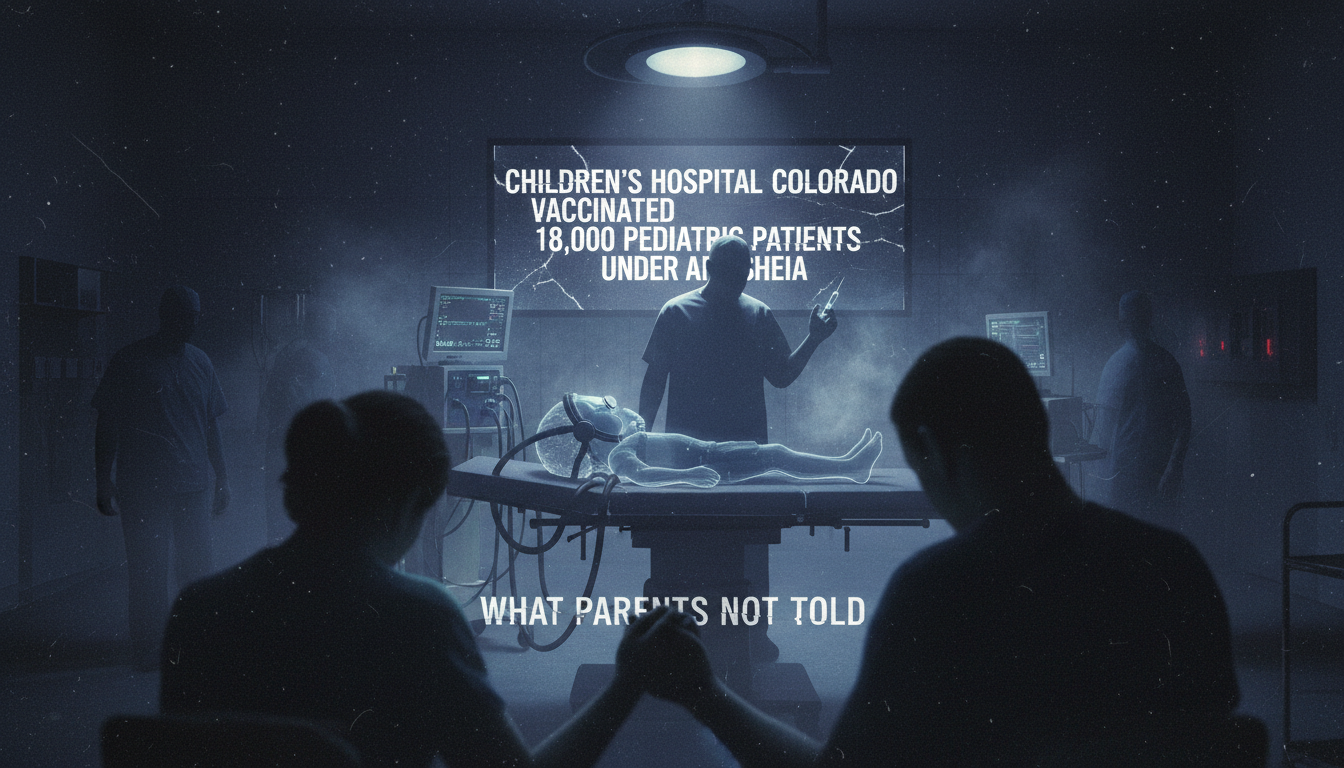
A March 2026 publication in the American Academy of Pediatrics journal documented a program at Children’s Hospital Colorado in which more than 18,000 pediatric patients received vaccines while under deep sedation or general anesthesia during surgical procedures. The program ran from 2020 through early 2026 and was described by anesthesiologists Drs. Caroline A. Pasquariello and Kim M. Strupp. The publication did not detail what parents were told about the specific risks of vaccinating a child while unconscious, nor did it address how that disclosure was documented.
What the Program Involved
The Colorado program focused primarily on children with neurocognitive conditions who could not tolerate awake vaccinations. Administering vaccines during a scheduled surgical procedure was presented as a practical solution for a genuinely difficult clinical population. A parallel program at Children’s Hospital of Philadelphia vaccinated 2,054 children with flu shots during the 2025 to 2026 season and is now exploring expansion to COVID-19 and RSV vaccines.
The scale of the Colorado program, more than 18,000 children over roughly six years, makes it one of the largest documented instances of vaccination under anesthesia in the United States. Despite that scale, the American Academy of Pediatrics publication did not specify what written disclosures parents received regarding the particular risks that arise when vaccines are given alongside surgical anesthesia.
The Informed Consent Problem
Informed consent in medicine requires that a patient or guardian receive complete, understandable information about a procedure’s risks and benefits before agreeing to it. For parents of children undergoing surgery, the preoperative window is already filled with competing demands: fasting instructions, anesthesia risk disclosures, surgical consent forms, and the visible distress of a child who cannot eat and does not understand what is about to happen.
Dr. Paul Thomas has stated publicly that informed consent requires physicians to understand the full risks and benefits of any medical intervention they are recommending. When a physician lacks knowledge about potential links between vaccines and conditions such as allergies, eczema, or neurological changes, Thomas argues, the patient’s guardian cannot give true consent because the information provided is incomplete.
The AAP publication does not resolve this question. It describes the program and its patient numbers but does not reproduce consent language, describe how vaccine risks were communicated separately from surgical risks, or report whether parents were given the option to defer vaccination to a later outpatient visit.
Diagnostic Confusion After the Procedure
A distinct clinical concern, documented in peer-reviewed literature, is that vaccine reactions can resemble surgical complications. A 2007 review published in Pediatric Anesthesia found that inflammatory responses and fever following vaccination may interfere with post-operative assessment. The authors of that review recommended delaying elective surgery for two days after inactivated vaccines and 14 to 21 days after live vaccines, specifically to prevent vaccine adverse events from being misread as surgical complications.
When vaccines are given during surgery rather than before it, that separation disappears entirely. A fever in the recovery room, an unusual inflammatory response, or a change in neurological status could originate from the anesthesia, the surgical procedure itself, or a vaccine reaction. Clinicians would be working without a clear baseline to distinguish among those causes.
This is not a theoretical concern. Children with neurocognitive conditions, the population these programs specifically targeted, may already have altered baselines for fever, irritability, and neurological presentation. Separating a post-surgical complication from a vaccine reaction in that population is harder, not easier, than it would be in a neurotypical child.
How Consent Was Collected and What Was Missing
The research material from the AAP publication does not describe the consent process in detail. Parents arriving for their child’s surgery face a compressed timeline. They review and sign multiple documents, often in a preoperative holding area, while managing a hungry and anxious child. Hospital staff presenting vaccine discussions in that environment are doing so at a moment of considerable psychological pressure.
The absence of documentation about what risks were specifically disclosed for the anesthesia-plus-vaccination combination is the core gap. Standard surgical consent covers the risks of the procedure being performed. Standard vaccine consent, when it occurs in a clinic, covers the risks of that specific vaccine. When both happen simultaneously, the question is whether the overlap and the specific interaction risks were addressed in writing and whether parents had time to consider and decline.
The AAP publication does not answer that question.
The Philadelphia Program and Planned Expansion
Children’s Hospital of Philadelphia ran a comparable but smaller program, vaccinating 2,054 children with flu vaccines during surgical sedation in the 2025 to 2026 flu season. Philadelphia’s program is now considering expansion to include COVID-19 and RSV vaccines administered the same way.
That expansion would significantly increase the number of children receiving multiple vaccines while unconscious during a single operative event. The clinical rationale, reaching children who cannot otherwise be vaccinated in a standard outpatient setting, remains consistent. The consent and diagnostic-confusion questions remain unanswered.
Legal and Ethical Background
California’s SB-866, introduced in January 2022, addressed a related but distinct issue: whether minors aged 12 and older could consent to vaccines without parental knowledge. That bill died on the inactive file in November 2022 after passing the full Assembly. The bill’s legislative history shows it passed the Assembly 38 to 22 before being ordered to the inactive file at the request of Assembly Member Santiago.
SB-866 did not address vaccination under anesthesia. Its trajectory does illustrate the ongoing tension in American law over who holds decision-making authority when it comes to vaccines administered to minors, a tension the Colorado and Philadelphia programs bring into sharper relief because the children involved were unconscious and entirely dependent on whatever agreements adults had reached beforehand.
What Remains Open
Three questions the available documentation does not resolve: whether parents were told about the specific risk that vaccine reactions might complicate post-operative assessment; whether parents were offered a clear option to defer vaccination to a separate appointment; and whether adverse events recorded in the recovery room were systematically reviewed to determine if any originated from the vaccines rather than the surgery.
The 2007 Pediatric Anesthesia review recommended against combining elective surgery with vaccination precisely because of the diagnostic confusion it creates. The Colorado program ran for six years and covered more than 18,000 children. Whether any adverse events during those recoveries were attributed to the wrong cause is a question the AAP publication does not address. That gap is worth watching as the Philadelphia program considers expanding its scope.
This article draws on reporting from Activist Post and bill records from the California Legislative Information portal.
How many children were vaccinated under anesthesia at Children’s Hospital Colorado?
More than 18,000 pediatric patients received vaccines while under deep sedation or general anesthesia during surgical procedures at Children’s Hospital Colorado between 2020 and early 2026, according to a March 2026 publication in the American Academy of Pediatrics journal.
Can vaccine reactions be mistaken for surgical complications after anesthesia?
Yes. A 2007 review in Pediatric Anesthesia found that fever and inflammatory responses from vaccines can interfere with post-operative assessment, and recommended delaying elective surgery for at least two days after inactivated vaccines to avoid misattributing vaccine reactions as surgical complications.
Did parents give informed consent for vaccines given during surgery?
The AAP publication documents the program’s patient numbers but does not reproduce consent language, describe how vaccine-specific risks were communicated apart from surgical risks, or confirm whether parents were offered the option to defer vaccination to a later outpatient visit.
Want to go deeper? Ask NEX, the Decrypted Matrix research assistant, about the documents behind this story. It indexes every article here the day it is published and cites its sources.