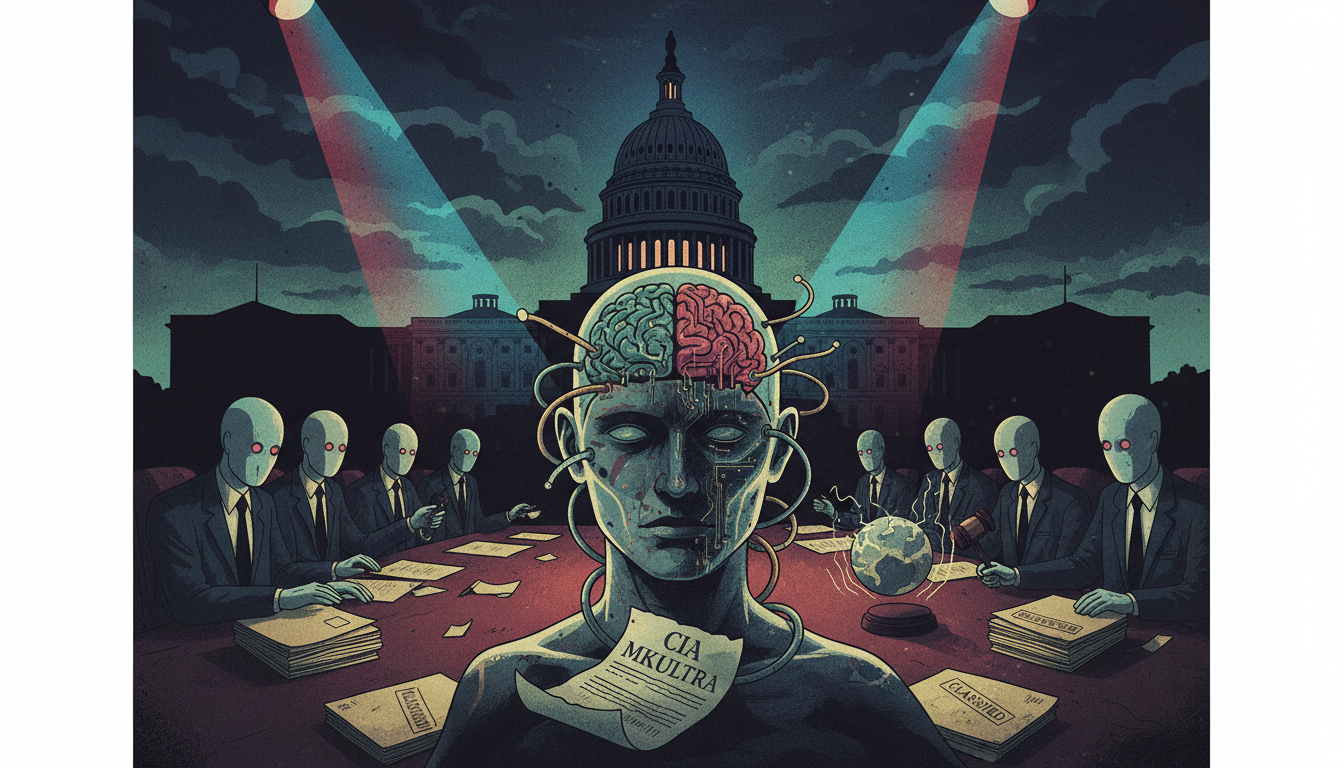
For more than half a century, the full truth of the CIA’s MKULTRA program has remained buried beneath destroyed files, unpunished officials, and decades of institutional silence. On June 30, 2026, a congressional task force convened to reopen one of American intelligence history’s most disturbing chapters, a covert program in which the CIA subjected American citizens, prisoners, hospital patients, and veterans to LSD, electroshock, hypnosis, and sensory deprivation without their knowledge or consent. The hearing, titled “Mind Control and Accountability: Uncovering the Truth of the CIA’s MKULTRA Project,” offered renewed promises of transparency. Whether those promises will be honored remains an open question with a troubling historical precedent.
A Program Built on Systematic Deception
MKULTRA was not an isolated experiment gone wrong. According to documents reviewed by the Congressional Task Force on the Declassification of Federal Secrets, the program comprised at least 149 subprojects, operated across more than 80 institutions, and involved 185 non-government researchers. The CIA covertly contributed $375,000 to a hospital research wing, approved directly by then-Director of Central Intelligence Allen Dulles with Richard Helms’s concurrence, to conduct experiments on unwitting subjects. Georgetown University Hospital served as one such institutional “cut-out” for the program.
Internal CIA documents, many of which only survived because an archivist discovered seven misfiled boxes during a Freedom of Information Act review in 1977, reveal the scope of what the agency’s Technical Services Staff was pursuing. Records indicate researchers were developing substances to “promote illogical thinking and impulsiveness,” materials that could “alter personality structure,” methods for “physical disablement,” and a so-called “knockout pill” for undercover drugging. The program also explored ways to produce symptoms of diseases “in a reversible way” and sought techniques for inducing “physical methods of producing shock and confusion.”
CIA operative Sidney Gottlieb, the program’s primary architect, later confirmed in depositions that approximately 40 unwitting tests were conducted by federal narcotics agent George White in CIA safehouses, designed to “explore the full range of the operational use of LSD,” including for interrogation purposes and to “provoke erratic behavior.”
The Bonfire of Evidence
What makes the MKULTRA case particularly egregious in the historical record is not only what was done, but what was deliberately erased afterward. Task Force Chairwoman Anna Paulina Luna laid out the documented chain of destruction in her opening statement before Congress.
In January 1973, as CIA Director Richard Helms prepared to leave office, he personally ordered the destruction of MKULTRA records. An internal CIA document states plainly: “Over my stated objectives, the MKULTRA files were destroyed by the order of DCI.” A separate internal account confirms that Helms telephoned Gottlieb directly and instructed him to destroy “all files pertaining to drug research and associated activities.” Four people spent an entire day tearing and burning 152 files. Gottlieb then had his personal papers destroyed by his secretary before his retirement. The head of the CIA’s own records center formally protested the destruction in writing, and was overruled.
The legal consequences for this destruction were effectively nonexistent. Helms received a $2,000 fine for lying to Congress about an unrelated matter and collected his government pension until his death. Gottlieb retired to rural Virginia. Neither man was ever charged with the destruction of federal records or faced criminal accountability for the program itself.
“That is obstruction of justice. That is criminal destruction of federal records,” Luna stated before the task force. “No one went to prison. No victim was ever formally compensated by the government.”
What Survived the Purge
The seven boxes of financial records discovered by accident in 1977 became the foundation for nearly everything the public knows about MKULTRA’s true scope. Without them, as Luna noted, “the vast majority of MKULTRA would only be a rumor”, precisely the outcome Helms and Gottlieb had intended.
In December 2024, the National Security Archive and ProQuest published a new collection of over 1,200 documents detailing the program, announced fifty years after Seymour Hersh’s original New York Times investigation and seventy years after Eli Lilly & Company became the CIA’s primary source of LSD. The collection, titled “CIA and the Behavioral Sciences: Mind Control, Drug Experiments and MKULTRA”, is largely composed of FOIA documents previously compiled by former State Department official John Marks and includes records from Operations MKULTRA, BLUEBIRD, and ARTICHOKE.
Among the documents: a CIA Security Office memo detailing the process for drugging and hypnotizing subjects, including inducing “a complete hypnotic trance,” in the context of interrogating suspected Russian agents under Project ARTICHOKE. Legal depositions by Gottlieb were also released, including testimony given to attorneys representing Velma Orlikow, a patient of the Allan Memorial Institute in Canada, a facility where Dr. Ewen Cameron experimented on psychiatric patients in the 1950s and 60s with partial CIA funding.
Congress Has Been Here Before
The June 30 hearing was not the first time Congress gathered to confront MKULTRA. By 1975, the Church Committee and the Rockefeller Commission had already established through sworn testimony and a surviving 1963 Inspector General report that MKULTRA existed and that the CIA had run a program of human experimentation on unwitting Americans. A joint Senate hearing followed in August 1977, featuring testimony from then-CIA Director Stansfield Turner.
The promises made during those earlier hearings, full disclosure, victim identification, accountability, were never fulfilled. Author Tom O’Neill, whose research into the CIA’s Cold War programs was cited at the 2026 hearing, reminded lawmakers that they were retracing a path Congress had already walked without completing.
The National Security Archive, while welcoming transparency efforts, noted ahead of the hearing that the task force risked conflating documented historical abuses with unsubstantiated contemporary claims. Analysts at the Archive emphasized that the genuine and enduring secrets of MKULTRA, the identities of victims, the full list of subproject participants, the fates of those experimented upon, remain the proper focus of any serious declassification effort.
Victims Without Names, Crimes Without Punishment
One of the most haunting dimensions of the MKULTRA record is the absence of a complete victim roster. Because so many records were deliberately destroyed, the full human cost of the program has never been calculated. Luna’s opening statement acknowledged this directly: “The victims and their families deserve acknowledgment, accountability, and justice.”
Some researchers have examined individual cases that may intersect with the program’s activities. The case of Jimmy Shaver, a decorated US Air Force serviceman who, with no prior history of violence, was convicted of the rape and murder of a three-year-old girl near San Antonio, Texas, and who reportedly appeared to be in a trance when found, later failing to recognize his own wife in jail, and who maintained until his execution that he had no memory of the crime, has been cited by some researchers as potentially connected to CIA experimentation during this period, though no definitive documentary link has been established.
What the documented record does establish is that the CIA ran a decades-long program of non-consensual human experimentation on American soil, funded by taxpayer dollars, authorized at the highest levels of the intelligence apparatus, and then deliberately concealed through the criminal destruction of evidence. More than sixty years after the program officially ended, the complete accounting that victims and their families were promised has still not arrived.
Whether the 2026 congressional hearing marks a genuine turning point, or another chapter in a long pattern of incomplete reckoning, remains to be seen.
This article draws on reporting from RT News, the House Committee on Oversight, the National Security Archive at George Washington University, the U.S. Senate Select Committee on Intelligence (1977 hearing transcript), and the Daily Caller via the National Security Archive.