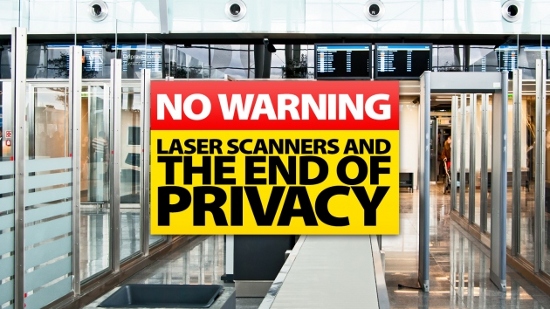
In the near future, the U.S. Department of Homeland Security could gain the ability to learn virtually everything about your physical person — your clothing, your belongings, even your recent meals — using an advanced laser-based molecular scanner that operates from as far as 50 meters (164 feet) away. Traces of narcotics, residue from firearms, stress hormones coursing through your bloodstream — all of it detectable without any physical contact.
And you would never even realize it was happening.
CIA-Linked Firm In-Q-Tel Partners With Laser Startup
The scanning system proved so promising that by November 2011, its creators were brought on board through In-Q-Tel, the venture capital arm originally established in February 1999 at the behest of the CIA director with congressional backing. In-Q-Tel describes its role as bridging the gap between intelligence agencies and emerging technology firms. Through this partnership, the plan called for deploying molecular-level scanning systems at airports and border checkpoints across the country. The stated objective was rapid identification of explosive materials, hazardous chemicals, and biological threats at a safe distance.
What makes this system particularly alarming is its sheer capability. It operates roughly ten million times faster and one million times more sensitively than anything previously available. That level of performance means it could feasibly scan every single traveler passing through security — not just flagged individuals or random selections.
Genia Photonics: The Company Behind the Molecular Scanner
The device can detect far more than weapons-grade materials. Genia Photonics, the Montreal-based company that developed the technology, stated that its laser scanning platform can see through clothing and numerous organic materials while providing detailed spectroscopic data — particularly useful for identifying explosives and pharmaceutical compounds.
Founded in 2009 by a team of PhD researchers specializing in laser technology and fiber optics, Genia Photonics held 30 patents related to this platform. The company touted applications spanning from real-time cancer cell detection during medical scans to identifying microscopic quantities of dangerous chemicals in industrial settings.
In-Q-Tel highlighted a key advantage of the Genia system: the entire synchronized laser apparatus fits into a single, portable, alignment-free unit suitable for deployment across diverse environments. The laser can rapidly cycle through wavelengths in any desired pattern or sequence, making it extraordinarily versatile.
The portability factor is what makes this truly unsettling. Deployment would not be limited to airports. Subway stations, intersections, stadiums, public gatherings — virtually any location becomes a potential scanning point.
How Picosecond Laser Scanning Technology Works
The system is a mobile, rack-mountable unit that fires laser pulses to generate molecular-level data at distances up to 50 meters in mere picoseconds — effectively instantaneous. Connected to a computer running real-time analysis software, it can detect everything from cocaine residue on currency to gunpowder traces on footwear. Attempting to carry even a sealed water bottle past this system would be pointless — operators could determine your last meal while you stroll down a corridor.
The underlying science is not entirely new. In 2008, researchers at George Washington University built a laser spectrometer using a different method that could identify drug metabolites in urine within a second, detect explosive traces on paper money, and observe chemical processes in plant tissue. Russian scientists announced a comparable system in April of the same period, claiming their laser sensor could isolate a single molecule among a million at distances up to 50 meters.
What Genia Photonics brought to the table was a massive leap in speed, miniaturization, and practical usability — with far-reaching consequences for civil liberties.
Privacy Rights and Fourth Amendment Concerns
At the time of the technology’s announcement, virtually no public discourse had taken place regarding privacy implications. Critical questions remained unanswered. Which molecular signatures would authorities target? Who would establish those parameters? What detection thresholds would trigger law enforcement action? If an innocent person inadvertently picked up a microscopic cannabis particle on their shoe — similar to a traveler who was jailed in Dubai over a speck of cannabis weighing less than a grain of sugar — would that be grounds for arrest?
The portability of the system raised even more troubling scenarios. Would police cruisers be outfitted with these scanners, enabling officers to identify pedestrians with elevated adrenaline levels as potential threats? Would vehicles be scanned at traffic signals for any suspicious molecular signature? And critically — would all of this biometric and chemical data be stored permanently in government databases?
Mass Molecular Surveillance Could Arrive at U.S. Airports
According to the DHS undersecretary for science and technology at the time, the scanning platform was projected to reach operational readiness within one to two years, meaning deployment at airports could have begun as early as 2013.
The practical reality of this technology means that cascading laser beams could sweep across every traveler’s body during routine movements through an airport terminal — walking between gates, visiting a restroom, stopping at a vending machine — all while generating and storing a comprehensive molecular profile without consent or awareness.
The medical potential of such scanning technology is genuinely revolutionary for diagnostic purposes, and any alternative to invasive physical pat-downs carries obvious appeal. However, the surveillance applications demand serious public scrutiny. The capacity for warrantless molecular profiling of entire populations goes well beyond traditional eavesdropping, GPS tracking, or even full-body imaging — and that conversation needed to happen before deployment, not after.
This article covers developments originally reported by Gizmodo in 2012 regarding DHS molecular scanning technology developed by Genia Photonics in partnership with In-Q-Tel.