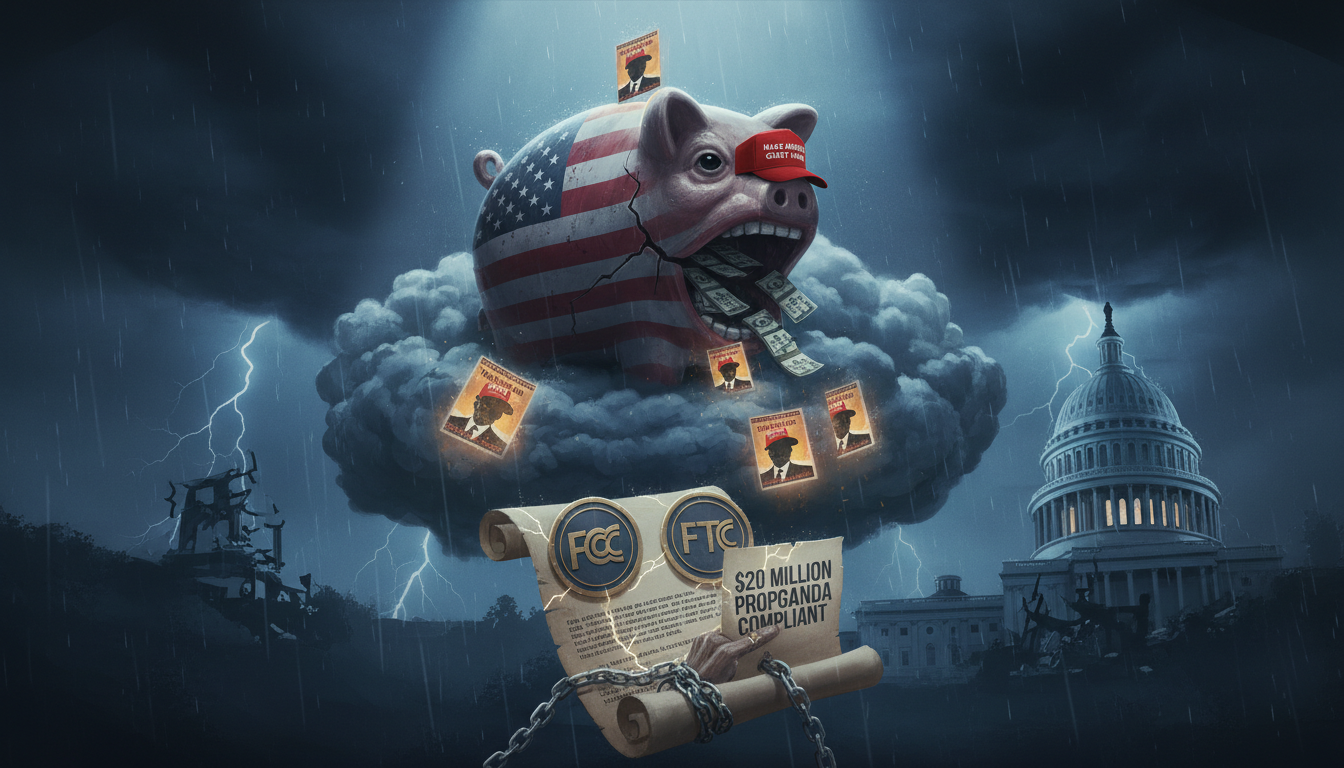
A nonprofit advocacy group has formally petitioned federal regulators to halt the broadcast of White House advertisements that critics, including members of both parties, say constitute illegal government propaganda funded by American taxpayers. The ads, which bear striking resemblance to Donald Trump’s 2024 campaign commercials, are being aired during prime-time television slots and NFL broadcasts, stamped with a single distinguishing notice: “Paid for by the US Government.”
The Ads: Campaign Material Repurposed with a Government Label
Three advertisements have drawn the most scrutiny. The first, titled “The Final Battle,” presents black-and-white footage of Trump marching down a corridor while his voice declares: “This is the final battle. With you at my side, we will demolish the deep state. We will expel the warmongers from our government.” The ad continues: “We will cast out the communists, Marxists, and fascists. We will throw off the sick political class that hates our country, we will rout the fake news media, and we will liberate America from these villains once and for all.”
According to Public Citizen, the consumer advocacy organization founded by Ralph Nader in 1971, this ad is nearly identical to one Trump’s campaign committee aired in 2024, with the sole material difference being the funding disclosure. The 2024 version was paid for by Trump’s campaign. The 2026 version is paid for by the US government.
A second ad shows images of Trump at various events while a choir sings “Love Me” in the background, with Trump declaring “America will never be a communist country.” A third features footage of Mount Rushmore and Trump proclaiming that “the United States of America is the most successful, most accomplished, most exceptional nation ever to exist in human history.”
The White House has labeled these productions “public service announcements” and established a dedicated web page defending their use. Legal experts and political observers across the spectrum have challenged that characterization, noting that unlike traditional government PSAs, these ads are not designed to help Americans access any specific federal program.
Where Did the $20 Million Come From?
The Wall Street Journal first reported that Department of Homeland Security funds were used to finance the ads, and that President Trump personally pushed for them and was involved in their creation. NBC News confirmed that the funding was drawn from money appropriated for US Customs and Border Protection.
Senate Democrats placed the total figure at $20 million. In a letter addressed to Homeland Security Secretary Markwayne Mullin, Senators Patty Murray of Washington, the top Democrat on the Senate Appropriations Committee, and Chris Murphy of Connecticut wrote: “We should not have to remind you that using government funding to create or air political ads like the ones that have been running over the last few days is illegal and a shockingly corrupt misuse of taxpayer dollars.”
The senators said the money was drawn from Trump’s “One Big Beautiful Bill,” the legislation Republicans passed along party lines in 2025, where funds had been allocated specifically for CBP commemorative events related to border security. Analytics firm AdImpact estimated that over $1.7 million in federal funds had already been spent simply on airing the ads at the time of the letter’s writing, with more broadcasts planned.
Axios reported that more ads are forthcoming, with Trump personally selecting which ones to deploy during the lead-up to November’s midterm elections, elections which most polls suggest Republicans are on course to lose.
Public Citizen’s Complaint: Which Laws Are Allegedly Being Broken?
Public Citizen filed formal complaints with both the Federal Communications Commission and the Federal Trade Commission, urging both agencies to direct broadcasters to cease airing the advertisements. The group cited two categories of legal violations.
First, federal law explicitly prohibits using congressionally appropriated funds for government propaganda or partisan political advertising, a prohibition that critics say these ads directly transgress. Second, the ads allegedly run afoul of laws restricting political activity by federal government employees and government entities.
“Federal law explicitly prohibits using appropriated public funds for government propaganda, self-aggrandizement, or partisan political advertising,” Public Citizen wrote. “Yet, that is exactly the nature of Trump’s recent campaign ads.”
The group characterized the advertisements as being “designed to boost the image and character of Donald Trump” as part of the Republican Party’s campaign strategy heading into November’s midterms. Notably, while broadcast stations cannot reject ads from legally qualified political candidates, Trump is not technically a candidate in 2026, though he has urged Republican voters to “imagine” that he is on the ballot.
Bipartisan Criticism Meets a Captured Regulatory Landscape
Criticism of the ads has crossed party lines, which is notable in the current political environment. Senate Majority Leader John Thune, a Republican from South Dakota, told reporters of the most recent ad: “It’s a great message. I like the message, but it shouldn’t be paid for with taxpayer dollars.” Senator Susan Collins of Maine publicly confirmed that the funds were diverted from CBP appropriations.
Senate Minority Leader Chuck Schumer stated that only Trump would have “the audacity to force Americans not only to watch his propaganda, but to pay for it.”
However, the regulatory bodies petitioned by Public Citizen are unlikely to act against the administration’s interests. FCC Chairman Brendan Carr has a documented history of targeting broadcasters that have drawn Trump’s displeasure. Both Carr and FTC Chairman Andrew Ferguson have aligned themselves with Trump’s expansion of executive authority over nominally independent agencies. Ars Technica noted that Carr is more likely to threaten the licenses of broadcasters that refuse to run the ads than to order any halt to their broadcast.
This creates a chilling dynamic for the television industry. Broadcasters that might otherwise decline to air the advertisements face potential FCC retaliation. ABC’s parent company Disney, for instance, is already engaged in a legal fight against an ongoing FCC proceeding that could affect its operating licenses, a fact that illustrates the leverage the current FCC leadership holds over the media landscape.
The Broader Pattern: Government Messaging or Political Electioneering?
The core legal and democratic question at the heart of this controversy is the distinction between legitimate government communication and state-funded political advertising. Traditional public service announcements from administrations of both parties have directed citizens toward specific programs, healthcare enrollment, disaster preparedness, public safety information. They serve an identifiable public function.
Legal experts and critics argue these Trump ads serve no such function. They do not point viewers to a government service or program. They do not convey actionable public information. They present the sitting president in a heroic light, using imagery and rhetoric drawn directly from his own political campaign, with the only modification being who is paying the bill.
The ads ran during NBC’s Saturday Night Live, Fox News Sunday, and multiple college and NFL football games, high-viewership slots chosen for maximum public reach, not for audiences most in need of government information. An administration official told Axios: “This is just the beginning,” adding that the ads are being produced inside the White House itself.
What Comes Next
The senators’ letter demanded a response from DHS Secretary Mullin within 48 hours. At the time of publication, neither the FCC nor the FTC had publicly responded to Public Citizen’s complaint. Ars Technica reported it had contacted both agencies and would update upon receiving comment.
With midterm elections approaching, the pressure to resolve the legal questions surrounding these advertisements is mounting. Whether any regulatory body with the authority to act will choose to do so, given the current alignment of federal agency leadership, remains an open question that observers across the political spectrum are watching closely.
This article draws on reporting from Ars Technica, PBS NewsHour / Associated Press, NBC News, and The Guardian.
What laws do the Trump government ads allegedly violate?
Federal law prohibits using congressionally appropriated funds for government propaganda or partisan political advertising. Critics also say the ads violate laws restricting political activity by federal government entities.
Where did the money for the Trump TV ads come from?
The Department of Homeland Security used approximately $20 million in funds originally appropriated for US Customs and Border Protection through Trump’s ‘One Big Beautiful Bill’ legislation to pay for the ads.
What is the difference between the 2024 Trump campaign ad and the 2026 government ad?
The ‘Final Battle’ ad uses the same video and audio as a 2024 Trump campaign ad, with the only material difference being that the 2026 version displays ‘Paid for by the US Government’ instead of a campaign committee disclosure.
Want to go deeper? Ask NEX, the Decrypted Matrix research assistant, about the documents behind this story. It indexes every article here the day it is published and cites its sources.