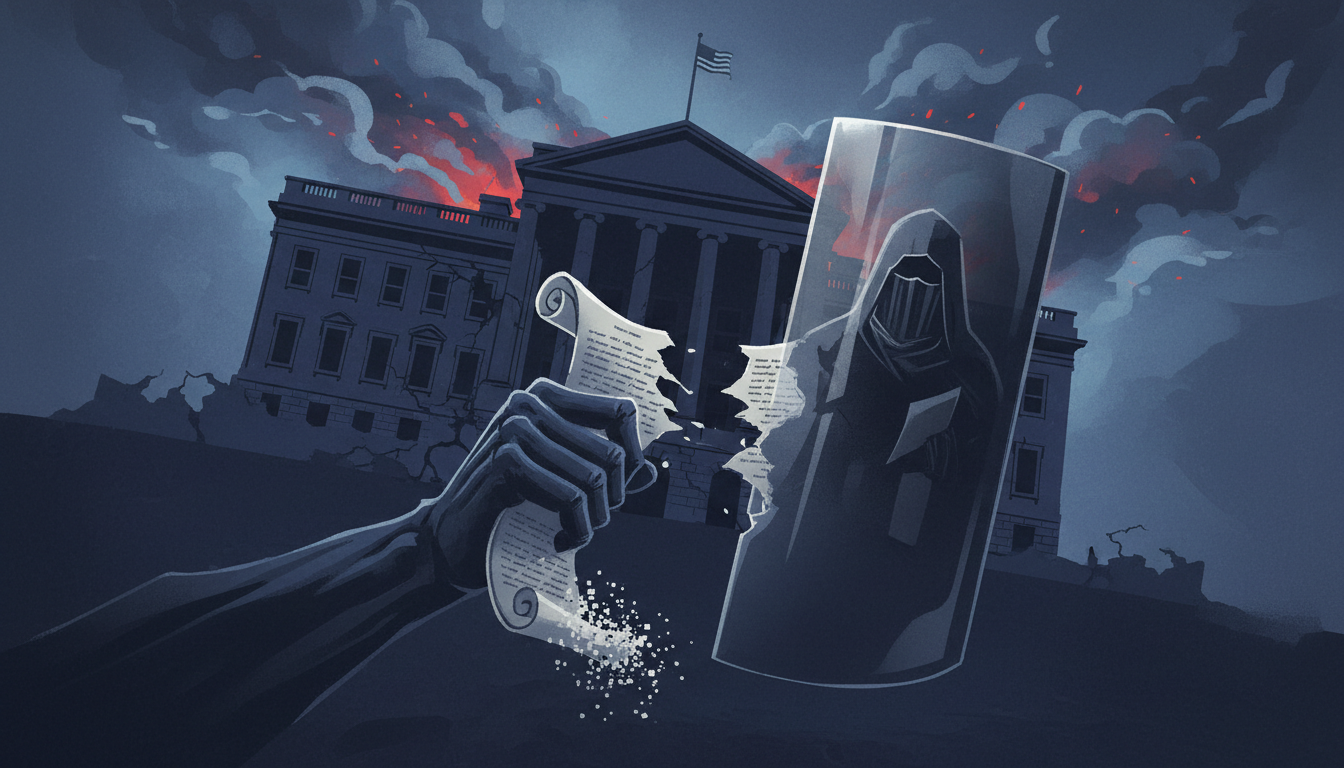
The Department of Justice has delivered a sweeping legal opinion that could fundamentally alter presidential transparency, declaring the Presidential Records Act unconstitutional and arguing that presidential documents are private property rather than public records. This radical reinterpretation of executive power threatens to undo nearly five decades of government accountability measures established in the wake of Watergate.
Watergate-Era Transparency Law Under Attack
The Presidential Records Act, enacted in 1978 following the Nixon administration’s abuses, established that records from every president since Ronald Reagan belong to the American people and must be transferred to the National Archives and Records Administration at the end of each term. The law mandates that these documents become subject to Freedom of Information Act requests five years after a president leaves office.
According to the Justice Department’s Office of Legal Counsel memorandum, this foundational transparency law violates constitutional principles of executive power. The opinion grants President Trump, and all future presidents, what critics describe as “a license to steal American history” by treating official White House communications as personal property.
Immediate Impact on Historical Access
The timing of the DOJ opinion creates immediate practical consequences. More than 78,000 pages of records from President Bill Clinton’s administration were scheduled for public release, including details on federal court nominees, foreign investment reviews, and the Bosnia conflict. Archives personnel, who rely on the Presidential Records Act daily to review and release documents, now face legal uncertainty about their established procedures.
Jason R. Baron, former litigation director for the National Archives, warns that if applied retroactively, the opinion “might see NARA being forced to declare that records of past administrations covered by the PRA should always have been considered ‘personal’ in nature.” This interpretation could block access to more than 700 million White House emails currently held by the Archives.
Legal Challenges Mount Against DOJ Position
The American Historical Association, in collaboration with American Oversight, has filed a federal lawsuit challenging the Justice Department’s memorandum. The complaint argues that the DOJ opinion “relies on virtually no judicial authority and defies binding Supreme Court precedent outright, representing a radical attempt to nullify a law that has governed presidential records for nearly half a century.”
Dr. Sarah Weicksel, executive director of the American Historical Association, emphasizes the historical significance: “Presidential records are essential for transparency and accountability in our democracy; they are also essential sources for researching and understanding the American past. Those records and the history they tell belong not to any individual, but to the American people.”
Pattern of Records Destruction
The current legal challenge follows a documented pattern of presidential records issues during Trump’s previous term. Reports from 2018 revealed Trump’s “enduring habit” of tearing up official documents, requiring White House staff to retrieve pieces and tape them back together. In some instances, documents were reportedly torn “into pieces so small they looked like confetti.”
This destruction of records violated the Presidential Records Act’s requirement that the White House preserve all presidential communications for transfer to the National Archives. The pattern continued through Trump’s classified documents case, where hundreds of government documents were retained at Mar-a-Lago after his presidency ended.
Broader Implications for Executive Power
Legal experts warn that the Justice Department’s position represents more than a records dispute—it reflects “a broader push to concentrate power in the presidency, at the expense of the public’s right to know.” Chioma Chukwu, Executive Director of American Oversight, argues that “the White House does not get to decide what is preserved, what is hidden, or what is destroyed.”
The opinion’s impact extends beyond current records to the established framework for releasing documents from prior administrations. Since Office of Legal Counsel opinions are typically binding throughout the executive branch, archivists who have followed the same legal procedures for decades now face institutional uncertainty.
Historical Context and Democratic Accountability
The Presidential Records Act has enabled public access to crucial historical insights, from President Obama’s Iran nuclear negotiations to the Bush administration’s Hurricane Katrina response and Supreme Court nomination processes for justices including Sonia Sotomayor and Brett Kavanaugh. These records provide essential documentation for understanding presidential decision-making and ensuring democratic accountability.
The American Historical Association’s lawsuit emphasizes that presidential records serve as “materials which historians must use in order to ascertain the truth.” Without access to these documents, future researchers and the public lose critical insights into how major policy decisions were made and whether officials acted in the national interest.
The Justice Department’s constitutional challenge to presidential records transparency represents a fundamental shift away from post-Watergate reforms designed to prevent executive abuse. As legal challenges proceed, the outcome will determine whether presidential communications remain part of the public record or become private property controlled by individual presidents.
This article draws on reporting from The Intercept, American Historical Association, Politico, and MSNBC.