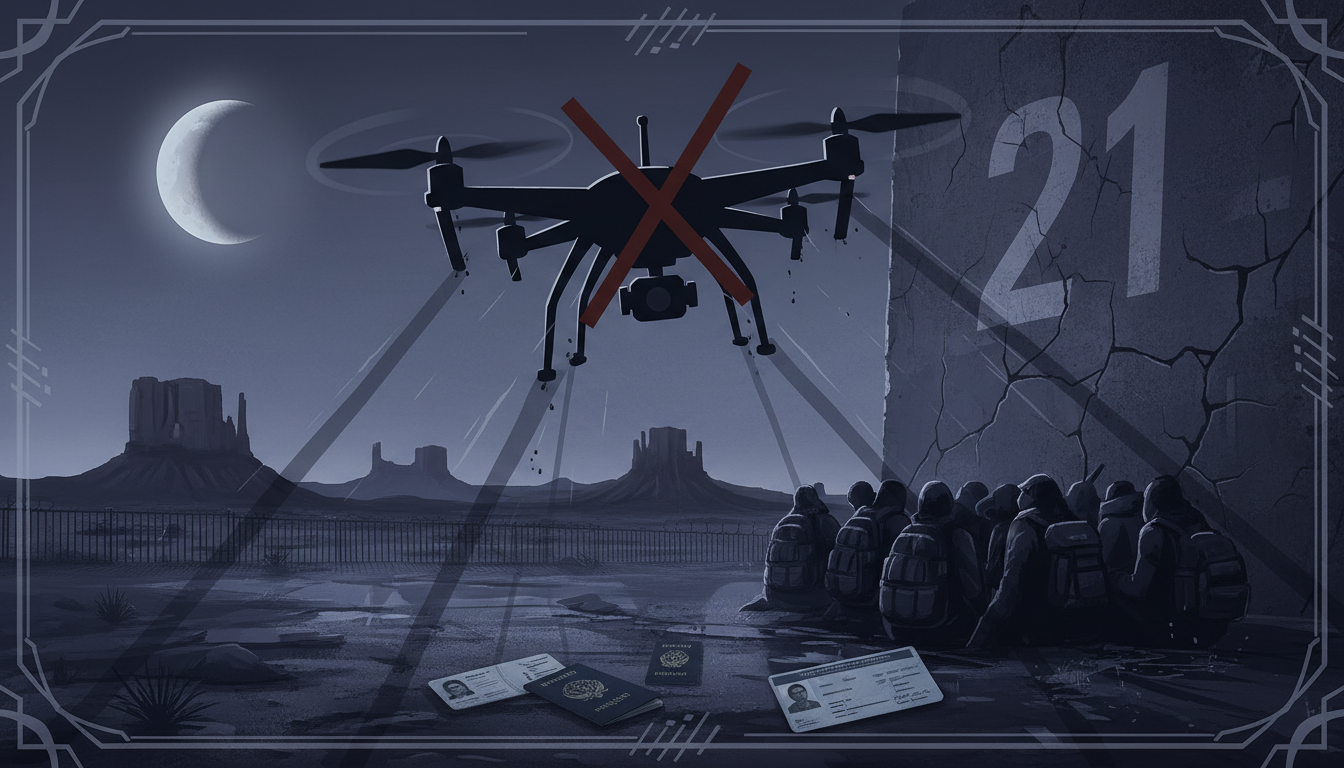
The Federal Aviation Administration has imposed an unprecedented nationwide flight restriction that effectively criminalizes drone operations within half a mile of any Immigration and Customs Enforcement or Customs and Border Protection vehicle. The sweeping ban, designated as Temporary Flight Restriction FDC 6/4375, represents a dramatic departure from typical aviation restrictions and has drawn sharp criticism from press freedom advocates.
Unlike standard temporary flight restrictions that last mere hours and target specific locations during events like natural disasters or presidential visits, this restriction spans 21 months—from January 16, 2026, through October 29, 2027—and covers the entire United States. The restriction prohibits any unmanned aircraft from operating within 3,000 feet horizontally and 1,000 feet vertically of Department of Homeland Security “facilities and mobile assets,” including ground vehicle convoys and escorts.
Legal Challenge Emerges from Press Freedom Advocates
Minneapolis photojournalist Rob Levine has filed a federal lawsuit challenging the restriction, represented by attorneys from the Reporters Committee for Freedom of the Press. Filed in the U.S. Court of Appeals for the District of Columbia Circuit, the petition argues that the flight restrictions violate the Administrative Procedure Act, are unconstitutionally vague, and create a chilling effect on First Amendment rights to gather news.
“Drones have helped photojournalists capture powerful perspectives that a reporter on the ground can’t,” Levine stated. “But these restrictions force drone pilots to choose between not gathering the news and risking criminal charges, massive fines, or a career-ending revocation of their right to fly.”
The Electronic Frontier Foundation, along with major media organizations including The New York Times and The Washington Post, sent a letter to the FAA in January demanding the restriction be lifted. Over two months later, they report receiving no response from the agency.
Enforcement Creates Impossible Compliance Standards
The practical implementation of this restriction creates significant challenges for drone operators. Immigration agents frequently use unmarked rental cars, vehicles without license plates, or regularly switch license plates to avoid detection during operations. This makes it virtually impossible for drone pilots to know in advance whether their planned flight path will violate the restriction.
During Operation Metro Surge in Minneapolis, Levine noted that between 3,000 and 4,000 DHS agents from ICE and CBP were conducting operations across the Twin Cities region using civilian vehicles and disguising themselves as delivery drivers. “When I saw that NOTAM and I read it closely, it seemed like you just couldn’t fly in the Twin Cities anymore,” Levine explained.
Criminal Penalties and Equipment Seizure
Violations of the flight restriction carry serious consequences. Drone operators face potential criminal and civil penalties, while their aircraft risk being seized or destroyed by authorities. This creates what critics describe as a “predictable chilling effect” that discourages all drone flights, particularly those intended for newsgathering purposes.
Historical Context of Press Documentation Rights
The restriction comes at a time when video documentation of law enforcement activities has proven crucial for accountability. High-profile cases involving the deaths of George Floyd, Renée Good, and Alex Pretti demonstrate how camera footage can expose misconduct and drive reforms. The First Amendment has long been interpreted to protect the right to record law enforcement activities in public spaces.
Press freedom advocates argue that the FAA restriction effectively creates a moving no-fly zone around immigration enforcement operations, preventing journalists from documenting activities that are matters of significant public concern. The restriction’s 21-month duration coincides with the current administration’s expanded immigration enforcement efforts.
Broader Implications for Aviation Regulation
The unprecedented scope and duration of this flight restriction raises questions about the FAA’s authority to impose such sweeping limitations. Traditional temporary flight restrictions are geographically and temporally limited, designed to address specific safety concerns during discrete events or around fixed locations.
This nationwide restriction covering mobile assets for nearly two years represents a fundamental shift in how flight restrictions are conceived and implemented. Critics argue it exceeds the FAA’s traditional safety mandate and ventures into territory more appropriate for law enforcement coordination.
Industry Impact Beyond Journalism
While press freedom concerns have driven the legal challenge, the restriction affects all drone operators, including commercial pilots conducting legitimate business operations. The inability to predict where DHS vehicles might be operating creates compliance uncertainty that extends far beyond newsgathering activities.
The restriction covers not only ICE and CBP vehicles but all “mobile assets” of the Departments of Defense, Energy, Justice, and Homeland Security, potentially encompassing a vast array of federal vehicles operating throughout the country on any given day.
As Levine’s legal challenge proceeds through the federal courts, the case will likely establish important precedents regarding the balance between aviation safety, national security concerns, and First Amendment press freedoms in the drone age. The outcome may determine whether federal agencies can effectively create mobile censorship zones that follow enforcement operations across the country.
This article draws on reporting from Activist Post, Reporters Committee for Freedom of the Press, and DroneLife.