
FBI Rapid DNA Initiative Targets Local Police Departments
In 2014, the FBI announced plans to dramatically accelerate the collection of DNA profiles for its expanding biometric identification database. The initiative sought to enlist local police departments across the country in gathering genetic material from arrestees, raising significant civil liberties concerns among privacy advocates and legal scholars.
The effort built upon two key foundations: a Supreme Court ruling that classified DNA collection as comparable to fingerprinting during the arrest process, and the FBI’s multi-billion-dollar Next Generation Identification (NGI) biometrics system — a massive database program whose full scope and capabilities were only partially disclosed to the public.
How Rapid DNA Analysis Would Work at the Local Level
According to an August 2014 federal business notice, multiple FBI divisions were collaborating to develop streamlined and automated DNA collection processes at the point of arrest, booking, and conviction. The goal was to integrate Rapid DNA Analysis technology into the FBI’s Combined DNA Index System (CODIS) and the Next Generation Identification system.
Unlike traditional DNA processing, which required accredited laboratory technicians and could take several days, Rapid DNA analysis could be performed by police officers in under two hours. An officer could collect a cheek swab on the spot or while an arrestee was in temporary custody. If the sample matched an existing database entry, the suspect could be detained immediately.
The FBI was actively seeking what officials described as a “legislative tweak” that would allow local law enforcement to bypass the requirement of having DNA examined in an accredited lab and instead transmit arrestees’ genetic profiles directly to the national database.
Scale of the Potential Dragnet
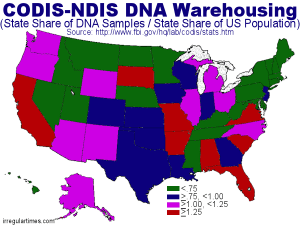
The scope of the program was potentially enormous. According to available statistics, approximately one in every 25 Americans was arrested in 2011 alone. If Rapid DNA collection became standard practice during routine arrests, the national database would expand at an unprecedented rate.
Civil Liberties and Racial Disparities
Jennifer Lynch of the Electronic Frontier Foundation, a recognized expert on FBI biometrics programs, outlined the privacy implications. Under existing legal precedent, DNA left behind — similar to discarded trash — could be collected by law enforcement without a warrant. If DNA was legally treated as a form of identification, and courts had already upheld the authority of officers to demand identification during stops, then warrantless DNA collection at the point of contact became a logical extension of that framework.
Lynch also highlighted the racial dimensions of the program. Given well-documented patterns of disproportionate police stops of Black and Latino individuals, a DNA collection system tied to police encounters would inevitably create a database skewed along racial and ethnic lines. Communities already subject to higher rates of police contact would see their genetic information over-represented in the national system.
Resistance at the Local Level
Privacy advocates urged citizens to engage with local government to prevent their municipalities from participating in the rapid DNA collection program. The argument centered on the principle that arrest alone — which does not constitute a finding of guilt — should not automatically trigger the permanent collection and federal storage of an individual’s genetic information.
The initiative reflected a broader trend in federal law enforcement toward building comprehensive biometric databases, with DNA joining fingerprints, facial recognition data, and iris scans in an expanding surveillance infrastructure.