
Global Anti-Monsanto Movement Gains Momentum Across Six Continents
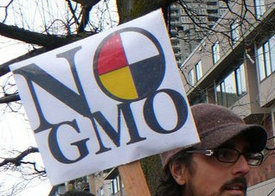
A coalition report published jointly by La Via Campesina, Friends of the Earth International, and Combat Monsanto documented a significant escalation in worldwide resistance to the biotechnology giant Monsanto and the industrial agriculture model it embodies. The report drew on evidence from farming communities, civil society organizations, and activist movements across every inhabited continent to demonstrate that opposition to genetically modified crops and corporate seed monopolies had reached unprecedented levels.
The findings showed that small-scale farmers, indigenous communities, and environmental organizations were mounting increasingly coordinated campaigns against Monsanto’s products, business practices, and environmental record. At the same time, the report argued that food sovereignty—the principle that communities should control their own food production systems—represents a viable and proven alternative to the corporate agribusiness model.
France: The Voluntary Reapers and Non-Violent Direct Action
In France, a movement known as the Faucheurs Volontaires (Voluntary Reapers) emerged as one of Europe’s most visible anti-GMO resistance groups. These self-organized activists conducted open, non-violent direct actions to destroy genetically modified field trials operated by biotech corporations. The group operated without formal leadership, though agricultural activist José Bové served as a prominent public figure associated with the movement.
The Voluntary Reapers distinguished themselves by acting unmasked and publicly claiming responsibility for their actions. They voluntarily turned themselves in to police and used their subsequent court appearances as platforms to present their case against GMO cultivation to the public. In August 2010, sixty Voluntary Reapers and fifteen farmers received two-month suspended prison sentences after destroying 70 genetically modified grapevines that were part of an experimental trial in Colmar, Alsace.
Their legal strategy framed civil disobedience as a democratic necessity when public authorities align with corporate interests against the common good.
India: Monsanto Quit India Protests Draw on Anti-Colonial History
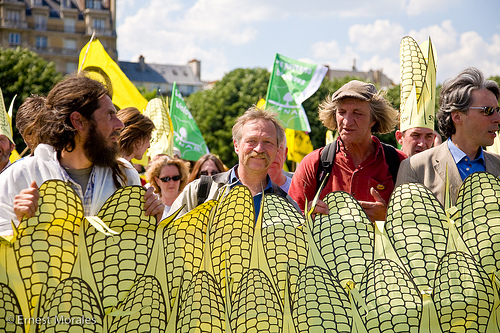
Indian farmers and activists launched nationwide “Monsanto, Quit India” protests in August 2011, deliberately timing their actions to coincide with Independence Day. The campaign drew explicit parallels between the historical anti-colonial movement that campaigned against British rule and the contemporary struggle against foreign corporate control over India’s seed supply and agricultural systems.
The movement gained momentum following a temporary ban on Bt brinjal (eggplant), a genetically modified crop that had become a flashpoint for debates over food safety and corporate influence in Indian agriculture. The Tamil Nadu Farmers’ Association organized demonstrations in Coimbatore, while the Bhartiya Kissan Union led a five-day protest against GM crop trials in Uttar Pradesh, highlighting agroecological farming methods that had produced high rice yields without genetic modification.
Protests spread to the states of Orissa, Andhra Pradesh, Bihar, Karnataka, Maharashtra, Punjab, Madhya Pradesh, and Gujarat, reflecting the geographic breadth of farmer opposition to corporate seed monopolization.
Haiti: Farmers Burn Monsanto Seed Donations After Earthquake
Following the devastating 2010 earthquake, Monsanto announced a shipment of over 60 tons of hybrid maize and vegetable seeds to Haiti, with plans to send an additional 400 tons over the following year. The donation was coordinated with USAID and reportedly originated from discussions at the World Economic Forum in Davos, Switzerland—discussions in which Haitian officials apparently had no involvement.
More than 10,000 Haitian farmers marched in opposition under the leadership of the Papaye Peasant Movement (MPP), a La Via Campesina affiliate. Peasant leader Chavannes Jean-Baptiste described Monsanto’s seed donation as “the next earthquake,” arguing that hybrid seeds that cannot be replanted from one season to the next would destroy farmer self-sufficiency and create permanent dependency on corporate seed and chemical suppliers.
The anger reflected a broader crisis in agricultural biodiversity. The UN Food and Agriculture Organization estimated that approximately 75 percent of the genetic diversity of agricultural crops had been lost globally over the previous century. In Haiti, where roughly 65 percent of the population consisted of subsistence farmers in rural areas, the introduction of corporate hybrid seeds threatened to accelerate that loss at the local level.
United States: Legal Battles Over GMOs in National Wildlife Refuges
In the United States, the Public Employees for Environmental Responsibility (PEER) documented how the federal government had been collaborating with Monsanto to expand agricultural export markets and remove regulatory barriers to genetically modified crop cultivation, including within national wildlife refuges.
The primary concern centered on crops engineered to resist Monsanto’s Roundup herbicide. The widespread use of these herbicide-tolerant crops had triggered an epidemic of resistant “superweeds” that conventional herbicides could no longer control. The spread of such resistant weeds into wildlife refuges posed a direct threat to biodiversity in some of the country’s most ecologically sensitive areas.
Legal action by PEER and the Center for Food Safety forced the U.S. Fish and Wildlife Service to end the planting of genetically modified crops in refuges across 12 states, representing a significant legal precedent for limiting GMO expansion into protected ecosystems.
South Africa: Farmers Resist GM Maize Experiments Despite Government Approval
South African authorities approved imports of Bayer CropScience’s genetically modified rice strain LL62 in October 2011, despite opposition from farmers and civil society organizations who warned of contamination risks to non-GM rice varieties. The approved rice was engineered to resist glufosinate ammonium, a herbicide classified as toxic to reproductive health and scheduled for a European Union ban.
In the same month, the Lutzville Emerging Farmers Forum and the Food Sovereignty Campaign organized protests alongside West Coast residents against Monsanto’s drought-resistance experiments conducted in collaboration with South Africa’s Agricultural Research Council. Scientific research consistently showed that organic matter content in soil was the most important factor in drought resilience, while biotechnology had failed to produce genuinely drought-resistant seed varieties or yield-enhancing GM crops. Despite this evidence, Monsanto’s engineered traits were present in an estimated 75 percent of all GM maize grown in South Africa.
The Case for Food Sovereignty Over Corporate Agriculture
The report’s conclusions painted a stark picture of the consequences of corporate agricultural dominance. In regions where Monsanto and similar companies operated, native seed varieties were being rendered illegal through intellectual property enforcement. Biodiversity was declining as monoculture farming expanded. Agricultural land was being contaminated by chemical inputs and genetic drift from GM fields. Farmers and agricultural workers faced poisoning from pesticide exposure, criminalization for saving and replanting seeds, and displacement from their land.
The coalition called for collective international action, arguing that the concentration of food production in the hands of profit-driven corporations fundamentally undermined community health, environmental sustainability, and farmer autonomy. The report positioned food sovereignty not merely as an ideal but as a demonstrated and practical alternative already being implemented by farming communities worldwide.