
The Monsanto-Government Pipeline
The appointment of former Monsanto executive Michael Taylor to a senior food safety role in the Obama administration raised serious questions about corporate influence over federal regulatory agencies. Taylor, who had served as Monsanto’s chief attorney and lobbyist, was already well-connected within both the FDA and USDA before taking on his government role.
Taylor had previously championed the approval of recombinant Bovine Growth Hormone (rBGH), a controversial Monsanto product administered to dairy cows. Under his influence, dairy farms that chose not to use rBGH faced restrictions on labeling their products as hormone-free, creating financial pressure on independent operations that resisted the technology.
Monsanto’s Track Record of Controversial Products
Monsanto’s corporate history includes the production of several products that generated significant public health and environmental concerns: Agent Orange, PCBs, aspartame, rBGH, and Roundup herbicide. Each of these products became the subject of extensive litigation, scientific scrutiny, or regulatory debate.
The company also developed terminator seed technology, which produced crops incapable of generating viable seeds for replanting. This forced farmers into purchasing new seed stock every growing season. Meanwhile, Monsanto pursued aggressive patent enforcement, filing lawsuits against farmers whose non-GMO crops were inadvertently cross-pollinated by neighboring GMO fields.
The company’s broader strategy appeared aimed at consolidating control over global food production through both GMO dominance and the acquisition of patents on conventional seed varieties.
The Gates Foundation and Agricultural Investments
Bill Gates purchased approximately $23 million in Monsanto stock, connecting one of the world’s wealthiest individuals to the agrochemical giant. Through the Gates Foundation, substantial funding flowed toward vaccine development and distribution programs, often targeting developing nations.
The Gates Foundation also backed the Alliance for a Green Revolution in Africa (AGRA), hiring former Monsanto director Robert Horsh in 2006. Critics argued that AGRA served as a vehicle for displacing traditional African farming practices in favor of genetically modified seed systems. Similar corporate agricultural programs in India had already produced devastating consequences for small-scale cotton farmers who took on debt to purchase proprietary seeds.
Private Military Contractors and Corporate Intelligence
In a development that drew considerable attention, Monsanto reportedly developed a relationship with Xe Services, formerly known as Blackwater, the largest private military company in the world. Investigative journalist Jeremy Scahill reported that Cofer Black, a former CIA director who led Total Intelligence Solutions (a Blackwater subsidiary), began pitching his firm’s services to Monsanto around 2008.
The reported purpose of this arrangement involved intelligence gathering on anti-GMO activist groups and farmers who resisted adopting genetically modified crops. The use of private intelligence contractors by a food and agriculture corporation represented an unusual and concerning escalation in corporate responses to public opposition.
The Revolving Door Between Industry and Government
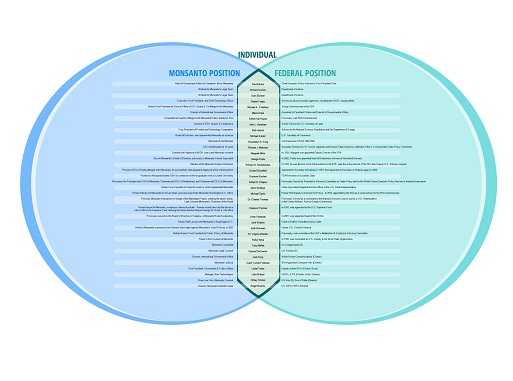
The connections between Monsanto, government regulators, private military firms, and major investors illustrated a network of overlapping interests that critics argued undermined the independence of food safety oversight. The revolving door between corporate boardrooms and federal agencies remained one of the most persistent concerns in debates over agricultural policy and food regulation.