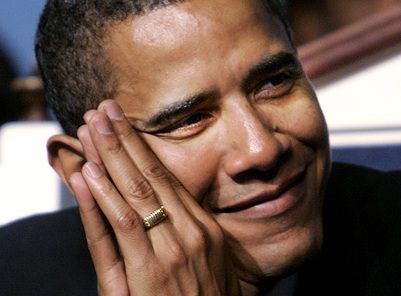
The Ring That Sparked a Debate
Long before Barack Obama entered the White House, fellow students at Harvard Law School noticed something unusual: the unmarried bachelor consistently wore a gold band on his wedding-ring finger. A satirical edition of the Harvard Law Review published by students in 1990 even listed among Obama’s “Latest Accomplishments” the item “Deflecting Persistent Questioning About Ring On Left Hand.”
When photographs from Obama’s time at Occidental College in the early 1980s were published by the New Yorker in October 2012, they revealed that the ring he wore as president appeared to be the same one he had been wearing since at least 1981 — more than a decade before Michelle Robinson placed it on his finger during their October 3, 1992 wedding ceremony at Trinity United Church of Christ in Chicago.
A 2009 New York Times article by Jodi Kantor described the ring as “an intricate gold design from Indonesia, where he had lived as a boy,” noting it was non-traditional compared to Michelle’s wedding band. The article made no mention of Obama having worn the ring for years before the marriage.
The Inscription Claim
The ring attracted renewed scrutiny in 2012 when filmmaker Joel Gilbert, an Arabic speaker and Middle East researcher, examined photographs and concluded that the gold band bore an Arabic inscription. Specifically, he identified what he believed to be the first half of the Islamic Shahada: “La Ilaha Illallah” — “There is no god but Allah.”
Egyptian-born Islamic scholar Mark A. Gabriel, who holds a Ph.D. and graduated from the prestigious Al-Azhar University in Cairo in 1990, examined photographs of the ring and concurred with Gilbert’s assessment. Gabriel, who grew up in an Islamic household and memorized the Quran by age twelve, described how the inscription appeared to be arranged in two sections consistent with traditional Arabic calligraphic conventions used on jewelry.
According to Gabriel’s analysis, the upper portion contained the Arabic letters spelling “There is no god” (Lam, Alif, Alif, Lam, Ha), while the lower portion contained “except Allah” (Alif, Lam, Alif, Alif, Lam, Lam, Ha), with some letters artistically overlapping to fit the available space — a common technique in Islamic decorative arts.
Significance of the Shahada
The Shahada is the first of the Five Pillars of Islam, expressing the two foundational beliefs of the Muslim faith: that there is no deity except Allah, and that Muhammad is Allah’s prophet. A single sincere recitation in Arabic is traditionally considered sufficient for conversion to Islam.
Gabriel explained the cultural weight of the inscription: “Muslims recite the Shahada when they wake up in the morning and before they go to sleep at night. It is repeated five times every day in the call to prayer in every mosque.”
He added that wearing the inscription on jewelry represents a personal connection to Islam: “By wearing this religious statement on one’s hand, it connects the person to Islam. It is worn in hopes that Allah’s protections would be with the person, in hopes of gaining favor with Allah.”
Regarding the use of gold — technically prohibited for men under Islamic law — Gabriel noted that the practice was widely accepted in non-Arab Islamic societies such as Indonesia, Bangladesh, Malaysia, and Pakistan, where local cultural influences often outweigh strict doctrinal prohibitions, particularly when the jewelry carries religious significance.
Obama’s Connection to Islamic Culture
Obama lived in Indonesia from 1967 to 1971, attending local schools that included Islamic religious instruction. In a 2008 interview with New York Times columnist Nicholas Kristof, Obama recited the opening lines of the Arabic call to prayer, the Adhan, which Kristof noted was delivered “with a first-rate accent.”
Obama described the call to prayer as “one of the prettiest sounds on Earth at sunset” — a remark Kristof characterized as “delightfully uncalculated.”
The Adhan incorporates the Shahada, with each line repeated:
- Allah is supreme
- I witness that there is no god but Allah
- I witness that Muhammad is his prophet
Gilbert pointed to Obama’s June 2009 speech in Cairo, during which Obama told the audience he had “known Islam on three continents” and described it as part of his responsibility as president “to fight against negative stereotypes of Islam wherever they appear.” Gilbert noted that Obama appeared to be wearing the ring during this address.
The Photographic Timeline
Photographs spanning three decades showed Obama wearing what appeared to be the same distinctive ring:
At Occidental College in 1981, photographs showed Obama wearing the gold band while seated with roommate Hasan Chandoo and while reaching for books in the college library. The ring’s distinctive parallel bar design on its outer circumference was visible in these early images.
Subsequent photographs documented the ring at Columbia University in 1983, during a trip to Africa in 1988, and throughout his time at Harvard Law School from 1988 to 1991.
White House photographs showed the ring during official meetings, while signing legislation, and during the Cairo speech — appearing consistent in design with the earlier images across all these contexts.
Counterarguments and Context
Obama consistently identified as a Christian throughout his political career, having attended Reverend Jeremiah Wright’s Trinity United Church of Christ in Chicago for approximately two decades before his presidency. His campaign and White House communications repeatedly affirmed his Christian faith.
Skeptics of the inscription claim argued that the photographs lacked sufficient resolution to definitively identify Arabic script, and that the patterns on the ring could represent abstract geometric ornamentation common in Indonesian jewelry rather than specific calligraphic text.
The claim emerged during the 2012 presidential campaign, a period of heightened political sensitivity around Obama’s biography, religious identity, and cultural background. Critics viewed the ring analysis as part of a broader pattern of questioning Obama’s identity and loyalties, while proponents maintained it raised legitimate questions about transparency regarding the president’s personal history and beliefs.
Broader Implications
The ring controversy illustrated how seemingly minor biographical details could become flashpoints in an era of intense political polarization. Whether the ring bore an Islamic inscription or simply featured decorative Indonesian metalwork, the debate it generated reflected deeper anxieties about cultural identity, religious pluralism, and the limits of what the public could or should demand to know about its elected leaders.
The First Amendment guarantees freedom of religion, and no religious test is constitutionally permitted for holding public office in the United States. Yet the intensity of public interest in this question demonstrated that cultural expectations around presidential identity continued to carry significant weight in American political life, often in ways that tested the boundaries between legitimate inquiry and discriminatory suspicion.