“History of Halloween – Secret Occult Origins from Mystery Babylon”
Halloween History: from Pagans to Pumpkin Patches
Strange Facts On Why We Celebrate Halloween
Show Transcript
Introduction: Why We Should Know the True History of Halloween
Ladies and gentleman, ghouls of all ages, happy Halloween to those out there to celebrate this crazy holiday. Whether you’re getting dressed up, being someone else for the night, everyone’s got an opportunity to wear a different persona. We can appreciate the celebration beyond the religious, beyond the dark and the occult. But hey, who should know the true history of these holidays, these things, these rituals that we participate in? We should know the origins of humanity’s culture and the celebrations that we partake in, many of us not even realizing why we do so.
Tonight, an interesting show. October thirty-first, two thousand twelve. We also continue this year, hell-bent with less than two months away from December twenty-first, two thousand twelve. You never know what this day could be exploited by the powers that be, used as an opportunity to continue bringing in martial law. Who knows? The warning signs may or may not be out there. We continue to improve our realities regardless of what the powers that be manipulate. The vast ocean of information we’re constantly sifting through — I try to get the best of it here on Decrypted Matrix, try to get the best quality from typically confirmed sources where you can really tie it in to the bigger, greater picture. That vast tapestry, as David Icke calls it, of information that you really have to see for yourself to behold, to really understand and grasp just how dire and yet how awesome our existence can be.
So tonight, we’re going to dive into the history. Considered mostly in the United States as a holiday mostly for children, you know, it has roots in ancient religions and folklore, including paganism, ancient Roman religions, early Catholic Christianity, and Irish folklore. Children and adults alike enjoy this holiday today with funny costumes and candy and parties. Some countries observe this time as a remembrance of departed loved ones and religious saints. Let’s go through a short story, a crash course if you will.
Ancient Celtic Origins: Samhain and the Festival of the Dead
The holiday has ancient roots and much greater meaning than the boisterous, costume-filled holiday that we know today. Around two thousand years ago, the Celts — the pre-Christian Celtic people who lived in what is now the United Kingdom, Ireland, and northern France — had a festival commemorating the end of the year. Their new year was November first, and this festival was called Samhain, spelled S-A-M-H-A-I-N. The end of their year signaled the end of summer, the end of the harvest season, and the beginning of a long, hard winter that often caused many deaths of animals and people.
Weaker livestock were often killed and eaten during this holiday, as they most likely would not survive the winter anyway. Because of this cruel winter, this time of year signified death to the pagan Celts. They believed the night before the new year, the wall between the living and the dead was open, allowing the spirits of the dead, both good and bad, to mingle among the living. Some of these spirits were thought to possess living people, cause trouble, ruin crops, or search for passage to the afterlife.
Samhain was considered a magical holiday, and there are many stories about what the Celts practiced and believed during this festival. Some say the spirits that were unleashed were those that had died in the year, and offerings of food and drink were left to appease the spirits or ward them away. Other versions say people dressed up in costumes and roamed the neighborhoods making noise to scare those spirits away. Many thought they could predict the future or communicate with spirits.
Something important: the heavily structured life of the pagan Celts was abandoned during Samhain, and people did unusual things such as moving horses to different fields, moving gates and fences, women dressing as men and vice versa. Other trickery now associated with Halloween. Another belief is that the Celts honored, celebrated, and feasted their dead during Samhain. A sacred central bonfire was always lit. Some accounts say that individual home fires were extinguished during Samhain to make their homes unattractive to roving spirits, and then home fires would be relit following the festival from the sacred bonfire.
Fortunes were told with marked stones placed around the fire. If a person’s stone was not found afterward, it was believed that person would die during the next year. Creepy, right? Some Celts wore costumes made of animal skins during Samhain. Fairies were believed to roam the earth during Samhain, dressed as beggars, asking for food door to door. Those who gave food to the fairies were rewarded, while those that did not were punished. This is reported to be the first origin of the modern trick-or-treat practice we all know so well.
Roman Influence, Christianity, and the Transformation of Samhain
When the Roman Empire took over most of the Celtic lands, the Romans had two festivals also occurring around the same time as Samhain. One was Feralia, also in late October, which was the Roman day honoring the dead. The second festival was for Pomona, the Roman goddess of trees and fruit. Pomona’s symbol was the apple. These two festivals were combined with Samhain during the four hundred years of the Roman Empire’s rule over the Celts. The goddess Pomona’s apple might be the root of the Halloween tradition of bobbing for apples.
Over the next several hundred years, Christianity had spread to include the lands inhabited by the Celts and the Romans, but the festival of Samhain was still celebrated by the people. The Christian church reportedly did not like a festival with pagan roots practiced by Christians, so a replacement was needed. In 609 AD, Pope Boniface the Fourth designated May thirteenth as All Saints’ Day to honor dead church saints and martyrs. But Samhain continued to be celebrated.
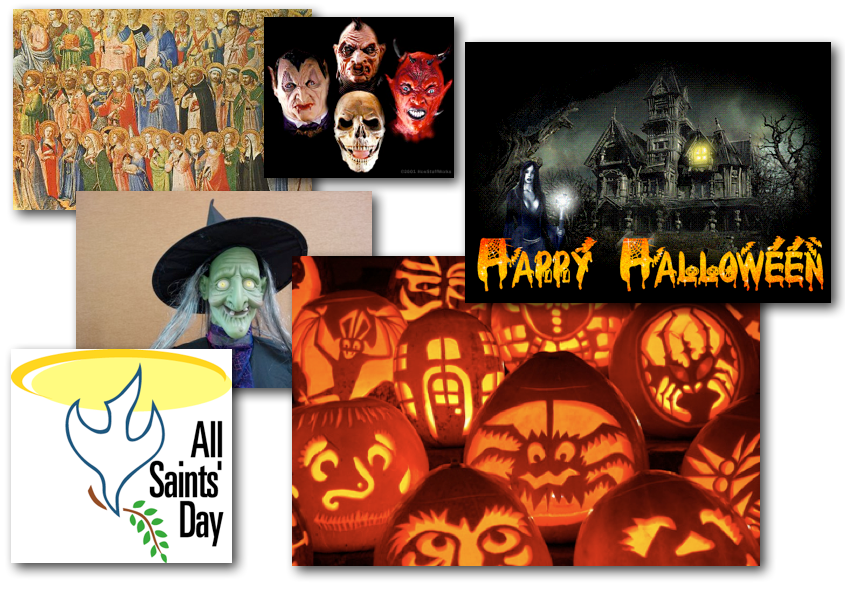
Around 835 AD, Pope Gregory the Fourth moved All Saints’ Day to November first, probably to steal attention away from the pagan Samhain festival and replace it. Since All Saints’ Day was sanctioned by the church and related to the dead, the church was happy, but many pagan traditions of Samhain continued to be practiced, including bonfires, parades, and dressing up in costumes. All Saints’ Day was also known as All Hallows or All Hallowmas — “Hallowmas” is Old English for All Saints’ Day. Since Samhain was celebrated the night before November first, the celebration became known as All Hallows’ Eve, and later called Halloween.
In 1000 AD, the church designated November second as All Souls’ Day to honor the dead who were not saints. These eventually became combined and celebrated as Hallowtide. On All Souls’ Day in England, the poor would go “souling” — they would go door to door asking for food, and in return would pray for the souls of their dead relatives. It was widely believed at the time that the souls of the dead awaited passage to heaven and that people’s prayers would help their souls. The Christian church encouraged this practice to replace the old pagan tradition of leaving cakes and wine for the spirits of the dead. The poor would be given soul cakes, which were pastries, made for those who promised to pray for their dead relatives. In some cultures, soul cakes would be given in exchange for a performance or song as well. Children eventually adopted this practice and were given food and treats.
Halloween Traditions and Their Origins
Jack-o’-lanterns on Halloween have at least two historical roots. The pagan Celtic peoples hollowed out turnips, gourds, or rutabagas to hold an ember from the sacred bonfire. They would take an ember from that sacred bonfire, put it in a hollowed-out turnip or gourd, and that’s how they would keep it from burning anything else so they could light their home fires from the sacred fire.
The other origin hails from an Irish folk tale. The jack-o’-lantern is believed to come from the Irish legend of a man known as Stingy Jack, who was a swindler. Jack had convinced the devil to have a drink with him. Jack convinced the devil to change himself into a coin to pay for the drink, but then Jack put the coin in his pocket next to a silver cross, which trapped the devil and prevented him from changing himself back. Jack agreed to free the devil on the condition that the devil would not bother Jack for one year.
Later, Jack tricked the devil into climbing a tree to fetch a piece of fruit. While the devil was up in the tree, Jack carved a cross into the trunk, preventing him from climbing back down. To get out of the tree, the devil promised Jack not to seek his soul anymore. When Jack died, he was not allowed into heaven because of his drunken and swindling ways, but he was not allowed into hell either, because the devil kept his word. Taking pity on Jack, the devil gave him an ember to light his way in the dark, putting it into a hollowed-out turnip for Jack to carry on his lonely and everlasting roaming of the earth. People from Ireland and Scotland would make jack-o’-lantern turnips during the season to scare away Stingy Jack and other evil spirits wandering about. When the Irish immigrated to the new world, pumpkins — which were very plentiful — ended up being substituted for turnips in the United States.
Costumes have their roots in the pagan Celtic festival of Samhain. One theory is that costumes were a disguise from the evil spirits let loose on October thirty-first so people would not be possessed by the spirits. Another theory is that people dressed in costumes as part of the trick-or-treat practice after the church replaced Samhain with All Saints’ Day. People would dress up for festivities and go door to door. The legend of the fairies, who dressed as beggars asking for food, meant that those who did not show hospitality would be harassed. The souling tradition carried forward, with people asking for soul cakes — sweet pastries — in exchange for prayers to help expedite a departed one’s passage to heaven. Sometimes costumed groups would sing or perform in exchange for food, ale, or money. In the Guy Fawkes era, children would go door to door asking for “a penny for the Guy.”
Bonfires have two origins. The first was the sacred ritual of extinguishing home fires and relighting them from the sacred Samhain bonfires to start the new year. Some say the reason home fires were extinguished was to scare evil spirits from the homes, while others say the home fires were supposed to be relit from embers of the sacred bonfires to start the new year fresh. The second origin was from Guy Fawkes Day in England, when they burned effigies of the Catholic Pope and later of Guy Fawkes himself.
Apples come back to the symbol of the Roman goddess Pomona, who was thought at the time to possess qualities of knowledge, resurrection, and immortality. Bobbing for apples and other manipulations of the fruit are thought to have foretold the future on the night of Samhain.
Ghost stories probably have their roots in the original Celtic belief that the spirits of the dead, both good and bad, walked the earth on October thirty-first during Samhain. Later, when the church replaced Samhain with All Saints’ Day and All Souls’ Day, the dead were remembered and spoken about. In the United States, ghost stories were used to scare children and get them into the “spirit” of Halloween.
Halloween Around the World
By the twentieth century, Halloween had turned into a secular holiday with community center parties, citywide parades, great costumes. Halloween is mostly aimed at children, clearly, but young and old enjoy this holiday with friends and parties. Starting in 1950, UNICEF started a campaign for children to collect money for underprivileged children around the world. Halloween is the United States’ second-largest commercial holiday, with spending of approximately six point nine billion dollars a year. Follow the money — Halloween is a billion-dollar industry recurring every year.
In other countries, it spreads like a virus. Mexico, Guatemala, and Spain observe All Saints’ Day and All Souls’ Day with a three-day celebration starting on the evening of October thirty-first through November second. In most areas of Mexico, November first is set aside for dead children, and November second to honor those who died as adults. Streets are filled with decorations, flowers, and toys made like skeletons and other macabre shapes. Sweet pastries and candies shaped like bones, coffins, and dead bodies are made in preparation for the festivities, called the Day of the Dead. The spirits of relatives are supposed to visit their families’ homes. An area of the home is cleared away and an altar is erected, decorated with flowers, photographs of the deceased, candles, and pastries shaped like skulls inscribed with their names, along with a selection of the deceased’s favorite foods and drinks — even after-dinner cigarettes and playing cards for after-dinner enjoyment. Incense is burned to help them find their way home.
This happens as the tradition in Mexico, Central America, and Spain. How cool is that? They maintain the root significance of it, and I personally appreciate that. The graves of the deceased are cleaned, painted, and decorated for the occasion. Families gather November second for a festive family reunion. Food, drinks, and tequila are brought along, sometimes even a mariachi band. In some areas, fireworks announce an open-air mass. Costumes vary depending on the particular city or culture, but all over Mexico, the Day of the Dead is considered a celebration of their departed family.
Eastern Europe’s celebration of All Saints’ Day is usually spent by praying to the saints and thanking God, often at the cemetery. Slovakia, Hungary, Lithuania, Slovenia, and Poland observe All Saints’ Day as a public holiday, but unlike Mexico or the United States, this day is a somber day of remembrance and reflection. It’s not a party. France, Italy, and Germany are celebrating Halloween American-style, as does Canada. Ireland celebrates American-style but retains elements of its Celtic roots. England still observes Guy Fawkes Day on November fifth with bonfires, burning effigies of Guy Fawkes, and fireworks.
The Occult Connections: Numerology, Witchcraft, and the Druids
The occult believes that numbers contain inherent power. Numerology is a key component of the astrological system which the occult follows closely. The occult calendar is divided into four parts of thirteen weeks each — notice that thirteen times four equals fifty-two weeks in our year. In the occult system, the number six represents man, the number seven represents divine perfection or God, and thirteen represents the state of man having reached divine perfection — self-achieved perfection and illumination.
The word “occult” means that which is hidden from sight. It deals with the evil side of the supernatural. The Bible is full of the goodness and grace of God; it proclaims this knowledge openly to everyone. The supernatural is a subject in which the ongoing battle of good versus evil plays out. From this point of view, Satan’s religion is the occult, propagated behind a cloak of superstition and secrecy. Satan is the personification of pride. He has an insatiable desire to be like God and he continually attempts to replace God in the hearts and minds of men.
Some people say they sense the presence of something from another dimension, yet they’re often embarrassed to admit belief in a dark side of the supernatural. However, most of our children have no problems relating to the dark side because they have been so indoctrinated by movies and books that proclaim it.
Halloween has Celtic roots as a pagan holiday sacred to the ancient Druids, as well as to the modern-day Wiccans, the Illuminati, Satanists, and others. Those who think Halloween is harmless fun are actually part of the majority of those who participate in a so-called harmless tradition and are unwitting participants in a worldwide deception of staggering proportions.
This is where the Druids bridge in. The Druid holiday was the Vigil of Samhain. In early Britain, it was called Samhain as well. Then the Roman church came in with All Saints’ Day. The Druids, the Christians — they share a recurring theme of the devil. That is why so many kids dress up as demons for Halloween. The word “Halloween” comes from “All Hallows’ Eve.” It is a little weird when you trace it, but still, this is just a crash course.
As for witches, that comes from pagan women who were sometimes spiritual or metaphysical in nature. They would sometimes have abilities — perhaps psychic abilities — or were able to read people’s emotions and tell them things about themselves. They were the spiritual healers of their time and culture, and were not so much vilified as they are now. They were the wise and spiritual ones, looked up to. Then the church came along and labeled those women as witches. “She’s a witch, let’s burn her” comes from pagan women who were often spiritual or metaphysical in nature and perhaps had the ability to demonstrate things we call magic, which is simply science not yet understood. That’s not to divert us, but everyone should know that is the true origin of witches. This came from persecuting women who were metaphysical or spiritual in nature.
Babylonian Roots: Nimrod, Saturn, and the Mystery Religion
Let’s look deeper at the Babylonian roots. At the end of the third millennium before the common era, a religious system emerged in what we now know as Iraq, in the city of Babylon, the center of the then-known world. The leader of the religious system is identified in the Bible as Nimrod. The religion that emerged from Babylon was a mystery system centered on Nimrod and a goddess figure identified with him. By the way, Queen Semiramis is actually what the Statue of Liberty represents. She’s holding the torch of illumination, representing power and control over the people by withholding and carrying that torch of illumination, only for the illuminated. This goes back to Babylon and Nimrod. Queen Semiramis is also believed to have connections to the symbolic sacrifice of Princess Diana — she was in some respects seen as a future incarnation of this archetype. But let’s not divert too much.
Here on the Decrypted Matrix, we take you down to the depths of the rabbit hole. It’s never supposed to be easy, but it will expand your mind and your horizons. The false religious doctrines that spread from Babylon then spread about the face of the earth. They used this mystery system. The system is not new — it’s ancient. The Bible calls it “Mystery Babylon the Great, the Mother of Harlots and Abominations of the Earth” in Revelation 17:5. Mysticism is the vehicle by which it is transported everywhere. It seems to release the individual from obedience to the one true God.
They believed Nimrod was Saturn. The Babylonian mysteries centered on Saturn, also known by many names. The rites of the Babylonian mysteries included worship of the Babylonian sacred deities and worship of the seven planets — the Moon, Mercury, Venus, Mars, Jupiter, and Saturn. The worship of the seven planets literally devoured Israel, and so God gave them up to worship the host of heaven. Saturn was usually pictured as an aged man holding a sickle, from which we undoubtedly get our representation of death — an old man with a sickle. Saturn is associated with death, with the Grim Reaper, a skeleton dressed in black, a black-hooded figure carrying a sickle. The Grim Reaper signifies the end of the year, just as a newborn baby symbolizes the start of the new year — but those symbols of the Grim Reaper and baby represent time. Another name for Saturn is Kronos, which also means time.
Of course, these symbols refer back to Nimrod. The House of Israel offered sacrifices to the planet-god Saturn, and Saturn was the highest of the seven planets they worshiped. They declared Saturn to be their king. In ancient times, planets were called wandering stars. The king of Saturn was none other than Nimrod, who was proclaimed in the Babylonian mysteries to have been resurrected and ascended to the planet Saturn. Nimrod was also known by other names throughout history: Osiris, Saturn, Jupiter, Tammuz, Baal, Moloch, Melqart, Kronos, and more. Jupiter was the main god. Saturn, as lord of the underworld, was worshiped throughout Egypt as the patron of the dead, lord of the necropolis and the dead, and as the granter of rebirth.
The Phoenicians worshiped the father-god Baal and the mother-goddess, sometimes called Astarte or Asherah. The name Baal is the name used in the Old Testament for the false deities. Baal was worshiped as the ruler of the universe, referred to as the son of Dagon. Baal’s father is El — again, these names all referring back to their connection to Nimrod.
The deity was considered ever-present at the foundation of all the cities in Sumer and Akkad, since no king or even one of the false gods ever ruled over a greater part of Mesopotamia in history. It’s possible that Moses, in writing the first five books of the Old Testament, may have decided to give the name Nimrod as a generic name, just as he did with the term “the Tower of Confusion” to describe Babel. Moses would have avoided mentioning the name of a foreign false god in his writing, potentially to avoid breaking God’s first commandment.
Closing Thoughts: The Hidden History Behind the Holiday
So folks, that is pretty much Halloween in a nutshell. We can keep going with the Babylonian history — you know, it goes deep. We see the occult in these shows, on television every day, through computer games, role-playing games. This exposure is purposefully hidden from us so we are not consciously aware of it. How can this happen? Well, I believe that the powers that be have been putting this occult stuff right out in the open, right under our noses, almost rubbing our faces in it, forcing us to participate in this without even knowing the origins. Not even knowing the true history of why kids are running around, partying, getting dressed up, eating obscene amounts of candy, going door to door collecting candy from random strangers. And you’ve got the devils, the ghosts, the ghouls, the goblins, the trolls, the creepy scary stuff, the rehashed monsters.
You deserve to know the true history behind all of it, with a healthy sprinkle of the Babylonian connections. I hope you enjoyed that and that it helped you learn a little something. We’ll come back to bring you more. Not sure about a part two just yet, but hope you enjoyed the Halloween special episode. That’s Decrypted Matrix on Revealing Talk Radio, signing off.