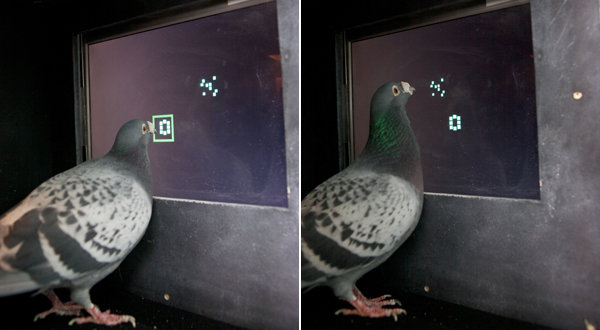
Pigeons, long dismissed as simple urban scavengers, demonstrated an ability to learn abstract numerical rules that scientists had previously observed only in primates. A study published in the journal Science revealed that pigeons could rank groups of objects from lowest to highest quantity, matching the performance of rhesus monkeys on the same task.
The Experiment
Damian Scarf, a postdoctoral researcher at the University of Otago in New Zealand, designed an experiment based on earlier primate research from the 1990s. In that original work, rhesus monkeys were trained to view groups of items on a screen and arrange them in ascending numerical order. The monkeys learned to correctly rank groups of one, two, and three items regardless of the shapes or sizes of the objects. When presented with unfamiliar quantities, they could generalize the rule: having learned that two exceeds one and three exceeds two, they could determine that eight exceeds six.
Scarf replicated this protocol with pigeons. The birds underwent approximately a year of training, during which they were presented with groups of one, two, and three items in varying shapes, sizes, and colors. The pigeons learned to peck the images in ascending numerical order, demonstrating they had internalized an abstract rule rather than simply memorizing specific visual patterns.
Results That Matched Primate Performance
When tested with quantities they had never encountered during training, such as groups of six and nine, the pigeons correctly ordered the images from lower to higher. Elizabeth Brannon, a professor of psychology and neuroscience at Duke University who conducted the original monkey experiments, noted that the pigeons’ performance was statistically comparable to the primates’.
The finding was particularly striking because it demonstrated abstract rule learning, not just counting. The pigeons were not merely identifying quantities but applying a relational concept: that one set contains fewer items than another, even when both sets were entirely unfamiliar.
Evolutionary Implications
The parallel performance of pigeons and primates on the same numerical task raised a significant evolutionary question. Either both groups independently evolved the capacity for abstract numerical reasoning, a phenomenon known as convergent evolution, or the ability traces back to a common ancestor that lived approximately 300 million years ago, long before the emergence of either mammals or dinosaurs.
Scarf noted that both explanations were plausible but expressed a tentative preference for convergent evolution, reasoning that the survival advantages of numerical reasoning would have created similar selective pressures in both lineages. The ability to quickly assess quantities, whether of food sources, predators, or competitors, confers obvious advantages regardless of the species.
What This Tells Us About Avian Intelligence
The pigeon study added to a growing body of research demonstrating sophisticated cognitive abilities across bird species. African grey parrots have demonstrated verbal comprehension and categorization skills. Scrub jays display episodic-like memory in managing their food caches. New Caledonian crows manufacture and use tools with a sophistication that surpasses many primate species.
These findings collectively challenge the long-held assumption that complex cognition requires a large brain or a cerebral cortex. Birds possess a fundamentally different brain architecture than mammals, yet achieve comparable cognitive feats through alternative neural pathways, suggesting that intelligence may be less about brain structure and more about how neural circuits are organized and deployed.
The study did not test pigeons with numbers larger than nine, leaving open the question of just how far their numerical abilities extend.