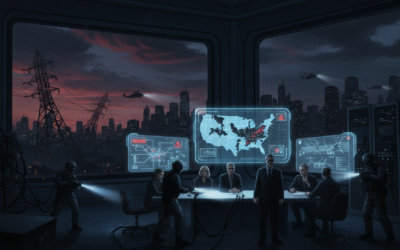
Since the September 11, 2001 attacks, an estimated 5,000 American civilians have been killed by police officers — a figure roughly equivalent to the number of U.S. soldiers killed in the Iraq war during the same period. The statistics have prompted difficult questions about the nature of policing in the United States and whether the escalating use of military equipment and tactics by local departments has fundamentally altered the relationship between law enforcement and the communities they serve.
The Scale of Police-Involved Killings
Estimates suggest that between 500 and 1,000 Americans are killed by police officers annually, though precise numbers remain elusive because the U.S. government has not maintained a comprehensive database of police-involved shootings. Individual police departments are not required to submit data on their officers’ use of deadly force, leaving citizens, journalists, and independent researchers to compile records from published reports.
According to analysis based on official data, Americans are statistically eight times more likely to be killed by a police officer than by a terrorist. This calculation, drawn from a Washington’s Blog analysis of government statistics, highlighted the gap between public perception of threats and the actual risks posed by different actors.
The CATO Institute’s National Police Misconduct Reporting Project documented 4,861 unique reports of police misconduct in 2010 alone, involving 6,613 sworn officers and 6,826 alleged victims. While most allegations involved physical force such as punches or baton strikes, approximately one-quarter of reported cases involved firearms or stun guns.
Racial Disparities in Police Violence
Research has consistently shown that racial minorities bear a disproportionate share of police violence. A 2013 study by the Malcolm X Grassroots Movement found that police officers, security guards, or self-appointed vigilantes killed at least 313 Black people in 2012 — roughly one every 28 hours.
Advocates pointed to cases like that of Rigoberto Arceo, a 34-year-old biomedical technician at St. Francis Medical Center in Southern California, who was shot and killed by police on May 11, 2013. While the Los Angeles County Sheriff’s Department stated that Arceo had advanced on a deputy and attempted to grab his weapon, both his sister and an independent witness said his hands were raised above his head at the time.
The Militarization of Local Police
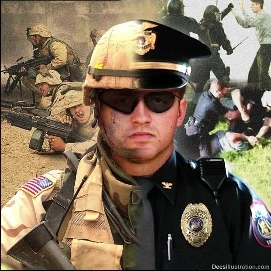
A significant factor in the changing character of American policing has been the transfer of military equipment to local departments. In 1994, Congress passed legislation allowing the Pentagon to donate surplus Cold War military equipment to local law enforcement agencies. This program placed weapons and gear designed for foreign battlefields into the hands of officers patrolling American neighborhoods.
Radley Balko, author of “Rise of the Warrior Cop,” documented how this trend accelerated over time. Writing in the Wall Street Journal, he observed that since the 1960s, law enforcement agencies at every level of government had been blurring the line between police officer and soldier, driven by martial rhetoric and the availability of military-style equipment ranging from M-16 rifles to armored personnel carriers.
The War on Drugs provided much of the operational justification. FBI statistics showed that arrests for marijuana possession outnumbered arrests for all violent crimes combined — 658,231 marijuana possession arrests compared with 521,196 arrests for murder, forcible rape, robbery, and aggravated assault.
Accountability Gaps
Internal review processes consistently failed to hold officers accountable. In Minneapolis, a report found that of 439 cases of police misconduct brought before the city’s misconduct review board, not a single officer was disciplined — despite the city paying $14 million in misconduct-related settlements between 2006 and 2012.
This pattern of unaccountable policing prompted citizens to form volunteer police watch groups in an effort to counter what observers called the “Blue Code of Silence,” the informal practice of officers declining to report misconduct by colleagues.
Officers Who Questioned the Trend
Not all law enforcement professionals supported the escalation. Former Arizona police officer Jon W. McBride argued that concerns about being “outgunned” were often a self-fulfilling prophecy. He warned that without explicit prohibitions, police managers would continually push an arms race, driven by professional literature focused predominantly on acquiring newer weapons and more aggressive techniques.
McBride observed that officers frequently failed to recognize their own role in escalating encounters, and that simple requests often achieved cooperation that aggressive tactics could not. Another anonymous former officer echoed these concerns, calling for a return to traditional community policing and cautioning that the real danger of police work was psychological rather than physical.
The Broader Pattern
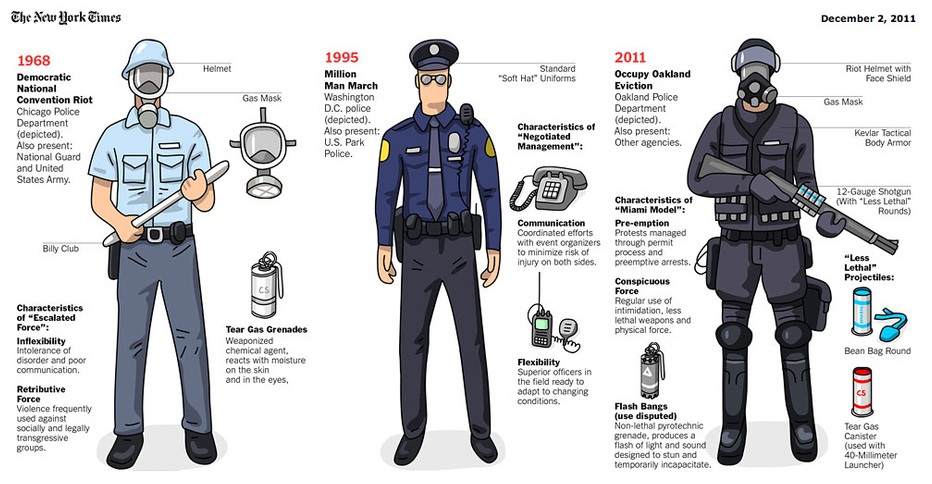
The American Civil Liberties Union summarized the tension: while keeping up with technology was critical for effective policing, the fundamental mission should be protection rather than combat. With more than 900,000 sworn law enforcement officers in the United States and only 120 officer deaths in the line of duty in 2012, critics argued that the level of militarization was disproportionate to the actual threats officers faced.
The trend toward police departments investing in drones, night vision equipment, surveillance cameras, license plate readers, and armored vehicles continued to accelerate, raising ongoing questions about the appropriate balance between officer safety and civil liberties in a democratic society.