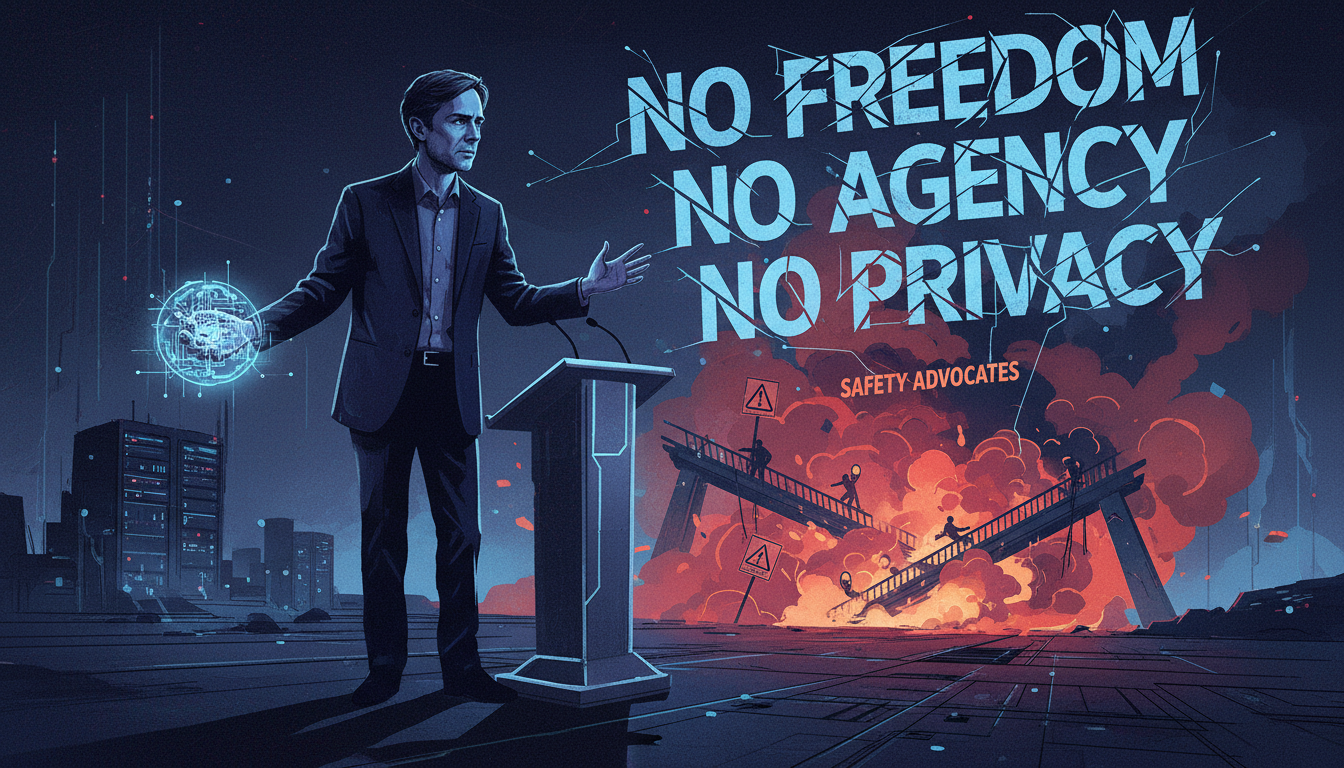
Sam Altman, CEO of OpenAI, stood before a packed Chase Center alongside Y Combinator CEO Garry Tan and described, in his own words, a future where ordinary people have no freedom, no agency, and no privacy. The remarks, which spread rapidly across social media, painted a picture of a world ten years from now in which artificial intelligence cures cancer, produces material abundance, and manages nearly every human need, while human beings are left, in Altman’s own framing, with nothing meaningful to do inside what amounts to a perfected surveillance state.
The phrase that ignited the online firestorm was unambiguous: “You will have no freedom. You will have no agency.” Fact-checkers were quick to contextualize it, Altman was, technically, describing a dystopian outcome he said society should avoid, not a blueprint he was advocating for. Read the full transcript and that framing holds. But that defense, however accurate in the narrow sense, raises a far more consequential set of questions about who is doing the building, who is accelerating the timeline, and who, exactly, Altman identifies as the real source of danger.
The Warning Comes From the Architect
There is a meaningful difference between a policy researcher warning about the dangers of unchecked artificial intelligence development and the CEO of one of the most powerful AI companies on earth doing the same. Altman is not a detached observer. He runs OpenAI, the organization behind ChatGPT. He is raising hundreds of billions of dollars, consuming vast amounts of electricity, building out enormous data center infrastructure, and driving AI into nearly every corner of modern life.
When the person holding the steering wheel tells you the car might go off a cliff, the responsible question is not only “did he mean it as a warning?” It is also: “Why is he still accelerating?”
Altman’s remarks at the Chase Center event acknowledged that the trajectory of AI development could produce a world where surveillance replaces freedom and comfort substitutes for agency. He did not announce he was stopping. He did not announce he was slowing down. He continued, as he has consistently done, to position OpenAI at the center of an accelerating technological transformation that he himself describes as potentially civilization-altering.
Who Altman Says Is the Real Problem
The most structurally revealing element of Altman’s remarks was not the dystopian vision itself, it was his diagnosis of what would cause it. According to Altman, the surveillance state scenario could emerge because society “overreacts to AI safety.”
In other words: the danger does not primarily come from the companies collecting mountains of personal data, centralizing economic power, replacing workers, or building systems that even their own engineers acknowledge they cannot always fully predict or control. According to the person leading one of those companies, the danger comes from the people demanding oversight.
This is a significant claim, and it deserves to be examined clearly. Altman positioned AI safety advocates, regulators, and the broader public asking hard questions about AI development as the agents most likely to produce the dystopian outcome he described. The implicit argument is that if governments and institutions clamp down in response to AI risks, the result will be a world of restricted freedom, and therefore the people raising safety concerns are, paradoxically, the threat to human liberty.
That framing is convenient for anyone who wants to build without meaningful external constraint. It positions the builder as the responsible adult who understands the risks, while casting critics, researchers, and regulators as the reckless actors. It allows Altman to acknowledge the dangers of the technology he is developing, assign the blame for those dangers to his critics, and then return to headquarters to continue accelerating that same development.
The Underclass Question
Altman also addressed, and dismissed, concerns that AI development could produce a permanent economic underclass, a segment of the population structurally locked out of the prosperity that advanced AI might generate for those at the top of the system. He called that idea “dumb” and stated that if it were true, the world would be, in his words, “totally fucked.”
That is a notable choice of standard. The question of whether AI-driven economic concentration will benefit broadly distributed populations or deepen existing inequalities is one of the central policy debates of this technological moment. Dismissing it with an expletive-laced assertion does not resolve it. And notably, Altman’s own description of the worst-case AI future, comfort provided by machines, human beings stripped of meaningful work and self-determination, maps closely onto the very underclass scenario he dismissed.
A world where AI handles nearly every human need, where people have no agency and no meaningful role, is not obviously distinguishable from a world where a technological and economic elite controls the infrastructure of daily life while the majority of the population becomes structurally dependent on systems they do not own or govern.
Context: A Viral Moment and Its Limits
The remarks spread widely in part through a viral TikTok clip, which prompted significant public backlash. News.com.au reported that the clip showed Altman warning of a future with “no freedom,” “no agency,” and “no privacy”, and noted that online reaction was swift and largely alarmed, even after the fuller context of his remarks was circulated.
That context matters, but it does not fully neutralize the concern. The fact that Altman was describing a scenario he framed as undesirable does not change the underlying architecture of the situation: he leads an organization that is, by his own account, building toward a technological inflection point with no clear precedent in human history, with a governance structure and regulatory environment that has not kept pace with the pace of development, and with a public explanation for why the greatest risks come from those urging caution rather than from those driving acceleration.
What the Remarks Actually Illuminate
Taken together, Altman’s comments at Chase Center illuminate several things worth sitting with. First, the person most responsible for accelerating the development of transformative AI technology openly acknowledges that one plausible outcome is a world without individual freedom or privacy. Second, his diagnosis locates the primary risk not in the technology or its developers, but in the societal response, specifically, in oversight and safety advocacy. Third, he dismissed concerns about structural inequality produced by AI as not worth serious engagement.
None of this requires attributing malicious intent to Altman personally. It does require paying attention to the structural logic of what he is describing. A technology that its own leading developer acknowledges could produce a surveillance state, being built at unprecedented scale and speed, by a company whose CEO argues that the people demanding slower, more accountable development are the real danger, that is a set of facts that warrant scrutiny, regardless of how any individual statement is framed in context.
The question is not whether Altman meant his remarks as a warning. The question is whether warnings from the person building the thing have any operational meaning if the building continues unabated.
Conclusion: Warning as Performance, or Warning as Reckoning?
Altman’s remarks at the Chase Center were covered as a controversy about context, did he mean it or didn’t he? That framing allows the most important content of what he said to slide past without examination. He described a plausible future that strips human beings of freedom and agency. He identified safety advocates as the primary cause of that risk. He dismissed economic inequality concerns as not worth serious consideration. And then he returned to building.
The gap between articulating a danger and taking responsibility for not producing it is precisely where citizens, policymakers, and anyone affected by AI development, which is to say, everyone, should be paying the closest attention. Warnings from architects are only meaningful if the architecture changes.
This article draws on reporting from Activist Post and News.com.au.