Google AdSense Payout Policy: Anonymous Leaker Speaks

I am a former Google employee and I am writing this to leak information to the public of what I
witnessed and took part in while being an employee. My position was to deal with AdSense accounts,
more specifically the accounts of publishers (not advertisers). I was employed at Google for a period of
several years in this capacity.
Having signed many documents such as NDA’s and non-competes, there are many repercussions for me,
especially in the form of legal retribution from Google. I have carefully planned this leak to coincide with
certain factors in Google such as waiting for the appropriate employee turn around so that my identity
could not be discovered.
To sum it up for everyone, I took part in what I (and many others) would consider theft of money from
the publishers by Google, and from direct orders of management. There were many AdSense employees
involved, and it spanned many years, and I hear it still is happening today except on a much wider scale.
No one on the outside knows it, if they did, the FBI and possibly IRS would immediately launch an
investigation, because what they are doing is so inherently illegal and they are flying completely under
the radar.
It began in 2009. Everything was perfectly fine prior to 2009, and in fact it couldn’t be more perfect from
an AdSense employees perspective, but something changed.
Google Bans and Ban Criteria
Before December 2012:
In the first quarter of 2009 there was a “sit-down” from the AdSense division higher ups to talk about
new emerging issues and the role we (the employees in the AdSense division needed to play. It was a
very long meeting, and it was very detailed and intense. What it boiled down to was that Google had
suffered some very serious losses in the financial department several months earlier. They kept saying
how we “needed to tighten the belts” and they didn’t want it to come from Google employees pockets.
So they were going to (in their words) “carry out extreme quality control on AdSense publishers”. When
one of my fellow co-workers asked what they meant by that. Their response was that AdSense itself
hands out too many checks each month to publishers, and that the checks were too large and that
needed to end right away. Many of the employees were not pleased about this (like myself). But they
were successful in scaring the rest into thinking it would be their jobs and their money that would be on
the line if they didn’t participate. The meeting left many confused as to how this was going to happen.
What did they mean by extreme quality control? A few other smaller meetings occur with certain key
people in the AdSense division that furthered the idea and procedure they planned on implementing.
There were lots of rumors and quiet talking amongst the employees, there was lots of speculations,
some came true and some didn’t. But the word was that they were planning to cut off a large portion of
publisher’s payments.
After that point there was a running gag amongst fellow co-workers where we would walk by each other
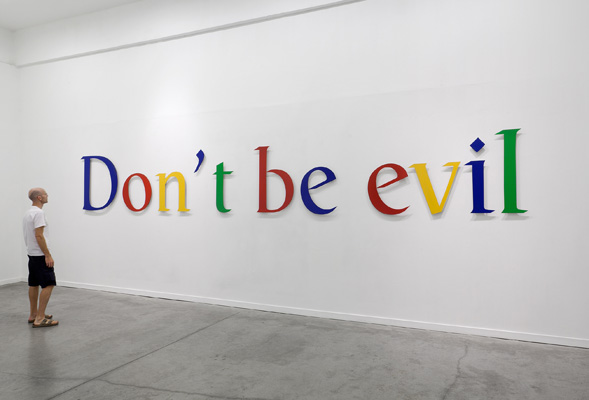
and whisper “Don’t be evil, pft!” and roll our eyes.
What happened afterwards became much worse. Their “quality control” came into full effect. Managers
pushed for wide scale account bans, and the first big batch of bans happened in March of 2009. The
main reason, the publishers made too much money. But something quite devious happened. We were
told to begin banning accounts that were close to their payout period (which is why account bans never
occur immediately after a payout). The purpose was to get that money owed to publishers back to
Google AdSense, while having already served up the ads to the public.
This way the advertiser’s couldn’t claim we did not do our part in delivering their ads and ask for money
back. So in a sense, we had thousands upon thousands of publishers deliver ads we knew they were
never going to get paid for.
Google reaped both sides of the coin, got money from the advertisers, used the publishers, and didn’t
have to pay them a single penny. We were told to go and look into the publishers accounts, and if any
publisher had accumulated earnings exceeding $5000 and was near a payout or in the process of a
payout, we were to ban the account right away and reverse the earnings back. They kept saying it was
needed for the company, and that most of these publishers were ripping Google off anyways, and that
their gravy train needed to end. Many employees were not happy about this. A few resigned over it.
I did not. I stayed because I had a family to support, and secondly I wanted to see how far they would
go.
From 2009 to 2012 there were many more big batches of bans. The biggest of all the banning sessions
occurred in April of 2012. The AdSense division had enormous pressure from the company to make up
for financial losses, and for Google’s lack of reaching certain internal financial goals for the quarter prior.
So the push was on. The employees felt really uneasy about the whole thing, but we were threatened
with job losses if we didn’t enforce the company’s wishes. Those who voiced concerned or issue were
basically ridiculed with “not having the company’s best interest in mind” and not being “team players”.
Morale in the division was at an all-time low. The mood of the whole place changed quite rapidly. It no
longer was a fun place to work.
The bans of April 2012 came fast and furious. Absolutely none of them were investigated, nor were they
justified in any way. We were told to get rid of as many of the accounts with the largest
checks/payouts/earnings waiting to happen. No reason, just do it, and don’t question it. It was heart
wrenching seeing all that money people had earned all get stolen from them. And that’s what I saw it as,
it was a robbery of the AdSense publishers. Many launched appeals, complaints, but it was futile
because absolutely no one actually took the time to review the appeals or complaints. Most were simply
erased without even being opened, the rest were deposited into the database, never to be touched
again.
Several publishers launched legal actions which were settled, but Google had come up with a new policy
to deal with situations such as that because it was perceived as a serious problem to be avoided.
So they came up with a new policy.
After December 2012: The New Policy
The new policy; “shelter the possible problem makers, and fuck the rest” (those words were actually
said by a Google AdSense exec) when he spoke about the new procedure and policy for “Account
Quality Control”.
The new policy was officially called AdSense Quality Control Color Codes (commonly called AQ3C by
employees). What it basically was a categorization of publisher accounts. Those publisher’s that could
do the most damage by having their account banned were placed in a VIP group that was to be left
alone. The rest of the publishers would be placed into other groupings accordingly.
The new AQ3C also implemented “quality control” quotas for the account auditors, so if you didn’t meet
the “quality control” target (aka account bans) you would be called in for a performance review.
There were four “groups” publishers could fall into if they reached certain milestones.
They were:
Red Group: Urgent Attention Required
Any AdSense account that reaches the $10,000/month mark is immediately flagged (unless they are part
of the Green Group).
– In the beginning there were many in this category, and most were seen as problematic and were seen
as abusing the system by Google. So every effort was taken to bring their numbers down.
– They are placed in what employees termed “The Eagle Eye”, where the “AdSense Eagle Eye Team”
would actively and constantly audit their accounts and look for any absolute reason for a ban. Even if
the reason was far-fetched, or unsubstantiated, and unprovable, the ban would occur. The “Eagle Eye
Team” referred to a group of internal account auditors whose main role was to constantly monitor
publisher’s accounts and sites.
– A reason has to be internally attached to the account ban. The problem was that notifying the
publisher for the reason is not a requirement, even if the publisher asks. The exception: The exact
reason must be provided if a legal representative contacts Google on behalf of the account holder.
– But again, if a ban is to occur, it must occur as close to a payout period as possible with the most
amount of money accrued/earned.
Yellow Group: Serious Attention Required
Any AdSense account that reaches the $5,000/month mark is flagged for review (unless they are part of
the Green Group).
– All of the publisher’s site(s)/account will be placed in queue for an audit.
– Most of the time the queue is quite full so most are delayed their audit in a timely fashion.
– The second highest amount of bans occur at this level.
– A reason has to be internally attached to the account ban. Notifiying the publisher for the reason is not
a requirement, even if the publisher asks. The exception: The exact reason must be provided if a legal
representative contacts Google on behalf of the account holder.
– But again, if a ban is to occur, it must occur as close to a payout period as possible with the most
amount of money accrued/earned.
Blue Group: Moderate Attention Required
Any AdSense account that reaches the $1,000/month mark is flagged for possible review (unless they
are part of the Green Group).
– Only the main site and account will be place in queue for what is called a quick audit.
– Most bans that occur happen at this level. Main reason is that a reason doesn’t have to be attached to
the ban, so the employees use these bans to fill their monthly quotas. So many are simply a random pick
and click.
– A reason does not have to be internally attached to the account ban. Notifying the publisher for the
reason is not a requirement, even if the publisher asks.
– But again, if a ban is to occur, it must occur as close to a payout period as possible with the most
amount of money accrued.
Green Group: VIP Status (what employees refer to as the “untouchables”)
Any AdSense account associated with an incorporated entity or individual that can inflict serious
damage onto Google by negative media information, rallying large amounts of anti-AdSense support, or
cause mass loss of AdSense publisher support.
– Google employees wanting to use AdSense on their websites were automatically placed in the Green
group. So the database contained many Google insiders and their family members. If you work or
worked for Google and were placed in the category, you stayed in it, even if you left Google. So it
included many former employees. Employees simply had to submit a form with site specific details and
their account info.
– Sites in the Green Group were basically given “carte blanche” to do anything they wanted, even if they
flagrantly went against the AdSense TOS and Policies. That is why you will encounter sites with AdSense,
but yet have and do things completely against AdSense rules.
– Extra care is taken not to interrupt or disrupt these accounts.
– If an employee makes a mistake with a Green Level account they can lose their job. Since it seen as
very grievous mistake.
New Policy 2012 Part 2:
Internal changes to the policy were constant. They wanted to make it more efficient and streamlined.
They saw its current process as having too much human involvement and oversight. They wanted it
more automated and less involved.
So the other part of the new policy change was to incorporate other Google services into assisting the
“quality control” program. What they came up with will anger many users when they find out. It
involved skewing data in Google Analytics. They decided it was a good idea to alter the statistical data
shown for websites. It first began with just altering data reports for Analytics account holders that also
had an AdSense account, but they ran into too many issues and decided it would be simpler just to skew
the report data across the board to remain consistent and implement features globally.
So what this means is that the statistical data for a website using Google Analytics is not even close to
being accurate. The numbers are incredibly deflated. The reasoning behind their decision is that if an
individual links their AdSense account and their Analytics account, the Analytics account can be used to
deflate the earnings automatically without any human intervention. They discovered that if an individual
had an AdSense account then they were also likely to use Google Analytics. So Google used it to their
advantage.
This led to many publishers to actively display ads, without earning any money at all (even to this day).
Even if their actual website traffic was high, and had high click-throughs the data would be automatically
skewed in favor of Google, and at a total loss of publishers. This successfully made it almost impossible
for anyone to earn amounts even remotely close what individuals with similar sites were earning prior
to 2012, and most definitely nowhere near pre-2009 earnings.
Other policy changes also included how to deal with appeals, which still to this day, the large majority
are completely ignored, and why you will rarely get an actual answer as to why your account was
banned and absolutely no way to resolve it.
—-
The BIG Problem (which Google is aware of)
There is an enormous problem that existed for a long time in Google’s AdSense accounts. Many of the
upper management are aware of this problem but do not want to acknowledge or attempt to come up
with a solution to the problem.
It is regarding false clicks on ads. Many accounts get banned for “invalid clicks” on ads. In the past this
was caused by a publisher trying to self inflate click-throughs by clicking on the ads featured on their
website. The servers automatically detect self-clicking with comparison to IP addresses and other such
information, and the persons account would get banned for invalid clicking.
But there was something forming under the surface. A competitor or malicious person would actively go
to their competitor’s website(s) or pick a random website running AdSense and begin multiple-clicking
and overclicking ads, which they would do over and over again. Of course this would trigger an invalid
clicking related ban, mainly because it could not be proven if the publisher was actually behind the
clicking. This was internally referred to as “Click-Bombing”. Many innocent publishers would get caught
up in bans for invalid clicks which they were not involved in and were never told about.
This issue has been in the awareness of Google for a very long time but nothing was done to rectify the
issue and probably never will be. Thus if someone wants to ruin a Google AdSense publishers account,
all you would have to do is go to their website, and start click-bombing their Google Ads over and over
again, it will lead the servers to detect invalid clicks and poof, they get banned. The publisher would be
completely innocent and unaware of the occurrence but be blamed for it anyways.
—-
Their BIG Fear
The biggest fear that Google has about these AdSense procedures and policies is that it will be publicly
discovered by their former publishers who were banned, and that those publishers unite together and
launch an class-action lawsuit.
They also fear those whose primary monthly earnings are from AdSense, because in many countries if a
person claims the monthly amount to their tax agency and they state the monthly amount and that they
are earning money from Google on a monthly basis, in certain nations technically Google can be seen as
an employer. Thus, an employer who withholds payment of earnings, can be heavily fined by
government bodies dealing with labor and employment. And if these government bodies dealing with
labor and employment decide to go after Google, then it would get very ugly, very quickly ….. that is on
top of a class-action lawsuit.