Jul 19, 2015 | Globalist Corporations, News
So I’m certain you’ve seen the news non stop, Chapo escaped, again. Happened on a Saturday night, he disappeared from the view of a surveillance camera in his cell and went underground into a tunnel under the Altiplano maximum security prison and wasn’t seen again. That’s the summary of the official story, and the video does appear to show that he went out through the tunnel dug where his shower was located. The story being spun is that since they couldn’t see him escape because Chapo was in a blind spot for the cameras. The authorities stated that out of respect for “human rights” they didn’t want to invade a prisoner’s privacy by placing a surveillance camera that could look into the shower area. That’s their trick up their sleeve, and the one that brings the story down.
An ex prisoner of the very same jail Chapo was doing time in said there is no respect for human rights let alone privacy rights in that prison. The authorities made it seem like they thought Chapo might have just been getting ready to shower. The ex prisoner explained that showers at night are not allowed. You can only shower once, at six in the morning. So there goes that part. He also states that there are indeed cameras that can see into the shower, even the toilet. That you’re only allowed ten minutes in the shower but really about 8 since the guards rush the prisoners to finish. He says the only blind spot in a jail cell at Altiplano is under your bed. You have to take into account that the authorities have stressed that the reason for these so called blind spots, is their concern for human rights. Okay.
If you’ve read enough about the Mexican government and their many hands, then you know that the last thing on their mind is a concern for human rights for its citizens. You can look at a photo of what police did to a young student that will verify that, Google that if you would like to but a face ripped off isn’t something I recommend you look at. The Mexican authorities aren’t concerned with human rights for its citizens let alone prisoners. The conditions at that jail and many others throughout Mexico are nightmarish. Put aside that we all know they don’t care about privacy, because don’t forget about this right here.
Secretary of the Interior Osorio Chong had repeatedly stated that the reason for the blind spots was out of respect for human rights, that turned into backlash as people began to say they looked the other way. He had to state that respecting human rights for a prisoner is not the same as helping them escape. That is true, it isn’t the same thing, but he wasn’t respecting human rights, so let’s get that straight.
It was obvious from the beginning of the story that Chapo must have had help from the inside, and you could ask any Mexican if they thought he had bought his way out and they’ll laugh and explain to you how reasoning works. It was confirmed that several prison workers including the director of Altiplano were detained for their alleged roles in Chapo’s escape. The former prisoner however stated that Chapo needed to have four departments under his control in that prison because of its maximum security status. He needed to control the federal, the prison guards, the prison officials and the special guards. So obviously he was able to do that, since he’s out of prison. Outside the prison is another link of the story of how Chapo was released.
The house at the end of the tunnel had no permit to be built. How could a maximum security prison not notice a building being built not far from its walls? You can say that Mexican authorities are very relaxed with their regulations, but a maximum security prison that houses the most wanted criminals is something else. Not only did it house Chapo, it had the leader of The Zetas Cartel, leader of the Knights Templar Cartel, “La Barbie” of the Beltran-Leyva Cartel, it is the prison of the most high profile cartel leaders. Surely they would notice a house being built about a mile from their walls, right? People familiar with the area have stated how secure that entire area is, you can’t even pick up radio signals there. With regards to how Chapo could’ve pulled this off, again, it isn’t how but why. Chapo didn’t escape if the authorities allowed all the pieces to be put into place for him to leave. He didn’t escape, he just left. He left behind a nice gift at least. That little bracelet used to monitor his location.
The bracelet that kept track of him doesn’t work outside the prison walls, pretty neat feature there for a maximum security prison. That’s another story in itself, the bracelet isn’t of importance because he removed it before going down the tunnel. How did he remove it so easily? What kind of bracelet for prisoner monitoring be so easily removable? Well, it was left behind and even if he couldn’t remove it, it would have stopped working once he was out. To be honest, he could have a huge lighthouse blaring out his location on top of his head and the authorities will still not find him, because they’re not looking for him. They released him. Well, for certain the local authorities did.
Shit rolls downhill, and so does money. This is an embarrassment for the upper echelons of power. President Enrique Peña Nieto is looking like quite the fool for being en route to France as the most prolific drug trafficker in the world just slipped out of prison on a motorcycle through a tunnel. Secretary of the Interior Osorio Chong looked like he was about to suffer an anxiety attack as he held a press conference over Chapo’s escape. They might not be happy about it, but certainly the lower level officials have quite a nice family retirement plan because of this. Sorry, us Mexicans usually think about, “I hope my family is taken care of” not, “I hope the president and the top brass is happy.” I can assure you, anyone involved in letting Chapo go aren’t worrying about the future of their family. They might go to jail, but just like those who sacrifice their being to work endlessly in the US to send money back home to ensure their families are taken care of, that’s all that matters. Speaking of money, that might be the key to the whole story.
Not going to get into specifics here, but the biggest buzz from the Left in Mexico on this story is, the bigger picture. Yeah Chapo is the head of arguably the biggest and most powerful cartel in the world. It was that way when he was in jail, and when he wasn’t in jail. So why all the effort to find him, arrest him, jail him? Well, the biggest bit on that has to do with a general goal with the EPN administration. Privatization and more oversight from the US government over Mexico. There has been talks about the need to privatize Mexican prisons, among other neoliberal proposals such as in the education sector which has met with fierce resistance from education workers. There’s lots of quotes in US media from law enforcement agents saying this is an embarrassment for the corrupt and weak Mexican judicial system, that it needs more US assistance, and you get the idea. This of course is the US lead war on drugs, and they have the final say and if need be, final action. Loretta Lynch went as far to say that the US is ready to “help” Mexico find and capture Chapo. Anytime the US says they’re ready to help another country find “justice” well you know how that story ends. Sovereignty or any resemblance to it not only flies out the window, it leaves a bloody mess. Wow, sorry but I’m looking at this post and it is rather long and tedious to write and I’m certain it’s getting tedious to read as well so I’ll break this down to the core, just a moment.
The rumors, Chapo was allowed to walk right out the front door of the prison. Let’s say that was the truth, that the tunnel was just a prop to assist this novela like story streaming from the TV networks. Even if it wasn’t, his release, yes release, serves a powerful purpose. Either the Mexican state is weak and corrupt, it is. Or, it’s another excuse for a “soft” intervention from the US. It can be both, it most certainly feels that way. We forget the War on Drugs is an actual war, and propaganda is a tool of war. You can point to the bad guy and say that’s enough reason to go to war, but at least recognize that this is part of a war. So treat it like one. Bin Laden was sought after in the War on Terror and many innocent people died going after the bad guy. Remember that lives are a factor here, it’s war after all.
source: MexicanAnarchist.WordPress.com
Apr 9, 2014 | 2020 Relevant, Events & Assassinations, Leaks, News
The Blaze A high-ranking Mexican drug cartel operative currently in U.S. custody is making startling allegations that the failed federal gun-walking operation known as “Fast and Furious” isn’t what you think it is.
It wasn’t about tracking guns, it was about supplying them — all part of an elaborate agreement between the U.S. government and Mexico’s powerful Sinaloa Cartel to take down rival cartels.
The explosive allegations are being made by Jesus Vicente Zambada-Niebla, known as the Sinaloa Cartel’s “logistics coordinator.” He was extradited to the Chicago last year to face federal drug charges.
Zambada-Niebla claims that under a “divide and conquer” strategy, the U.S. helped finance and arm the Sinaloa Cartel through Operation Fast and Furious in exchange for information that allowed the DEA, U.S. Immigration and Customs Enforcement (ICE) and other federal agencies to take down rival drug cartels. The Sinaloa Cartel was allegedly permitted to traffic massive amounts of drugs across the U.S. border from 2004 to 2009 — during both Fast and Furious and Bush-era gunrunning operations — as long as the intel kept coming.
This pending court case against Zambada-Niebla is being closely monitored by some members of Congress, who expect potential legal ramifications if any of his claims are substantiated. The trial was delayed but is now scheduled to begin on Oct. 9.
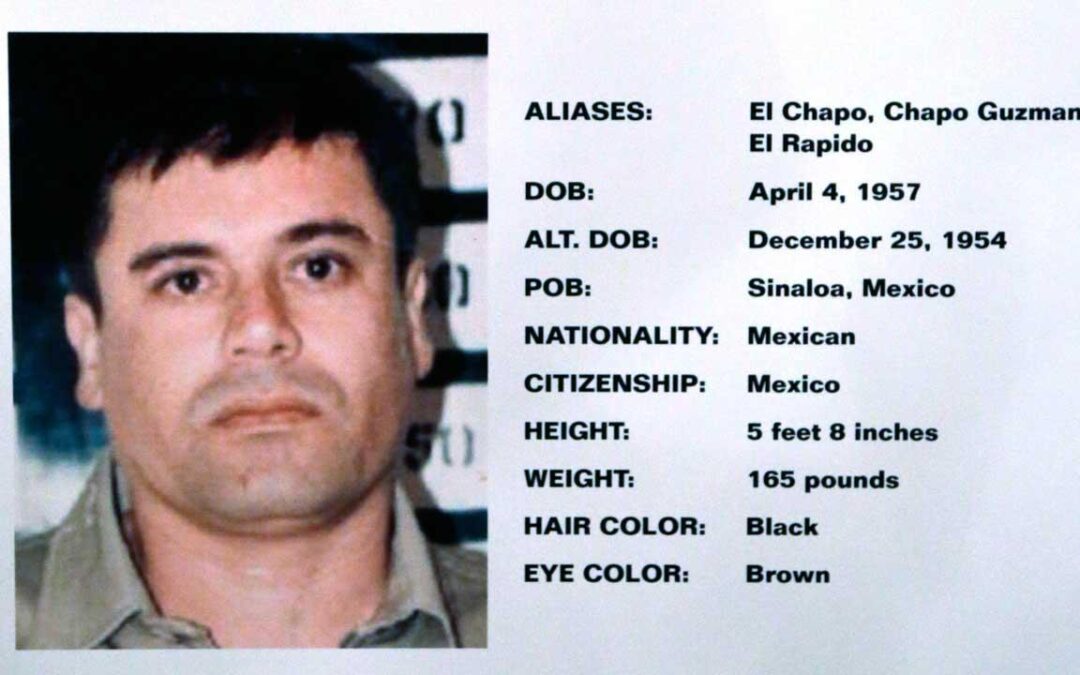
Zambada-Niebla is reportedly a close associate of Sinaloa Cartel kingpin Joaquin “El Chapo” Guzman and the son of Ismael “Mayo” Zambada-Garcia, both of which remain fugitives, likely because of the deal made with the DEA, federal court documents allege.
Based on the alleged agreement ”the Sinaloa Cartel under the leadership of defendant’s father, Ismael Zambada-Niebla and ‘Chapo’ Guzman, were given carte blanche to continue to smuggle tons of illicit drugs into Chicago and the rest of the United States and were also protected by the United States government from arrest and prosecution in return for providing information against rival cartels which helped Mexican and United States authorities capture or kill thousands of rival cartel members,” states a motion for discovery filed in U.S. District Court by Zambada-Niebla’s attorney in July 2011.
A source in Congress, who spoke to TheBlaze on the condition of anonymity, said that some top congressional investigators have been keeping “one eye on the case.” Another two members of Congress, both lead Fast and Furious Congressional investigators, told TheBlaze they had never even heard of the case.
One of the Congressmen, who also spoke to TheBlaze on the condition of anonymity because criminal proceedings are still ongoing, called the allegations “disturbing.” He said Congress will likely get involved once Zambada-Niebla’s trial has concluded if any compelling information surfaces.
“Congress won’t get involved in really any criminal case until the trial is over and the smoke has cleared,” he added. “If the allegations prove to hold any truth, there will be some serious legal ramifications.”
Earlier this month, two men in Texas were sentenced to 70 and 80 months in prison after pleading guilty to attempting to export 147 assault rifles and thousands of rounds of ammunition to Mexico’s Los Zetas cartel. Compare that to the roughly 2,000 firearms reportedly “walked” in Fast and Furious, which were used in the murders of hundreds of Mexican citizens and U.S. Border Agent Brian Terry, and some U.S. officials could potentially face jail time if they knowingly armed the Sinaloa Cartel and allowed guns to cross into Mexico.
If proven in court, such an agreement between U.S. law enforcement agencies and a Mexican cartel could potentially mar both the Bush and Obama administrations. The federal government is denying all of Zambada-Niebla’s allegations and contend that no official immunity deal was agreed upon.
To be sure, Zambada-Niebla is a member of one of the most ruthless drug gangs in all of Mexico, so there is a chance that he is saying whatever it takes to reduce his sentence, which will likely be hefty. However, Congress and the media have a duty to prove without a reasonable doubt that there is no truth in his allegations. So far, that has not been achieved.
Zambada-Niebla was reportedly responsible for coordinating all of the Sinaloa Cartel’s multi-ton drug shipments from Central and South American countries, through Mexico, and into the United States. To accomplish this, he used every tool at his disposal: Boeing 747 cargo planes, narco-submarines, container ships, speed boats, fishing vessels, buses, rail cars, tractor trailers and automobiles. But Guzman and Zambada-Niebla’s overwhelming success within the Sinaloa Cartel was largely due to the arrests and dismantling of many of their competitors and their booming businesses in the U.S. from 2004 to 2009 — around the same time ATF’s gun-walking operations were in full swing. Fast and Furious reportedly began in 2009 and continued into early 2011.
According Zambada-Niebla, that was a product of the collusion between the U.S. government and the Sinaloa Cartel.
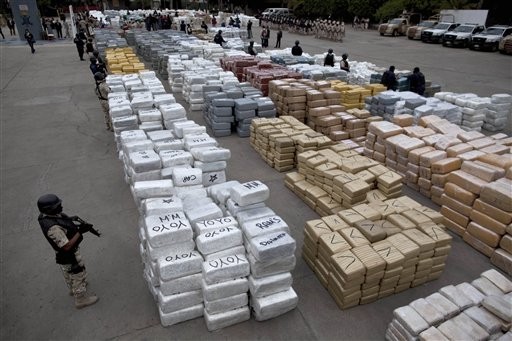
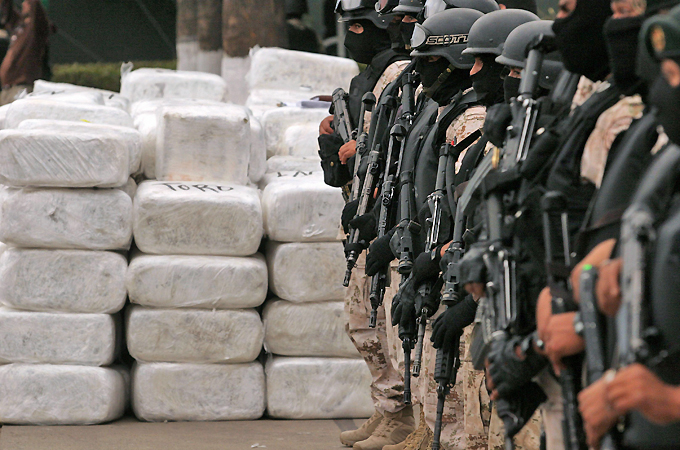
Soldiers and police officers guard packages of seized marijuana during a presentation for the media in Tijuana, Mexico. (AP Photo/Guillermo Arias)
The claims seem to fall in line with statements made last month by Guillermo Terrazas Villanueva, a spokesman for the Chihuahua state government in northern Mexico who said U.S. agencies ”don’t fight drug traffickers,“ instead ”they try to manage the drug trade.”
Also, U.S. officials have previously acknowledged working with the Sinaloa Cartel through another informant, Humberto Loya-Castro. He is also allegedly a high-ranking member of the Sinaloa Cartel as well as a close confidant and lawyer of “El Chapo” Guzman.
Loya-Castro was indicted along with Chapo and Mayo in 1995 in the Southern District of California in a massive narcotics trafficking conspiracy (Case no. 95CR0973). The case was dismissed in 2008 at the request of prosecutors after Loya became an informant for the United States government and subsequently provided information for years.
In 2005, “the CS (informant Loya-Castro) signed a cooperation agreement with the United States Attorney’s Office for the Southern District of California,” states an affidavit filed in the Zambada-Niebla case by Loya-Castro’s handler, DEA agent Manuel Castanon.
“Thereafter, I began to work with the CS. Over the years, the CS’ cooperation resulted in the seizure of several significant loads of narcotics and precursor chemicals. The CS’ cooperation also resulted in other real-time intelligence that was very useful to the United States government.”
Under the alleged agreement with U.S. agencies, “the Sinaloa Cartel, through Loya-Castro, was to provide information accumulated by Mayo, Chapo, and others, against rival Mexican Drug Trafficking Organizations to the United States government,” a motion for discovery states.
In return, the United States government allegedly agreed to dismiss the charges in the pending case against Loya-Castro (which they did), not to interfere with his drug trafficking activities and those of the Sinaloa Cartel and not actively prosecute him or the Sinaloa Cartel leadership.
Taken directly from the motion filed in federal court:
“This strategy, which he calls ‘Divide & Conquer,’ using one drug organization to help against others, is exactly what the Justice Department and its various agencies have implemented in Mexico. In this case, they entered into an agreement with the leadership of the Sinaloa Cartel through, among others, Humberto Loya-Castro, to receive their help in the United States government’s efforts to destroy other cartels.”
“Indeed, United States government agents aided the leaders of the Sinaloa Cartel.”
The government has denied this and says the deal did not go past Loya-Castro.
Zambada-Niebla was arrested by Mexican soldiers in late March of 2009 after he met with DEA agents at a Mexico City hotel in a meeting arranged by Loya-Castro, though the U.S. government was not involved in his arrest. He was extradited to Chicago to face federal drug charges on Feb. 18, 2010. He is now being held in a Michigan prison after requesting to be moved from Chicago.
“Classified Materials”
During his initial court proceedings, Zambada-Niebla continually stated that he was granted full immunity by the DEA in exchange for his cooperation. The agency, however, argues that an “official” immunity deal was never established though they admit he may have acted as an informant.
Zambada-Niebla and his legal council also requested records about Operation Fast and Furious, which permitted weapons purchased in the United States to be illegally smuggled into Mexico, sometimes by paid U.S. informants and cartel leaders. Their request was denied. From the defense motion:
“It is estimated that approximately 3,000 people were killed in Mexico as a result of ‘Operation Fast and Furious,’ including law enforcement officers in the state of Sinaloa, Mexico, the headquarters of the Sinaloa cartel. The Department of Justice’s leadership apparently saw this as an ingenious way of combating drug cartel activities.”
“It has recently been disclosed that in addition to the above-referenced problems with ‘Operation Fast & Furious,’ the DOJ, DEA, and the FBI knew that some of the people who were receiving the weapons that were being allowed to be transported to Mexico, were in fact informants working for those organizations and included some of the leaders of the cartels.”
Zambada’s attorney has filed several motions for discovery to that effect in Illinois Federal District Court, which were summarily denied by the presiding judge who claimed the defendant failed to make the case that he was actually a DEA informant.
In April, 2012, a federal judge refused to dismiss charges against him.
From a Chicago Sun Times report: “According to the government, [Zambada-Niebla] conveyed his interest and willingness to cooperate with the U.S. government, but the DEA agents told him they ‘were not authorized to meet with him, much less have substantive discussions with him,’” the judge wrote.

In this courtroom artist’s drawing Jesus Vincente Zambada-Niebla appears before U.S. District Judge Ruben Castillo Tuesday, Feb. 23, 2010, in Chicago. (AP Photo/Verna Sadock)
In their official response to Zambada-Niebla’s motion for discovery, the federal government confirmed the existence of “classified materials” regarding the case but argued they “do not support the defendant’s claim that he was promised immunity or public authority for his actions.”
Experts have expressed doubts that Zambada-Niebla had an official agreement with the U.S. government, however, agree Loya Castro probably did. Either way, the defense still wants to obtain DEA reports that detail the agency’s relationship with the Sinaloa Cartel and put the agents on the stand, under oath to testify.
The documents that detail the relationship between the federal government and the Sinaloa Cartel have still not been released or subjected to review — citing matters of national security.
via
Jul 24, 2012 | Government Agenda, News

| Juarez, Mexico– The US Central Intelligence Agency and other international security forces “don’t fight drug traffickers”, a spokesman for the Chihuahua state government in northern Mexico has told Al Jazeera, instead “they try to manage the drug trade”.Allegations about official complicity in the drug business are nothing new when they come from activists, professors, campaigners or even former officials. However, an official spokesman for the authorities in one of Mexico’s most violent states – one which directly borders Texas – going on the record with such accusations is unique.
“It’s like pest control companies, they only control,” Guillermo Terrazas Villanueva, the Chihuahua spokesman, told Al Jazeera last month at his office in Juarez. “If you finish off the pests, you are out of a job. If they finish the drug business, they finish their jobs.”
A spokesman for the CIA in Washington wouldn’t comment on the accusations directly, instead he referred Al Jazeera to an official website.
Accusations are ‘baloney’
Villanueva is not a high ranking official and his views do not represent Mexico’s foreign policy establishment. Other more senior officials in Chihuahua State, including the mayor of Juarez, dismissed the claims as “baloney”.
“I think the CIA and DEA [US Drug Enforcement Agency] are on the same side as us in fighting drug gangs,” Hector Murguia, the mayor of Juarez, told Al Jazeera during an interview inside his SUV. “We have excellent collaboration with the US.”
Under the Merida Initiative, the US Congress has approved more than $1.4bn in drug war aid for Mexico, providing attack helicopters, weapons and training for police and judges.
More than 55,000 people have died in drug related violence in Mexico since December 2006. Privately, residents and officials across Mexico’s political spectrum often blame the lethal cocktail of US drug consumption and the flow of high-powered weapons smuggled south of the border for causing much of the carnage.
Drug war ‘illusions’
“The war on drugs is an illusion,” Hugo Almada Mireles, professor at the Autonomous University of Juarez and author of several books, told Al Jazeera. “It’s a reason to intervene in Latin America.”
“The CIA wants to control the population; they don’t want to stop arms trafficking to Mexico, look at [Operation] Fast and Furious,” he said, referencing a botched US exercise where automatic weapons were sold to criminals in the hope that security forces could trace where the guns ended up.
The Bureau of Alcohol Tobacco and Firearms lost track of 1,700 guns as part of the operation, including an AK-47 used in 2010 the murder of Brian Terry, a Customs and Border Protection Agent.
Blaming the gringos for Mexico’s problems has been a popular sport south of the Rio Grande ever since the Mexican-American war of the 1840s, when the US conquered most of present day California, Utah, Nevada, Arizona and New Mexico from its southern neighbour. But operations such as Fast and Furious show that reality can be stranger than fiction when it comes to the drug war and relations between the US and Mexico. If the case hadn’t been proven, the idea that US agents were actively putting weapons into the hands of Mexican gangsters would sound absurd to many.
‘Conspiracy theories’
“I think it’s easy to become cynical about American and other countries’ involvement in Latin America around drugs,” Kevin Sabet, a former senior adviser to the White House on drug control policy, told Al Jazeera. “Statements [accusing the CIA of managing the drug trade] should be backed up with evidence… I don’t put much stake in it.”
Villanueva’s accusations “might be a way to get some attention to his region, which is understandable but not productive or grounded in reality”, Sabet said. “We have sort of ‘been there done that’ with CIA conspiracy theories.”
In 1996, the San Jose Mercury News published Dark Alliance, a series of investigative reports linking CIA missions in Nicaragua with the explosion of crack cocaine consumption in America’s ghettos.
In order to fund Contra rebels fighting Nicaragua’s socialist government, the CIA partnered with Colombian cartels to move drugs into Los Angeles, sending profits back to Central America, the series alleged.
“There is no question in my mind that people affiliated with, or on the payroll of, the CIA were involved in drug trafficking,” US Senator John Kerry said at the time, in response to the series.
Other newspapers, including the Washington Post and the Los Angeles Times, slammed Dark Alliance, and the editor of the Mercury News eventually wrote that the paper had over-stated some elements in the story and made mistakes in the journalistic process, but that he stood by many of the key conclusions.
Widespread rumours
US government has neglected border corruption
|
“It’s true, they want to control it,” a mid-level official with the Secretariat Gobernacion in Juarez, Mexico’s equivalent to the US Department of Homeland Security, told Al Jazeera of the CIA and DEA’s policing of the drug trade. The officer, speaking on the condition of anonymity, said he knew the allegations to be correct, based on discussions he had with US officials working in Juarez.
Acceptance of these claims within some elements of Mexico’s government and security services shows the difficulty in pursuing effective international action against the drug trade.
Jesús Zambada Niebla, a leading trafficker from the Sinaloa cartel currently awaiting trial in Chicago, has said he was working for the US Drug Enforcement Agency during his days as a trafficker, and was promised immunity from prosecution.
“Under that agreement, the Sinaloa Cartel under the leadership of [Jesus Zambada’s] father, Ismael Zambada and ‘Chapo’ Guzmán were given carte blanche to continue to smuggle tonnes of illicit drugs… into… the United States, and were protected by the United States government from arrest and prosecution in return for providing information against rival cartels,” Zambada’s lawyers wrote as part of his defence. “Indeed, the Unites States government agents aided the leaders of the Sinaloa Cartel.”
The Sinaloa cartel is Mexico’s oldest and most powerful trafficking organisation, and some analysts believe security forces in the US and Mexico favour the group over its rivals.
Joaquin “El Chapo”, the cartel’s billionaire leader and one of the world’s most wanted men, escaped from a Mexican prison in 2001 by sneaking into a laundry truck – likely with collaboration from guards – further stoking rumours that leading traffickers have complicit friends in high places.
“It would be easy for the Mexican army to capture El Chapo,” Mireles said. “But this is not the objective.” He thinks the authorities on both sides of the border are happy to have El Chapo on the loose, as his cartel is easier to manage and his drug money is recycled back into the broader economy. Other analysts consider this viewpoint a conspiracy theory and blame ineptitude and low level corruption for El Chapo’s escape, rather than a broader plan from government agencies.
Political changes
After an election hit by reported irregularities, Enrique Pena Nieto from the Institutional Revolutionary Party (PRI) is set to be sworn in as Mexico’s president on December 1.
He wants to open a high-level dialogue with the US about the drug war, but has said legalisation of some drugs is not an option. Some hardliners in the US worry that Nieto will make a deal with some cartels, in order to reduce violence.
“I am hopeful that he will not return to the PRI party of the past which was corrupt and had a history of turning a blind eye to the drug cartels,” said Michael McCaul, a Republican Congressman from Texas.
Regardless of what position a new administration takes in order to calm the violence and restore order, it is likely many Mexicans – including government officials such as Chihuahua spokesman Guillermo Villanueva – will believe outside forces want the drug trade to continue.
The widespread view linking the CIA to the drug trade – whether or not the allegations are true – speaks volumes about officials’ mutual mistrust amid ongoing killings and the destruction of civic life in Mexico.
“We have good soldiers and policemen,” Villanueva said. “But you won’t resolve this problem with bullets. We need education and jobs.”
Follow Chris Arsenault on Twitter: @AJEchris
Source: