Aug 16, 2012 | Leaks, News
The text below is translated from the official Spanish transcript of today’s press statement issued by Ecuadorian Foreign Minister Ricardo Patiño Aroca
, explaining Ecuador’s decision to grant asylum to Julian Assange. Here is a backup text in case Ecuadorian govt. website goes down : backup 1, backup 2.
This translation was crowd-sourced with the help of @DUVFree, BCK, BM, and other anonymous volunteers. Thanks for your contribution!
Note: links inserted in brackets have been added by WLPress for reference
Declaration by the Government of the Republic of Ecuador on Julian Assange’s asylum application

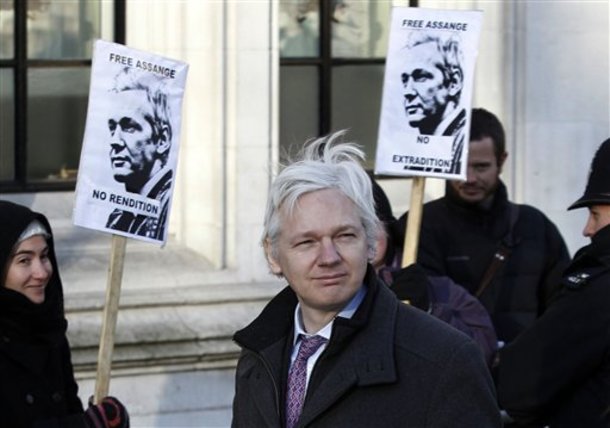
Ecuadorian nationals show their support for Assange outside of the Embassy of Ecuador in London.
On June 19, 2012, the Australian national Mr. Julian Assange appeared at the premises of the Ecuadorian Embassy in London to request that the Ecuadorean State provide him with diplomatic protection, thus invoking the existing Diplomatic Asylum rules. The applicant had made his asylum request based on his fear of eventual political persecution by a third country, the same country whom could use his extradition to the Kingdom of Sweden to enable an expedited subsequent extradition.
The Government of Ecuador, faithful to the asylum procedures and with the utmost attention to this case, has reviewed and evaluated all aspects of this case, particularly the arguments presented by Mr. Assange to support the fear he feels regarding this situation as a threat to his life, personal safety and freedoms.
It is important to note that Mr. Assange has taken the decision to seek asylum and protection of Ecuador over alleged allegations of “espionage and treason,” which “instigate fear of the possibility of being handed over to the United States of America by British, Swedish or Australian authorities,“ said Mr. Assange, since the USA is chasing him for releasing compromising information sensitive to the U.S. Government. The applicant mentions that he “is a victim of persecution in various countries, which is deduced not only from their ideas and actions, but of his work of publishing information which compromises the powerful, uncovers the truth and therefore exposes corruption and abuses of human rights of citizens around the world.”
Therefore, according to the applicant, the indictment for crimes of a political nature is the basis for his asylum request, because in his judgement he is facing a situation involving an imminent danger which he cannot escape. In order to assess his fear of possible political persecution, and that this persecution could end up becoming a situation which curtails and violates his rights, integrity, and could become a risk to his personal safety and freedom, the Government of Ecuador has considered the following:
- Julian Assange is an award-winning communications professional internationally known for his struggles for freedom of expression, press freedom and human rights in general;
- Mr. Assange shared privileged documents and information generated by various sources that affected employees, countries and organizations with a global audience;
- That there is strong evidence of retaliation by the country or countries that produced the information disclosed by Mr. Assange, retaliation that may endanger his safety, integrity, and even his life;
- That, despite Ecuador’s diplomatic efforts, countries which have been asked togive adequate safeguards for the protection and safety for the life of Mr. Assange have refused to facilitate them;
- That Ecuadorian authorities are certain of the possibility that Mr. Assange could be extradited to a third country outside the European Union without proper guarantees for their safety and personal integrity;
- That legal evidence clearly shows that, given an extradition to the United States of America, it would be unlikely for Mr. Assange to receive a fair trial, and likely that he would be judged by special or military courts, where there is a high probability of suffering cruel and degrading treatment, and be sentenced to life imprisonment or capital punishment, which would violate his human rights;
- That while Mr. Assange must answer for the investigation in Sweden, Ecuador is aware that the Swedish prosecutor has had a contradictory attitude that prevented Mr. Assange the full exercise of the legitimate right of defense;
- Ecuador is convinced that the procedural rights of Mr. Assange have been infringed upon during the investigation;
- Ecuador has observed that Mr. Assange lacks the protection and assistance that should be received from the State of which he is a citizen;
- That, following several public statements and diplomatic communications by officials from Britain, Sweden and the USA, it is inferred that these governments would not respect international conventions and treaties, and would give priority to domestic law, in violation of explicit rules of universal application and,
- That, if Mr. Assange is remanded to custody in Sweden (as is customary in this country), a chain of events would begin that would prevent further protective measures from being taken to avoid possible extradition to a third country.
Thus, the Government of Ecuador believes that these arguments lend support to the fears of Julian Assange, and it believes that he may become a victim of political persecution, as a result of his dedicated defense of freedom of expression and freedom of press as well as his repudiation of the abuses of power in certain countries, and that these facts suggest that Mr. Assange could at any moment find himself in a situation likely to endanger life, safety or personal integrity. This fear has driven him to exercise the right to seek and receive asylum in the Embassy of Ecuador in the UK.
Article 41 of the Constitution of the Republic of Ecuador clearly defines the right of asylum. Under this provision, the rights of asylum and refugee status are fully recognized in Ecuador in accordance with international law and instruments of human rights. According to this constitutional provision:
“Persons who find themselves in a situation of asylum and refuge shall enjoy special protection to ensure the full exercise of their rights. The State shall respect and ensure the principle of non-refoulement [
http://en.wikipedia.org/wiki/Non-refoulement], and shall provide emergency legal and humanitarian assistance.”
Similarly, the right to asylum is enshrined in Article 4.7 of the Foreign Service Act of 2006 (Ley Orgánica del Servicio Exterior), which establishes the ability of the Ministry of Foreign Affairs, Trade and Integration of Ecuador to hear cases of diplomatic asylum, in accordance with laws, treaties, and international norms and laws.
It should be stressed that our country has stood out in recent years to accommodate a large number of people who have applied for territorial asylum or refugee status, having unconditionally respected the principle of non-refoulement and non-discrimination, while it has taken steps to provide refugee status in an expeditious manner, taking into account the circumstances of applicants, mostly Colombians fleeing armed conflicts in their own country. The UN High Commissioner for Refugees has praised Ecuador’s refugee policy, and highlighted the important fact that the country has not confined these people to camps, but has integrated them into Ecuadorian society, with full enjoyment of their human and natural rights.
Ecuador places the right of asylum in the category of universal human rights and beliefs, therefore, that the effective implementation of this right requires international cooperation that our countries can provide, without which it would be fruitless, and the institution would be totally ineffective. For these reasons, and recalling the obligation of all States to assist in the protection and promotion of human rights as provided by the United Nations Charter, we invite the British Government to lend its assistance in achieving this purpose.
To that effect, the state of Ecuador can confirm, following analysis of the legal institutions related to asylum, that the foundation of these rights has set out fundamental principles of general international law, the same as for its universal scope and importance, because of its consistance with the general interest of the entire international community, and full recognition by all states. These principles, which are set forth in various international instruments are as follows:
a) Asylum in all its forms is a fundamental human right creating obligations erga omnes, ie “for all” states.
b) Diplomatic asylum, refuge (or territorial asylum), and the right not to be extradited, expelled, delivered or transferred, are comparable human rights, since they are based on the same principles of human protection: non-refoulement and non-discrimination without any adverse distinction based on race, color, sex, language, religion or belief, political or other opinion, national or social origin, property, birth or other status or any other similar criteria.
c) All these forms of protection are governed by the principles pro person (i.e. more favorable to the individual), equality, universality, indivisibility, interrelatedness and interdependence.
d) The protection occurs when the State granting asylum, required refuge, or powers of protection, consider that there is a risk or fear that the protected person may be a victim of political persecution, or is charged with political offenses.
e) The State granting asylum qualifies the causes of asylum and extradition case, weigh the evidence.
f) No matter which of its forms or modality, asylum always has the same cause and lawful object, i.e. political persecution, which makes it permissible, and to safeguard the life, personal safety and freedom of the protected person, which is its legitimately intended purpose.
g) The right of asylum is a fundamental human right, therefore, belongs to jus cogens, i.e. the system of mandatory rules of law recognized by the international community as a whole, for which no derogation is permitted, making null all treaties and provisions of international law which oppose it.
i) The lack of international agreement or domestic legislation of States cannot legitimately be invoked to limit, impair or deny the right to asylum.
j) The rules and principles governing the rights to asylum or refuge, no extradition, no handing over, no expulsion and no transfer are convergent, to the extent necessary to enhance the protection and provide it with maximum efficiency. In this sense, they are complementary to the international human rights law, the right of asylum and refugee law, and humanitarian law.
k) The rights of protection of the human being are based on ethical principles and universally accepted values and therefore have a humanistic, social, solidaric, peaceful and humanitarian character.
l) All States have a duty to promote the progressive development of international human rights through effective national and international action.
Ecuador has judged that the laws applicable to the asylum case of Mr. Julian Assange comprise the entire set of principles, standards, mechanisms and procedures provided for international human rights instruments (whether regional or universal), which include among their provisions the right to seek, receive and enjoy asylum for political reasons, the conventions governing the right of asylum and refugee law, and which recognize the right not to be delivered, returned, or expelled when credible fear of political persecution exists; conventions governing extradition law recognize the right not to be extradited when this measure covers political persecution, and conventions governing humanitarian law, recognize the right not to be transferred when there is a risk of political persecution. All these forms of asylum and international protection are justified by the need to protect this person from possible political persecution, or a possible accusation of political crimes and / or crimes related to the latter, which in the opinion of Ecuador, not only endanger Mr. Assange, but also pose a serious injustice committed against him.
It is undeniable that states, having agreed to numerous and substantive international instruments (many of them legally-binding), have the obligation to provide protection or asylum to persons persecuted for political reasons and have expressed their desire to establish a legal institution to protect human rights and fundamental freedoms based on a general practice accepted as law, which confers on such obligations a mandatory nature, erga omnes [
http://en.wikipedia.org/wiki/Erga_omnes], linked to the respect, protection and progressive development of human rights and fundamental freedoms that are part of jus cogens [
http://en.wikipedia.org/wiki/Peremptory_norm]. Some of these instruments are mentioned below:
a) United Nations Charter of 1945, Purposes and Principles of the United Nations: the obligation of all members to cooperate in the promotion and protection of human rights;
b) Universal Declaration of Human Rights 1948: right to seek and enjoy asylum in any country, for political reasons (Article 14);
c) Declaration of the Rights and Duties of Man, 1948: right to seek and enjoy asylum for political reasons (Article 27);
d) Geneva Convention of August 12, 1949, relative to the Protection of Civilian Persons in Time of War: the protected person should in no case be transferred to a country where they fear persecution for his political views ( Article 45);
e) Convention on the Status of Refugees 1951 and Protocol of New York, 1967: prohibits returning or expelling refugees to countries where their lives and freedom would be threatened (Art. 33.1);
f) Convention on Diplomatic Asylum, 1954: The State has the right to grant asylum and classify the nature of the offense or the motives of persecution (Article 4);
g) Convention on Territorial Asylum of 1954: the State is entitled to admit to its territory such persons as it considers necessary (Article 1), when they are persecuted for their beliefs, political opinions or affiliation, or acts that may be considered political offenses ( Article 2), the State granting asylum may not return or expel a refugee who is persecuted for political reasons or offenses (Article 3); also, extradition is not appropriate when dealing with people who, according to the requested State, be prosecuted for political crimes , or common crimes committed for political purposes, or when extradition is requested obeying political motives (Article 4);
h) European Convention on Extradition of 1957, prohibits extradition if the requested Party considers that the offense is a political charge (Article 3.1);
i) 2312 Declaration on Territorial Asylum of 1967 provides for the granting of asylum to persons who have that right under Article 14 of the Universal Declaration of Human Rights, including persons struggling against colonialism (Article 1.1). It prohibits the refusal of admission, expulsion and return to any State where he may be subject to persecution (Article 3.1);
j) Vienna Convention on the Law of Treaties of 1969, provides that the rules and principles of general international law imperatives do not support a contrary agreement, the treaty is void upon conflicts with one of these rules (Article 53), and if there arises a new peremptory norm of this nature, any existing treaty which conflicts with that provision is void and is terminated (Article 64). As regards the application of these Articles, the Convention allows States to claim compliance with the International Court of Justice, without requiring the agreement of the respondent State, accepting the court’s jurisdiction (Article 66.b). Human rights are norms of jus cogens.
k) American Convention on Human Rights, 1969: right to seek and enjoy asylum for political reasons (Article 22.7);
l) European Convention for the Suppression of Terrorism of 1977, the requested State is entitled to refuse extradition when there is a danger that the person is prosecuted or punished for their political opinions (Article 5);
m) Inter-American Convention on Extradition of 1981, the extradition is not applicable when the person has been tried or convicted, or is to be tried in a court of special or ad hoc in the requesting State (Article 4.3), when, under the classification of the requested State, whether political crimes or related crimes or crimes with a political aim pursued, and when, the circumstances of the case, can be inferred that persecution for reasons of race, religion or nationality; that the situation of the person sought may be prejudiced for any of these reasons (Article 4.5). Article 6 provides, in reference to the right of asylum, that “nothing in this Convention shall be construed as limiting the right of asylum, when appropriate.”
n) African Charter on Human and Peoples of 1981, pursued individual’s right to seek and obtain asylum in other countries (Article 12.3);
p) Charter of Fundamental Rights of the European Union 2000: establishes the right of diplomatic and consular protection. Every citizen of the Union shall, in the territory of a third country not represented by the Member State of nationality, have the protection of diplomatic and consular authorities of any Member State, under the same conditions as nationals of that State (Article 46).
The Government of Ecuador believes it is important to note that the rules and principles recognized in the international instruments mentioned above and in other multilateral agreements take precedence over domestic law of States, because these treaties are based on universal rules guided by intangible principles, whereof deriving greater respect, protection and fulfillment of human rights against unilateral attitudes of such States. This would compromise international law, which should instead be strengthened in order to consolidate the respect of fundamental rights in terms of integration and ecumenical character.
Furthermore, since Assange applied for asylum in Ecuador, we have maintained high-level diplomatic talks with the United Kingdom, Sweden and the United States.
In the course of these conversations, our country has sought to obtain strict guarantees from the UK government that Assange would face, without hindrance, an open legal process in Sweden. These safeguards include that after facing his legal responsibilities in Sweden, that he would not be extradited to a third country; that is, ensuring that the Specialty Rule [
http://www.publications.parliament.uk/pa/cm200203/cmstand/d/st030114/am/30114s01.htm] is not waived. Unfortunately, despite repeated exchanges of messages, the UK at no time showed signs of wanting to reach a political compromise, and merely repeated the content of legal texts.
Assange’s lawyers invited Swedish authorities to take Assange statements in the premises of the Embassy of Ecuador in London. Ecuador officially conveyed to Swedish authorities its willingness to host this interview without interference or impediment to the legal processes followed in Sweden. This measure is absolutely legally possible. Sweden did not accept.
On the other hand, Ecuador raised the possibility that the Swedish government establish guarantees to not subsequently extradite Assange to the United States. Again, the Swedish government rejected any compromise in this regard.
Finally, Ecuador wrote to the U.S. government to officially reveal its position on Assange’s case. Inquiries related to the following:
- If there is an ongoing legal process or intent to carry out such processes against Julian Assange and/or the founders of the WikiLeaks organization;
- Should the above be true, then under what kind of legislation, and how and under what conditions would such persons be subject to under maximum penalties;
- Whether there is an intention to request the extradition of Julian Assange to the United States.
The U.S. response has been that it cannot provide information about the Assange case, claiming that it is a bilateral matter between Ecuador and the United Kingdom.
With this background, the Government of Ecuador, true to its tradition of protecting those who seek refuge in its territory or on the premises of its diplomatic missions, has decided to grant diplomatic asylum to Mr. Assange, based on the application submitted to the President of the Republic, transmitted in writing in London, dated June 19, 2012, and supplemented by letter written in London dated June 25, 2012, for which the Government of Ecuador, after a fair and objective assessment of the situation described by Mr. Assange, according to his own words and arguments, endorsed the fears of the appellant, and accepts that there are indications which lead to the conclusion that he may face political persecution, or that such persecution could occur if timely and necessary measures are not taken to avoid it.
The Government of Ecuador is certain that the British Government knows how to assess the justice and righteousness of the Ecuadorian position, and consistent with these arguments, it is confident that the UK will offer safe passage guarantees necessary and relevant to the asylum, so that their governments can honor with action the fidelity owed to law and international institutions that both nations have helped shape along their common history.
It also hopes to maintain unchanged the excellent ties of friendship and mutual respect which bind Ecuador and the United Kingdom and their people, as they are also engaged in promoting and defending the same principles and values, and because they share similar concerns about democracy, peace, and well being, which are only possible if the fundamental rights of everyone are respected.
SOURCE: Wikileaks-Press.org
Aug 16, 2012 | News
 The latest twist in the Julian Assange case, as we await Ecuador’s decision on granting him asylum (a decision which would not, as I’ve written before, in itself allow protection from arrest if he steps outside the embassy), is that people are wondering whether the UK can simply strip the embassy of its diplomatic status, so allowing police officers to enter it.
It seems the British embassy in Quito has written to the Ecuadorian government (hat tip to @JasonLeopold) saying
You need to be aware that there is a legal base in the UK, the Diplomatic and Consular Premises Act 1987, that would allow us to take actions in order to arrest Mr Assange in the current premises of the Embassy.
We sincerely hope that we do not reach that point, but if you are not capable of resolving this matter of Mr Assange’s presence in your premises, this is an open option for us.
The 1987 Act does indeed give ministers a power to withdraw recognition from diplomatic premises. Section 1(3) says
In no case is land to be regarded as a State’s diplomatic or consular premises for the purposes of any enactment or rule of law unless it has been so accepted or the Secretary of State has given that State consent under this section in relation to it; and if—
(a) a State ceases to use land for the purposes of its mission or exclusively for the purposes of a consular post; or
(b) the Secretary of State withdraws his acceptance or consent in relation to land,
it thereupon ceases to be diplomatic or consular premises for the purposes of all enactments and rules of law.
On the face of it, then, the Secretary of State (in practice a foreign office minister) could now simply withdraw consent, and with one bound, police would be free to make an arrest.
But it’s not quite as simple as that. You’ll note that section 1(4) says
The Secretary of State shall only give or withdraw consent or withdraw acceptance if he is satisfied that to do so is permissible under international law
and that according to section 1(5), in deciding whether to withdraw consent, the minister
shall have regard to all material considerations, and in particular, but without prejudice to the generality of this subsection—
(a) to the safety of the public;
(b) to national security; and
(c) to town and country planning.
The “compliance with international law” requirement may present a problem, since article 21 of the Vienna Convention on Diplomatic Relations requires the UK to facilitate the acquisition by Ecuador of premises necessary for its mission, or assist it in obtaining accommodation. It’s not obvious this allows the UK to just de-recognise the current premises without helping arrange something new.
Section 1(5) is interesting because, in spite of the way the drafting clearly intends to preserve ministers’ ability to take account of anything they think relevant, I’ve no doubt lawyers for Ecuador could argue that the list of three particular concerns colours the scope of ministers’ considerations, the result being that only some particular difficulty relating to safety or to the premises themselves could justify withdrawal.
More importantly, they could argue that Assange’s presence in the embassy and Ecuador’s conduct in sheltering him is not a material consideration; and that since that clearly lay behind the withdrawal, ministers would in deciding to withdraw consent, have taken into account an irrelevant factor.
In addition, there’d be a potentially strong argument to be made that ministers had exercised their power for an improper purpose not intended by Parliament when it enacted the 1987 legislation – their desire to arrest Julian Assange.
Ecuador could judicially review any proposed withdrawal: I think the effect on Assange means this is the type of case in which, as Lord Sumption explained in a recent speech, the courts would consider intervening in a foreign policy decision. Perhaps Assange could obtain an injunction on judicial review, preventing any arrest pending the outcome of proceedings. Of course, if the government successfully fought off that judicial review, the arrest could go ahead. But I don’t think a defence would be easy, and at the very least, a judicial review would create further delay – which probably suits Assange fairly well. I’m not sure giving him a hook to hang one on would be the best tactical move for the government.
The Quito letter from the UK to Ecuador went on apparently to say
We need to reiterate that we consider the continued use of the diplomatic premises in this way incompatible with the Vienna Convention and unsustainable and we have made clear the serious implications that this has for our diplomatic relations.
If I were advising the government, I think I’d say that, if ministers are determined to allow the arrest of Assange, it might be better simply to cut off diplomatic relations with Ecuador, send the ambassador home, close the embassy and arrest Assange after that. Ending diplomatic relations is the major sort of foreign affairs decision I doubt the courts would interfere with. But that’d be a major diplomatic call.
by Carl Gardner on August 15, 2012
SOURCE: HeadOfLegal.com