Chemtrails Exposed: A History of the New Manhattan Project

Chemtrails Exposed: A History of the New Manhattan Project

“Discoveries and inventions are not terminals; they are fresh starting points from which we can climb to new knowledge.” – Dr. Willis R. Whitney, founder of General Electric Laboratories

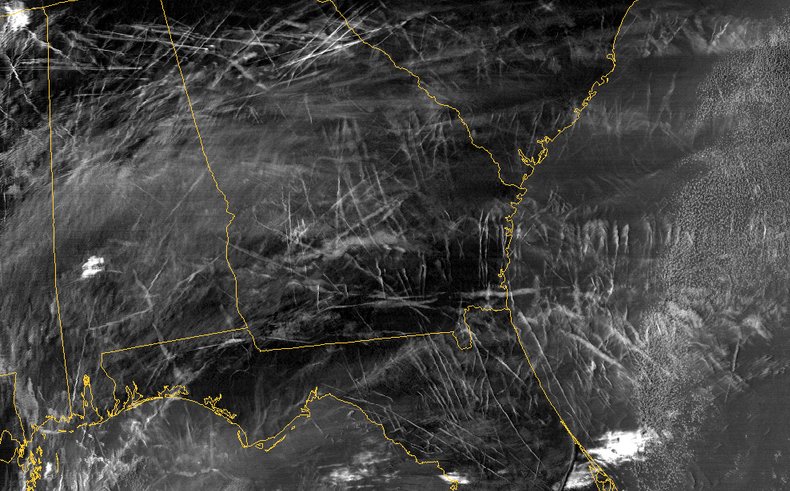
After so many years of watching airplanes produce the lines in the sky, largely without knowing of what this Project consists or why, we have recently gained an understanding. Evidence suggests that today’s chemtrail spraying operations consist of airplanes saturating our atmosphere with nano-sized particles influenced by electromagnetic energy for the purpose of weather modification.

U.S. patent #4,686,605 “Method and Apparatus for Altering a Region in the Earth’s Atmosphere, Ionosphere and/or Magnetosphere” shows how stratospheric and tropospheric aerosols can be manipulated using electromagnetic energy in order to modify the weather. The ground-based antennas (known as ionospheric heaters) needed to produce the appropriate electromagnetic energy exist. For a detailed discussion, please see the author’s previous article “Smoking Gun: The HAARP and Chemtrails Connection.”

The 1996 U.S. military document “Weather as a Force Multiplier: Owning the Weather in 2025” outlines a program using aerosols sprayed from airplanes which are then manipulated with electromagnetic energy in order to modify the weather. This document will be discussed shortly.

The common thread here is weather modification; or as the Library of Congress calls it, “weather control.” Lots of other evidence supporting this assertion exists as well, but these two documents are the most salient.

Motives are plenty. Most notably, significant direct benefits can be gained by playing financial markets which rise and fall with the weather such as the weather derivatives and catastrophe reinsurance markets; not to mention agricultural and energy commodities. Enron pioneered the markets. With foreknowledge of the weather, so many scams could be concocted that it boggles the mind. Weather routinely changes the course of Human history. It determines what we do every day. It determines the outcomes of wars and influences elections. Control of the weather is God-like power. Money and power junkies want it.

Controlling Earth’s weather would necessarily require a gigantic scientific effort. Oddly enough, when one looks for a National effort in weather modification, one finds a lot. Specifically, if one looks, one can find a history of weather control programs involving electromagnetic energy and atmospheric particles; all in a coherent chronological order.

This paper is the result of thousands of dollars and countless hours spent researching many thousands of pages of source, organizational and Government documents related to weather modification and the atmospheric sciences. This article serves as the foundation for a series of shortly forthcoming articles detailing the history and current state of this Project. May this work help end the spraying. For the fact that these environmental modifications have been done without our informed consent, may this work contribute to the largest class-action lawsuit in history.

This paper examines the origins and development of this; the first planetary level scientific endeavor. Now is our opportunity to gain a deeper understanding of the New Manhattan Project.

The Origins of Weather Modification

People have been attempting to modify the weather for ever. Most commonly, man has gone about making it rain; especially in times of drought. The earliest recorded efforts were those of mystics. Local shaman would be called upon to ingest a certain concoction in order to communicate with the weather gods and ask for help. In some cases, the sacrifice of certain animals in certain fashions may have been the thing to do. Sometimes a good old rain dance may have done the trick.

Some early Western efforts to stop destructive weather are outlined in professor James Fleming’s book Fixing the Sky. On page 78 he writes, “In ancient Greece, the official ‘hail wardens’ of Cleonae were appointed at public expense to watch for hail and then signal the farmers to offer blood sacrifices to protect their fields: a lamb, a chicken, or even a poor man drawing blood from his finger was deemed sufficient.”

A little later professor Fleming writes, “In Austria, it was traditional to ring ‘thunder bells’ or blow on huge ‘weather horns’ while herdsmen set up a terrific howl and women rattled chains and beat milk pails to scare away the destructive spirit of the storm.”

Much of the early Western attempts at weather modification involved the detonation of explosive charges in the lower atmosphere. It was hypothesized that atmospheric explosions cause precipitation.

Early American Involvement

Although there has been much international participation, this article focuses on America’s participation in the New Manhattan Project. Throughout the development of the New Manhattan Project, America was the world’s technological leader; especially in the area of military technology. America led the way and developed most of this Project. America continues to lead the Project today. Therefore the early history of weather modification in America is relevant.

James Pollard Espy (1785-1860) also known as “The Storm King” was the first meteorologist in U.S. government service. Although he never received Federal funding for it, he suggested that forest fires can produce rainfall and that experiments in this area should be carried out. His magnum opus was a book called The Philosophy of Storms. This book contains a long section entitled “Artificial Rains.”

The first Federally funded weather modification field effort took place in Texas in 1891, with funds appropriated by the Congress in the amount of nine thousand dollars through the Department of Agriculture. The experiment involved weather modifier Robert St. George Dyrenforth (1844-1910) attacking the atmosphere with balloons, kites, dynamite, mortars, smoke bombs and fireworks. The results were inconclusive, but you can bet that the atmosphere was absolutely terrified!

From these early efforts until the beginning of the scientific era in 1946, the realm of weather modification was inhabited largely by a motley collection of pseudo-scientists and con artists similar to Dyrenforth. These people, who referred to themselves as “rainmakers,” traveled around the Country (mostly the West), going where local governments were willing to pay for their services. If a certain region was experiencing a severe drought, people were often desperate for solutions. These rainmakers’ activities often involved the mixing and open air release of dangerous chemicals. Some of these efforts were Federally funded. Since the days of Robert Dyrenforth, the Federal money has not stopped flowing.

Nikola Tesla

In the late 1800s, inventor Nikola Tesla (1856-1943) popularized the use of electromagnetic energy. In his 1905 United States patent number 787,412 “Art of Transmitting Electrical Energy Through the Natural Mediums” Tesla describes how electromagnetic energy may be sent and received through the atmosphere. The Supreme Court found that U.S. patent #645,576 “System of Transmission of Electrical Energy” proves he invented radio; not Marconi. He pioneered radar. He invented wireless signal and power transmission. Yes, power can be transmitted wirelessly; we’ll have more about that later.

Tesla’s musings and scientific discoveries pioneered what are today’s ionospheric heaters which use electromagnetic energy to cause atmospheric perturbations from great distances and play a defining role in the New Manhattan Project. Specifically, he pioneered the use of a certain type of electromagnetic energy called extremely-low frequency (ELF). This is a specific type of energy known to be used in the New Manhattan Project; the other being very-low frequency (VLF) electromagnetic energy.

In her book Tesla: Man Out of Time, Margaret Cheney writes that he did a good deal of theorizing about weather control. She also writes that he theorized that the entire earth might be illuminated by shooting electromagnetic energy 35,000 feet up into the atmosphere. 35,000 feet is about the altitude of today’s offending airplanes.

The Beginning of the Scientific Era

The scientific era of weather modification began famously in 1946 with a trio of scientists from General Electric Laboratories: Irving Langmuir, Vincent Schaefer and Bernard Vonnegut. Leading the group was the world famous Nobel Peace Prize winning scientist Irving Langmuir (1881-1957). This trio popularized the fact that, under certain circumstances, dumping substances from airplanes into clouds causes precipitation. Early experiments used dry ice while later experiments pioneered the use of silver iodide. Also invented were silver iodide generation equipment and many other weather related scientific instruments. Much of this trio’s work here was done in cooperation with the Office of Naval Research and the Air Force. Although others had previously dumped stuff out of airplanes in attempts to modify the weather, the G.E. scientists practiced a sound scientific method previously unseen in the field.

Schaefer, Langmuir & Vonnegut
image source: General Electric Laboratories

Following the famous scientific weather modification efforts of the G.E. Labs trio, the public’s imagination was sparked and a government regulated weather modification industry flourished. To this day, the government-regulated weather modification industry (or “conventional” weather modification industry as we will call it) expels dry ice, lead iodide or silver iodide (usually silver iodide) from airplanes.

However, the conventional weather modification industry is distinct from the New Manhattan Project and therefore is not the focus of this article. The New Manhattan Project employs electromagnetic energy to manipulate dispersed particles while conventional weather modifiers do not. Also, conventional weather modification efforts are conducted on a regional basis while the New Manhattan Project is global.

Not long after the scientific breakthroughs of the G.E. Labs trio, fueled by high level political rhetoric and popular interest, the United States federal government began pouring hundreds of millions of dollars annually into basic atmospheric research. Since then, the United States government is admitted to have spent many tens of billions of dollars on weather modification and the atmospheric sciences. Much of that was expended in 1950s, ’60s and ’70s dollars. If one is to control the weather, one must know how the atmosphere works. Or as geoengineer Dr. Clement J. Todd wrote in 1970, “Our ability to manage precipitation depends upon four factors: (1) understanding the physical processes of the atmosphere, (2) real-time knowledge of the weather we wish to manipulate, (3) devising the optimum treatment material and technique, and (4) delivery of that treatment to the cloud where and when we wish.”

The majority of the vast expanses of literature pertaining to weather modification and the atmospheric sciences is geared towards conventional weather modification. However, both the New Manhattan Project and conventional weather modification are supported by basic atmospheric research. So, buried in this body of literature, one may find glimpses of the New Manhattan Project. The rest of this paper recounts these glimpses.

Bernard Vonnegut

One member of the G.E. Labs trio, Bernard Vonnegut (1914-1997) went on to pioneer weather modification research involving the use of artificial electric charges and atmospheric aerosols. His work in this area was performed under Government contracts outsourced to a research and development firm called Arthur D. Little Inc.

Bernard Vonnegut
image source: Life Magazine

The earliest recorded instances of electricity being intentionally used to modify particles in the atmosphere can be found in the 1884 experiments of Sir Oliver Lodge (1851-1940). The 1918 U.S. patent #1,279,823 “Process and Apparatus for Causing Precipitation by Coalescence of Aqueous Particles Contained in the Atmosphere” by J.G. Balsillie built upon Lodge’s work. Using this knowledge as a basis, Mr. Vonnegut resumed Lodge’s work; this time with massive funding and modernized scientific equipment.

Beginning in 1953, Bernard Vonnegut, Arthur D. Little et al., conducted experiments involving stainless steel wires miles long strung from the tops of telephone poles, connected to a power supply and discharging corona. The coronal discharge’s effect upon ambient aerosols and the clouds above was monitored and analyzed. Through 1961, these experiments were carried out in Massachusetts, New Hampshire, Texas, Illinois and New Mexico. These types of experiments are referred to as “space charge” experiments. The U.S. Signal Corps and the U. S. Coast Guard provided support. Others performed similar experiments.

Space charge experiment
image source: The Massachusetts Institute of Technology

The 1958 “Final Report of the Advisory Committee on Weather Control” contained an article by Bernard Vonnegut, Vincent Schaefer, J. S. Barrows and Paul MacCready titled “The Future.” In it they outline an atmosphere saturated with “chemicals” and “altering” atmospheric electrical variables. It reads:

When the nature of thunderstorm electrification is understood it may prove possible to control this process by the introduction of chemicals into the atmosphere or by altering electrical variables. Such variables might be atmospheric conductivity, field, and space charge, or perhaps the corona giving properties of the earth’s surface.

When we become sufficiently sophisticated concerning the dynamics of the atmosphere it is possible that weather may be controlled by the large scale release of chemical or more probably thermonuclear heat energy.

In 1961, Bernard Vonnegut, Arnold W. Doyle and D. Read Moffett wrote a paper for Arthur D. Little titled “Research in Electrical Phenomena Associated with Aerosols.” This was a report about their experiments of the previous 3 months involving the effects of electromagnetic energy upon a grounded sphere in a small chamber surrounded by gas. Please consider the implications of that. We will revisit this paper much later.

If you are wondering… yes, Bernard Vonnegut was related to the novelist Kurt Vonnegut. They were brothers.

***

In 1958 the chief White House advisor on weather modification, Captain Howard T. Orville, said the U.S. defense department was studying “ways to manipulate the charges of the earth and sky and so affect the weather” by using an electronic beam to ionize or de-ionize the atmosphere over a given area.

***

The Department of Commerce Weather Bureau reported in 1960 that they were conducting a weather modification study in which, “Chemicals are introduced into the cloud which noticeably changes the surface tension of the droplets. Electrification effects are being observed by artificially electrifying the droplets and subjecting them to impressed electric fields.”

***

For better or for worse, this super secret program had a prophet. His name was United States Navy Admiral William Francis Raborn (1905-1990).

William Francis Raborn
image source: United States Navy

In the January 1963 edition of the U.S. Naval Institute Proceedings, Admiral Raborn outlined a program using electromagnetic energy to modify the weather. His article was entitled “New Horizons of Naval Research and Development.” In this paper, underneath the heading of ‘Environmental Warfare’ he wrote:

The possibilities for the military employment of the “weather weapon” may be as diverse as they are numerous. An ability to control the weather could introduce greater changes in warfare than those which occurred in 1945 with the explosion of the first nuclear weapons.

A severe storm or hurricane striking a naval force may well inflict greater damage than could an enemy. The capability to change the direction of destructive storms and guide them toward enemy concentrations may exist in the future arsenal of the naval tactical commander.

Ground, sea, air and amphibious operations might be supported by the dissipation of fog or clouds, or by the production of rain or drought. Conversely, the creation of solid, low overcasts might be used to conceal troop concentrations, movements, and task force deployments. Large-scale weather control techniques might be used to cause extensive flooding in strategic areas or even to bring a new “ice age” upon the enemy. By influencing the ionosphere and atmosphere simultaneously, magnetic, acoustic, and pressure effects might be generated in such a way that ocean-wide sweeping of mines would occur.

Creating or dissipating atmospheric temperature/humidity ducts might modify the refractive index of the atmosphere enough to influence radar or radio transmission. Artificially-induced ionospheric storms might produce a blackout of communications.

Certain electromagnetic waves are unable to pass through an area of precipitation. A cloud seeding generator could be employed under appropriate meteorological conditions to produce precipitation that would interfere with the operation of radio-guided or remotely-controlled devices or vehicles. We already have taken our first steps toward developing an environmental warfare capability. We are using satellite weather data from Tiros II for current, tactical operations and more accurate, long-range weather predictions. Some experiments in fog dissipation have shown promise, and some exploratory research has been conducted on ways to change the heading of major storms.

For these reasons – and because our advances in science make it reasonable – we are now engaged in planning a ten-year, comprehensive study of the atmosphere, a study which we will designate ATMOS. This plan will be co-ordinated with our TENOC oceanographic studies.

About the ATMOS program, the author has failed to find any other significant information. The author has looked over a 1961 report pertaining to the Navy TENOC (Ten Year Program in Oceanography) program. Although it did not contain any specific information pertinent to the New Manhattan Project, it did make mention of another, classified TENOC report.

It is notable that the title of Raborn’s article includes the word “horizon” because the type of electromagnetic energy to which he refers is akin to “over the horizon radar.” This type of radar is called “over the horizon” because it is bounced off the ionosphere and therefore is effective far beyond the range of the forty miles or so (depending on terrain) afforded by previous radar systems. Forty miles is approximately the distance one can see over flat land or sea before the curvature of the Earth obscures points beyond. Over the horizon radar, on the other hand, is effective to thousands of miles. Today’s ionospheric heaters evolved as over the horizon radar.

Also of note is the fact that the United States Navy, of which Mr. Raborn was an admiral, is today one of the managers of the HAARP facility in Alaska. The HAARP facility contains the world’s most powerful ionospheric heater which is documented to be able to modify the weather.

***

In the 1967 National Science Foundation’s ninth annual weather modification report, it reads, “ESSA [Environmental Science Services Administration] is also investigating the effect of cirrus clouds on the radiation budget of the atmosphere by studying aircraft-produced contrails which often spread into cirrus layers covering considerable fractions of the sky. One technique proposed for modifying lower cloud development has been the generation of a high level cirrus deck with jet aircraft. By intercepting solar radiation at high altitude it may be possible to influence larger scale cloud development elsewhere by reducing solar input and reducing convective cloud generation in areas where they are not needed.” This is essentially today’s geoengineering thesis.

A little later in that same report, it reads that their computer atmospheric simulations, or ‘models’ as they call them, might simulate, “…producing high-level cirrus cloud cover over an area by means of jet aircraft, inserting particulate matter into the upper atmosphere to alter the solar radiation balance and the like.”

***

In 1966, the Interdepartmental Committee on Atmospheric Sciences Select Panel on Weather Modification produced a document titled “Present and Future Plans of Federal Agencies in Weather-Climate Modification.” On page 17 of this report, it reads, “It is anticipated that there will be a few large-scale facilities funded for the testing of modification schemes. Typical schemes might be the suspension of a spray nozzle over a valley between two mountain peaks to produce cloud-sized droplets into which electrical charges can be introduced in either polarity, contaminants can be introduced, and the drop size spectrum can be adjusted to any reasonable distribution.” The Interdepartmental Committee on Atmospheric Sciences subsequently agreed to proceed with the development of a National Weather Modification Program along the lines of this report.

The now defunct Interdepartmental Committee for Atmospheric Sciences (ICAS) was created by the Federal Council for Science and Technology in 1959 in order to oversee and coordinate a wide range of basic atmospheric research originating from many previously disparate government offices. Their focus was weather modification. Members of the ICAS included the departments of Agriculture, Commerce, Defense, Interior, Transportation and State as well as the Environmental Protection Agency, the Energy Research and Development Administration, the National Aeronautics and Space Administration and the National Science Foundation. These are the government agencies which have been involved in weather modification all along.

The ICAS produced a series of semi-annual reports between 1960 and 1978. In these reports, ICAS member organizations’ weather related scientific activities and expenditures were recounted. The ICAS reports’ areas of study included: Earth’s natural geomagnetic energy, different ways clouds form and different ways they precipitate, lightning, hurricanes and other extreme weather, inadvertent weather modification, intentional weather modification and extra-planetary atmospheres. The ICAS is duly noted here because so much of the history of the New Manhattan Project is accounted for in the pages of their reports.

In the 1969 ICAS report, under the heading of “Cloud Electricity Modification,” it is written that the National Science Foundation is developing, “Means for injecting significant quantities of charge artificially into clouds…”

Again in this 1969 report, on page 37 it describes the Army’s intentions in the area of weather modification. It reads, “Studies will continue on upper atmospheric structure and dynamics, lasers and other electromagnetic propagation, and acoustic propagation. New approaches to atmospheric modification will be studied.”

On page 42 of the 1971 ICAS special report “A National Program for Accelerating Progress in Weather Modification,” the authors write of fog being cleared by airplanes releasing chemicals and ‘electrical methods’ of fog dissipation.

On page 79 of the 1973 ICAS report, it is written, “There is a great deal to be learned before we can with confidence say what effect can be produced by the injection of chemically active trace gasses and particulates into the lower stratosphere. New emphasis has been given to both dynamical and physical meteorological research relevant to this question.”

***

United States patent #5,003,186 “Stratospheric Welsbach Seeding for Reduction of Global Warming” was filed by the Hughes Aircraft Corporation in 1991. The patent describes a method for dispersing particulates into the upper atmosphere in order to save us from global warming. The author David B. Chang suggests that aluminum oxide be used for this purpose. Lab tests from around the world have shown aluminum to be the number one chemtrail ingredient.

“One proposed solution to the problem of global warming,” it reads, “involves the seeding of the atmosphere with metallic particles. One technique proposed to seed the metallic particles was to add the tiny particles to the fuel of jet airliners, so that the particles would be emitted from the jet engine exhaust while the airliner was at its cruising altitude.”

The first mention of aluminum occurs in this passage, “The method comprises the step of seeding the greenhouse gas layer with a quantity of tiny particles of materials characterized by wavelength-dependent emissivity or reflectivity, in that said materials have high emissivities in the visible and far infrared wavelength region. Such materials can include the class of materials known as Welsbach materials. The oxides of metal, e.g., aluminum oxide, are also suitable for the purpose.”

The second mention of aluminum occurs a little later. It reads, “Another class of materials having the desired property includes the oxides of metals. For example, aluminum oxide (Al2O3) is one metal oxide suitable for the purpose and which is relatively inexpensive.”

The Hughes Aircraft Corporation was acquired by and is now integrated into Raytheon.

***

A 1994 document produced by Stanford Research International called “Multiple Instrument Studies of Chemical Releases and Heating at Arecibo” details three barium releases of 48 kilograms each over Puerto Rico. The barium clouds produced by these rocket-borne explosions were subsequently hit with man-made electromagnetic energy from an ionospheric heater and thus turned into a plasma. Barium has been found to be the number two chemtrail ingredient.

***

In 1996 the Air Force produced a previously mentioned document called “Weather as a Force Multiplier: Owning the Weather in 2025.” The document was produced by the Department of Defense and written as ordered by the chief of staff of the Air Force, Ronald R. Fogleman. “Owning the Weather” was but one in a series of 39 documents speaking to a great overhaul of Air Force operations to be achieved by the year 2025. The larger set of documents is called “Air Force 2025.” “Owning the Weather” describes a system of weather modification combining atmospheric aerosols with electromagnetic energy.

On page 2 the document reads, “Prior to the attack, which is coordinated with forecasted weather conditions, the UAVs begin cloud generation and seeding operations. UAVs [unmanned aerial vehicles] disperse a cirrus shield to deny enemy visual and infrared (IR) surveillance. Simultaneously, microwave heaters create localized scintillation to disrupt active sensing via synthetic aperture radar (SAR) systems such as the commercially available Canadian search and rescue satellite-aided tracking (SARSAT) that will be widely available in 2025. Other cloud seeding operations cause a developing thunderstorm to intensify over the target, severely limiting the enemy’s capability to defend. The WFSE monitors the entire operation in real-time and notes the successful completion of another very important but routine weather-modification mission.”

The document mostly speaks to military combat applications, but there are some very interesting quotes. Here’s one, “In the United States, weather-modification will likely become a part of national security policy with both domestic and international applications.” Let’s hear more about those “domestic applications”

On page 34 the document reads, “The ability to modify the weather may be desirable both for economic and defense reasons.”

Also in 1996, as part of the same series containing “Owning the Weather,” the Air Force produced a document entitled “An Operational Analysis for Air Force 2025” which briefly outlines something they call a “weather analysis and modification system.” This system is described as employing both particulate seeding and microwave energy for the purpose of weather modification.

Under the heading of “Weather Analysis and Modification System,” the document reads, “A global network of sensors provides ‘weather warriors’ with the means to monitor and accurately predict weather activities and their effects on military operations. A diverse set of weather modification tools allows manipulation of small-to-medium scale weather phenomena to enhance friendly force capabilities and degrade those of the adversary.”

***

In the mid-nineties, Lawrence Livermore Laboratories scientists Edward Teller, Lowell Wood and Roderick Hyde wrote a series of papers calling for the spraying of megatons of aluminum to save us from global warming. The mid-nineties was when reports of chemtrail spraying in American skies began pouring in. If you will recall, aluminum has been found to be the number one chemtrail ingredient.

In their 1997 paper “Global Warming and Ice Ages,” the Livermore Labs trio wrote, “It has been suggested that alumina injected into the stratosphere by the exhaust of solid-rocket motors might scatter non-negligible amounts of sunlight. We expect that introduction of scattering-optimized alumina particles into the stratosphere may well be overall competitive with use of sulfur oxides; alumina particles offer a distinctly different environmental impact profile.”

They continue to espouse the virtues of stratospheric alumina in the footnotes writing, “Alumina, like sulfate, is ubiquitous in the terrestrial biosphere, and its stratospheric injection seemingly poses no significant environment issues.”

In conclusion

So there you have an evolutionary history of a project employing sprayed particles and the electrification of clouds for the purpose of weather modification. Is this a coincidence? Are all these examples simply isolated, one-off events not a part of a larger overall plan? What are the odds of these data points evolving in a chronological order such as they have without being part of a coordinated effort? One may be looking at something like a quadrillion to one; and that is conservative.

For five days only, from Thursday, February 19 through Monday, February 23, my ebook Chemtrails Exposed will be available for free from Amazon.

Stay tuned. God willing, this article is only the first of many coming in this year; 2015. The heavy lifting (studying the history of weather modification) is complete. The next papers will come much easier because they involve smaller topics and half or more of the work on each is already done. Although the topic will remain secret until publication, you can expect the next article in a couple of months, possibly sooner. Until then, keep firing in the information war. Thank you.

Notes:

Adventure into the Unknown: the first 50 years of the General Electric Research Laboratory by Laurence A. Hawkins, published by William Morrow & Company, 1950

U.S. patent #4,686,605 “Method and Apparatus for Altering a Region in the Earth’s Atmosphere, Ionosphere and/or Magnetosphere,” 1987

“Weather as a Force Multiplier: Owning the Weather in 2025” by Col. Tamzy J. House, Lt. Col. James B. Near, Jr., LTC William B. Shields (USA), Maj. Ronald J. Celentano, Maj. David M. Husband, Maj. Ann E. Mercer and Maj. James E. Pugh, published by the United States Air Force, 1996

The Smartest Guys in the Room by Bethany McLean and Peter Elkind, published by the Penguin Group, 2004

The Weather Changers by D.S. Halacy, Jr., published by Harper and Row, 1968

Fixing the Sky by James Roger Fleming, published by Columbia University Press, 2010

U.S. patent #787,412 “Art of Transmitting Electrical Energy Through the Natural Mediums,” 1905

U.S. patent #645,576 “System of Transmission of Electrical Energy,” 1900

Tesla: Man Out of Time by Margaret Cheney, published by Simon & Schuster, 1981

Early History of Cloud Seeding by Barrington S. Havens, published by the Langmuir Laboratory at the New Mexico Institute of Mining and Technology, the Atmospheric Sciences Research Center at the State University of New York at Albany and the Research and Development Center of the General Electric Company, 1978

Interdepartmental Committee for Atmospheric Sciences reports 1960-1978, published by the Federal Council for Science and Technology

“Department of the Interior Program in Precipitation Management for 1970” by Dr. Clement J. Todd as it appeared in the “Proceedings of the Twelfth Interagency Conference on Weather Modification” 1970

U.S. patent #1,279,823 “Process and Apparatus for Causing Precipitation by Coalescence of Aqueous Particles Contained in the Atmosphere”

“Technique for Introducing Low-Density Space Charge into the Atmosphere” by B. Vonnegut, K. Maynard, W.G. Sykes and C.B. Moore, published by Arthur D. Little and the Journal of Geophysical Research, volume 66, number 3, March, 1961

“The Future” by Bernard Vonnegut, Vincent Schaefer, J. S. Barrows and Paul MacCready, published in the Final Report of the Advisory Committee on Weather Control, p201, 1958

Research in Electrical Phenomena Associated with Aerosols by Bernard Vonnegut, Arnold W. Doyle and D. Read Moffett, published by Arthur D. Little, 1961

Angels Don’t Play this HAARP: advances in Tesla technology by Jeane Manning and Dr. Nick Begich, published by Earthpulse Press, p78, 1995

1st National Science Foundation annual weather modification report, p14, 1960

“New Horizons of Naval Research and Development” by William Francis Raborn, published in U.S.Naval Institute Proceedings, January, 1963

“Ten Year Program in Oceanography: TENOC” by the U.S. Navy, March 13, 1961

9th National Science Foundation annual weather modification report, 1967

“Present and Future Plans of Federal Agencies in Weather-Climate Modification” by the Interdepartmental Committee on Atmospheric Sciences Select Panel on Weather Modification, 1966

Interdepartmental Committee on Atmospheric Sciences memorandum to Homer E. Newell dated June 21, 1966, as it appeared in the appendix to “Present and Future Plans of Federal Agencies in Weather-Climate Modification” by the Interdepartmental Committee on Atmospheric Sciences Select Panel on Weather Modification, 1966

“The Interdepartmental Committee on Atmospheric Sciences: A Case History” by Robert E. Morrison

U.S. patent #5,003,186 “Stratospheric Welsbach Seeding for Reduction of Global Warming,” 1991

“Multiple Instrument Studies of Chemical Releases and Heating at Arecibo” by Stanford Research International, published by Stanford Research International, 1994

“Air Force 2025” by the U.S. Air Force, published by the U.S. Air Force, 1996

“An Operational Analysis for Air Force 2025” by the U.S. Air Force, published by the U.S. Air Force as part of “Air Force 2025” by the U.S. Air Force, published by the U.S. Air Force, 1996

Global Warming and Ice Ages by Edward Teller, Lowell Wood and Roderick Hyde, published by the Lawrence Livermore National Laboratory, 1997


via PeterKirby/ActivistPost


Sanders Releases Explosive Bailout List

Sanders Releases Explosive Bailout List

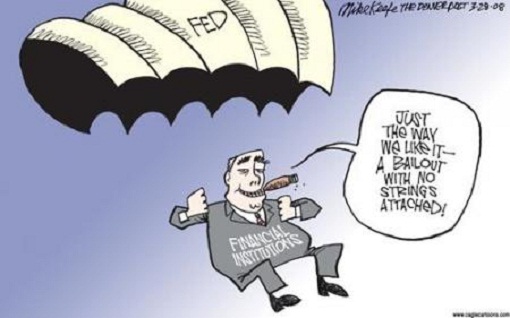
More than $4 trillion in near zero-interest Federal Reserve loans and other financial assistance went to the banks and businesses of at least 18 current and former Federal Reserve regional bank directors in the aftermath of the 2008 financial collapse, according to Government Accountability Office records made public for the first time today by Sen. Bernie Sanders.

On the eve of Senate testimony by JPMorgan Chase CEO Jamie Dimon, Sanders (I-Vt.) released the detailed findings on Dimon and other Fed board members whose banks and businesses benefited from Fed actions.

A Sanders provision in the Dodd-Frank Wall Street Reform Act required the Government Accountability Office to investigate potential conflicts of interest. The Oct. 19, 2011 report by the non-partisan investigative arm of Congress laid out the findings, but did not name names. Sanders today released the names.


“This report reveals the inherent conflicts of interest that exist at the Federal Reserve.  At a time when small businesses could not get affordable loans to create jobs, the Fed was providing trillions in secret loans to some of the largest banks and corporations in America that were well represented on the boards of the Federal Reserve Banks.  These conflicts must end,” Sanders said.

The GAO study found that allowing members of the banking industry to both elect and serve on the Federal Reserve’s board of directors creates “an appearance of a conflict of interest” and poses “reputational risks” to the Federal Reserve System.

In Dimon’s case, JPMorgan received some $391 billion of the $4 trillion in emergency Fed funds at the same time his bank was used by the Fed as a clearinghouse for emergency lending programs. In March of 2008, the Fed provided JPMorgan with $29 billion in financing to acquire Bear Stearns. Dimon also got the Fed to provide JPMorgan Chase with an 18-month exemption from risk-based leverage and capital requirements. And he convinced the Fed to take risky mortgage-related assets off of Bear Stearns balance sheet before JP Morgan Chase acquired the troubled investment bank.

Another high-profile conflict involved Stephen Friedman, the former chairman of the New York Fed’s board of directors. Late in 2008, the New York Fed approved an application from Goldman Sachs to become a bank holding company giving it access to cheap loans from the Federal Reserve. During that period, Friedman sat on the Goldman Sachs board.  He also owned Goldman stock, something that was prohibited by Federal Reserve conflict of interest regulations. Although it was not publicly disclosed at the time, Friedman received a waiver from the Fed’s conflict of interest rules in late 2008. Unbeknownst to the Fed, Friedman continued to purchase shares in Goldman from November 2008 through January of 2009, according to the GAO.

In another case, General Electric CEO Jeffrey Immelt was a New York Fed board member at the same time GE helped create a Commercial Paper Funding Facility during the financial crisis. The Fed later provided $16 billion in financing to GE under this emergency lending program.

Sanders on May 22 introduced legislation to prohibit banking industry and business executives from serving as directors of the 12 Federal Reserve regional banks.

To read a report summarizing the new GAO information, click here.


Jamie Dimon Is Not Alone


During the financial crisis, at least 18 former and current directors from Federal Reserve Banks worked in banks and corporations that collectively received over $4 trillion in low-interest loans from the Federal Reserve.

US Senator Bernard Sanders (I-Vt.)
Washington, DC
June 12, 2012


    1. Jamie Dimon, the Chairman and CEO of JP Morgan Chase, has served on the Board of Directors at the Federal Reserve Bank of New York since 2007. During the financial crisis, the Fed provided JP Morgan Chase with $391 billion in total financial assistance. JP Morgan Chase was also used by the Fed as a clearinghouse for the Fed’s emergency lending programs.In March of 2008, the Fed provided JP Morgan Chase with $29 billion in financing to acquire Bear Stearns. During the financial crisis, the Fed provided JP Morgan Chase with an 18-month exemption from risk-based leverage and capital requirements. The Fed also agreed to take risky mortgage-related assets off of Bear Stearns balance sheet before JP Morgan Chase acquired this troubled investment bank.
    1. Jeffrey Immelt, the CEO of General Electric, served on the New York Fed’s Board of Directors from 2006-2011. General Electric received $16 billion in low-interest financing from the Federal Reserve’s Commercial Paper Funding Facility during this time period.
    1. Stephen Friedman. In 2008, the New York Fed approved an application from Goldman Sachs to become a bank holding company giving it access to cheap Fed loans. During the same period, Friedman, who was chairman of the New York Fed at the time, sat on the Goldman Sachs board of directors and owned Goldman stock, something the Fed’s rules prohibited. He received a waiver in late 2008 that was not made public. After Friedman received the waiver, he continued to purchase stock in Goldman from November 2008 through January of 2009 unbeknownst to the Fed, according to the GAO. During the financial crisis, Goldman Sachs received $814 billion in total financial assistance from the Fed.
    1. Sanford Weill, the former CEO of Citigroup, served on the Fed’s Board of Directors in New York in 2006. During the financial crisis, Citigroup received over $2.5 trillion in total financial assistance from the Fed.
    1. Richard Fuld, Jr, the former CEO of Lehman Brothers, served on the Fed’s Board of Directors in New York from 2006 to 2008. During the financial crisis, the Fed provided $183 billion in total financial assistance to Lehman before it collapsed.
    1. James M. Wells, the Chairman and CEO of SunTrust Banks, has served on the Board of Directors at the Federal Reserve Bank in Atlanta since 2008. During the financial crisis, SunTrust received $7.5 billion in total financial assistance from the Fed.
    1. Richard Carrion, the head of Popular Inc. in Puerto Rico, has served on the Board of Directors of the Federal Reserve Bank of New York since 2008. Popular received $1.2 billion in total financing from the Fed’s Term Auction Facility during the financial crisis.
    1. James Smith, the Chairman and CEO of Webster Bank, served on the Federal Reserve’s Board of Directors in Boston from 2008-2010. Webster Bank received $550 million in total financing from the Federal Reserve’s Term Auction Facility during the financial crisis.
    1. Ted Cecala, the former Chairman and CEO of Wilmington Trust, served on the Fed’s Board of Directors in Philadelphia from 2008-2010. Wilmington Trust received $3.2 billion in total financial assistance from the Federal Reserve during the financial crisis.
    1. Robert Jones, the President and CEO of Old National Bancorp, has served on the Fed’s Board of Directors in St. Louis since 2008. Old National Bancorp received a total of $550 million in low-interest loans from the Federal Reserve’s Term Auction Facility during the financial crisis.
    1. James Rohr, the Chairman and CEO of PNC Financial Services Group, served on the Fed’s Board of Directors in Cleveland from 2008-2010. PNC received $6.5 billion in low-interest loans from the Federal Reserve during the financial crisis.
    1. George Fisk, the CEO of LegacyTexas Group, was a director at the Dallas Federal Reserve in 2009. During the financial crisis, his firm received a $5 million low-interest loan from the Federal Reserve’s Term Auction Facility.
    1. Dennis Kuester, the former CEO of Marshall & Ilsley, served as a board director on the Chicago Federal Reserve from 2007-2008. During the financial crisis, his bank received over $21 billion in low-interest loans from the Fed.
    1. George Jones, Jr., the CEO of Texas Capital Bank, has served as a board director at the Dallas Federal Reserve since 2009. During the financial crisis, his bank received $2.3 billion in total financing from the Fed’s Term Auction Facility.
    1. Douglas Morrison, was the Chief Financial Officer at CitiBank in Sioux Falls, South Dakota, while he served as a board director at the Minneapolis Federal Reserve Bank in 2006. During the financial crisis, CitiBank in Sioux Falls, South Dakota received over $21 billion in total financing from the Federal Reserve.
    1. L. Phillip Humann, the former CEO of SunTrust Banks, served on the Board of Directors at the Federal Reserve Bank in Atlanta from 2006-2008. During the financial crisis, SunTrust received $7.5 billion in total financial assistance from the Fed.
    1. Henry Meyer, III, the former CEO of KeyCorp, served on the Board of Directors at the Federal Reserve Bank in Cleveland from 2006-2007. During the financial crisis, KeyBank (owned by KeyCorp) received over $40 billion in total financing from the Federal Reserve.
  1. Ronald Logue, the former CEO of State Street Corporation, served as a board member of the Boston Federal Reserve Bank from 2006-2007. During the financial crisis, State Street Corporation received a total of $42 billion in financing from the Federal Reserve.

SOURCE: ReaderSupportedNews.org

Smart Meters: Surveillance Devices


Smart Meters Are Surveillance Devices That Monitor The Behavior In Your Home Every Single Minute Of Every Single Day

Have you heard about the new “smart meters” that are being installed in homes all across America?  Under the guise of “reducing greenhouse gas emissions” and “reducing energy bills”, utility companies all over the United States are forcing tens of millions of American families to accept sophisticated surveillance devices in their homes.  Currently, approximately 9 percent of all electric meters in the U.S. have been converted over to smart meters.  It is being projected that by 2012, the number of smart meters in use will rise to 52 million, and the federal government is spending a lot of money to help get these installed everywhere.  Eventually the goal is to have these smart meters in all of our homes and if that ever happened there would essentially be no more privacy.  Once installed, a smart meter monitors your home every single minute of every single day and it transmits very sophisticated data about your personal behavior back to the utility company.

(more…)

Media Ownership Chart: The Big Six

The U.S. media landscape is dominated by massive corporations that, through a history of mergers and acquisitions, have concentrated their control over what we see, hear and read. In many cases, these giant companies are vertically integrated, controlling everything from initial production to final distribution. In the interactive charts below we reveal who owns what.

Click here to learn more about our campaign to stop big media and to support local ownership, diverse voices, and truly competitive media markets that serve the public interest.


2011 revenues: $55 billion

In 2011, the Federal Communications Commission approved Comcast’s takeover of a majority share of NBCUniversal from General Electric. This merger combines the nation’s largest cable company and residential Internet service provider and one of the world’s biggest producers of TV shows and motion pictures. Comcast’s media holdings now reach almost every home in America. It serves customers in 39 states and the District of Columbia. In addition to its vast NBCUniversal holdings, Comcast has 23.6 million cable subscribers, 18 million digital cable subscribers, 15.9 million high-speed Internet customers and 7.6 million voice customers. Comcast recently entered into a partnership with Verizon in which each company will market and sell the other’s services.

TV: NBCUniversal; twenty-four television stations and the NBC television network; Telemundo; USA Network; SyFy; CNBC; MSNBC; Bravo; Oxygen; Chiller; CNBC World; E!; the Golf Channel; Sleuth; mun2; Universal HD; VERSUS; Style; G4; Comcast SportsNet (Philadelphia), Comcast SportsNet Mid-Atlantic (Baltimore/Washington, D.C.), Cable Sports Southeast, Comcast SportsNet Chicago, MountainWest Sports Network, Comcast SportsNet California (Sacramento), Comcast SportsNet New England (Boston), Comcast SportsNet Northwest (Portland, Ore.), Comcast Sports Southwest (Houston), Comcast SportsNet Bay Area (San Francisco), New England Cable News (Boston), Comcast Network Philadelphia, Comcast Network Mid-Atlantic (Baltimore/Washington, D.C.); the Weather Channel (25 percent stake); A&E (16 percent stake); the History Channel (16 percent stake); the Biography Channel (16 percent stake); Lifetime (16 percent stake); the Crime and Investigation Channel (16 percent stake); Pittsburgh Cable News Channel (30 percent stake); FEARnet (31 percent stake); PBS KIDS Sprout (40 percent stake); TV One (34 percent stake); Houston Regional Sports Network (23 percent stake); SportsNet New York (8 percent stake)

Online Holdings: MSNBC.com (50 percent stake); Hulu (32 percent stake); DailyCandy; iVillage; Fandango

Telecom: Clearwire Communications (9 percent stake)

Other: Comcast Interactive Media; Plaxo; Universal Studios Hollywood; Wet ‘n Wild theme park; Universal Studios Florida; Universal Islands of Adventure; Philadelphia 76ers; Philadelphia Flyers; Wells Fargo Center; iN DEMAND; Music Choice (12 percent stake); SpectrumCo (64 percent stake).

2011 revenues: $40.1 billion

The Walt Disney Company owns the ABC television network; cable networks including ESPN, the Disney Channel, SOAPnet, A&E and Lifetime; 277 radio stations, music- and book-publishing companies; film-production companies Touchstone, Miramax and Walt Disney Pictures; Pixar Animation Studios; the cellular service Disney Mobile; and theme parks around the world.

TV: Eight television stations and the ABC television network; ESPN; Disney Channels Worldwide; ABC Family; SOAPnet Networks; A&E (42 percent stake); Lifetime Television (42 percent stake); the History Channel (42 percent stake); Lifetime Movie Network (42 percent stake); the Biography Channel (42 percent stake); History International (42 percent stake); Lifetime Real Women (42 percent stake); Live Well Network (42 percent stake)

Radio: ESPN Radio Network; Radio Disney

Print: ESPN The Magazine; Disney Publishing Worldwide; Juvenile Publishing; Digital Publishing; Disney Music Publishing; Marvel Publishing

Entertainment: Marvel Entertainment; ABC Studios; ABC Media Production; Pixar; Walt Disney Pictures; Walt Disney Records; Hollywood Records; Mammoth Records; Buena Vista Records; Lyric Street Records

Other: Buena Vista Concerts; Disney Mobile; Disney Theatrical Productions; the Disney Store; Disney theme parks and water parks; Disney English; Disney Interactive Media Group; Disney Games; Playdom, Inc.

2011 revenues: $33.4 billion

News Corporation’s media holdings include the FOX Broadcasting Company; television and cable networks such as Fox, Fox Business Channel, National Geographic and FX; print publications including the Wall Street Journal, the New York Post and TV Guide; the magazines Barron’s and SmartMoney; book publisher HarperCollins; film production companies 20th Century Fox, Fox Searchlight Pictures and Blue Sky Studios; numerous websites including MarketWatch.com; and non-media holdings including the National Rugby League.

TV: Twenty-seven television stations and FOX Broadcasting Company (FOX Network, MyNetworkTV); FOX News; FOX Business; FOX News Radio Network; FOX News Talk Channel; FSN (12 regional sports networks); FX; SPEED; FUEL TV; Fox College Sports; Fox Movie Channel; Fox Soccer Channel; Fox Soccer Plus; Fox Pan American Sports; Fox Deportes; Big Ten Network; National Geographic U.S.; Nat Geo Adventure; Nat Geo Music; Nat Geo Wild; Fox International Channels; Utilisima; Fox Crime; NEXT; FOX History & Entertainment; the Voyage Channel; STAR World; STAR Movies; NGC Network International; NGC Network Latin America; LAPTV; Movie City; City Mix; City Family; City Stars; City Vibe; the Film Zone; Cinecanal; Elite Sports Limited; BabyTV; STAR India; STAR Taiwan; ESPN STAR Sports; Shine Limited

Online Holdings: Hulu.com (32 percent minority share)

Print: HarperCollins Publishers; the New York Post; the Daily News; News International (the Times; the Sunday Times; the Sun); News Limited (146 newspapers in Australia); Dow Jones (Wall Street Journal, Barron’s, SmartMoney, Factiva, Dow Jones Newswires, Dow Jones Local Media, Dow Jones VentureSource)

Telecom: Satellite: BSkyB (39 percent minority share); SKY Italia

Entertainment: Fox Filmed Entertainment; Twentieth Century Fox Home Entertainment; Twentieth Century Fox Television; Twentieth Television; Fox Television Studios

Other: Marketing/advertising: News America Marketing Group; News Outdoor; Fox Library; IGN Entertainment, Inc.; Making Fun, Inc.; Wireless Generation

2011 revenues: $29 billion

Time Warner is the world’s second-largest entertainment conglomerate with ownership interests in film, television and print.

TV: One television station and the Warner Brothers Television Group; Warner Brothers Television; Warner Horizon Television; CW Network (50 percent stake); TBS; TNT; Cartoon Network; truTV; Turner Classic Movies; Boomerang; CNN; HLN; CNN International; HBO; Cinemax; Space; Infinito; I-Sat; Fashion TV; HTV; Much Music; Pogo; Mondo TV; Tabi; CNN Español

Online Holdings: Warner Brothers Digital Distribution; TMZ.com; KidsWB.com

Print: Time, Inc.; 22 magazines including People, Sports Illustrated, Time, Life, InStyle, Real Simple, Southern Living, Entertainment Weekly and Fortune

Entertainment: Warner Brothers; Warner Brothers Pictures; New Line Cinema; Castle Rock; WB Studio Enterprises, Inc.; Telepictures Productions, Inc.; Warner Brothers Animation, Inc.; Warner Home Video; Warner Premiere; Warner Specialty Films, Inc.; Warner Brothers International Cinemas

Other: Warner Brothers Interactive Entertainment; DC Entertainment; DC Comics

2011 revenues: $14.9 billion

Viacom is the world’s fourth-largest media conglomerate, with interests primarily in cable television networks, programming production and distribution. Viacom controls over 160 networks that reach more than 600 million people around the globe.

TV: Viacom Media Networks (160 cable channels including MTV, VH1, CMT, Logo, Nickelodeon, Comedy Central, TV Land, Spike TV, Tr3s, BET and CENTRIC)

Online Holdings: ParentsConnect.com

Entertainment: Viacom Filmed Entertainment (produces motion pictures under numerous studio brands including Paramount Pictures, Insurge Pictures, MTV Films and Nickelodeon Movies)

Other: Nickelodeon Games Group

2009 revenues: $13 billion

CBS Corporation “has operations in virtually every field of media and entertainment, including broadcast television (CBS and the CW — a joint venture between CBS Corporation and Warner Bros. Entertainment), cable television (Showtime Networks, Smithsonian Networks and CBS Sports Network), local television (CBS television stations), television production and syndication (CBS Television Studios, CBS Studios International and CBS Television Distribution), radio (CBS Radio), advertising on out-of-home media (CBS Outdoor), publishing (Simon & Schuster), interactive media (CBS Interactive), music (CBS Records), licensing and merchandising (CBS Consumer Products), video/DVD (CBS Home Entertainment), motion pictures (CBS Films) and socially responsible media (EcoMedia).”

TV: Twenty-nine television stations and CBS Television Studios; CBS Entertainment; CBS News; CBS Sports; CBS television stations; CBS Television Studios; CBS Studios International; CBS Television Distribution; the CW; Showtime; CBS College Sports Network; CBS Television Network; Smithsonian Networks

Radio: CBS Radio and 130 radio stations

Online Holdings: CBS Interactive; CNET

Print: Simon & Schuster; Watch! Magazine; Pocket Books; Scribner; Free Press (publishing house)

Entertainment: CBS Films

Other: CBS Outdoor; CBS Connections; EcoMedia