Maybe it’s because the Times story never comes right out and says “drug money laundering.” It doesn’t have to.
What the Times article does say translates directly and unambiguously as DRUG MONEY LAUNDERING, in caps, exclamation point.
According to the Los Angeles Times, Romney’s company, Bain Capital, “paid out a stunning 173% in average annual returns over a decade.” “Stunning” is not the word. “Criminal” is more like it.
Bernie Madoff was arrested and went to jail because he was paying 10% annual returns. That’s how it came to light that he was running a criminal enterprise. You just cannot possibly pay 10% returns consistently, year in and year out, with legitimate investments. Never happened, never will.
Ponzi schemes sometimes pay as high as 20% – and soon collapse, and the perps go to jail. But a 173% annual return is far beyond the range of the craziest, most short-lived ponzi scheme.
Romney wasn’t running a ponzi scheme. He was running a drug money laundry. His clients, the Times explains, were shady characters from Panama. Here’s how it works:
A druglord hands Romney, a.k.a. Bain Capital, ten million dollars in cash. Romney puts it on his books as a one million dollar investment in Bain Capital.
At 173% interest, it only takes Romney a few years (officially) to return ten million laundered dollars to the druglord.
When the druglord is asked where he got his ten million dollars, he explains that he made a lucky investment with Bain Capital. And he has the papers to prove it.
Getting caught paying out an average 173% interest over ten years is like getting caught with a hundred pounds of cocaine. If you’re busted with a hundred pounds of cocaine, the presumption is that you’re dealing. If you’re caught paying 173% interest, the presumption is that you’re laundering drug money.
Romney’s secrecy in business is detailed, and revealed; as well as his role as a drug money launderer for GHW Bush; his connection, through Bush, to CIA death squads in Central America; his role in 9-11; in the murder of US ambassador to Libya, Christopher Stevens; and the significance of his endorsement of and by Cheney.
Facts lead me to speculate that the chemtrails so often seen in our skies are sprayed for financial gain. Chemtrails are admittedly sprayed as part of weather modification programs. There are two large financial markets that rise and fall with the weather; the weather derivatives market and the catastrophe reinsurance market. Chemtrails may be sprayed as part of a plan to manipulate the weather derivative and catastrophe reinsurance markets.
Even though the catastrophe reinsurance market is much larger, the focus of this paper is the history of the weather derivatives market because, while the history of the catastrophe reinsurance market is murky (I may uncover more in time), lots of information about the history of the weather derivatives market is available. It is this way because Enron originated the weather derivatives market. The fall of Enron was one of the greatest corporate scandals in American history, so there has been much already investigated and exposed.
Enron
When you’re talking about the history of weather derivatives, you’re talking about Enron. They developed the most widely used early trading platforms, they were founding members of the leading industry association and were counterparties in the first known domestic and international transactions.
In their heyday, Enron received Fortune Magazine’s award for ‘Most Innovative Company’ six years in a row. They gave their Enron Prize for Distinguished Public Service to people like Nelson Mandela and Mikhail Gorbachev. Henry Kissinger and James Baker worked as Enron consultants; traveling to such far-flung destinations as Kuwait and China preaching the Enron gospel. Stock analysts gushed over everything Enron did. Enron could seemingly do no wrong.
The only problem was, Enron was cooking the books seven ways to Sunday. When the S.H.T.F., Enron’s stock tanked like World Trade Center building 7 and eventually brought down one of the nation’s oldest and largest accounting firms, Arthur Andersen.
Although the company itself has long since been chopped up and sold off, former Enron employees now populate many other financial market trading establishments.
Enron Weather
The particular division known to buy and sell weather derivatives was called ‘Enron Weather.’ Enron Weather started as a small, but promising bit of the company. By the time of Enron’s demise in 2001, Enron Weather had grown to a significant part of their business.
It is suggested that Enron CEO Jeff Skilling’s brother, Tom Skilling originally had the idea for weather derivatives. Peter Fusaro and Ross Miller write in their book ‘What Went Wrong at Enron’:
“As temperatures spike upward in summer and fall in winter, utilities also potentially needed a hedge against the weather. Or so Enron thought – thanks to an idea that some Enron sources say Jeff Skilling’s brother Thomas, a weatherman in Chicago, suggested.”
Tom Skilling is the chief meteorologist at WGN-TV in Chicago, Illinois.
Loren Fox, the author of ‘Enron: The Rise and Fall’ tells the story of Enron Weather like this:
“…weather derivatives came to be championed by an employee working at the grassroots level and seeing customers’ daily needs. John Sherriff, who at the time managed gas trading for the western United States, began looking at derivatives linked to the weather in late 1995, and Vincent Kaminski’s research group worked on the idea in 1996. A gas trader named Lynda Clemmons was very interested in the idea, based on her conversations with executives at electric utilities that used coal-fired power plants…. In 1997, Enron handed off its weather derivatives effort to Clemmons, who was only 27. She began a one-person weather-hedging department within ECT…”
Fox continues:
“…Clemmons built up Enron’s weather business so that it did 350 transactions (hedging up to $400 million in potential revenues) in 1998, turning its first profit that year.”
Enron initiated the weather derivatives market in Europe as well. According to scholar Samuel Randalls, “In the UK, the first weather derivative deal was sold by Enron to Scottish Hydropower who, at that time, 1998, were taking part in a government pilot scheme for the privatization and deregulation of energy markets.”
Enron’s Oslo office became the base of their European weather derivatives business.
In 2000, Enron also introduced weather derivatives in Australia; offering temperature-based products for Sydney, Melbourne, Hong Kong, Tokyo and Osaka.
In 2002, after the bankruptcy, the Enron trading desk (including Enron Weather) was bought by UBS Warburg.
John Sherriff is now the owner of Lake Tahoe Financial and other Sherriff family businesses.
Mrs. Clemmons left Enron in 2000. She took a number of her colleagues from Enron’s weather team and set up weather derivatives company Element Reinsurance. After Enron, Lynda Clemmons also worked at XL Weather & Energy, The Storm Exchange Inc. and Vyapar Capital Market Partners. According to her Linkedin profile, Mrs. Clemmons is now an independent consultant.
a history of corruption
The Enron financial market trading desk, just like the company itself, had a history of corruption. Back in 1987, the Enron trading operations were called ‘Enron Oil.’ When questions about an Enron account at New York’s Apple Bank began surfacing, Enron management turned a blind eye. Money was pouring into this questionable account from a bank in the Channel Islands and flowing out to the account of a man named Tom Mastroeni; the treasurer of Enron Oil.
Enron management explained away these money flows and this questionable account as completely legal profit shifting. Although Mastroeni produced doctored bank statements and admitted a cover-up, Enron management didn’t pursue the issue. Nobody involved was even reprimanded. Revelations continued to come out, but Enron management did nothing. Enron’s accounting firm Arthur Andersen exhibited a similar disinterest.
After management confirmed an official lack of responsible oversight, Enron Oil traders ignored position limits and got themselves in big trouble. Only then did Enron executives show interest.
The authors of ‘The Smartest Guys in the Room’ tell the story like this:
“For months, Borget [the CEO of Enron Oil] had been betting that the price of oil was headed down, and for months, the market had stubbornly gone against him. As his losses had mounted, he had continually doubled down, ratcheting up the bet in the hope of recouping everything when prices ultimately turned in his direction. Finally, Borget had dug a hole so deep – and so potentially catastrophic – that there was virtually no hope of ever recovering.”
Enron brass was in a panic. Enron was looking at a $1 billion loss; enough to bankrupt the company. Management sent in some expert traders who, over the course of a few weeks, managed to clear out these positions with only a $140 million hit.
Enron had to tell people about this $140 million trading loss, though. Enron’s stock slid 30%. The blame game began. Ken Lay, the affable Enron founder and CEO, denied any responsibility. News of the scandal conveniently came out right after a big bank loan approval.
The U.S. attorney’s office charged Borget and Mastroeni with fraud and personal income tax violations. In 1990, Borget pled guilty to three felonies and was sentenced to a year in jail and and five years’ probation. Mastroeni pled guilty to two felonies. He got a suspended sentence and two years probation.
deregulation
Ken Lay helped his company make more money and created new financial markets (such as the weather derivatives market) through energy sector deregulation. Deregulation created a situation where Enron and others could more effectively manipulate and arbitrage (specifically regulatory arbitrage) markets.
Let us refer to a feature article published by industry publication Risk.net:
“‘Enron was the focal point of the deregulation agenda,’ says Jonathan Whitehead, who started with Enron Europe in 1996 and was heading the liquefied natural gas (LNG) business in Houston at the time of Enron’s demise. ‘It was the most vocal when explaining to regulators and governments and customers the benefits of deregulated markets. I don’t think deregulation in power and gas in Europe or the US would have come as far as it has without Enron,’ he says.
“Pushing for deregulation was very much a part of the company’s strategy from the start. ‘Ken Lay [chairman and chief executive of Enron] was the visionary at the time as far as seeing where deregulation could go and actually driving deregulation,’ says Mark Frevert, who worked at one of Enron’s predecessor companies, Houston Natural Gas, from 1984 and stayed at Enron until it’s demise.”
the right connections
Deregulation necessarily required help from the federal government. To make it happen, Enron and Ken Lay (who died in 2006) had the right federal connections in spades.
Ken Lay enlisted in the navy in 1968. His friend pulled some strings and had him transfered to the Pentagon. According to the authors of The Smartest Guys in the Room, Lay spent his time at the Pentagon, “…conducting studies on the military-procurement process. The work provided the basis for his doctoral thesis on how defense spending affects the economy.”
As I have explained in earlier writings, there is reason to believe that domestic chemtrail spraying operations and weather modification activities are carried out by our military. Ken Lay had many high level military connections.
Mr. Lay had the right political and specifically energy related political connections as well. He worked in the Nixon administration as a Federal Power Commission aide, then as deputy undersecretary of energy in the Interior Department. As chairman and CEO of Enron, he sat on the boards of Washington think tanks and often travelled to Washington.
A revolving door existed between Enron and the federal government. Enron executive Tom White left the company to join the Bush Jr. administration as secretary of the army. Enron executive Herbert ‘Pug’ Winokur was Lay’s old Pentagon friend. Robert Zoellick (now head of the World Bank) represented Enron, then the United States as Trade Representative and later as Deputy Secretary of State.
According to the authors of ‘The Smartest Guys in the Room’:
“In 1993, Lay added Wendy Gramm [to the Enron board], who had just finished a stint as chairman of the Commodities Futures Trading Commission (CFTC) and was married to Texas Senator Phil Gramm.”
It goes on:
“Just after Wendy Gramm stepped down from the CFTC, that agency approved an exemption that limited the regulatory scrutiny of Enron’s energy-derivatives trading business, a process she had set in motion.”
When Enron galloped into Europe, they had an influential lord on their side. Greg Palast covers it like this:
“The fact that a truly free market [in electricity] didn’t exist and cannot possibly work did not stop Britain’s woman in authority, Prime Minister Margaret Thatcher, from adopting it. It was more than free market theories that convinced her. Whispering in her ear was one Lord Wakeham, then merely ‘John’ Wakeham, Thatcher’s energy minister. Wakeham approved the first ‘merchant’ power station. It was owned by a company created only in 1985 – Enron. Lord Wakeham’s decision meant that, for the first time in any nation, an electricity plant owner, namely Enron, could charge whatever the market could bear… or, more accurately, could not bear.
“It was this act in 1990 that launched Enron as the deregulated international power trader. Shortly thereafter, Enron named Wakeham to its board of directors and placed him on Enron’s audit and compliance committee.”
As I speculate, a scheme to manipulate financial markets by modifying the weather would necessarily involve intelligence agencies. According to the authors of ‘The Smartest Guys in the Room,’ Enron had intelligence agency connections:
“One of Enron’s key advantages over its competitors was information: it simply had more of it than its competitors. It’s physical assets provided information, of course. And Enron didn’t stop there. It employed CIA agents who could find out anything about anyone. In stead of tracking the weather on the Weather Channel, the company had a meteorologist on staff. He’d arrive at the office at 4:30 A.M., download data from a satellite, and meet with the traders at 7:00 A.M. to share his insights.”
It continues:
“By the late 1990’s, these research efforts were herded together into something called the fundamentals group – fundies in trader parlance. The fundies group produced intelligence reports and held morning briefings…”
the Bush family
Mr. Lay and Enron had many connections to the Bush family and their cohorts. President George W. Bush (Bush Jr.) lovingly called Ken Lay ‘Kenny Boy.’ Mr. Lay was also close to his father, fellow Houstonian, George H.W. Bush (Bush Sr.). For example, in 1991, Bush Sr. offered Mr. Lay the position of commerce secretary. Mr. Lay turned him down. He wanted to be treasury secretary.
Greg Palast, in his book ‘The Best Democracy Money Can Buy,’ characterizes the Bush/Enron relationship like this:
“But what about Pioneer Lay of Enron Corp? His company, America’s number one power speculator, was also Dubya’s number-one political career donor ($1.8 million to Republicans during the 2000 presidential campaign). Lay was personal advisor to Bush during the postelection ‘transition.’ And his company held secret meetings with the energy plan’s drafters. Bush’s protecting electricity deregulation meant a big payday for Enron – subsequent bankruptcy not withstanding – sending profits up $87 million in the first quarter of Bush’s reign.”
Other Bushes were getting some, too. Greg Palast writes:
“Two months after the bankruptcy, Governor Jeb Bush of Florida traveled to the Texas home of Enron’s ex-president, Rich Kinder, to collect a stack of checks totaling $2 million at the power pillager’s $500-per-plate fund-raising dinner. There are a lot of workers in Florida who will wish they had a chance to lick those plates, because that’s all that’s left of the one-third of a billion dollars Florida’s state pension fund invested in Enron – three times as much as any other of the fifty states.”
Mr. Palast continues:
“Governor Bush encouraged a scheme by a company called Azurix to repipe the entire Southern Florida water system with new reservoirs that would pump fresh water into the swamps. From the view of expert hydrologists, such a mega-project is a crackbrained and useless waste of gobs of money. As part of the deal, Azurix would be handed the right to sell the reservoir’s water to six million Florida customers. Azurix was the wholly owned subsidiary of Enron that had recently been kicked out of Buenos Aires.”
Specializing in private equity buyouts, The Carlyle Group is one of their two main family businesses and one of the nation’s largest defense contractors. Chemtrail spraying is a military operation. The Carlyle Group could help geoengineering programs happen.
Participation in a scheme to defraud the population while murdering them at the same time would probably be A-o.k. with the Bush family. Bush family members exhibit recurring criminal behavior. Forget about the Enron connections. Do you know about the Nazi connections? Are you aware of the numerous links to 9/11? Have you heard of the connections to the attempted Reagan assassination or the attempted assassination of Pope John Paul II? Don’t forget that little Iran-Contra fiasco and the drug dealing, gun running and money laundering. Yup, they’re connected to that dirty, dirty BCCI thing, too. Folks, these are just some of the things we know about. When you see a few cockroaches, you can bet there are hundreds more in the wall.
So, who funds the Bush family? The answer is a little investment bank called Brown Brothers Harriman. Maybe you’ve heard of it. Webster Tarpley and Anton Chaitkin in their book ‘George Bush: the Unauthorized Biography’ describe the situation like this:
“For George Bush, Brown Brothers Harriman was and remains the family firm in the deepest sense. The formidable power of this bank and its ubiquitous network, wielded by Senator Prescott Bush up through the time of his death in 1972, and still active on George’s behalf down to the present day, is the single most important key to every step of George’s business, covert operations and political career.”
And I’ll go you one better. Who owns Brown Brothers Harriman (BBH)? That’s a good question because they are a private company. You cannot buy shares of BBH on any stock exchange. But, in fact, it really doesn’t matter who owns BBH because BBH (like all other big banks) suckles at the teet of the United States Federal Reserve Bank.
In order to get that fresh, uncirculated capital (which has more value than the money which is already in circulation), Brown Brothers Harriman acts upon the orders of the United States Federal Reserve Bank. Sure, BBH has businesses that make money, but when they start a new business such as weather derivatives, they act with the approval of the Fed. I understand this may be a lot to swallow for the uninitiated, but this is the way it works. Read ‘The Creature from Jekyll Island’ by G. Edward Griffin.
Who owns the Fed? Well, that’s the power behind the throne. It is an official secret, but I dare write the name of N.M. Rothschild as represented by the Bank of England.
In short, the Bush family, Enron and Ken Lay had the right political, business, intelligence and military connections necessary to facilitate the scheme I outline.
conclusions
Enron was a business laboratory directed by big banks. In the new world of deregulation created by the Bushes, Enron and others, the purpose of the company was to throw things against the wall and see what stuck. Enron employees were merely minions of those who controlled the purse strings. Enron was the perfect environment in which to try something new like weather derivatives. In light of the histories of corruption exhibited by those involved, it is understandable that the weather derivatives market they created may have been part of yet another murderous rip-off.
While most financial market trading operations are seen as unreliable, Enron’s trading desk was often regarded as their most productive and stable business. Could this have been because they were getting inside information about weather produced by geoengineering activities? I don’t know. I do know they had the ways and means necessary. Enron had motive and opportunity. Enron benefitted from weather derivatives.
notes -‘The Smartest Guys in the Room’ book by Bethany McLean and Peter Elkind, Penguin Books 2004 -‘Weather as a Force Multiplier: Owning the Weather 2025’ report by the United States Air Force 1996 -‘The BCCI Affair’ report by Senators John Kerry and Hank Brown, 1992 -‘George Bush: the Unauthorized Biography’ book by Webster Tarpley and Anton Chaitkin, Progressive Press 2004 -‘The Best Democracy Money Can Buy’ book by Greg Palast, Penguin Books 2003 -‘Wall Street and the Rise of Hitler’ book by Antony Sutton, Buccaneer Books 1976 -‘Conspiracy of Fools’ by Kurt Eichenwald, Broadway Books 2005 -‘Enron: Charting the Legacy 10 Years on’ article by Risk.net 2011 -Enron annual report, 2000 -‘The Secrets of the Federal Reserve’ book by Eustace Mullins, Bridger House Publishers, Inc. 2009 -‘The Creature from Jekyll Island’ book by G. Edward Griffin, American Media 2010 -‘Enron: The Rise and Fall’ book by Loren Fox, John Wiley & Sons, Inc. 2003 -‘What Went Wrong at Enron: Everyone’s Guide to the Largest Bankruptcy in U.S. History’ book by Peter C. Fusaro and Ross M. Miller, John Wiley & Sons 2002 -‘Weather, Finance and Meteorology – forecasting and derivatives’ by Samuel Randalls School of Geography, Earth and Environmental Sciences, University of Birmingham
In 1989 President George H. W. Bush began the multi-billion dollar Project Hammer program using an investment strategy to bring about the economic destruction of the Soviet Union including the theft of the Soviet treasury, the destabilization of the ruble, funding a KGB coup against Gorbachev in August 1991 and the seizure of major energy and munitions industries in the Soviet Union. Those resources would subsequently be turned over to international bankers and corporations. On November 1, 2001, the second operative in the Bush regime, President George W. Bush, issued Executive Order 13233 on the basis of “national security” and concealed the records of past presidents, especially his father’s spurious activities during 1990 and 1991. Consequently, those records are no longer accessible to the public. [1] The Russian coup plot was discussed in June 1991 when Yeltsin visited with Bush in conjunction with his visit to the United States. On that same visit, Yeltsin met discreetly with Gerald Corrigan, the chairman of the New York Federal Reserve. [2]
Because of numerous Presidential Executive Orders, the ethically questionable Project Hammer was deemed legal. Of course, even Hitler’s acts were “lawful,” as he had manipulated the laws to accommodate his actions. Many of Reagan’s executive orders were actually authored by Vice President Bush or his legal associates, and it is possible that Project Hammer was created by Reagan’s CIA Director, William Casey, who had directed OSS operations through Alan Dulles in Europe during World War II. Prior to his OSS affiliation, Casey worked for the Board of Economic Warfare which allegedly targeted “Hitler’s economic jugular.” [3] Allen Dulles, brother of John Foster Dulles, was the Director of the CIA from 1953 to 1961. He was a senior partner at the Wall Street firm of Sullivan and Cromwell, which represented the Rockefeller Empire and other mammoth trusts, corporations and cartels.
Project Hammer was staffed with CIA operatives and others associated with the National Security apparatus. Covert channels were already in place as a result of other illegal Bush activities. Thus, it was a given (1) that the project would use secret, illegal funds for unapproved covert operations, and (2) that the American public and Congress would not be informed about the illegal actions perpetrated in foreign countries. The first objective was allegedly to crush Communism, a growing political philosophy and social movement that was initially funded by the usual group of international bankers who now supported their demise. To this end, the “Vulcans,” under George H. W. Bush, waged war against the Soviet Union. [4]
The Return of the Vulcans
In their reincarnation in the administration of George W. Bush, the Vulcans functioned as a supposedly benign group, led by Council of Foreign Relations (CFR) member Condoleezza Rice, who attempted to augment and compensate for the Bush’s lack of experience and education concerning foreign policy during his presidential campaign. Rice had been President George H. W. Bush’s Soviet and East European Affairs Advisor in the National Security Council during the Soviet Union’s dissolution and during the German reunification (July 1, 1990). The resurrected Vulcan group included Richard Armitage, Robert Blackwill, Stephen Hadley, Richard Perle, Rabbi Dov S. Zakheim, Robert Zoellick and Paul Wolfowitz. Other key campaign figures included Dick Cheney, George P. Shultz and Colin Powell, all influential but not actually a part of the Vulcan Group. All of these people, associated with the George H. W. Bush administration, returned to powerful, strategic positions in George W. Bush’s administration.
Richard Perle and Paul Wolfowitz have been accused of being agents for the Israeli government. Investigations by Congress and the FBI have substantiated those allegations. Zakheim and his family were heavily involved in Yeshivat Sha’alvim, an educational organization in which students are taught to render absolute commitment to the State of Israel. [5]
Many of these individuals were also members of the Project for a New American Century (PNAC) which was established in the spring of 1997 with the intention of promoting American Global leadership at any cost. The chairman and co-founder was William Kristol, son of Irving Kristol (CFR), considered the godfather of neo-conservatism which promotes the ideas of Max Shachtman and Leo Strauss, a noted Zionist and professor of political science at the University of Chicago. Kristol’s co-founder was Robert W. Kagan (CFR). Kristol is also the editor and co-founder, along with John Podhoretz, of the Weekly Standard Magazine, established September 17, 1995 and owned by Rupert Murdoch until August 2009. This “conservative” magazine is edited by William Kristol and Fred Barnes and promotes Middle East warfare and a huge military budget, a mentality that infects the most popular “conservative” talk show radio hosts. Kristol is a trustee for the Manhattan Institute which was founded by CIA Director William Casey and was staffed with former CIA officers.
The Vulcans had almost limitless financing from a cache known by several names — the Black Eagle Trust, the Marcos gold, Yamashita’s Gold, the Golden Lily Treasure, or the Durham Trust. Japan, under Emperor Hirohito, appointed a brother, Prince Chichibu, to head Golden Lily, established in November 1937 before Japan’s infamous Rape of Nanking, to accompany and follow the military. The Golden Lily operation carried out massive plunder throughout Asia and included an army of jewelers, financial experts and smelters. [6] While the Nazis also engaged in plundering the countries they invaded, they were not as organized and methodical as the Japanese. After the Allied blockade, Golden Lily headquarters were moved from Singapore to Manila where 175 storage sites were built by slave laborers and POWs. Billions of dollars worth of gold and other plundered treasures were stockpiled in these underground caverns, some of which were discovered by the notorious Cold Warrior, Edward G. Lansdale who directed the recovery of some of the vaults. Truman and subsequent presidents, without congressional knowledge, have used those resources to finance the CIA’s chaotic clandestine activities throughout the world. Much of the Middle East chaos is financed by those pillaged funds. A tiny portion of that treasure was the source of Ferdinand Marcos’ vast wealth. Marcos worked with the CIA for decades using Golden Lily funds to bribe nations to support the Vietnam War. In return, Marcos was allowed to sell over $1 trillion in gold through Australian brokers. [7]
In July 1944, the leaders of forty-four nations met at Bretton Woods, New Hampshire to plan the post-war economy and to discuss organizing a global political action fund which would use the Black Eagle Trust ostensibly to fight communism, bribe political leaders, enhance the treasuries of U.S. allies, and manipulate elections in foreign countries and other unconstitutional covert operations. Certainly, those politicos who managed the funds also received financial benefits. This trust was headed by Secretary of War Henry Stimson, assisted by John J. McCloy (later head of the World Bank) and Robert Lovett (later Secretary of Defense) and consultant Robert B. Anderson (later Secretary of the Treasury). [8] Anderson later operated the Commercial Exchange Bank of Anguilla in the British West Indies and was convicted of running illegal offshore banking operations and tax evasion. Investors lost about $4.4 million. Consequently, he was sent to prison for a token amount of time, one month. He was also under house arrest for five years. He could have received a ten-year sentence but Judge Palmieri considered Anderson’s “distinguished service” to the country in the “top levels of Government.” [9]
Between 1945 and 1947 huge quantities of gold and platinum were deposited in prominent banks throughout the world. These deposits came to be known as the Black Eagle Trust. Swiss banks, because of their neutrality, were pivotal in maintaining these funds. These funds were allocated to fighting communism and paying bribes and fixing elections in places like Italy, Greece, and Japan. [10] Stimson and McCloy, both retired from government service, continued their involvement in the management of the Black Eagle Trust. Robert B. Anderson, who toured the treasure sites with Douglas MacArthur, set up the Black Eagle Trust and later became a member of Eisenhower’s cabinet. [11] In order to maintain secrecy about the Trust, Washington officials insisted that the Japanese did not plunder the countries they invaded. Japanese officials who wanted to divulge the facts were imprisoned or murdered in a way that made it look like suicide, a common CIA tactic. [12] The Germans paid reparations to thousands of victims while the Japanese paid next to nothing. Military leaders who opposed foreign policies that embraced exploitation of third world countries were suicided or died from mysterious causes, which includes individuals such as George S. Patton, Smedley D. Butler and James V. Forrestal.
The Vulcan’s effort to crush Communism and end the Cold War was largely funded by that Japanese plunder. The Vulcans were resurrected when George W. Bush was installed as president in 2000, facilitated by election maneuvers, probably lots of payoffs, and Jeb Bush’s purge of Florida voters. They conducted other illegal operations, like securities fraud and money laundering. This entailed murder and false imprisonment to prevent penitent participants from divulging the activities of the group. During the process of accomplishing the main objective of destroying the Soviet Union, the operatives made massive profits. In September 1991, George H. W. Bush and Alan Greenspan, both Pilgrims Society members, financed $240 billion in illegal bonds to economically decimate the Soviet Union and bring Soviet oil and gas resources under the control of Western investors, backed by the Black Eagle Trust and supported later by Putin who for the right price purged certain oligarchs. The $240 billion in illegal bonds were apparently replaced with Treasury notes backed by U.S. taxpayers. [13] To conceal the clearance of $240 billion in securities, the Federal Reserve, within two months, increased the money supply to pre-9/11 numbers which resulted in the American taxpayer refinancing the $240 billion. [14]
The Takeover of Russia’s Oil Industry
BP Amoco became the largest foreign direct investor in Russia in 1997 when it paid a half-billion dollars to buy a 10 percent stake in the Russian oil conglomerate Sidanko. Then in 1999, Tyumen Oil bought Sidanko’s prize unit, Chernogorneft which allegedly made BP Amoco’s investment worthless. Tyumen offered to cooperate with BP Amoco on the development of Chernogorneft but BP Amoco was not interested. [15] In October 1998, Halliburton Energy Services had entered into an agreement with Moscow-based Tyumen Oil Company (TNK). Their efforts were focused on the four western Siberia fields, the first one being the Samotlorskoye field. [16] TNK has proven oil reserves of 4.3 billion barrels and possibly as many as 6.1 billion barrels, with crude oil production and refining capabilities of 420,000 barrels/day and 230,000 barrels/day, respectively. TNK markets gasoline through 400 retail outlets. [17] In 2002 Halliburton and Sibneft, Russia’s fifth largest crude oil producer, signed an agreement. Sibneft will use Halliburton’s new technologies to improve well construction and processing while Halliburton directs all project management. [18]
Tyumenskaya Neftyanaya Kompaniya (Tyumen Oil Company) was established in 1995 by government decree. It is now TNK-BP, the leading Russian oil company and ranks among the top ten privately owned oil companies worldwide in terms of crude oil production. The company, formed in 2003, resulted from the merger of BP’s Russian oil and gas assets and the oil and gas assets of Alfa, Access/Renova group (AAR). BP and AAR each own fifty percent of TNK-BP. The shareholders of TNK-BP own almost fifty percent of Slavneft, a vertically integrated Russian oil company. [19] This transaction was the biggest in Russian corporate history and was managed by Vladimir Lechtman, the Moscow partner for Jones Day, a global law firm with thirty offices and 2,200 lawyers worldwide. TNK-BP, Russia’s second-largest oil company employs almost 100,000 people and operates in Samotlor. [20]
Putin was financially rewarded by the collaborators and was happy to purge some annoying industrialists who stood in the way. Mikhail Khodorkovsky was the manager of Yukos, the company that he built into Russia’s second-largest oil company after acquiring it for $168 million when his Bank MENATEP, the first privately owned but notoriously corrupt bank since 1917 and wiped out in August 1998, purchased it through a controversial government privatization auction in 1995. MENATEP was named as a defendant in the Avisma lawsuit which was filed on August 19, 1999. [21] The bank may have facilitated the large-scale theft of Soviet Treasury funds before and following the USSR’s collapse in 1991. [22] His company had borrowed hundreds of millions of dollars from western banks. [23] He was arrested on October 25, 2003 and sentenced in June 2005 to eight years on fraud and tax evasion charges. He was allegedly targeted as a political enemy by President Vladimir Putin who went after other big business owners who apparently made money by acquiring states assets. Yukos was sold piecemeal to pay off $28 billion in back tax charges. Yukos was seized and given to Rosneft. [24]
When Khodorkovsky was arrested, his secretive business arrangement with the Rothschild family was exposed as Jacob Rothschild assumed Khodorkovsky’s 26% control of Yukos while Khodorkovsky’s directorial seat on the Yukos board went to Edgar Ortiz, a former Halliburton vice president during Dick Cheney’s reign as CEO at Halliburton. Cheney, as President and CEO of Halliburton, automatically had an association with the State Oil Company of Azerbaijan Republic (SOCAR). [25] In November 1997, Dick Chaney, in anticipation of imminent events, had appointed Edgar Ortiz as president of Halliburton Energy Services, their global division. [26]
The Yukos Oil Company merged with the smaller Sibneft Oil Company on October 3, 2003 which created Russia’s largest oil and gas business and the world’s fourth-largest private oil company. [27] On May 11, 2007 Halliburton announced they had made an agreement with the Tyumen State Oil and Gas University to open a new employee-training center in Russia to grow their business in that country and in the surrounding region. They are currently training students from five countries, Kazakhstan, the Netherlands, Norway, Russia and the United Kingdom. [28] Halliburton was awarded a $33 million contract by TNK-BP to provide oil field services to develop the Ust-Vakh field in Western Siberia. [29]
September 11 — Black Op Cover-up
Three top securities brokers had offices in the World Trade Center, Cantor Fitzgerald, Euro Brokers and Garbon Inter Capital. Flight 11 struck just under the floors where Cantor Fitzgerald was located. Cantor Fitzgerald, with possible connections to the U.S. Intelligence apparatus, was America’s biggest securities broker and apparently the main target. Within minutes, an explosion in the North Tower’s vacant 23rd floor, right under the offices of the FBI and Garbon Inter Capital on the 25th floor caused a huge fire from the 22nd through the 25th floors. At the same time, there was an explosion in the basement of the North Tower. [30] A vault in the North Tower basement held less than $1 billion in gold, much of which was reportedly moved before 9/11. However, the government had hundreds of billions of dollars of securities which were summarily destroyed. The Federal Reserve, untouched by the crisis at its downtown offices (as they had everything backed up to a remote location), assumed emergency powers that afternoon. The $240 billion in securities were electronically cleared. [31] Then, at 9:03, Flight 175 slammed into the 78th floor of the South Tower just below the 84th floor where Euro Brokers were located. [32] Brian Clark, the manager at Euro Brokers, heard numerous explosions, apparently unrelated to what he referred to as the oxygen-starved fire caused by the plane crash.
The September 11 attacks related to the financial improprieties during the preceding ten years which spurred at least nine federal investigations which were initiated in 1997-1998, about the same time that Osama bin Laden, after twenty years as a CIA asset, announced a fatwa against the U.S. The records of many of those investigations were held in the Buildings Six and Seven and on the 23rd floor of the North Tower. Those investigations were sure to reveal the black Eagle Trust shenanigans. [33] Building Seven, not hit by a plane, collapsed at 5:20:33 p.m. but was vacated as early as 9:00 when evacuees claimed to see dead bodies and sporadic fires within the building.
By 2008 and even earlier the covert securities were worth trillions. The securities used to decimate the Soviets and end the Cold War were stored in certain broker’s vaults in the World Trade Center where they were destroyed on September 11, 2001. They would have come due for settlement and clearing on September 12, 2001. [34] The federal agency investigating these bonds, the Office of Naval Intelligence was in the section of the Pentagon that was destroyed on September 11. Renovations at the Pentagon were due to be completed on September 16, 2001. However, the Office of Naval Intelligence (ONI), the entity that often monitors war games, was hurriedly moved. If they were monitoring the simultaneous war games that morning, they would have realized that the games were used as a distraction from the actual assault. Whatever hit the pentagon struck the Navy Command Center and the offices of the Chief of Naval Operations Intelligence Plot (CNO-IP). [35] There were 125 fatalities in the Pentagon; thirty-one percent of them were people who worked in the Naval Command Center, the location of the Office of Naval Intelligence. Thirty-nine of the forty people who worked in the Office of Naval Intelligence died. [36]
On September 10, 2001 Rumsfeld announced that the Pentagon couldn’t account for $2.3 trillion, “We are, as they say, tangled in our anchor chain. Our financial systems are decades old. According to some estimates, we cannot track $2.3 trillion in transactions. We cannot share information from floor to floor in this building because it’s stored on dozens of technological systems that are inaccessible or incompatible.” [37] It was forgotten the following morning. Accountants, bookkeepers and budget analysts who were in the section of the Pentagon being renovated met their unexpected deaths. The destruction of accounting facts and figures will prevent discovery of where that money went. I am quite certain someone knows where it is. Certainly this is not merely gross incompetence but private seizure of public funds. [38] At the time Rabbi Dov Zakheim was chief-financial officer for the Department of Defense. [39] In 1993, Zakheim worked for SPS International, part of System Planning Corporation, a defense contractor. His firm’s subsidiary, Tridata Corporation directed the investigation of the first “terrorist” attack on the World Trade Center in 1993. [40]
Certain National Security officials who had participated in the Cold War victory in 1991 thus comprised the collateral damage of the Cold War. They, along with hundreds of innocent people were in the World Trade Center towers and the Pentagon. Their deaths were presumably required to conceal the existence of the Black Eagle Trust, along with the numerous illegal activities it had funded for over 50 years. This massive destruction, and the lost lives, constitutes a massive cover-up and continued lawlessness by the brotherhood of death, Skull and Bones, and their accomplices, the Enterprise. [41] The Enterprise was established in the 1980s as a covert fascist Cold Warriors faction working with other groups like Halliburton’s private security forces and the Moonies. Citibank is connected to the Enterprise, along with all the CIA front banks, Nugen Hand and BCCI.
Double Dipping
Alvin B. “Buzzy” Krongard was elected Chief Executive Officer of Alexander Brown and Sons in 1991 and Chairman of the Board in 1994. Bankers Trust purchased Alexander Brown and Sons in 1997 to form BT Alex Brown. Krongard relinquished his investments in Alex Brown to Banker’s Trust as part of the merger. He became Vice Chairman of Banker’s Trust where he personally interacted with wealthy clients who were intimately linked to drug money laundering. After a year of possible networking, Krongard joined (or as Michael Ruppert suggests, rejoined) the CIA in 1998 where his friend, Director George Tenet, concentrated his skills on private banking ventures within the elite moneyed community. Senate investigations verify that private banking firms frequently engage in money laundering from illicit drugs and corporate crime operations. [42] On January 28, 2000 the Reginald Howe and GATA Lawsuit was filed which accused certain U.S. bullion banks of illegally dumping U.S. Treasury gold on the market. The lawsuit named Deutsche bank Alex Brown, the U.S. Treasury, Alan Greenspan, the Federal Reserve, and Citibank, Chase, as defendants. Gerald Corrigan was accused of having private knowledge of the scheme. [43] Krongard became the Executive Director of the CIA, essentially the Chief Operating Officer, and the number three man on March 16, 2001. Krongard, while at the CIA, arranged for Blackwater’s Erik Prince to get his first contract with the U.S. government, and later joined its board.
Richard Wagner, a data retrieval expert, estimated that more than $100 million in illegal transactions appeared to have rushed through the WTC computers before and during the disaster on September 11, 2001. A Deutsche Bank employee verified that approximately five minutes before the first plane hit the tower that the Deutsche Bank computer system in their WTC office was seized by an outside, unknown entity. Every single file was swiftly uploaded to an unidentified locality. This employee escaped from the building, but lost many of his friends. He knew, from his position in the company, that Alex Brown, the Deutsche Bank subsidiary participated in insider trading. Senator Carl Levin claimed that Alex Brown was just one of twenty prominent U.S. banks associated with money laundering. [44]
Andreas von Bülow, a Social Democratic Party member of the German parliament (1969-1994), was on the parliamentary committee on intelligence services, a group that has access to classified information. Von Bülow was also a member of the Schalck-Golodkowski investigation committee which investigates white-collar crime. He has estimated that inside trader profits surrounding 9/11 totaled approximately $15 billion. Von Bülow told The Daily Telegraph “If what I say is right, the whole US government should end up behind bars.” Further, he said, “They have hidden behind a veil of secrecy and destroyed the evidence…they invented the story of 19 Muslims working within Osama bin Laden’s al Qaeda in order to hide the truth of their own covert operation.” He also said, “I’m convinced that the US apparatus must have played a role and my theory is backed up by the [Washington] government’s refusal to present any proof whatsoever of what happened.” [45]
On September 26, CBS reported that the amount was more than $100 million and that seven countries were investigating the irregular trades. Two newspapers, Reuters and the New York Times, and other mainstream media reported that the CIA regularly monitors extraordinary trades and economic irregularities to ascertain possible criminal activities or financial assaults. In fact, the CIA uses specialized software, PROMIS, to scrutinize trades. [46]
Numerous researchers believe, with justification, that the transactions in the financial markets are indicative of foreknowledge of the events of 9/11, the attacks on the twin towers and the pentagon. One of the trades, for $2.5 million, a pittance compared to the total, went unclaimed. Alex Brown, once managed by Krongard, was the firm that placed the put options on United Airlines stock. President Bush awarded Krongard by appointing him as CIA Executive Director in 2004. [47]
Between September 6 and 7, 2001, the Chicago Board Options Exchange received purchases of 4,744 put options on United Airlines and only 396 call options. If 4,000 of those options were purchased by people with foreknowledge, they would have accrued about $5 million. On September 10, the Chicago exchange received 4,516 put options on American Airlines compared to 748 calls. The implications are that some insiders might profit by about $4 million. These two incidents were wholly irregular and at least six times higher than normal. [48]
Morgan Stanley Dean Witter & Company, who occupied floors 43-46, 56, 59-74 of the World Trade Center, Tower 2, saw 2,157 of its October $45 put options bought in the three trading days before Black Tuesday. This compares to an average of 27 contracts per day before September 6. Morgan Stanley’s share price fell from $48.90 to $42.50 in the aftermath of the attacks. Assuming that 2,000 of these options contracts were bought based upon knowledge of the approaching attacks, their purchasers could have profited by at least $1.2 million. The U.S. government never again mentioned the trade irregularities after October 12, 2001. [49] Catastrophic events serve two purposes for the top criminal element in society — the perpetrators seize resources while their legislative accomplices impose burdensome restrictions on the citizens to make them more submissive and silent.
NOTES:
[1] Collateral Damage: U.S. Covert Operations and the Terrorist Attacks on September 11, 2001 by E.P. Heidner, pp. 4-5
[2] Ibid, p. 20
[3] Ibid, pp. 4-5
[4] Ibid
[5] September 11 Commission Report by E. P. Heidner, 2008, p. 108
[6] Gold Warriors, America’s Secret Recovery of Yamashita’s Gold by Sterling and Peggy Seagrave, Verso Publishing, 2003, pp. 32-43
[7] Ibid, pp. 318
[8] Ibid, pp. 14-15
[9] Ex-Treasury Chief Gets 1-Month Term in Bank Fraud Case by Frank J. Prial, New York Times, June 28, 1987
[10] Gold Warriors, America’s Secret Recovery of Yamashita’s Gold by Sterling and Peggy Seagrave, Verso Publishing, 2003, p. 5
[11] Ibid, p. 98
[12] Ibid, p. 102
[13] Collateral Damage: U.S. Covert Operations and the Terrorist Attacks on September 11, 2001 by E.P. Heidner, pp. 4-6
[14] Ibid, p. 29
[15] Tyumen Oil of Russia Seeks Links to Old Foes After Winning Fight By Neela Banerjee, New York Times, December 2, 1999
[16] Halliburton Energy Services Enters Into Alliance Agreement With Tyumen Oil Company, Press Release, October 15, 1998, http://www.halliburton.com/news/archive/1998/hesnws_101598.jsp
[17] Ibid
[18] Halliburton Press Release, Halliburton And Russian Oil Company Sibneft Sign Framework Agreement, February 7, 2002, http://www.halliburton.com/news/archive/2002/corpnws_020702.jsp
[20] Russia’s largest field is far from depleted By Jerome R. Corsi, Word Net Daily, November 04, 2005, http://www.worldnetdaily.com/news/article.asp?ARTICLE_ID=47219
[21] Collateral Damage: U.S. Covert Operations and the Terrorist Attacks on September 11, 2001 by E.P. Heidner, p. 28
[22] Mikhail B. Khodorkovsky, Source Watch, http://www.sourcewatch.org/index.php?title=Mikhail_B._Khodorkovsky
[23] Russia’s Ruling Robbers by Mark Ames, Consortium News, March 11, 1999, http://www.consortiumnews.com/1999/c031199a.html
[24] “Sovest” Group Campaign for Granting Political Prisoner Status to Mikhail Khodorkovsky, February 7, 2008
[25] Halliburton Man to Sub for Khodorkovsky, Simon Ostrovsky, Moscow Times, April 30, 2004 as noted in the September 11 Commission Report, p. 233; See also Arrested Oil Tycoon Passed Shares to Banker, Washington Times, November 2, 2003
[26] Halliburton Press Release, Ortiz Named President Of Halliburton Energy Services, November 19, 1997, http://www.halliburton.com/news/archive/1997/hesnws_111997.jsp
[27] Russia: Yukos-Sibneft union forms world’s No. 4 oil producer, Global Finance, Jun 2003, http://mikhail_khodorkovsky_society.blogspot.com/
[28] Halliburton Opens Russia Training Center, International Business Times, May 11, 2007, http://www.ibtimes.com/articles/20070511/halliburton-training.htm
[29] Halliburton gets Russia work, Oil Daily, January 26, 2006, http://goliath.ecnext.com/coms2/summary_0199-5579583_ITM
[30] Collateral Damage: U.S. Covert Operations and the Terrorist Attacks on September 11, 2001 by E.P. Heidner, p. 2
[31] Ibid, p. 29
[32] Ibid, pp. 2
[33] Ibid, p. 28-29
[34] “Sioux City, Iowa, July 25, 2005 TomFlocco.com , According to leaked documents from an intelligence file obtained through a military source in the Office of Naval Intelligence (ONI), on or about September 12, 1991 non-performing and unauthorized gold-backed debt instruments were used to purchase ten-year “Brady” bonds. The bonds in turn were illegally employed as collateral to borrow $240 billion — 120 in Japanese Yen and 120 in Deutsch Marks — exchanged for U.S. currency under false pretenses; or counterfeit and unlawful conversion of collateral against which an unlimited amount of money could be created in derivatives and debt instruments…” from Cash payoffs, bonds and murder linked to White House 9/11 finance, Tom Flocco, tomflocco.com
[35] Collateral Damage: U.S. Covert Operations and the Terrorist Attacks on September 11, 2001 by E.P. Heidner, p. 45
[36] Ibid, p. 2
[37] Rumsfeld’s comments were on the Department of defense web site but have been understandably removed, http://www.defenselink.mil/speeches/2001/s20010910-secdef.ht
[38] The War On Waste Defense Department Cannot Account For 25% Of Funds — $2.3 Trillion, http://www.cbsnews.com/stories/2002/01/29/eveningnews/main325985.shtml
[39] September 11 Commission Report by E. P. Heidner, 2008, p. 108
[40] Following Zakheim and Pentagon Trillions to Israel and 9-11By Jerry Mazza, July 31, 2006, http://www.rense.com/general75/latest.htm
[41] Collateral Damage: U.S. Covert Operations and the Terrorist Attacks on September 11, 2001 by E.P. Heidner, p. 6
[42] Crossing the Rubicon, the Decline of the American Empire at the End of the Age of Oil by Michael C. Ruppert, New Society Publishers, Canada, 2004, p. 56
[43] Collateral Damage: U.S. Covert Operations and the Terrorist Attacks on September 11, 2001 by E.P. Heidner, p. 28
[44] Crossing the Rubicon, the Decline of the American Empire at the End of the Age of Oil by Michael C. Ruppert, New Society Publishers, Canada, 2004, pp. 243-247
[45] USA staged 9/11 Attacks, German best-seller by Kate Connolly, National Post & London Telegraph, November 20, 2003
[46] Crossing the Rubicon, the Decline of the American Empire at the End of the Age of Oil by Michael C. Ruppert, New Society Publishers, Canada, 2004, pp. 243-247
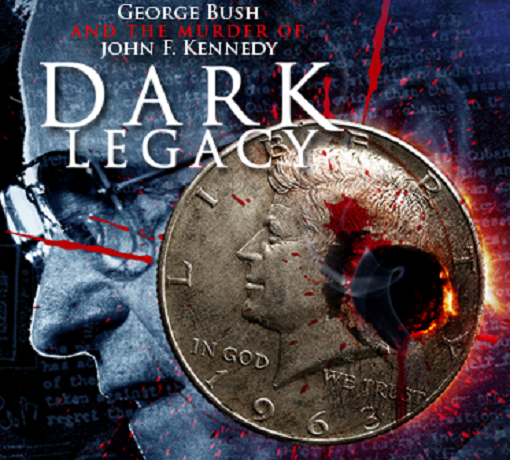
Short Version: For those too busy to follow this all the way through…. George HW Bush is ultimately responsible for the planning & execution of JFK, as sanctioned by his masters – The Federal Reserve families. This explains his subsequent rise in power, from novice CIA spook, to CIA Director, Presidential Cabinet, Vice President, President…. to 33 Degree Iluminati Freemason..? Details to prove this conclusively are best conveyed by John Hankey. The connections back to GW Bush are absolutely astounding, and numerous enough for one to lose count. -DCMX
ABOUT THIS DOCUMENTARY
Relying exclusively on government documents, statements from the best witnesses available, and the words from the mouths of the killers themselves, Dark Legacy produces a thoroughly substantiated criminal indictment of George Herbert Walker Bush, establishing beyond a reasonable doubt his guilt as a CIA supervisor in the conspiracy to assassinate John F. Kennedy. If we could present this evidence to a jury in Texas, he would pay with his life.
Part one presents the overwhelming mountain of evidence that President Kennedy was hit by bullets from the front and rear. Every witness in the Dallas emergency room attests, on camera, to the fact that a bullet from the right front blew a fist-sized whole in the back of the President’s head. The New York Times carried these statements on the day of the murder; and has covered them up ever since.
*************
Part two presents the on-camera testimony of the witnesses who actually handled the President’s body, the FBI report, and the photographic evidence all proving unequivocally that the President’s body was stolen from the Secret Service and the wounds altered, before the body was delivered to Bethesda Naval hospital for the autopsy. Jackie Kennedy accompanied an empty casket on the plane flight home. Who had the power to do all this without attracting public attention? It’s a short list.
************
Part three presents the Nazi-connections of the Bush family, which prompted the FBI to seize their assets during WW II, as Nazi assets. It presents the suppressed fact that Watergate burglar and CIA operative E. Howard Hunt was found by a jury to have been in Dallas and involved in the conspiracy to kill Kennedy. Hunt was a supervisor of the misguided CIA-led anti-Castro Cubans who broke into the Watergate. He is not only connected to Bush through Watergate; and through Bush’s father, Prescott; but five days after the assassination, the head of the FBI, J. Edgar Hoover, wrote a memo, titled “Assassination of President John Fitzgerald Kennedy” in which he named “George Bush of the Central Intelligence Agency” as the supervisor of what Hoover himself called the “misguided anti-Castro Cuban” killers of the President. Bush has said he doesn’t remember the events of that day, but FBI documents place him in Dallas.
It is difficult to assess the stature and significance of someone who has been dead as long as John Kennedy. His killers have also been his detractors, actively desecrating his memory, as they did his body. The movie begins with a short presentation of some of his most powerful and important speeches; including a stunning speech to the UN in which Kennedy calls for the complete abolition of the military industrial complex. These same men the military industrial complex, ripped him from us, and the darkest features of our history since that time are all directly the result of his murder.
******* JFK ASSASSINATION EXPLAINED *******
I don’t think we are much encouraged to see History as science. Quite the opposite, actually. And of course, that’s all politics. The winners write history, and the truth be damned. Even science can have trouble trying to act like science when political issues are involved, as we see with evolution, tobacco-and-cancer, and global warming. But I think History does have a lot in common with physical science. For example, I can remember when “Continental Drift”, the idea that Africa and America were once stuck together, was very much considered “just a theory”; ridiculed by some, and regarded with amusement by many, and promulgated as likely by a tiny minority. But as time goes by, the evidence accumulates; and the meaning of old evidence begins to settle in; and ideas that were once considered outrageous gradually get worn in and start to be regarded as obvious common sense. Part of this process is the continual accumulation of new evidence. New pieces are added to the puzzle and the picture becomes more clear. And sometimes the hidden meaning of old evidence, that has been lying around for years, suddenly jumps out. Evidence of the fossils and minerals that can be found on the east coast of Africa, and on the west coast of Brazil, may have been lying around for years, before someone decided to look and see if they matched, and found that they did; and proved conclusively that west Africa and Brazil were once attached.
With regard to George HW Bush and the murder of John Kennedy, Joseph McBride found this memo in 1988.
FBI director J. Edgar Hoover wrote this memo 5 days after the assassination, naming George Bush as a CIA officer.
The last, and most crucial paragraph, is very hard to read. The following is a transcription:
“The substance of the forgoing information was orally furnished to Mr. George Bush of the Central Intelligence Agency and Captain William Edwards of the Defense Intelligence Agency on November 23, 1963, by Mr. V.T. Forsyth of this Bureau.”
When it was first released in 1978, George Bush was an obscure bureaucrat, a virtual unknown. So when the best researchers on the planet saw this memo in 1978, they didn’t pay much attention to it. When Bush became vice president two years later, no one was able to connect his now well-known name to this obscure memo. But when Joseph McBride was messing around in 1988, Bush was running for president; and when McBride saw the memo, he jumped up and shouted “Hey, this memo is about Bush! It says he was in the CIA, way back in 1963!”
And for the longest time, the focus was on this simple isolated fact: that Hoover said Bush was in the CIA in ’63. Bush said the memo must be referring to another “George Bush,” because he wasn’t in the CIA at that time. But over the years, people were able to assemble the facts from Bush’s personal life, showing his deep involvement with the CIA at that time, and with the CIA’s anti-Castro Cubans (in the memo, Hoover calls them “misguided anti-Castro Cubans”). And over time, it has become undeniable; that Hoover was referring, in his memo, to none other than George Herbert Walker Bush. And for a while, that was it. End of story.
But the title of this Hoover memo is, “Assassination of President John Fitzgerald Kennedy”. Isn’t that important? Well, you’d think so. But for the longest time, no one made much out it. Besides, Hoover scarcely mentions the assassination in the memo, instead focusing on these “misguided anti-Castro Cubans.” The body of the memo does not appear, at first, to be in any way related to the title of the memo “the assassination of President John F Kennedy”. But then Mark Lane, in his book Rush to Judgment, did the fabulous work of demonstrating, and in fact persuading a jury, that E. Howard Hunt, a major lieutenant in the CIA’s “misguided anti-Castro Cuban” program, was in Dallas and involved in the assassination. With this background, with this framework to guide the researcher, it was then possible to assemble the considerable evidence linking Bush to Hunt.
People might have taken some notice before that Bush made the unusual request, as Nixon’s ambassador to the UN, to be given an office in the White House. They may have noticed that Hunt, although he was not being paid by anyone in the White House, or answering to anyone that we know of in the White House, also had a White House office. But with the Hoover memo in hand, establishing Bush as a supervisor of the CIA’s “misguided anti-Castro Cuban” operation, it is possible to connect Bush to Hunt at the Bay of Pigs. With this memo in hand, it is possible to connect Bush and Hunt as two CIA operatives with offices inside the White House. With this memo in hand, it is possible to answer who it was that Hunt answered to inside the White House; and how he got the office in the first place. And with all that, it is possible to connect Bush to Hunt, and therefore to Dallas, to Hunt in Dallas, and to the “misguided anti-Castro Cuban” assassins of John Kennedy. Which is what Hoover did for us when he wrote the title of the memo. Little by little, the pieces start to fall into place. And pieces that in isolation meant nothing, become key parts of a whole picture.
But even so, this is not a rock-solid connection: Hunt was directly involved in the murder of JFK. And Bush supervised Hunt. But Bush probably supervised a lot of CIA people, not all of whom were directly involved in the assassination. A high-ranking officer may be connected to all of the acts of all of his troops, by reason of his being their commander. But it’s not a direct connection. It doesn’t establish that the officer knew about, or approved of, or was involved in, all the actions of those troops.
Enter FBI memo # 2:
It will come up again in a minute, so please read the first line carefully. Bush identifies himself to the FBI as an independent oil man from Houston.
This memo establishes that sort of direct connection between Bush and Hunt, in Dallas, on the day of the assassination. This memo records Bush’s phone call to the FBI, precisely an hour and fifteen minutes after the assassination. When I first encountered this memo, and when I first put it into my movie, JFK II, I simply called it “weird”. I saw it only in isolation, a weird, isolated connection between Bush and the assassination. It took me years to see it in context. That is, to see that this phone call demonstrates, clearly, that George Bush, was on duty that day.
He was staying at the Dallas Sheraton because his duty assignment was in Dallas. His phone call to the FBI cannot have been random. This James Parrott worked for Bush as a sign-painter; he was not an assassin; this phone call is not what it purports to be; Bush was fulfilling some obscure under-cover function in making this call. So the phone call has to be seen as part of his CIA assignment; which was clearly connected to the assassination. This memo then establishes that Bush was in the Dallas area, and on duty; and that his duty assignment was connected to the assassination. And if his men were in Dallas shooting the President, as they were, he was certainly on duty supervising them. If he were not supposed to be supervising them, his bosses would have assigned him to be at his home office in Houston, Texas; or on his oil rigs in the Caribbean.
But, even in context, this memo and the phone call it describes is still weird, no? I mean, how could Bush have been so stupid as to make this insanely incriminating phone call? Without this FBI memo, recording this phone call, we don’t know, or even have a good clue as to where Bush was, or what he was doing the day of the assassination. Do we? Bush has, until recently, simply said that he did not remember what he was doing the day of the assassination. But with this memo, Bush tells us where he was and what he was doing — he hands us his head on a silver platter. What could possibly have motivated him to make such a stupid error as making this phone call to the FBI? It’s a valid question. It’s not an essential question. We can still value this memo, and extract a great deal of important content from it without answering the question of why, but the question remains.
And we can make a stab at answering it. Russ Baker in his fine book, Family of Secrets suggests that Bush was attempting to establish an alibi. Now, by making this phone call, he, in fact, establishes that he was in the Dallas area, and that he was on duty, related to the assassination. So if he’s trying to establish an alibi to cover-up where he actually was and what he was actually doing, what he is trying to cover up must be some pretty bad stuff, some pretty incriminating stuff, if it’s worse than what he gives us with this alibi.
And what could be worse than what he gives us? Well, obviously, he must have actually been in Dallas. In fact, I think, this situation suggests he must have actually been in Dealey Plaza. I mean seriously. Think about it. He’s so panicked about the truth coming out, that he puts his head in a noose and hands it to us. It makes me think he must have been in Dealey Plaza, he must have been in the company of the shooters, and he must have felt that there would be evidence to prove that.
We’re just speculating at the moment. We’ll get to the evidence right now, but I’m trying to set the scene. If a guilty party is in a panic, trying to cover evidence connecting them to a crime, they may invent an explanation, or an alibi, that seems like a good idea at the time; but that in fact constitutes a very damaging admission. Anyway, stew on that while you consider this photo:
You see this tall thin man in a suit, with a receding hair line. Many people claim this is Bush, standing in front of the Texas School Book Depository. And it might be. It might be a lot of people. And perhaps, when he called the FBI and incriminated himself, Bush was concerned that he might show up in a better picture than this, where he was positively recognizable, looking towards the camera.
Personally, I don’t think this photo looks much like Bush; and in fact, I didn’t think he’d be stupid enough to just be hanging around the murder scene. I thought he was sufficiently high ranking that he’d leave such on-scene stuff to his underlings. Right? At least in my mind, if you’re an officer like Bush, you’re the coach. You plan, you train and prepare your people, and then you stand back and watch it happen. Or so I thought. Fletcher Prouty was certain that he saw pictures of Ed Lansdale, a military operative of the highest rank, signaling to the “tramps” arrested behind the grassy knoll to “be cool,” that everything was alright. Hunt was a high-ranking CIA officer, chief of the CIA’s Mexico station; and his son says he is one of the “tramps” who show up in several photos of men who were arrested behind the grassy knoll. So, some of the highest ranking members of the killers’ operation were apparently there, on the front line, to make sure that when things went wrong, as they inevitably do, these high ranking officers could be there to fix whatever the problem was. So, given that high- and low- ranking CIA officers were present, this photo of this thin man in a suit might, indeed, be Bush. It’s possible.
And now, look at this picture of the Dal-Tex building. The Dal-Tex building is across the street from the Book Depository, and many leading researchers into the assassination, including Jim Garrison, say there was certainly a team of shooters in this building:
[click for larger]
And as you can see, some imaginative individual has added some color to indicate three men in this window. Very creative, very imaginative; and at least plausible. Still, it takes way too much imagination and effort, to see Bush’s face. But now observe this link: http://www.ratical.com/ratville/JFK/WTKaP.html
Actually, You don’t have to stop and read it, because I’ll quote the relevant part. It’s a statement from Roger Craig, winner of the deputy of the year award for Dallas in 1960, and one of the most honest men working that day in Dallas. He’s an amazing and heroic fellow, worthy of all the time you could take looking into his background and character. And here, in the following passage, he is describing a conversation he had with Jim Garrison, and he says,
“Jim also asked me about the arrests made in Dealey Plaza that day. I told him I knew of twelve arrests, one in particular made by R. E. Vaughn of the Dallas Police Department. The man Vaughn arrested was coming from the Dal-Tex Building across from the Texas School Book Depository. The only thing which Vaughn knew about him was that he was an independent oil operator from Houston, Texas. The prisoner was taken from Vaughn by Dallas Police detectives and that was the last that he saw or heard of the suspect.” (emphasis added)
Holy Moe Lee! Please notice that, in speaking to Jim Garrison, Craig says “in particular”. Apparently he and Vaughn thought this was the most significant arrest made that day; pretty amazing given that E.Howard Hunt was arrested in the rail yard behind the grassy knoll. And the only thing Craig knew about this “particular” arrestee was that he had exactly the same singular CIA-cover, “an independent oil operator from Houston, Texas”, that George Bush had used that same day in his contact with the FBI.
Now. There are a very limited number of possible explanations for who this “independent oil operator” was. Let’s look at them.
It is conceivable that the CIA had two men in Dallas area that day, supervising the shooters, who both had the designated cover of being an “independent oil operator from Houston.” Bush was one, as the evidence above clearly shows; and perhaps there was another who was with the shooters in the Dal-Tex building, supervising them directly. But unless the CIA overlords were trying to set Bush up, they would not have told anyone else to use Bush’s CIA cover to identify themselves to the police. If another man was involved in the crime, and was arrested for it, and he told the cops he was an “independent oil operator from Houston,” this would tend to throw suspicion in Bush’s direction. Bush’s association with the CIA’s Cubans was already widely known. Fletcher Prouty knew and wrote of it. Fabian Escalante, the head of Cuban counter intelligence, knew and has written about it. James Files, who claims very credibly, to have been a driver for the Mafia shooters in Dallas, has spoken on-camera about it. And FBI director J. Edgar Hoover, knew about it and wrote about it in his memo. So Bush was already a suspect in Hoover’s eyes. The CIA planners, then, would not have told anyone else, “in case you get arrested, tell the cops you’re an independent oil man from Houston”. Right? They would not have done this, since it would tend to incriminate Bush, who was already in a highly visible, highly suspicious position.
Another unlikely possibility is that this “independent oil operator from Houston” was just some innocent oil operator, who somehow managed to attract suspicion, and was arrested. Do you think it’s possible that another oil man from Houston just happened to be in that corner of Dealey Plaza? I hope you think it’s possible. Because, as unlikely as it seems, if you think it was possible, then certainly Bush would have been reasonable in thinking that, as he was being arrested, there were other independent oil operators in the crowd who witnessed his arrest. You see, Bush spoke to a group of oil men in Dallas the night before the assassination*2. If it were possible that some of them were in Dealey Plaza, he would need to be terrified of the possibility that some of them might actually have seen the arrest, and would have been able to identify him as the object of that arrest.
No wonder, then, that Bush freaked out, and made this stupid incriminating phone call to the FBI. Even if it showed that he was not in Houston, or in the Caribbean, but in Dallas, at least it suggested that he was not in police custody for the murder of the President, in Dealey Plaza.
But now stop and think a minute: why was he arrested? What was he doing that drew this cop’s attention at all? What could he possibly have been doing to make this cop think that he needed to arrest Bush? Perhaps walking out of a building without attracting attention is harder than it sounds; and it reasonable to suppose that the crowd outside the Dal-Tex building had heard the shots, had heard that the President had been wounded, and they were carefully scrutinizing anyone who came out of the building. But this story shows clearly that Bush was not the sort of cold-blooded killer who could take part in the murder of a man, and then act and look like nothing was going on as he tried to leave the scene of the crime. And it turns out that as an old man, Bush continues to suffer from this character trait, of being unable to hide feelings that need to be kept secret. As you can see in this link, http://www.youtube.com/watch?v=ft3eGWZd7LE , at Gerry Ford’s funeral, Bush suddenly breaks into a wide grin while speaking of the Kennedy assassination. This is not a Mona Lisa smile. This is face-wrenching spasm of glee.
In a minute we’ll take up the question of why Bush would grin at his recollection of watching John Kennedy’s brains splatter; the point for us now is that he apparently had a similarly inappropriate, show-stopping expression on his face as he attempted to exit the Dal-Tex building; he had the look of a murderer in his eye, so clearly that it could not be missed; as this funereal-grin could not be missed. And the guilt plastered all over Bush’s face drew people’s attention. And this cop, Vaughn, arrested him.
Now remember, Roger Craig tells this story in the context of his discussions with New Orleans District Attorney Jim Garrison about the suspects who were arrested that day and who then evaporated without leaving a mugshot, interview, fingerprint, or name. Garrison spoke not only to Roger Craig, but he no-doubt spoke to Vaughn, who made the arrest. And Garrison adds the following:
“At least one man arrested immediately after the shooting had come running out of the Dal-Tex Building and offered no explanation for his presence there. Local authorities hardly could avoid arresting him because of the clamor of the onlookers. He was taken to the Sheriff’s office, where he was held for questioning. However, the Sheriff’s office made no record of the questions asked this suspect, if any were asked; nor did it have a record of his name. Later two uniformed police officers escorted him out of the building to the jeers of the waiting crowd. They put him in a police car, and he was driven away. Apparently this was his farewell to Dallas, for he simply disappeared forever.”
— On the Trail of the Assassins, p. 238 —
This vision of the panicked Bush being arrested, no-doubt terrified as he was taken to the police station, and possibly even booked (though the record of any such booking has been destroyed) provides a context that explains a number of Bush’s otherwise-mysterious actions. Certainly Bush was freaked out and panic-stricken! An angry crowd clamored for his arrest, and jeered his release.
Being a newbie in these dark affairs, Bush didn’t have confidence in the ability of the old devils at CIA to make water run uphill, to make time run backwards, to silence the witnesses, to destroy the records, and make it all go away. And so he panicked; he acted on his own, stupidly; he called the FBI, thinking that he was “cleverly” providing evidence that it wasn’t him who was arrested in front of the Dal-Tex building that day. In his panic-stricken state, this seemed like a good idea. He was unable to see that he was actually creating a permanent absolutely-positive record of his involvement.
We can now also explain the grin. He grins ridiculously at Gerry Ford’s funeral, at the mention of John Kennedy’s murder, not because he is such a ghoul that he thinks splattering the contents of Kenney’s head all over Jackie Kennedy was funny; but because mentioning the assassination causes him to recall the comedy of errors that produced his own ridiculous panic, arrest, more panic, and so on.
Garrison wrote his paragraph about Bush’s arrest in 1988. Deputy Craig’s article was written in 1971 and posted in 1992. But the significance of these paragraphs was discovered last week. There hardly was an internet in 1992 when Craig’s article was posted. And for 19 years, no one noticed that this phrase, “independent oil man from Houston”, is a very unique description of Bush. No one noticed until last month, when one of the moderators of JFKMurderSolved showed it to me. And I wrote about it to some friends, and one of them suggested I read what Jim Garrison had to say.
So the pieces continue to fall into place. Little by little, the picture is filled in, the questions get answered. And the conclusions become more incontrovertible. This is just the sort thing that happened with the theory of Evolution and the Big Bang theory; and the theory of continental drift. And someday they may start to teach history, as a science, based on evidence, in the universities. Really! It could happen! At which point, Bush’s involvement in JFK’s murder will be taught, like evolution, as the only plausible explanation of the available reliable evidence.
Final note: Until recently, Bush had nothing more to say about his whereabouts the day of the assassination than that he doesn’t remember where he was. That in itself is extraordinarily incriminating. Everyone who was alive at the time remembers where they were on 9-11, and on the day Kennedy was murdered. But, saying that he doesn’t remember, however improbable, is at least consistent with Bush’s autobiography, which mentions nothing.
Lately, however, perhaps at least partly in response to my work, Bush and Co. have concocted a story that he was speaking in Tyler, Texas to the Rotary Club. The vice-president of the Rotary Club, Aubrey Irby, says that Bush was speaking when the bellhop came over and told him, that Kennedy was dead*1. Mr. Irby passed the information on to Mr. Wendell Cherry, who passed it on to Bush; who stopped his speech. Irby says that Bush explained that he thought a political speech, under the circumstances, was inappropriate; and then he sat down. As a would-be alibi proving Bush’s innocence, there are at least three huge problems with this story.
The first is that it is inconceivable that Bush would not have remembered such an event; or that he would have left it out of his autobiography, since it shows what a fine and respectful fellow he is. If he didn’t remember it sooner, or include it in his autobiography, it’s clearly because it never happened.
The second huge problem with this story is that it couldn’t possibly have happened; that is, it is made impossible by Bush’s original alibi, his phone call to the FBI, as you’ll see:
The witness who tells this story, Aubrey Irby, says that Bush excused himself and sat down. It doesn’t say that he rushed out of the room in a frantic search for a phone. The problem is that Walter Cronkite’s announcement to the world that Kennedy was dead came at 1:38 (http://www.youtube.com/watch?v=76gl3NZAdxo). Certainly, no one was listening to Walter Cronkite in the same room in which Bush was speaking. Therefore we can be sure that this bellhop, who told Irby that Kennedy was dead, was in another room. The bellhop had to make the decision that he had heard enough of the news to leave off listening to the news. This is no small point. Texas governor Connally was severely wounded. Lyndon Johnson was reportedly wounded. There was much other news to be confirmed. At some point, then, the bellhop decided to stop listening and go make an announcement. There’s no reason to think Irby would be the first person he would tell. But at some point he went to the room where Bush was speaking and informed Mr. Irby that the president was dead. This walk to find Irby took time, of course. Mr. Irby had to receive the information, and then he had to decide to inform Mr. Wendell Cherry, the president of the Kiwanis. Mr. Cherry had to decide that he should interrupt Bush’s speech; Mr. Cherry had to then walk over to Bush and tell him the news.
Bush had to decide what to say; and he had to say it. And, according to the only witness, Mr. Irby, Bush “then sat down”. Somehow, when he was finished sitting, without attracting Mr. Irby’s attention, Bush had to seek and find a phone. This would have been a hotel phone, so he would likely have had to go through the hotel switchboard to get an outside line. Do you suppose the switchboard was busy after the announcement of the President’s death? It’s a good guess. In Washington D.C. so many people rushed to make a phone call that the phone system went down. In any case, once he got through to the hotel operator and got an outside line, Bush then had to call information and get the number of the FBI. After getting through to information, and getting the number, he then had to call the FBI; and penetrate their switchboard, which was, no doubt, very busy; and he had to locate an agent, on what must have been the busiest day in the history of the Dallas bureau. How many minutes do you suppose that would take? Twenty seems a fair guess, though it seems implausible that a civilian could even get through, given all the official police business going on at the time. We know that the Dallas FBI was all over the murder scene, confiscating camera film and intimidating witnesses; so it’s hard to imagine how Bush, an hour after the shooting, was able to reach an agent at all. Given the “sitting” that Mr. Irby observed Bush doing, for all this to have transpired in 45 minutes would be tidy work. But Bush had to do all of this, as the FBI memo states, by 1:45, seven minutes after the news of Kennedy’s death first went out; which is blatantly impossible.
The third problem is this question of why Bush would feel that it was necessary to concoct such a story at all? Why does he have to tell us this lie? Why does he have to get others, like Irby, to lie for him? The irony is that the harder he tries to make himself appear innocent, by lying, the more evidence he gives us of his guilt.
*1 Kitty Kelley, The Family: the Real Story of the Bush Dynasty, p.213; cited by Russ Baker in Family of Secrets, p.54
*2
There are some people who manage to point to this and say “ahah! That’s why Bush was in Dallas! Not to kill the President, but to speak to the other oilmen!” But as the Hoover memo shows, being an oilman was just a cover for Bush’s real occupation as a CIA supervisor of trained killers. He needed an excuse for being in Dallas. This speaking engagement provided him with one.
———————-
FROM THE DIRECTOR
George Bush killed Kennedy. Or was it the Mafia? Maybe Castro did it. Who cares? It was 40 years ago. What difference does it make?
It matters.
The day he died we lost an invaluable treasure. This video documents that we lost a man of peace, who tried to cool off the cold war, and to get the American people to see their Russian enemies, not as despicable inhuman monsters, but as people like us.
On November 22, 1963, you lost the man who saved your life on October 17, 1962. At the height of the missile crisis, Kennedy’s generals and advisors were urging him to launch a first strike attack against Cuba. They assured Kennedy that the Russian missiles in Cuba were not nuclear and were not ready; but that he and they should quietly slip away to the safety of bomb shelters anyway, just to be safe; and then launch an attack, leaving the rest of us out to die. Kennedy thought about it. And then he told them that nobody was going anywhere. If anyone died, they would be the first to go, sitting as they were in the Whitehouse, the prime target of those Russian missiles. Together they then figured out a safer plan. Robert McNamara, Secretary of Defense at the time, recently learned from the Russians that the missiles were armed, were ready, were nuclear, and that their commanders were authorized to use them in case of an attack. If you live in the northern hemisphere, the lives of your parents, and your future, were certainly saved by John Kennedy on that day. It matters that his killers be exposed.
In his farewell address, President Eisenhower had warned Kennedy, and the rest of us, of the threat posed to democracy by what Eisenhower called “the military industrial complex.” And while Kennedy famously went after the CIA, and refused to commit troops to Vietnam, I always wondered why he didn’t more openly attack this military industrial complex. And then I stumbled upon a speech he gave at the United Nations. As you will see in the video, he called upon the Russians, and United Nations, to help him to take on this military industrial complex, in order to “abolish all armies and all weapons.” But he was swept away. And in the years since, millions have died in needless wars, trillions of dollars have been wasted on “defense”, and millions more people have lived and died needlessly in poverty. It matters that we lost him.
In 2007, Bruce Willis told Vanity Fair magazine, “They still haven’t caught the guy that killed Kennedy. I’ll get killed for saying this, but I’m pretty sure those guys are still in power, in some form. The entire government of the United States was co-opted.”
Now Willis probably would not mind my suggesting that he’s no genius. At best, his observation is common sense. 80% of the American people agree with him. Indeed, this video, proving that Kennedy was brought down by the most powerful men in the world and their hired thugs, is not based on secret documents. It is all information that has merely been suppressed. Oswald allegedly shot Kennedy from behind. But the day he died, the NY Times carried the story, told by the doctors in Dallas, that Kennedy had an entrance wound in his throat, another in his right temple, and a large gaping exit wound in the back of his head. After talking to the emergency room doctors, Kennedy’s press secretary described, to the assembled press, a shot to the right temple from the right front that went “right through the head.” All of the witnesses near the right front, the grassy knoll, described hearing shots from that direction, and dozens of witnesses raced up the knoll in pursuit of the shooters. These witnesses talked to the press. But all of this information has been suppressed for the last 50 years. By whom? Who could?
You will also see in this video the overwhelming best evidence, from the best witnesses, proving beyond a reasonable dispute, that Kennedy’s body was stolen from Air Force One, and the wound to his right temple was mutilated, before the autopsy. Jackie Kennedy kept watch over an empty casket on the flight from Dallas to Bethesda Naval Hospital. Then the body was quietly taken to Bethesda for the autopsy, arriving 20 minutes before Jackie and the empty casket. Who had the power to arrange this? Who HAS the power today to suppress all this evidence?, and to continue to bombard us with ridiculous lies about a lone gunman? It’s a short list, isn’t it? It doesn’t include the mafia, or the Russians, or Castro. It does include the Bush family – or rather their masters in Big Oil; the banking elite; the backbone of the military industrial complex. These men, and their successors, carried out the attacks of 9-11. It matters.
NEW DOWNLOADABLE EXTRAS!
To compliment the DVD, here are four audio extras with increased appreciation for the events described in the film:
[Lee Wanta is not mentioned here but he was pivotal in the intelligence operations against the Soviet ruble from 1988!]
Deanna Spingola February 8, 2010
In 1989 President George H. W. Bush began the multi-billion dollar Project Hammer program using an investment strategy to bring about the economic destruction of the Soviet Union including the theft of the Soviet treasury, the destabilization of the ruble, funding a KGB coup against Gorbachev in August 1991 and the seizure of major energy and munitions industries in the Soviet Union. Those resources would subsequently be turned over to international bankers and corporations. On November 1, 2001, the second operative in the Bush regime, President George W. Bush, issued Executive Order 13233 on the basis of “national security” and concealed the records of past presidents, especially his father’s spurious activities during 1990 and 1991. Consequently, those records are no longer accessible to the public. [1] The Russian coup plot was discussed in June 1991 when Yeltsin visited with Bush in conjunction with his visit to the United States. On that same visit, Yeltsin met discreetly with Gerald Corrigan, the chairman of the New York Federal Reserve. [2]