Danny Casolaro Shortly before his death, Casolaro told people that he was nearly ready to reveal a wide-ranging conspiracy spanning the Inslaw case, Iran-Contra, the alleged October Surprise conspiracy, and the closure of BCCI.[7]David Corn writes in The Nation that the papers Casolaro left behind reveal few clues, except that he was in over his head, but was tenacious.[8]
His papers included old clippings, handwritten notes that were hard to read, and the names of former CIA officers and arms dealers. Corn writes that the notes show Casolaro was influenced by the Christic Institute and that he had pursued material fed to him by a reporter who worked for Lyndon LaRouche.[8] Richard Fricker writes in Wired that Casolaro had been led into a “Bermuda Triangle of spooks, guns, drugs and organized crime.”[9]
Danny Casolaro Journalist, Freelance Writer
Danny Casolaro Shortly before his death, Casolaro told people that he was nearly ready to reveal a wide-ranging conspiracy spanning the Inslaw case, Iran-Contra, the alleged October Surprise conspiracy, and the closure of BCCI.[7]David Corn writes in The Nation that the papers Casolaro left behind reveal few clues, except that he was in over his head, but was tenacious.[8]
His papers included old clippings, handwritten notes that were hard to read, and the names of former CIA officers and arms dealers. Corn writes that the notes show Casolaro was influenced by the Christic Institute and that he had pursued material fed to him by a reporter who worked for Lyndon LaRouche.[8] Richard Fricker writes in Wired that Casolaro had been led into a “Bermuda Triangle of spooks, guns, drugs and organized crime.”[9]
Danny Casolaro Journalist, Freelance Writer
Danny Casolaro Shortly before his death, Casolaro told people that he was nearly ready to reveal a wide-ranging conspiracy spanning the Inslaw case, Iran-Contra, the alleged October Surprise conspiracy, and the closure of BCCI.[7]David Corn writes in The Nation that the papers Casolaro left behind reveal few clues, except that he was in over his head, but was tenacious.[8]
His papers included old clippings, handwritten notes that were hard to read, and the names of former CIA officers and arms dealers. Corn writes that the notes show Casolaro was influenced by the Christic Institute and that he had pursued material fed to him by a reporter who worked for Lyndon LaRouche.[8] Richard Fricker writes in Wired that Casolaro had been led into a “Bermuda Triangle of spooks, guns, drugs and organized crime.”[9]
We’ve all been part of these discussions, and we’ve all read a ton of them on forums and blogs over the years: “if you could have only one gun for TEOTWAWKI, what would it be?” A more enlightened-seeming variant on this same theme are discussions that start with, “if you could pick only three guns for TSHTF…”
Here’s what’s wrong with so many of these discussions: no matter what flavor of civilization-ending apocalypse you contemplate — meteor strike, supervolcano, global pandemic , EMP blast, etc. — a SHTF scenario is likely to play out in phases, and for each phase you’re going to need a different skill set and a different load-out — not just a gun, but a complement of tools and skills.
Below is my brief attempt to sketch out the three phases that society would go through in a total collapse, and to think about some load-out options for each. Sure, you could read this and then pick three guns — one gun per phase — but by the end you’ll see that this attitude is putting the cart before the horse. The smarter thing to do is to put together a set of load-outs that will give you multiple options for dealing with each phase. You may still end up with three guns, but the point is that “which three guns… ” is not the question that you start with. Instead, the right question is “what mix of weapons and accessories are the best fit for each of the scenarios I’m envisioning?”
Phase 1: martial law and trigger-happy authorities
In the initial phase of a catastrophe, a phase that admittedly may last only a day or two depending on the swiftness and severity of the cataclysm, there will be some attempt by authorities to maintain law and order. During this phase, if you’re walking around with an AR or AK strapped to your back, you’re likely to be taken for a looter and shot on sight.
This is the red dot or reflex sight + polymer frame pistol phase. Mobile, concealable, accurate, quiet, and 100% reliable are what you’re looking for. Don’t worry about how long the batteries will last in your Aimpoint right now — you just have to get through this phase without getting arrested or shot.
If you think you’re going to get through this phase with a bow or a crossbow, then all I can say is that I’ll be glad to use your bow in phase 3 when I stumble across your corpse clutching it.
My personal fantasy load-out for this phase would be a suppressed Glock 17 paired with something like the Daniel Defense ISR-300 (a short-barreled rifle chambered in .300 Blackout with an integrally attached suppressor).
Why the focus on stealth? Because if you do have to shoot someone or something during this phase, there’s a good chance that you may not want the whole neighborhood to know that shots were fired at your house. The authorities will be dealing with mass chaos and won’t have time to sort out who shot first, so if they show up at your house and you’re armed to the teeth and standing over a pile of corpses, then it may not go well for you. So a suppressed short-barreled rifle is your best bet for home defense here, because at least you have the option of not involving an organized gang of heavily armed, yet frightened and confused people (i.e. the police or whoever is trying to maintain order) who may decide that you’re a threat.
Note that now is the time for you to either start your NFA paperwork, or obtain the theoretical know-how to build a homemade can. I’m not saying go out and build a silencer, because that’s illegal. But maybe download the info and print it out, and store it as part of your bug-out gear. Do not under any circumstances attempt to actually make a homemade silencer, though, because that’s a felony. You do it, you get caught, you go to jail — end of story. I’m not winking or smiling here — do not do it, and in fact don’t even gather the materials for it because you don’t want to be guilty of constructive possession of such a thing.
Experienced pistol shooters (which does not describe me) will no doubt be fine skipping the CQB personal defense weapon (PDW) and using a suppressed semi-auto pistol for this phase. This is great, because as I mentioned above, you’ll need a pistol anyway.
So get your phase 1 load-out together, and learn to shoot and move with it. And for God’s sake just pick the best tools for the immediate job at hand, without worrying about whether or not the batteries will last another 20 years. You’ll need every technological advantage, no matter how fragile and/or short-lived that technology may seem, to fight your way through this temporary phase. If you can afford some good night-vision equipment, then by all means add it to your phase 1 load-out, and quit worrying about whether your grandchildren will still be able to use it to defend the homestead.
Phase 2: lawlessness and die-off
This is the open-carry assault rifle phase. Very few people are going to make it past this phase, but if you do, it’s because you have reliable long gun, plenty of ammo, a good optic, some training, and a few capable allies at your side.
The people who have survived phase 1 are not going to be happy campers. They’ll be hungry, justifiably terrified, and aggressive. They’ll also be gathered together in groups and gangs, which is exactly how you should plan to roll during this phase. More allies with guns means a better chance for you and yours to survive, which is why the training that you do for this phase should involve learning to shoot and move as part of a group.
You’ll want carbine and shotgun options — the pistol that got you through phase 1 will probably become a rarely used backup weapon, and your long guns will become your primary weapons. My personal pick for phase 2 is an AR-15 with a Trijicon ACOG, but that’s because I know the AR platform pretty well. Others will choose the AK. There’s also the Tavor, SCAR, and numerous other options. I won’t wade into this debate, because this is what most people are thinking of when they post “what gun and optic should I get for SHTF?” in various forums.
Phase 3: long-term survival
At some point your optics will run out of batteries, and depending on your stockpiles you may run out of ammo even before then. When this happens, it’s all about trapping and snares, fishing, farming, and finding ways to harvest a few thousand calories per day per family member.
Note that taking wild game of any kind is difficult, and it involves a lifetime of practice. Depending on the terrain you’re in and your skill set, hunting for food will range from very difficult to downright impossible. Farming is an order of magnitude easier and more predictable, so if you really want to be prepared then you should learn to grow your own food.
Of course, you will still do some shooting — this is the phase where you get to bust out that double-barreled shotgun with the multi-caliber barrel inserts, and go scavenging for ammo. If that shotgun was your phase 1 weapon, then you probably didn’t make it this far, but it will make a fine phase 3 hunting and home/farm defense gun.
This is the phase where a lot of people plan to rely on archery to take game. Please. Bowhunting is hard. Trapping isn’t a cakewalk, but it’s a vastly easier and more reliable way to get protein that stalking around in the woods with a bow; it also relies far less on expensive consumables (i.e arrowheads and strings) that you’d need to stockpile.
I personally think that .once-again-cheap 22LR ammo is the best thing to stock up on for this phase, and judging by the recent shortage, plenty of people agree with me.
Conclusion
Many of you will disagree with some, or even all, of my recommendations. But I hope if you take away anything from this article, it’s the idea that any catastrophe will unfold in series of distinct phases or stages, and you’ll need to prepare for each one. The tools and skills that will get you through the initial phase won’t necessarily be the best suited for the next phase, and so on. So the answer is to have specialized load-outs for different types of situations. You want to have options, so that you can improvise, adapt, and overcome. Don’t think in terms of “one gun” or “three guns” — think in terms of scenarios and loadouts.
This is actually how US Special Forces operate. They have different load-outs that fit different mission profiles; sometimes this involves selecting different weapons and tools, and sometimes it involves reconfiguring the same weapon or tool. But the main thing is that they have options, and they adapt their load-out to fit their situation.
What types of scenarios do you imagine that you’ll face in a catastrophe, and what type of load-out (gun, optic, ammo, clothing, tools) would be the best fit for each scenario? Don’t get sucked into the game of trying to put together one single loadout that will fit every scenario, because I promise you, when you’re watching the chaos unfold and you’re wetting your pants, you’re going to wish dearly that you hadn’t tied yourself to a one-size-fits-all, jack-of-all-trades-master-of-none solution. You’re going to want to reach for the very best tool for the job that is immediately staring you in the face, and you won’t be happy if you’re stuck with the second- or third-best tool for wide a range of jobs that you may or may not encounter.
*Apologies for Mis-communicating the correct DATE of broadcast, January 11th (not 10th)
Idaho Dad’s letter says it all: ‘These guns protect my children’
FBI Crime Stats Reminder
BEN SWANN – MSM’s lone voice of reason AT IT AGAIN!! DESTROYS the GUN CONTROL AGENDA’s ARGUMENT
Obama Signs Bill Giving Him Armed Protection For Life
Nationwide ammo shortage so severe that even cops can’t buy bullets; ammo rationing imminent?
Sandy Hook ‘Reminders’ why the alternative crowd won’t let this go..
*QUICK NEWS*
RAPID DNA analyzers coming to Police Stations & TSA Checkpoints NEAR YOU
Whistle-blower SALUTE to Bradley Manning by Thomas Drake
The Government Lied When It Said It Only Bailed Out Healthy Banks … 12 of the 13 Big Banks Were Going Bust
New questions over CIA nominee Brennan’s denial of civilian drone deaths : The Bureau of Investigative Journalism
Flu (Scare) Season Goes Into Overdrive
World War Z – More Apocalypse & War Propaganda *gun owners are evil *global control force to ‘fix’ the Zombie infestation *millions of ‘disgusting’ humans must die
The massacre of 20 children and 7 adults at the Sandy Hook elementary school last Friday was one more in a long line of atrocious mass murders committed in the USA. By now, five days later, an official version of events has more or less solidified to explain the chain of events. The familiar ‘lone gunman’ narrative has once more stoked the hot-button issue of gun control and left the general population as clueless as ever as to why people suddenly ‘go postal’ and target the most vulnerable members of society.
On closer inspection, however, there is clearly more to many of these mass shootings than meets the eye. Very often the earliest reports present information that directly contradicts key foundations of the final ‘official’ analysis of events. Granted, confusion is natural when a story breaks, but some of the initial reports conflict so completely with the lone gunman narrative that I’m going to compile them here and then try to put this tragedy in a more objective context. In his speech at the Sandy Hook Interfaith Prayer Vigil in Newtown, Connecticut on Sunday night, President Obama quoted the following biblical passage:
“So we fix our eyes not on what is seen, but on what is unseen, since what is seen is temporary, but what is unseen is eternal.”
~ 2 Corinthians 4:18
The traumatised Newtown community deserves the facts without the spin. Everyone touched by this brutal event deserves to know what really happened, so let’s fix our eyes on what remains unseen…
A 20-year-old ‘tech geek’ named Adam Lanza is supposed to have snapped early last Friday, December 14th, shot dead his mother Nancy Lanza, loaded her car up with her guns and ammo, then driven it across town to his former school, the Sandy Hook Elementary School, shot dead 27 people in two classrooms and an adjoining hallway, then turned one of his guns on himself.
That’s how most will now remember the shooting, but is that actually what happened?
All the child victims were first-graders between the ages of 6 and 7. If there’s any saving grace to be found in this event, it’s that it was all over within minutes. Police were reportedly on the scene “instantaneously”, according to Connecticut State Police Commander, Lt. Vance and by then the shooting had ended. Listed among the slain school teachers and administrative staff was the school principal, 47-year-old Dawn Hochsprung. Right here we encounter our first problem:
Sandy Hook School Principal Dawn Hochsprung told The Bee that a masked man entered the school with a rifle and started shooting multiple shots – more than she could count – that went “on and on.”
How could the principal have survived to give this statement to local press describing what happened … if she was one of the first to be killed? Incidentally, The Newtown Bee‘s article was taken down on Monday December 17th. Of course, a plausible explanation is that a reporter mistook another teacher for the principal.
We were initially told that two handguns – a Glock and a Sig Sauer – were found next to the body of the dead shooter, while a third weapon, a .223-caliber rifle was also recovered “in the trunk of a car” later, in the school’s parking lot. All of the weapons were allegedly legally bought and registered in Nancy Lanza’s name. The car was later identified as a black Honda, also registered in her name. More weapons have since been introduced to the story but we’ll get back to those later on.
Besides anonymous ‘law enforcement officials’ telling the media that Adam Lanza was a former pupil at the school, they also said his mother was currently a teacher there, that she was found among the dead and that her son had specifically sought out her classroom first. But when it emerged that teaching staff at the school had never heard of a Nancy Lanza, it was suggested that she was a substitute teacher whose name therefore mightn’t appear on staff lists.
But this claim too has disappeared down the memory hole because it’s now known that Nancy had no connection with the school. Adam Lanza was in fact home-schooled. Nancy Lanza has since been painted as a “survivalist” who loved firearms, taught her sons how to shoot and was “stockpiling” because she was “worried about economic collapse.”
Last night it also emerged Nancy was a member of the Doomsday Preppers movement, which believes people should prepare for end of the world.
Her former sister-in-law Marsha said she had turned her home ‘into a fortress’. She added: ‘Nancy had a survivalist philosophy which is why she was stockpiling guns. She had them for defense.
‘She was stockpiling food. She grew up on a farm in New Hampshire. She was skilled with guns. We talked about preppers and preparing for the economy collapsing.’
It’s not difficult to see that their efforts to insinuate that Nancy Lanza was somehow responsible for this massacre by being an irresponsible mother also serve to rile the large contingent of gun owners in the country, particularly the far-right who see a conspiracy on the government’s part to “take back our guns.” More on that later, but for now I just want to note that all of the Lanza family members seemed to live more or less normal middle-class lives. Yes, the parents were divorced, but it was apparently amicable and both put their own needs second to those of their children (and anyway, divorce in the US these days is decidedly ‘normal middle class’).
Despite “family insiders” claiming that he was a “deeply disturbed kid”, Adam Lanza, like so many other alleged ‘lone(r) gunmen’ before him, does not fit the profile of a mass-murdering maniac. His 24-year-old brother, Ryan Lanza, said he hadn’t seen his brother since 2010. This fact brings into question Ryan’s claim that his younger brother may have had his identity card on his person at the school shooting. Although perhaps the question that needs to be asked here is, why would a person bother to carry identification with them after going to the trouble of dressing up in a bullet-proof vest, mask and black camouflage gear and going on a killing spree …
The live emergency services audio feed from the scene reveals some interesting observations from first responders that have been completely overlooked by the mainstream media. Note that the unedited version lasts over two hours, so the abridged version I’m going to quote from has a compressed sequence of events that are not in real time. In this abridged version, we hear at 1.38′ a report that gunfire is still being heard, even though the shooting was supposed to have ended by the time police arrived. The next report at 2.35′ says that the shooting has stopped and the school is “in lockdown”. At 3.23′, the police relay a teacher’s report that she saw “two shadows running past the gym”. This is followed by another officer on the scene who says, “Yeh, we got ‘em, they’re coming at me! … [inaudible] … coming up the driveway real slowly!” That same officer at 5.40′ says he has them “proned out”, which presumably means he has apprehended them and they are laid out on the ground, before another officer comes on to say, “be aware that we do have a second [inaudible] …”
Later on, at 19.10′, an officer who sounds out of breath, like he’s just given chase, reports what I think sounds like “these guys” followed certainly by “multiple weapons, including long rifles and shotgun”. If these were found so early on, why were they not included in the initial press reports which stated that three firearms had been found – the above mentioned Glock, Sig Sauer and Bushmaster AR-15 rifle? Further conflicting, and possibly planted evidence was thrown into the mix by ‘law enforcement officials’ when they published video footage of a long weapon being retrieved from the trunk of a car. Look closely and you’ll see that it’s a shotgun, not a rifle. In addition, this ‘discovery’ was made late in the day (it’s dark outside), while the Bushmaster rifle was first reported found “in the trunk of a car” much earlier in the day. This would logically suggest that the rifle and shotgun were found in the trunks of two different cars.
Besides the above two suspects “proned out” in front of the school, another suspected gunman was apprehended after he gave chase, this time in the woods next to the school:
The police are clearly chasing someone whom they appear to apprehend in the middle of the woods next to the school, a fact confirmed by several eyewitnesses:
This fleeing suspect, wearing camouflage gear, a bulletproof vest and armed with four guns, has since disappeared from media coverage. Who was this person and how did he know what “it” was when he protested that “I didn’t do it”?
Perhaps most astonishingly, this suspect arrested in the woods was named in an Associated Press report as 24-year-old Ryan Lanza. The original report has long since vanished of course, but you can see it referenced here. This was despite the fact that Ryan had already been named as the deceased suspect inside the school, lying next to two handguns.
Ryan Lanza was actually at work in Hoboken, New Jersey, that morning when his name and photo began circulating in the media. And so, for most of Friday, the ‘lone shooter’ was erroneously reported as “Ryan Lanza, confirmed dead.” At the same time, we were being told that Ryan’s girlfriend and a room-mate were reported missing, also from Hoboken, New Jersey.
So this isn’t just a case of mistaken identity, as later claimed when it was suggested that Adam had a piece of identification belonging to his brother on his person. Not one, but BOTH Lanza brothers were being placed by ‘law enforcement officials’ at the scene of the shooting. It could be that Ryan’s quick reflexes to leave his workplace to get on a bus to go back to his apartment while protesting innocence via his Facebook page may have saved his life.
Now remember, all of this confusion somehow resulted from a single guy going into a school and shooting children and teachers and then shooting himself, all within three to five minutes. Surely it should have been fairly easy to rapidly and concretely identify the details of such a crime and a rough layout of the scene?
What it’s starting to look like is that the Lanzas were framed for this mass shooting in advance. Long before any suspects were named, and even as we were being told that Nancy Lanza was among the dead at the school, we were told that police were investigating a murder in … Hoboken, New Jersey, where a body had been found at the home of … Ryan Lanza! An older “confirmed” version of events had RYAN, not Adam, travelling to Hoboken that morning to murder his father before going to the school in Newtown, Connecticut. Other variants had Ryan OR Adam going to both their divorced parents’ homes and killing them before going to the school.
The narrative has now settled on the younger brother killing his mother in Newtown then going to the school. So what about the rest of it? Do we just put it down to ‘keen’ journalism that was having a field day last Friday as media outlets sought to bring us the latest ‘breaking news’? Confusion and ‘Chinese whispers’ undoubtedly play a part in the early stages of national media events, but I think back to those news anchors reading scripts about Osama Bin Laden within minutes of the first plane being hit on 9/11 and I think, ‘Wait a minute!’ All these misleading reports had to have been issued by someone or some people “confirming” to Associated Press and other media outlets that the Ryans’s father had been murdered [he wasn’t even aware that the shooting at the school had taken place until journalists turned up on his doorstep], or that Ryan’s girlfriend had gone missing from Hoboken, or that either Ryan or Adam were pulled out of the adjacent woods in handcuffs yelling “I DIDN’T DO IT” to assembled parents. These aren’t just ‘little details’ that can be confused for other details, these are detailed narratives. So how, or why, would any member of the press come up with such details? They strike me as a set of alternative scenarios that might have found their way into the official narrative had facts on the ground turned out differently.
Watch this snippet of State Police Lt. Paul Vance at the press conference he gave the day after the shootings. His answer is as bizarre as it is revealing. When asked whether Nancy Lanza had any connection with the school, he replied defensively about something that is both unrelated and arguably the most significant fact that completely undermines the official narrative: the arrest of a second gunman in the woods:
Most of the initial mainstream media reports have since been rewritten to fit ‘new’ facts proclaimed by ‘law enforcement officials’. Here’s an example from Business Insider. The following excerpts are the opening paragraphs from the ‘same’ article, one earlier original version, followed by the later revised version:
The massacre […] was reportedly perpetrated with a .233 caliber rifle, a Glock pistol and a Sig Sauer pistol.
The Bushmaster rifle was found in the trunk of the shooter’s car. The Sig Sauer and Glock pistols were the only weapons used in the shooting, according to CBS. Now the question is what kind of magazine would allow a shooter to fire “100″ rounds in such a short period.
Indeed, I was wondering the same thing. How could two pistols do so much damage? The report was updated as follows:
The massacre in Connecticut that’s taken the lives of at least 26 people was reportedly perpetrated with a .223 caliber rifle, a Glock pistol and a Sig Sauer pistol, according to NBC:
The shooter was using one Sig Sauer and one Glock pistol, according to CNN. Later details emerged that the primary weapon was the Bushmaster “assault-style” rifle.
Altogether, though, it doesn’t matter what type of weapon the shooter used. The bottom line is that it was likely a magazine fed, semi-automatic, with enough rounds to shoot “100 shots” in a matter of minutes, as quoted in USA Today.
What actually happened may not matter to some, but surely a journalist’s role is to at least try to find out?
This Associated Press/Newsday article on Saturday, December 15th, reported that “Only the rifle was used on the victims“, a statement that is supported by Dr. H. Wayne Carver II, Connecticut state’s chief medical examiner. Of the seven autopsies he personally performed on Sandy Hook victims, all of them had “three to 11 wounds apiece”. He also said that the ‘gunman’ used a military-style rifle rigged to quickly reload, and that the ‘shooter’ was able to reload so quickly because he had “taped two magazines together.” Even before the State Chief Medical Examiner had given these statements, it had been stated that spent shell casings from .233-caliber (rifle) bullets were found inside the school.
So all the victims’ wounds were the result of rifle-fire, specifically from “the rifle”, the one we were told in early reports was found in the trunk of a car in the parking lot! This is simply not credible.
Remember that only “the rifle” was used on all the victims. If only this rifle was used, and if we try to make this claim fit into the (admittedly fluid) official version of events, then the alleged lone gunman would have had to leave the school, place the rifle back in his trunk, then return inside the school and shoot himself. No one reported any such maneuver on the part of any gunman or gunmen. What we do have, however, is live emergency services radio feed in which we hear that two men have been apprehended and are “proned out” AND live video footage supported by eyewitness testimony showing what appears to be a THIRD man being arrested by police in the woods.
We can see how the authorities’ hands are tied because they need to fit all the facts into the usual ‘lone gunman’ narrative. For that, there can only be ONE rifle and a couple of handguns. The problem is that they have already claimed to find that solitary Bushmaster rifle in the trunk of a car in the school parking lot, so the earliest police reports of a cache of long arms being found inside the school will no longer fit with the lone gunman narrative, especially as they’re now saying that he had already opened fire as he burst into the school.
Could “scrawny” 20-year-old Adam Lanza have stormed the school, solo Rambo-style, while carrying “multiple long arms, including rifles and shotguns”? Only one person was wounded. Everyone else who was shot was killed. How could Adam Lanza achieve such deadly accuracy, in such a short length of recorded time?
Initial reports put the beginning of the shooting in the school administrators’ office, where someone, reportedly the school principal, had a confrontation with the gunman(men). We know this because someone supposedly turned on the school intercom system, alerting the teaching staff to the loud swearing and commotion in the principal’s office and probably saving many more children from being gunned down as teachers took measures to hide the children in closets.
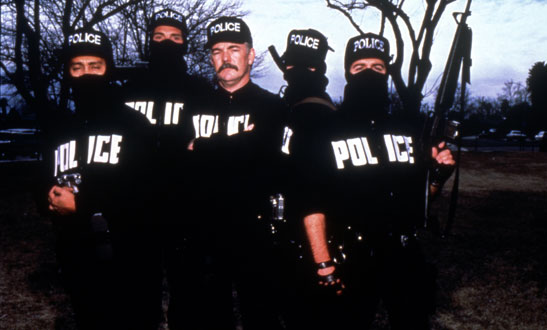
Similarly heavily armed men wearing black combat gear from head to toe… their job is to kill ‘terrorists’ to keep us safe, which they do by terrorising us all
One brave teacher, Kaitlin Roig, bundled a bunch of children into a bathroom and locked the door. What’s interesting about her testimony to ABC News is that when police arrived and asked her to open the door, she refused, saying that “if they were really cops, they’d know where to find keys to open the door.” In addition, she requested that they slide their badges under the door.
Now, this is generally a smart thing to do in any and all interactions with the police, especially in the U.S. But to have the wherewithal to do so under such traumatic circumstances strongly suggests that Ms. Roig had logically deduced by that point that multiple perpetrators were involved, and that they were either impersonating police officers or were indistinguishable from SWAT team police commandos, either in the way they dressed or the way they behaved upon entering the building. It also reminds us just how narrow the time window of the actual shooting was. The shooting appears to have barely ended when men knocked on that bathroom door and told Ms. Roig they were police.
There are also conflicting reports about how the gunmen entered the building. We were told initially that they came in through the main front entrance and proceeded straight to the administrators’/principal’s offices. But Sandy Hook elementary school has a security system with a video monitor, which allows staff to screen visitors before buzzing them in. A “masked gunman dressed in black tactical combat gear” from head to toe would kinda raise red flags, don’t you think?
Another possible anomaly is that Victoria Soto, one of the teachers killed at the school, appears to have had an ‘in memoriam’ Facebook page created in her name four days before the shooting.
Regarding this alleged ‘LIBOR scandal’ connection between this shooting and the Aurora theater shooting, there is as yet zero evidence to support the claim that either father of Lanza or Holmes were going to testify to anyone about anything, so for now this must remain just another rumor. I rather think that this is being spread to create the impression of a direct link that can be easily refuted, as in a straw man argument. The obvious and direct link staring everyone in the face is that the official accounts of these events are hocus-pocus. The glaring connection between these two shootings, the Sikh Temple shooting and the Fort Hood shooting is that multiple gunmen were reported at the time by eyewitnesses, but they are now all officially claimed to have been carried out by ‘lone gunmen’. This logically tells us that the real perpetrators are being protected with cover stories of what really happened because if the truth were known, some section of the U.S. government would be implicated.
Wade Michael Page, the ‘lone gunman’ in the Sikh Temple shooting in Wisconsin in August this year, was a highly decorated U.S. army psychological operations specialist, according to the Pentagon. But what happened to the three other gunmen seen by witnesses? It can’t surely be coincidence that Wade was (former?) military psy-ops. The thought has crossed my mind more than once during the aftermath of the Connecticut shooting. Others too have suggested this was a ‘false-flag’ event, or that Lanza was some sort of Manchurian Candidate.
But maybe there’s a simpler explanation (albeit more outrageous) than that? Was that really Adam Lanza they found inside the school? Do we even know for a fact that one of the gunmen was found dead inside the school? What we have instead are reports of two or three masked gunmen, apparently all dressed similarly in black tactical gear from head to toe, being wilfully forgotten about at best, or protected by the Federal Government at worst. Based on the authorities’ persistent but futile efforts to connect the Lanzas to this school, the multiple eyewitness reports of two shooters, the Connecticut State Medical Examiner’s report that all the victims were riddled with bullets from a rifle that we’re simultaneously being asked to believe was in the trunk of a car the whole time, similar reports of multiple shooters in previous mass shootings in recent years and the media focusing the emotional outcry onto the hot-button topic of gun control … I’m left wondering if this was actually the work of some highly trained professional hit team?
Was the massacre at Sandy Hook elementary school in Newtown, Connecticut, a psy-op, using what amounts to a ‘death squad’ and a carefully planned mission to terrorise people on behalf of the government, in combination with perception management to shape the narrative and vector the emotional fallout?
Gun control isn’t really the issue here. Control – period – is the issue. The U.S. government would long since have taken measures, quietly, to limit the supply of weapons, the 2nd Amendment of the constitution be damned (it’s “just a goddamned piece of paper“, remember?), if it was really concerned with limiting civilian access to weapons. That we’ve seen gun sales increase in the last few days to the point where Wal-Mart is all out of assault rifles is wholly unsurprising.
The psychopaths in power have absolutely no compunction about using state terrorism, in this case organising the deliberate massacre of innocent children, to control people. In effect, this is little different from what the U.S. government calls counter-insurgency or counter-terrorism in foreign countries, where it attacks innocent civilians to create the impression that they were killed by ‘communists’, ‘terrorists’, ‘insurgents’ or ‘militants’, with the aim of generating public support for the illusion that the common people need a strong, ruthless government to protect them from the ‘evil-doers’. When the common people buy into this manipulation, the end result, as history shows repeatedly, is an overt and brutal police state.
In the wake of the recent Sandy Hook shooting, I reached out to my contacts in law enforcement, military and (retired) FBI over the last three days, asking three simple questions:
#1) Do you think Obama will use executive orders to demand nationwide gun confiscation?
#2) If such an order is given, will you or fellow members of your organization enforce it against the citizens? (And if so, how?)
#3) What is the solution to stopping future mass shootings?
I posed these questions to one ex-FBI agent, one retired Sheriff’s deputy, two active duty city police detectives, one retired former police captain of a major U.S. city, two U.S. Army veterans and one USMC veteran, discharged several years ago after two tours in Afghanistan during which he sustained a severe personal injury. For obvious reasons, none of them wish to be identified by name, but their answers below speak to their credibility and authenticity.
Here are their answers.
#1) Will Obama use Executive Order to call for gun confiscation?
The majority of those answering this question told me they did not believe Obama would call for outright gun confiscation. One detective told me, “Obama will probably try to roll out an incremental restriction similar to the ’94 Clinton assault weapons ban.” He would then wait for another mass shooting and use that event to ratchet up the restrictions, I was told.
Only two of the eight people I questioned thought that Obama would call for outright gun confiscation, and one of those believed it would only be a restriction on so-called “assault rifles” but not shotguns or handguns.
Everyone believed that Obama would at minimum call for restrictions on weapon magazine capacity, most likely seeking to limit that to ten rounds per magazine (which is also the current limit in California). I was also told that Obama might attempt to federalize mandatory waiting periods for gun purchases, which already exist in some states but not all.
#2) Will you enforce gun confiscation against the citizens?
On this issue, the answer was resounding and unanimous: NO!
The retired police captain told me that, “Door-to-door confiscation by men and women in blue [i.e. city cops] would be a suicide mission.” If ordered to conduct such gun confiscation actions, many would simply resign on the spot rather than risk their lives in firefights with determined gun owners, he explained. “Our officers are not generally willing to assume the increased risk of such a police action.”
He also explained, importantly, that most police officers have not even been trained to conduct sweeping, community-level weapons confiscation programs. “This goes against all our community outreach efforts where we try to earn the trust of the community.” If cops suddenly became gun confiscation enforcers, trust would break down and policing would become extremely difficult, he explained.
The USMC veteran told me that some of the younger soldiers would go along with gun confiscation if ordered, but that nearly all the older military personnel would likely refuse such orders, even at risk of a court martial. “Some of the guys actually talked about this on deployment. The E-1’s might follow those orders but most of us who managed to stay alive through a couple of tours are too smart for that. You’d have AWOL out the ass. We didn’t sign up to engage Americans as enemy combatants. The answer would be F*%K NO all the way up the chain of command.”
One of the police detectives explained another reason for saying no: “There is no love for gun confiscation in law enforcement. We’re all gun owners and most of us grew up with guns, hunting, target shooting or just collecting. Most of us have gun collections when we’re off duty, and Obama himself isn’t well liked across law enforcement. There’s no way police officers are going to put their lives on the line to go along with an order from a President who really doesn’t have moral authority among cops.”
When I asked what if Bush had called for gun confiscation, and would cops be more likely to comply if the order was given by a Republican, the reply was, “For some guys, yes, because they will listen to a Republican more than a Democrat, but still for rank-and-file officers who are just here collecting a paycheck for a risky job, they’re no way they’re going to engage in what is basically a war action just to keep that job. You can’t pay them enough to pull that kind of duty, gun confiscation.”
I was told by more than one person in this group that any effort by Obama to invoke gun confiscation could lead America to civil war if any real effort were made to enforce it.
#3) What is the solution to stopping mass shootings?
The former police captain explained that the real problem with shootings in his city was, “dirt-cheap handguns” also called “Saturday Night Specials.” As he explained, “People that spend $500 on a nice handgun are almost never the problem when it comes to violent crime. It’s the ones who pick up a junk gun for $50 on the street.”
When I asked him about a practical solution to reduce shootings, he said that in his opinion, “Levying new taxes on all handguns like the tax stamps on class three weapons” would likely prevent new guns from being purchased by most violent criminals, but it wouldn’t take guns out of the hands of criminals who already have them. “These people will break into your car to steal the coins out of your vehicle console. They have no morals, no limits. There’s almost nothing they won’t do to get what they want, which is usually drugs.”
As background, the BATF currently levies a $200 tax stamp for the transfer of any suppressor (silencer), short-barreled rifle, or full-auto weapon, all of which are VERY expensive to acquire and require extensive background checks to legally own.
“Most of the gun violence in our city is drug addicts raiding the homes of other drug addicts. The statistics might appear to show a lot of armed robberies and shootings, but it’s really just a small subset of homes or apartments getting raided over and over again by the same people, the drug dealers.” When I asked what the real drug problem was, he answered without hesitation. “Meth.” Not pot, not marijuana, not even heroin. Meth is the drug that drives violent crime in America’s cities.
The retired Sheriff’s deputy told me that the solution was to, “Arm the teachers. Tear down the ‘gun free zone’ signs and put weapons in the hands of school personnel.”
This opinion was seconded by one of the active-duty police detectives, who said he had actually worked several shootings, but never a mass shooting. “A mass shooting takes time, often several minutes,” he explained. “That’s too fast for the police to arrive on scene, but it’s plenty of time for someone already on location to pursue and engage the active shooter.”
He went on to explain that in the training they have been receiving over the last five years, they have been taught that ANY engagement of an active shooter — even shots that don’t hit the shooter — are now believed among law enforcement to disrupt the shooter and force him to seek cover, during which his massacre is interrupted and delayed. Where police have traditionally been trained to “confirm your sight picture” of weapon sights on the target before pulling the trigger, that training is being modified in some cities where, in the context of a mass shooter firing off a large number of rounds, even returning so-called “suppressing fire” is now considered tactically acceptable until additional backup arrives. The idea now is to go in and engage the shooter, even if you’re just one officer on the scene.
This is contradictory to previous training, and it goes against most cops’ safety rules which include, “always know what is BEYOND your target.” But tacticians in law enforcement are apparently now figuring out that the opportunity cost of NOT shooting back is much greater than the relatively small risk of hitting an innocent victim when laying down suppressing fire.
It is therefore believed, I was told, that even concealed carry principals or other school staff can effectively lay down that “suppressing fire” even if they are not nailing the active shooter. Obviously, this does not mean firing blindly into a crowd, for example. Each tactical situation is unique and requires rapid assessment before pulling the trigger in any direction.
The challenge for law enforcement agencies and officers, then, is to overcome not only the attacks taking place in schools, but to first overcome the denial in the minds of mayors, city councils, school administrators, and parents. Grossman said that agencies and officers, although facing an uphill slog against the denial of the general public, must diligently work toward increasing understanding among the sheep that the wolves are coming for their children. Police officers must train and drill with teachers, not only so responding officers are intimately familiar with the facilities, but so that teachers know what they can do in the event of an attack.
“Come with me to the library at Columbine High School,” Grossman said. “The teacher in the library at Columbine High School spent her professional lifetime preparing for a fire, and we can all agree if there had been a fire in that library, that teacher would have instinctively, reflexively known what to do.
“But the thing most likely to kill her kids — the thing hundreds of times more likely to kill her kids, the teacher didn’t have a clue what to do. She should have put those kids in the librarian’s office but she didn’t know that. So she did the worst thing possible — she tried to secure her kids in an un-securable location. She told the kids to hide in the library — a library that has plate glass windows for walls. It’s an aquarium, it’s a fish bowl. She told the kids to hide in a fishbowl. What did those killers see? They saw targets. They saw fish in a fish bowl.”
Grossman said that if the school administrators at Columbine had spent a fraction of the money they’d spent preparing for fire doing lockdown drills and talking with local law enforcers about the violent dangers they face, the outcome that day may have been different.
Rhetorically he asked the assembled cops, “If somebody had spent five minutes telling that teacher what to do, do you think lives would have been saved at Columbine?”
Conclusion: Civil War?
All my contact in law enforcement are in Southern U.S. states. Opinions may be very different in Northern or Eastern cities such as Chicago, New York or New Jersey.
Nevertheless, even if opinions are different in other cities and states, it is clear to me that law enforcement in Southern states will NOT comply with gun confiscation directives issued by Obama. Obama simply does not have the moral authority — nor the law enforcement support — to pull off such an action. While his political supporters claim he has a “mandate” across America, that’s far from the truth. Obama is widely despised across states like Texas, Florida, Arizona and nearly all of rural America. He only enjoys support in the cities, and primarily in the inner cities.
Also, throughout law enforcement it is widely known that Obama staged Operation Fast & Furious and then got caught. The fact that at least one murder of a U.S. border patrol agent was caused by one of these weapons has made U.S. law enforcement officers realize that the Obama administration is, in many ways, actively working against their interests and even compromising their safety.
The question was raised to me: If Obama is against gun violence, why did he allow thousands of guns to “walk” into the hands of Mexican drug gangs, knowing they would be turned against U.S. law enforcement officers? (Don’t hold your breath waiting for Obama to shed a tear for Brian Terry…)
Conclusion? If Obama were to announce a nationwide gun confiscation order, it might set off a civil war, pitting armed gun owners, cops, veterans and preppers against the completely disarmed, trendy, undisciplined anti-gun inner-city liberals. Gee, I wonder who would win that war?
Is this all a ploy to open the door for UN troops on the streets in America?
Finally, it’s worth considering that civil war may be exactly what Obama wants to cause. It would rip America apart, making way for United Nations troops to invade and seize control, claiming “humanitarian” justification. This could be precisely the action needed to unleash blue helmets across America and push for nationwide disarmament and military occupation.
For the record, Natural News supports cops, veterans and Sheriffs in the fight to defend the U.S. Constitution, its Bill of Rights, and real freedom in America. We will not stand idly by and let a group of political thugs and bullies take away our sacred right to self defense. www.InfoWars.com
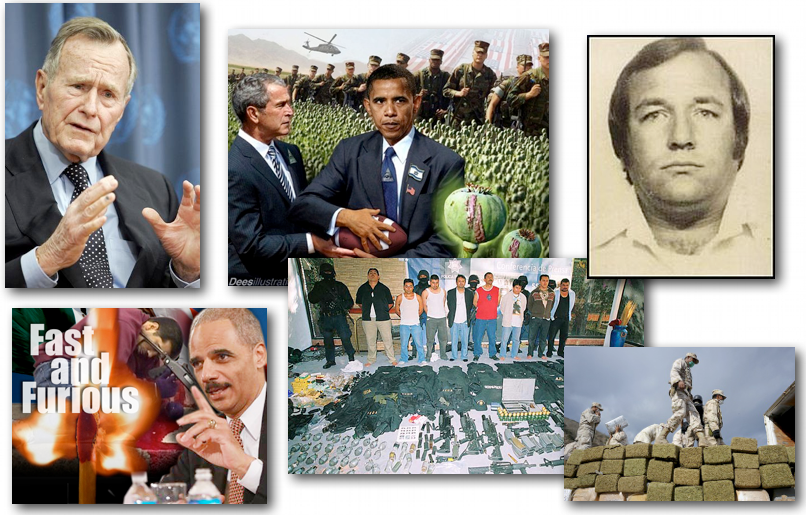
Suspicious Words and Phrases Alert! Drug War Facts, DEA Corruption, CIA Conspiracy, Who’s Who in the Drug Running Business, Untraceable Cash and the Reason the War on Drugs is just another War-by-Design.
Treacherous wording upholds “States” gun rights but not individuals
The text of the anticipated and hotly-contested United Nations Arms Trade Treaty has been leaked, with the treaty itself set to be adopted and signed by member States as early as tomorrow, July 27. President Obama, today joining the chorus for gun control inside the United States in the wake of the Batman massacre, has previously indicated that he would sign the treaty, which would then have to be ratified by the Senate.
Masked behind the language of promoting peace in an international world by preventing genocide, the UN has unleashed a great Trojan Horse that calls upon States to enact national legislation sufficient to meet the minimum goals outlined in this treaty– including gun registries, background checks, import/export controls and more for arms of all types, including small & conventional weapons. “Each State Party shall adopt national legislation or other appropriate national measures regulations and policies as may be necessary to implement the obligations of this Treaty,” the treaty text states in part.
It makes specific note that the treaty places no limit upon greater gun control efforts within individual nations, and additionally places no expiration on the agreement. The scope of this language proves the analysis by Infowars (1, 2, 3, 4), writers at Forbes and many other publications that have been warning about this deceptive encroachment to be correct– there is an effort to disarm America underway.
The devil, as usual, is in the details.
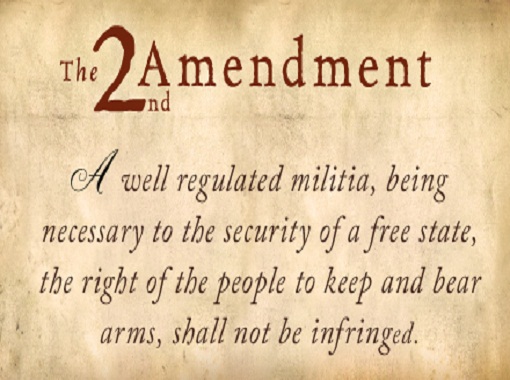
Repeatedly, the treaty obligates States to establish “national control systems” to meet the particulars of the treaty. While the phrase “within national laws and regulations” appears to suggest that the 2nd Amendment would limit the implementation, properly read in the context of the wording and history itself, it really only invites new “regulations” where no “law” can be established.
The first “principle” outlined in the preamble reads: “1. The inherent rights of all States to individual or collective self-defense.” While the language of the treaty appears to recognize the legal right to keep such arms, the text actually recognizes the “inherent right of States” to “individual and collective” self-defense.
This is NOT the same as individual persons’ inherent right to keep and bear arms as recognized and enumerated in the United States’ Bill of Rights. Instead, it puts the collectivist unit known as the State above the individual, in complete defiance of the system set-up in the United States. Individual defense for a State, for instance, refers to what is known on the international scene as “unilateral war,” while collective defense is recognize in such actions as that of NATO or other allied bodies. The States’ right to maintain internal order has also been recognized by the UN, but all other purposes for arms ownership are seen as illegitimate.
It specifically recognizes [only] the “lawful private ownership and use of conventional arms exclusively for, inter alia, recreational, cultural, historical and sporting activities for States where such ownership and use are permitted or protected by law.” There’s been a great deal of rhetoric from gun grabbers over the years attempting to emphasize gun ownership for legitimate sporting uses, but the real purpose of arms ownership is a balance of power at the individual level in order to discourage tyranny at the State level. THAT is what the founding fathers intended, and that is the historical legacy Americans cherish.
NO SPECIFIC PROTECTION for individual persons is contained in this dangerous treaty, though the same media who’ve been demonizing critics of the UN’s effort as delusional and paranoid will attempt to argue otherwise, clinging to deliberately inserted clauses herein that look like stop-guards and protections for gun rights, but properly read, do no such thing.
While the UN advises States to keep within the scope of their own laws, the end-run assault against American’s 2nd Amendment is unmistakeable.
The United Nations has a sordid history of pursuing “general and complete disarmament,” and individual arms including legally owned arms have always been part of that focus. The United Nations treaty from 2001, known as the “SADC Protocol: Southern African Development Community” is, according to the UN’s own disarmament website, a “regional instrument that aims to curtail small arms ownership and illicit trafficking in Southern Africa along with the destruction of surplus state weapons. It is a far-reaching instrument, which goes beyond that of a politically binding declaration, providing the region with a legal basis upon which to deal with both the legal and the illicit trade in firearms.”
As we have previously noted, U.S. troops have been trained to confiscate American guns, while the confiscation in New Orleans after Hurricane Katrina has already set the precedent. The deception over aiming for legal guns while pretending to target “illicit” weapons is continued here in this 2012 monster treaty.
Below is the text in full, as it has been proposed and released. Any changes in the signed version will be noted when that time comes:
————————
UNITED NATIONS ARMS TRADE TREATY TEXT
PREAMBLE
The States Parties to this Treaty.
Guided by the purposes and principles of the Charter of the United Nations.
Recalling that the charter of the UN promotes the establishment and maintenance of international peace and security with the least diversion for armaments of the world’s human and economic resources;
Reaffirming the obligation of all State Parties to settle their international disputes by peaceful means in such a manner that international peace and security, and justice, are not endangered, in accordance with the Charter of the UN;
Underlining the need to prevent, combat and eradicate the illicit trade of conventional arms and to prevent their diversion to illegal and unauthorized end use, such as terrorism and organized crime;
Recognizing the legitimate political, security, economic and commercial rights and interests of States in the international trade of conventional arms;
Reaffirming the sovereign right and responsibility of any State to regulate and control transfers of conventional arms that take place exclusively within its territory pursuant to its own legal or constitutional systems;
Recognizing that development, human rights and peace and security, which are three pillars of the United Nations, are interlinked and mutually reinforcing.
Recalling the United Nations Disarmament Commission guidelines on international arms transfers adopted by the General Assembly;
Noting the contribution made by the 2001 UN Programme of Action to preventing combating and eradicating the illicit trade in small arms and light weapons in all its aspects, as well as the 2001 Protocol against the illicit manufacturing of and trafficking in Firearms, their parts and components and ammunition, supplementing the United Nations Convention against Transnational Organized Crime;
Recognizing the security, social, economic and humanitarian consequences of the illicit trade in and unregulated trade of conventional arms;
Recognizing the challenges faced by victims of armed conflict and their need for adequate care, rehabilitation and social and economic inclusion;
Bearing in mind that the women and children are particularly affected in situations of conflict and armed violence;
Emphasizing that nothing in this treaty prevents States from exercising their right to adopt additional more rigorous measures consistent with the purpose of this Treaty;
Recognizing the legitimate international trade and lawful private ownership and use of conventional arms exclusively for, inter alia, recreational, cultural, historical and sporting activities for States where such ownership and use are permitted or protected by law;
Recognizing the active role that non-governmental organizations and civil society can play in furthering the goals and objectives of this Treaty; and
16. Emphasizing that regulation of the international trade in conventional arms should not hamper international cooperation and legitimate trade in material, equipment and technology for peaceful purposes;
Have agreed as follows:
Principles
Guided by the Purposes and Principles of the Charter of the United Nations, States Parties, In promoting the goals and objectives of this Treaty and implementing its provisions, shall act in accordance with the following principles:
The inherent rights of all States to individual or collective self-defense;
2. Settlement of individual disputes by peaceful means in such a manner that international peace and security, and justice, are not endangered;
3. The rights and obligations of States under applicable international law, including international humanitarian law and international human rights law;
4. The responsibility of all States, in accordance with their respective international obligations, to effectively regulate and control international transfer of conventional arms as well as the primary responsibility of all States to in establishing and implementing their respective national export control systems; and
5. The necessity to implement this Treaty consistently and effectively and in a universal, objective and non-discriminatory manner.
Article 1
Goals and Objectives
Cognizant of the need to prevent and combat the diversion of conventional arms into the illicit market or to unauthorized end users through the improvement of regulation on the international trade in conventional arms,
The goals and objectives of this Treaty are:
– For States Parties to establish the highest possible common standards for regulating or improving regulation of the international trade in conventional arms;
– To prevent, combat and eradicate the illicit trade in conventional arms and their diversion to illegal and unauthorized end use;
In order to:
– Contribute to international and regional peace, security and stability;
– Avoid that the international trade in conventional arms contributes to human suffering;
– Promote cooperation, transparency and responsibility of States Parties in the trade in conventional arms, thus building confidence among States Parties,
Article 2
– A. Covered Items
– 1. This Treaty shall apply to all conventional arms within the following categories:
– a. Battle Tanks
– b. Armored combat vehicles
– c. Large-caliber Artillery systems
– d. Combat aircraft
– e. Attack helicopters
– f. Warships
– g. Missiles and missile launchers
– h. Small Arms and Light Weapons
– 2. Each State Party Shall establish and Maintain a national control system to regulate the export of munitions to the extent necessary to ensure that national controls on the export of the conventional arms covered by Paragraph a1 (a)-(h) are not circumvented by the export of munitions for those conventional arms.
– 3. Each State Party shall establish and maintain a national control system to regulate the export of parts and components to the extent necessary to ensure that national controls on the export of the conventional arms covered by Paragraph A1 are not circumvented by the export of parts and components of those items.
– 4. Each State Party shall establish or update, as appropriate, and maintain a national control list that shall include the items that fall within Paragraph 1 above, as defined on a national basis, based on relevant UN instruments at a minimum. Each State Party shall publish its control list to the extent permitted by national law.
– B. Covered Activities
– 1. This Treaty shall apply to those activities of the international trade in conventional arms covered in paragraph a1 above, and set out in Articles 6-10, hereafter referred to as “transfer.”
– 2. This Treaty shall not apply to the international movement of conventional arms by a State Party or its agents for its armed forces or law enforcement authorities operating outside its national territories, provided they remain under the State Party’s ownership.
Article 3
Prohibited Transfers
A State Party shall not authorize any transfer of conventional arms within the scope of this Treaty if the transfer would violate any obligation under any measure adopted by the United Nations Security Council acting under Chapter VII of the Charter of the United Nations, in particular arms embargoes.
A State Party shall not authorize any transfer of conventional arms within the scope of this Treaty if the transfer would violate its relevant international obligations, under international agreements, to which it is a Party, in particular those relating to the international transfer of, or illicit trafficking in, conventional arms.
A State Party shall not authorize a transfer of conventional arms within the scope of this Treaty for the purpose of facilitating the commission of genocide, crimes against humanity, war crimes constituting grave breaches of the Geneva Conventions of 1949, or serious violations of Common Article 3 of the Geneva Convention of 1949.
Article 4
National Assessment
Each State Party, in considering whether to authorize an export of conventional arms within the scope of this Treaty, shall, prior to authorization and through national control systems, make an assessment specific to the circumstances of the transfer based on the following criteria:
Whether the proposed export of conventional arms would:
Be used to commit or facilitate serious violations of international humanitarian law;
Be used to commit or facilitate serious violations of international human rights law;
Contribute to peace and security;
Be used to commit or facilitate an act constituting an offense under international conventions and protocols relating to terrorism or transnational organized crime, to which the transferring State is a Party;
In making the assessment, the transferring State Party shall apply the criteria set out in Paragraph 2 consistently and in an objective and non-discriminatory manner and in accordance with the principles set out in this Treaty, taking into account relevant factors, including information provided by the importing State.
4. In assessing the risk pursuant to Paragraph 2, the transferring State Party may also take into consideration the establishment of risk mitigation measures including confidence-building measures and jointly developed programs by the exporting and importing State.
5. If in the view of the authorizing State Party, this assessment, which would include any actions that may be taken in accordance with Paragraph 4, constitutes a substantial risk, the State Party shall not authorize the transfer.
Article 5
Additional Obligations
Each State Party, when authorizing an export, shall consider taking feasible measures, including joint actions with other States involved in the transfer, to avoid the transferred arms:
being diverted to the illicit market;
be used to commit or facilitate gender-based violence or violence against children;
become subject to corrupt practices; or
adversely impact the development of the recipient State.
Article 6
General Implementation
Each State Party shall implement this Treaty in a consistent, objective and non-discriminatory manner in accordance with the goals and objectives of this Treaty;
The implementation of this Treaty shall not prejudice previous or future obligations undertaken with regards to international instruments, provided that those obligations are consistent with the goals and objectives of this Treaty. This Treaty shall not be cited as grounds for voiding contractual obligations under defense cooperation agreements concluded by States Parties to this Treaty.
Each State Party shall take all appropriate legislative and administrative measures necessary to implement the provisions of this Treaty and designate competent national authorities in order to have an effective, transparent and predictable national control system regulating the transfer of conventional arms;
Each State Party shall establish one or more national contact points to exchange information on matters related to the implementation of this Treaty. A State Party shall notify the Implementation Support Unit (See Article 13) of its national contact point(s) and keep the information updated.
State Parties involved in a transfer of conventional arms shall, in a manner consistent with the principles of this Treaty, take appropriate measures to prevent diversion to the illicit market or to unauthorized end-users. All State Parties shall cooperate, as appropriate, with the exporting State to that end.
If a diversion is detected the State or States Parties that made the decision shall verify the State or States Parties that could be affected by such diversion, in particulate those State Parties that are involved in the transfer, without delay.
Each State Party shall take the appropriate measures, within national laws and regulations, to regulate transfers of conventional arms within the scope of the Treaty.
Article 7
Export
Each State Party shall conduct risk assessments, as detailed in Articles 4 and 5, whether to grant authorizations for the transfer of conventional arms under the scope of this Treaty. State Parties shall apply Articles 3-5 consistently, taking into account all relevant information, including the nature and potential use of the items to be transferred and the verified end-user in the country of final destination.
Each State Party shall take measures to ensure all authorizations for the export of conventional arms under the scope of the Treaty are detailed and issued prior to the export. Appropriate and relevant details of the authorization shall be made available to the importing, transit and transshipment State Parties, upon request.
Article 8
Import
Importing State Parties shall take measures to ensure that appropriate and relevant information is provided, upon request, to the exporting State Party to assist the exporting State in its criteria assessment and to assist in verifying end users.
State Parties shall put in place adequate measures that will allow them, where necessary, to monitor and control imports of items covered by the scope of the Treaty. State Parties shall also adopt appropriate measures to prevent the diversion of imported items to unauthorized end users or to the illicit market.
Importing State Parties may request, where necessary, information from the exporting State Party concerning potential authorizations.
Article 9
Brokering
Each State Party shall take the appropriate measures, within national laws and regulations, to control brokering taking place under its jurisdiction for conventional arms within the scope of this Treaty.
Article 10
Transit and Transshipment
Each State Party shall adopt appropriate legislative, administrative or other measures to monitor and control, where necessary and feasible, conventional arms covered by this Treaty that transit or transship through territory under its jurisdiction, consistent with international law with due regard for innocent passage and transit passage;
Importing and exporting States Parties shall cooperate and exchange information, where feasible and upon request, to transit and transshipment States Parties, in order to mitigate the risk of discretion;
Article 11
Reporting, Record Keeping and Transparency
Each State Party shall maintain records in accordance with its national laws and regardless of the items referred to in Article 2, Paragraph A, with regards to conventional arms authorization or exports, and where feasible of those items transferred to their territory as the final destination, or that are authorized to transit or transship their territory, respectively.
Such records may contain: quantity, value, model/type, authorized arms transfers, arms actually transferred, details of exporting State(s), recipient State(s), and end users as appropriate. Records shall be kept for a minimum of ten years, or consistent with other international commitments applicable to the State Party.
States Parties may report to the Implementation Support Unit on an annual basis any actions taken to address the diversion of conventional arms to the illicit market.
Each State Party shall, within the first year after entry into force of this Treaty for that State Party, provide an initial report to States Parties of relevant activities undertaken in order to implement this Treaty; including inter alia, domestic laws, regulations and administrative measures. States Parties shall report any new activities undertaken in order to implement this Treaty, when appropriate. Reports shall be distributed and made public by the Implementation Support Unit.
Each State Party shall submit annually to the Implementation Support Unit by 31 May a report for the preceding calendar year concerning the authorization or actual transfer of items included in Article 2, Paragraph A1. Reports shall be distributed and made public by the Implementation Support Unit. The report submitted to the Implementation Support Unit may contain the same type of information submitted by the State Party to other relevant UN bodies, including the UN Register of Conventional Arms. Reports will be consistent with national security sensitivities or be commercially sensitive.
ARTICLE 12
ENFORCEMENT
Each State Party shall adopt national legislation or other appropriate national measures regulations and policies as may be necessary to implement the obligations of this Treaty.
ARTICLE 13
IMPLEMENTATION SUPPORT UNIT
This Treaty hereby establishes an Implementation Support Unit to assist States Parties in its implementation.
The ISU shall consist of adequate staff, with necessary expertise to ensure the mandate entrusted to it can be effectively undertaken, with the core costs funded by States Parties.
The implementation Support Unit, within a minimized structure and responsible to States Parties, shall undertake the responsibilities assigned to it in this Treaty, inter alia:
Receive distribute reports, on behalf of the Depository, and make them publicly available;
Maintain and Distribute regularly to States Parties the up-to-date list of national contact points;
Facilitate the matching of offers and requests of assistance for Treaty implementation and promote international cooperation as requested;
Facilitate the work of the Conference of States Parties, including making arrangements and providing the necessary service es for meetings under this Treaty; and
Perform other duties as mandated by the Conference of States Parties.
ARTICLE 14
INTERNATIONAL COOPERATION
States Parties shall designate national points of contact to act as a liaison on matters relating to the implementation of this Treaty.
States Parties shall cooperate closely with one another, as appropriate, to enhance the implementation of this Treaty consistent with their respective security interests and legal and administrative systems.
States Parties are encouraged to facilitate international cooperation, including the exchange of information on matters of mutual interest regarding the implementation and application of this Treaty in accordance with their national legal system. Such voluntary exchange of information may include, inter alia, information on national implementation measures as well as information on specific exporters, importers and brokers and on any prosecutions brought domestically, consistent with commercial and proprietary protections and domestic laws, regulations and respective legal and administrative systems.
4. Each State Party is encouraged to maintain consultations and to share information, as appropriate, to support the implementation of this Treaty, including through their national contact points.
5. States Parties shall cooperate to enforce the provisions of this Treaty and combat breaches of this Treaty, including sharing information regarding illicit activities and actors to assist national enforcement and to counter and prevent diversion. States Parties may also exchange information on lessons learned in relation to any aspect of this Treaty, to develop best practices to assist national implementation.
Article 15
International Assistance
In fulfilling the obligation of this Treaty, States Parties may seek, inter alia, legal assistance, legislative assistance, technical assistance, institutional capacity building, material assistance or financial assistance. States, in a position to do so, shall provide such assistance. States Parties may contribute resources to a voluntary trust fund to assist requesting States Parties requiring such assistance to implement the Treaty.
States Parties shall afford one another the widest measure of assistance, consistent with their respective legal and administrative systems, in investigations, prosecutions and judicial proceedings in relation to the violations of the national measures implemented to comply with obligations under of the provisions of this Treaty.
Each State Party may offer or receive assistance, inter alia, through the United Nations international, regional, subregional or national organizations, non-governmental organizations or on a bi-lateral basis. Such assistance may include technical, financial, material and other forms of assistance as needed, upon request.
Article 16
Signature, Ratification, Acceptance, Approval or Accession
This Treaty shall be open for signature on [date] at the United Nations Headquarters in New York by all States and regional integration organizations.
This Treaty is subject to ratification, acceptance or approval of the Signatories.
This Treaty shall be open for accession by any state and regional integration organization that has not signed the Treaty.
4. The instruments of ratification, acceptance, approval or accession shall be deposited with the Depositary.
5. The Depositary shall promptly inform all signatory and acceding States and regional integration organizations of the date of each signature, the date of deposit of each instrument of ratification, acceptance, approval or accession and the date of the entry into force of this Treaty, and of the receipt of notices.
6. “Regional integration organization” shall mean an organization constituted by sovereign States of a given region, to which its Member States have transferred competence in respect of matters governed by this Treaty and which has been duly authorized, in accordance with its internal procedures, to sign, ratify, accept, approve or accede to it.
7. At the time of its ratification, acceptance, approval or accession, a regional integration organization shall declare the extent of its competence with respect to matters governed by this Treaty. Such organizations shall also inform the Depositary of any relevant modifications in the extent of it competence.
8. References to “State Parties” in the present Treaty shall apply to such organizations within the limits of their competence.
Article 17
Entry into Force
This Treaty shall enter into force thirty days following the date of the deposit of the sixty-fifth instrument of ratification, acceptance or approval with the Depositary.
For any State or regional integration organization that deposits its instruments of accession subsequent to the entry into force of the Treaty, the Treaty shall enter into force thirty days following the date of deposit of its instruments of accession.
For the purpose of Paragraph 1 and 2 above, any instrument deposited by a regional integration organization shall not be counted as additional to those deposited by Member States of that organization.
Article 18
Withdrawal and Duration
This Treaty shall be of unlimited duration.
Each State Party shall, in exercising its national sovereignty, have the right to withdraw from this Convention. It shall give notice of such withdrawal to all other States Parties from this Convention. It shall give notice of such withdrawal to all other States Parties and to the Depositary. The instrument of withdrawal shall include a full explanation of the reasons motivating this withdrawal.
A state shall not be discharged, by reason of its withdrawal, from the obligations arising from this treaty while it was a party to the Treaty, including any financial obligations, which may have accrued.
Article 19
Reservations
Each State party, in exercising its national sovereignty, may formulate reservations unless the reservation is incompatible with the object and purpose of this Treaty.
Article 20
Amendments
At any time after the Treaty’s entry into force, a State Party may propose an amendment to this Treaty.
Any proposed amendment shall be submitted in writing to the Depository, which will then circulate the proposal to all States Parties, not less than 180 days before next meeting of the Conference of States Parties. The amendment shall be considered at the next Conference of States Parties if a majority of States Parties notify the Implementation Support Unit that they support further consideration of the proposal no later than 180 days after its circulation by the Depositary.
Any amendment to this Treaty shall be adopted by consensus, or if consensus is not achieved, by two-thirds of the States Parties present and voting at the Conference of States Parties. The Depositary shall communicate any amendment to all States Parties.
A proposed amendment adopted in accordance with Paragraph 3 of this Article shall enter into force for all States Parties to the Treaty that have accepted it, upon deposit with the Depositary. Thereafter, it shall enter into force for any remaining State Party on the date of deposit of its instrument of accession.
Article 21
Conference of States Parties
The Conference of States Parties shall be convened not later than once a year following the entry into force of this Treaty. The Conference of States Parties shall adopt rules of procedure and rules governing its activities, including the frequency of meetings and rules concerning payment of expenses incurred in carrying out those activities.
The Conference of States Parties shall:
a. Consider and adopt recommendations regarding the implementation of this Treaty, in particular the promotion of its universality; TR
b. Consider amendments to this Treaty;
c. Consider and decide the work and budget of the Implementation Support Unit;
d. Consider the establishment of any subsidiary bodies as may be necessary to improve the functioning of the Treaty;
e. Perform any other function consistent with this Treaty.
3. If circumstances merit, an exceptional meeting of the State Parties may be convened if required and resources allow.
Article 22
Dispute Settlement
States Parties shall consult and cooperate with each other to settle any dispute that may arise with regard to the interpretation or application of this Treaty.
States Parties shall settle any dispute between them concerning the interpretation or application of this Treat though negotiations or other peaceful means of the Parties mutual choice.
States Parties may pursue, by mutual consent, third party arbitration to settle any dispute between them, regarding issues concerning the implementation of this Treaty.
Article 23
Relations with States not party to this Treaty
States Parties shall apply Articles 3-5 to all transfers of conventional arms within the scope of this Treaty to those not party to this Treaty.
Article 24
Relationship with other instruments
States Parties shall have the right to enter into agreements on the trade in conventional arms with regards to the international trade in conventional arms, provided that those agreements are compatible with their obligations under this Treaty and do not undermine the objects and purposes of this Treaty.
Article 25
Depositary and Authentic Texts
The Secretary-General of the United Nations is the Depositary of this Treaty.
The original text of this Treaty, of which the Arabic, Chinese, English, Russian and Spanish texts are equally authentic.
(Emphasis in bold added by this author for help in analysis)
It looks like the power of the IRS to revoke passports is merely a drop in the tyrannical bucket.
The Senate has voted to approve Bill 1813, which is now on its way to the House. The insidious bill has so many attacks on freedom that the most serious one has been largely overlooked.
There are two attacks on gun ownership in this bill. The text of the bill, all 1676 pages of it, can be found HERE.
The first attack on the right to bear arms is found on page 1323.
The Secretary may modify, suspend, or terminate a special permit or approval if the Secretary determines that—(1) the person who was granted the special permit or approval has violated the special permit or approval or the regulations issued under this chapter in a manner that demonstrates that the person is not fit to conduct the activity authorized by the special permit or approval; or (2) the special permit or approval is unsafe.
In the ambiguous language that the Congress so loves to employ in all things unconstitutional, we can translate that to the parental favorite, “Because I said so.”
The second attack on gun ownership is more subtle.
First, if this bill passes, the IRS will have the authority to take away the passports of those whom they say owe more than $50,000 in taxes. (The tax debt doesn’t have to be proven, mind you, the IRS simply has to accuse you of owing the money.) You can find this section on page 1447 of the Bill.
When your passport is revoked by the government, you are suddenly on the “no-fly list”.
Membership in the no-fly club puts you on yet another list, as a potential domestic terrorist.
Domestic terrorists are not allowed to have guns.
Don’t believe me? Listen to Raul Emanuel gloat of it. He eloquently states “If you are known as maybe a possible terrorist you cannot buy a handgun in America.” (1:13 of the video)
Emanuel, the Mayor of Chicago and former Obama Chief of Staff, makes the top of my personal treason list for this statement. In his own words, “maybe a possible terrorist” means you shouldn’t be allowed the rights guaranteed to you as an American. No proof necessary.
Bill 1813, ‘‘Moving Ahead for Progress in the 21st Century Act’’, is chock full of new ways to take away our personal freedoms. The bill would require “stalker boxes” on our vehicles, puts a huge number of restrictions on travel and transportation within the US, allows the government to revoke documents and licenses in ambiguous language and is, in essence, nearly 1700 pages of new restrictions. (You can find a summaryHERE if you don’t want to read all 1676 pages).
A Call to Action
Did your Senator vote for this bill? There’s a good chance he or she did, as only 22 Senators voted against it. You can find out how your senator voted HERE.
The bill was sponsored by Barbara Boxer (California) and co-sponsored by Max Baucus (Montana), James N. Inhofe (Oklahoma), and David Vitter (Louisiana). For your convenience, I’ve included links to the contact information for each of these Senators. Be sure and send an email to let them know how you feel about this new attack on freedom.
Email your Representatives and make it very clear that you consider this Bill an act of treason against the Constitution. This directory contains email addresses and contact information for all members of Congress.
Every bill that goes through Congress right now appears to hold another threat to the Constitution (if not multiple threats). Every word needs to be carefully analyzed so we can fight these attacks.


 Danny Casolaro Journalist, Freelance Writer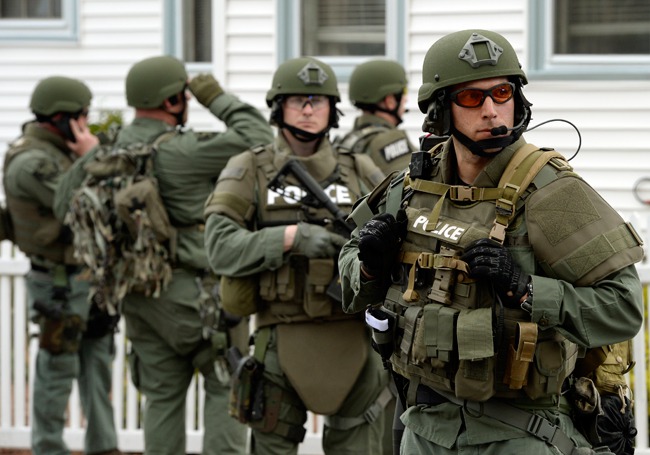
 We’ve all been part of these discussions, and we’ve all read a ton of them on forums and blogs over the years: “if you could have only one gun for TEOTWAWKI, what would it be?” A more enlightened-seeming variant on this same theme are discussions that start with, “if you could pick only three guns for TSHTF…”




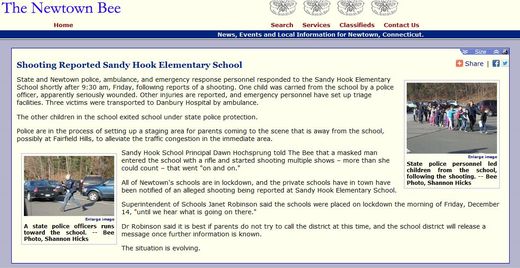 © The Newtown Bee
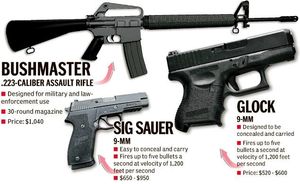 The three guns Adam Lanza is supposed to have brought to the school with him. © New York Daily News. The rifle was left in the trunk, leaving ‘Adam Lanza’ just the two handguns to let off “hundreds of rounds”… firing .233 caliber bullets that belonged to the rifle… which was left in the car
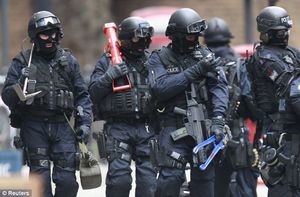 Similarly heavily armed men wearing black combat gear from head to toe… their job is to kill ‘terrorists’ to keep us safe, which they do by terrorising us all