Dec 9, 2013 | Government Agenda, Leaks, News
This story has been reported in partnership between The New York Times, the Guardian and ProPublica based on documents obtained by The Guardian.
Not limiting their activities to the earthly realm, American and British spies have infiltrated the fantasy worlds of World of Warcraft and Second Life, conducting surveillance and scooping up data in the online games played by millions of people across the globe, according to newly disclosed classified documents.
Fearing that terrorist or criminal networks could use the games to communicate secretly, move money or plot attacks, the documents show, intelligence operatives have entered terrain populated by digital avatars that include elves, gnomes and supermodels.
The spies have created make-believe characters to snoop and to try to recruit informers, while also collecting data and contents of communications between players, according to the documents, disclosed by the former National Security Agency contractor Edward J. Snowden. Because militants often rely on features common to video games — fake identities, voice and text chats, a way to conduct financial transactions — American and British intelligence agencies worried that they might be operating there, according to the papers.
Takeaways: How Spy Agencies Operate In Virtual Worlds
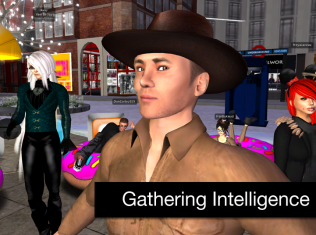
GATHERING INTELLIGENCE: U.S. and British intelligence agencies — including the Central Intelligence Agency, Defense intelligence agency and Britain’s Government Communications Headquarters — . For example, according to Snowden documents, the U.S. has conducted spy operations in Second Life (pictured), where players create human avatars to socialize, buy and sell goods and explore exotic virtual destinations. (Second Life image via Linden Lab)
Online games might seem innocuous, a top-secret 2008 NSA document warned, but they had the potential to be a “target-rich communication network” allowing intelligence suspects “a way to hide in plain sight.” Virtual games “are an opportunity!,” another 2008 NSA document declared.
But for all their enthusiasm — so many CIA, FBI and Pentagon spies were hunting around in Second Life, the document noted, that a “deconfliction” group was needed to avoid collisions — the intelligence agencies may have inflated the threat.
The documents do not cite any counterterrorism successes from the effort, and former American intelligence officials, current and former gaming company employees and outside experts said in interviews that they knew of little evidence that terrorist groups viewed the games as havens to communicate and plot operations.
(Transcript: What are intelligence agencies doing in virtual worlds?)
Games “are built and operated by companies looking to make money, so the players’ identity and activity is tracked,” said Peter W. Singer of the Brookings Institution, an author of “Cybersecurity and Cyberwar: What Everyone Needs to Know.” “For terror groups looking to keep their communications secret, there are far more effective and easier ways to do so than putting on a troll avatar.”
The surveillance, which also included Microsoft’s Xbox Live, could raise privacy concerns. It is not clear exactly how the agencies got access to gamers’ data or communications, how many players may have been monitored or whether Americans’ communications or activities were captured.
One American company, the maker of World of Warcraft, said that neither the NSA nor its British counterpart, the Government Communications Headquarters, had gotten permission to gather intelligence in its game. Many players are Americans, who can be targeted for surveillance only with approval from the nation’s secret intelligence court. The spy agencies, though, face far fewer restrictions on collecting certain data or communications overseas.
“We are unaware of any surveillance taking place,” said a spokesman for Blizzard Entertainment, based in Irvine, Calif., which makes World of Warcraft. “If it was, it would have been done without our knowledge or permission.”
A spokeswoman for Microsoft declined to comment. Philip Rosedale, the founder of Second Life and a former chief executive officer of Linden Lab, the game’s maker, declined to comment on the spying revelations. Current Linden executives did not respond to requests for comment.
A Government Communications Headquarters spokesman would neither confirm nor deny any involvement by that agency in gaming surveillance, but said that its work is conducted under “a strict legal and policy framework” with rigorous oversight. An NSA spokeswoman declined to comment.
Intelligence and law enforcement officials became interested in games after some became enormously popular, drawing tens of millions of people worldwide, from preteens to retirees. The games rely on lifelike graphics, virtual currencies and the ability to speak to other players in real time. Some gamers merge the virtual and real worlds by spending long hours playing and making close online friends.
In World of Warcraft, players share the same fantasy universe — walking around and killing computer-controlled monsters or the avatars of other players, including elves, animals or creatures known as orcs. In Second Life, players create customized human avatars that can resemble themselves or take on other personas — supermodels and bodybuilders are popular — who can socialize, buy and sell virtual goods, and go places like beaches, cities, art galleries and strip clubs. In Microsoft’s Xbox Live service, subscribers connect online in games that can involve activities like playing soccer or shooting at each other in space.
According to American officials and documents that Mr. Snowden provided to The Guardian, which shared them with The New York Times and ProPublica, spy agencies grew worried that terrorist groups might take to the virtual worlds to establish safe communications channels.
In 2007, as the NSA and other intelligence agencies were beginning to explore virtual games, NSA officials met with the chief technology officer for the manufacturer of Second Life, the San Francisco-based Linden Lab. The executive, Cory Ondrejka, was a former Navy officer who had worked at the NSA with a top-secret security clearance.
He visited the agency’s headquarters at Fort Meade, Md., in May 2007 to speak to staff members over a brown bag lunch, according to an internal agency announcement. “Second Life has proven that virtual worlds of social networking are a reality: come hear Cory tell you why!” said the announcement. It added that virtual worlds gave the government the opportunity “to understand the motivation, context and consequent behaviors of non-Americans through observation, without leaving U.S. soil.”
Ondrejka, now the director of mobile engineering at Facebook, said through a representative that the NSA presentation was similar to others he gave in that period, and declined to comment further.
Even with spies already monitoring games, the NSA thought it needed to step up the effort.
“The Sigint Enterprise needs to begin taking action now to plan for collection, processing, presentation and analysis of these communications,” said one April 2008 NSA document, referring to “signals intelligence.” The document added, “With a few exceptions, NSA can’t even recognize the traffic,” meaning that the agency could not distinguish gaming data from other Internet traffic.
By the end of 2008, according to one document, the British spy agency, known as GCHQ, had set up its “first operational deployment into Second Life” and had helped the police in London in cracking down on a crime ring that had moved into virtual worlds to sell stolen credit card information. The British spies running the effort, which was code-named “Operation Galician,” were aided by an informer using a digital avatar “who helpfully volunteered information on the target group’s latest activities.”
Though the games might appear to be unregulated digital bazaars, the companies running them reserve the right to police the communications of players and store the chat dialogues in servers that can be searched later. The transactions conducted with the virtual money common in the games, used in World of Warcraft to buy weapons and potions to slay monsters, are also monitored by the companies to prevent illicit financial dealings.
In the 2008 NSA document, titled “Exploiting Terrorist Use of Games & Virtual Environments,” the agency said that “terrorist target selectors” — which could be a computer’s Internet Protocol address or an email account — “have been found associated with Xbox Live, Second Life, World of Warcraft” and other games. But that document does not present evidence that terrorists were participating in the games.
Still, the intelligence agencies found other benefits in infiltrating these online worlds. According to the minutes of a January 2009 meeting, GCHQ’s “network gaming exploitation team” had identified engineers, embassy drivers, scientists and other foreign intelligence operatives to be World of Warcraft players — potential targets for recruitment as agents.
At Menwith Hill, a Royal Air Force base in the Yorkshire countryside that the NSA has long used as an outpost to intercept global communications, American and British intelligence operatives started an effort in 2008 to begin collecting data from World of Warcraft.
One NSA document said that the World of Warcraft monitoring “continues to uncover potential Sigint value by identifying accounts, characters and guilds related to Islamic extremist groups, nuclear proliferation and arms dealing.” In other words, targets of interest appeared to be playing the fantasy game, though the document does not indicate that they were doing so for any nefarious purposes. A British document from later that year said that GCHQ had “successfully been able to get the discussions between different game players on Xbox Live.”
By 2009, the collection was extensive. One document says that while GCHQ was testing its ability to spy on Second Life in real time, British intelligence officers vacuumed up three days’ worth of Second Life chat, instant message and financial transaction data, totaling 176,677 lines of data, which included the content of the communications.
For their part, players have openly worried that the NSA might be watching them.
In one World of Warcraft discussion thread, begun just days after the first Snowden revelations appeared in the news media in June, a human death knight with the user name “Crrassus” asked whether the NSA might be reading game chat logs.
“If they ever read these forums,” wrote a goblin priest with the user name “Diaya,” “they would realize they were wasting” their time.
Even before the American government began spying in virtual worlds, the Pentagon had identified the potential intelligence value of video games. The Pentagon’s Special Operations Command in 2006 and 2007 worked with several foreign companies — including an obscure digital media business based in Prague — to build games that could be downloaded to mobile phones., according to people involved in the effort. They said the games, which were not identified as creations of the Pentagon, were then used as vehicles for intelligence agencies to collect information about the users.
Eager to cash in on the government’s growing interest in virtual worlds, several large private contractors have spent years pitching their services to American intelligence agencies. In one 66-page document from 2007, part of the cache released by Mr. Snowden, the contracting giant SAIC promoted its ability to support “intelligence collection in the game space,” and warned that online games could be used by militant groups to recruit followers and could provide “terrorist organizations with a powerful platform to reach core target audiences.”
It is unclear whether SAIC received a contract based on this proposal, but one former SAIC employee said that the company at one point had a lucrative contract with the CIA for work that included monitoring the Internet for militant activity. An SAIC spokeswoman declined to comment.
In spring 2009, academics and defense contractors gathered at the Marriott at Washington Dulles International Airport to present proposals for a government study about how players’ behavior in a game like World of Warcraft might be linked to their real-world identities. “We were told it was highly likely that persons of interest were using virtual spaces to communicate or coordinate,” said Dmitri Williams, a professor at the University of Southern California who received grant money as part of the program.
After the conference, both SAIC and Lockheed Martin won contracts worth several million dollars, administered by an office within the intelligence community that finances research projects.
It is not clear how useful such research might be. A group at the Palo Alto Research Center, for example, produced a government-funded study of World of Warcraft that found “younger players and male players preferring competitive, hack-and-slash activities, and older and female players preferring noncombat activities,” such as exploring the virtual world. A group from the nonprofit SRI International, meanwhile, found that players under age 18 often used all capital letters both in chat messages and in their avatar names.
Those involved in the project were told little by their government patrons. According to Nick Yee, a Palo Alto researcher who worked on the effort, “We were specifically asked not to speculate on the government’s motivations and goals.”
Andrew W. Lehren contributed reporting.
Transcript: What are intelligence agencies doing in virtual worlds? ProPublica reporter Justin Elliott, New York Times reporter Mark Mazzetti and The Guardian’s James Ball discussed #SpyGames with our readers. Like this story? Get more great ProPublica journalism by signing up for our email newsletter.
via ProPublica
Dec 6, 2012 | Abuses of Power
Talk to someone who has never dealt with the cops about police behaving badly, and he or she will inevitably say, “But they can’t do that! Can they?” The question of what the cops can or can’t do is natural enough for someone who never deals with cops, especially if their inexperience is due to class and/or race privilege. But a public defender would describe that question as naïve. In short, the cops can do almost anything they want, and often the most maddening tactics are actually completely legal.
There are many reasons for this, but three historical developments stand out: the war on drugs provided the template for social control based on race; 9/11 gave federal and local officials the opportunity to ensnare Muslims (and activists) in the ever-increasing surveillance and incarceration state; and a lack of concern from the public at large means these tactics can be applied, often controversy-free, to anyone who resists them.
What follows are 10 of the innumerable tactics the police can use against a population often incapable of constraining their behavior.
1. Infiltration, informants and monitoring. The NYPD’s Demographics Unit has engaged in a massive surveillance program directed at Muslims throughout the entire Northeast region, ignoring any jurisdictional limitations and acting as a secret police and intelligence gathering agency – a regional FBI of sorts. The AP’s award-winning reports [3] on the Demographics Unit helped bring some information about the program to light, including the revelation that its efforts have resulted in exactly zero terrorism leads. [4]
Although a lawsuit from 1971, the Handschu case, [4] “resulted in federal guidelines that prohibit the NYPD from collecting information about political speech unless it is related to potential terrorism,” legal experts worry that privacy rights have been so diminished that Muslims who are spied on may not be able to seek recourse. The AP quoted [5] Donna Lieberman in November 2011, who said, “It’s really not clear that people can do anything if they’ve been subjected to unlawful surveillance anymore.”
Muslims are not the only group that has been targeted. The AP reported [6] that the NYPD has also infiltrated liberal groups and protest organizers. Other cases of entrapment of activists, such as the NATO 5 [7] and the Cleveland 5, are also troubling. [8]
2. Warrantless home surveillance. Just in case you still think there must be some limit on how the authorities can surveil you, there’s this — a federal agency, not the police, but the larger point stands. The Ninth Circuit Court of Appeals recently ruled that it is legal for a law enforcement agent [9] to enter your house and videotape you without your consent. The case, United States v. Wahchumwah, revolved around a U.S. Fish and Wildlife undercover agent who recorded Wahchumwah without a warrant. The Ninth Circuit found the search to be “voluntary,” which led the EFF to write on its Web site: “The sad truth is that as technology continues to advance, surveillance becomes ‘voluntary’ only by virtue of the fact we live in a modern society where technology is becoming cheaper, easier and more invasive.”
The Ninth Circuit isn’t the only one who thinks warrantless video surveillance is perfectly OK. [10]
“CNET has learned that U.S. District Judge William Griesbach [11] ruled that it was reasonable for Drug Enforcement Administration agents to enter rural property without permission — and without a warrant — to install multiple ‘covert digital surveillance cameras’ in hopes of uncovering evidence that 30 to 40 marijuana plants were being grown.”
During the Bush years, Congress had to grant retroactive immunity to giant telecoms that engaged in warrantless wiretapping. It seems, the judicial branch wants to save Congress the trouble.
3. Preemptive visits and harassment. One of the favorite tactics of police departments is targeting activists a day before a large event. We saw this on May Day in New York City, as cops descended on several activists’ apartments before the day of action, [12] and in Chicago before the massive No NATO protests. [13] The Cleveland 5 were also arrested before May Day, and back in 2008 the RNC8 were also preemptively arrested. [7]
4. Creating call logs from stolen phones. If you lose your phone in NYC and report it to the police, they’ll help you find it. So far, so good. Where the agreement turns pear-shaped, however, is what they do with your call logs. The NYPD subpoenas your call log from the day it was stolen onward, under the logic that the records could help find your phone.
But — and here’s the kicker — they get info for the calls you made on the day it was swiped, and possibly even info from your new cell phone if you keep your number. The information is added to a database called the Enterprise Case Management System, and the numbers are hyperlinked for cross-referencing. The call logs, all obtained without a court order and often without the victim’s permission or knowledge, could “conceivably be used for any investigative purpose,” according to the New York Times. [14]
5. Consent searches. Sometimes a cop gives you a command, but phrases it as a question, like, “Would you open your bag so I can look inside?” If you’re anything like the vast majority of people in the United States, you have no idea that you’re under no lawful obligation to answer in the affirmative. You can, legally speaking, ask if you are being detained, and if the answer is no, you are free to walk away. Or at the very least, not open your bag.
Cops are aware that they can intimidate someone they decide to search, and once they obtain “consent” – e.g. “Yes, man with a gun who is towering over me, you can look in my bag” – any evidence of criminality they find can be used in court. This method of searching people was developed, like several other tactics on this list, during the early 1980s when the Reagan administration ramped up the so-called war on drugs.
Many critics argue that the very idea of a “consensual” interaction between police and the public is impossible, if the police initiate contact. As Justin Peters writes [15], “[Police] know the average person doesn’t feel they’re in a position to decline a conversation with a cop.” A common tactic [16] is for officers to say they’ll let someone off with a warning, then proceed to ask a bunch of questions, even though the person is technically free to go.
6. Stop and frisk. You’ve probably heard about stop and frisk by now, but for years this odious tactic – and close cousin to consent searches – went woefully underreported in establishment media. The NYCLU released staggering statistics for the year 2011 detailing the massive size of the program in New York City. One particularly memorable figure was that the NYPD stopped more young men of color than there are men of color in NYC. [17] (More information at stopmassincarceration.org [18].)
7. Pretext stops (Operation Pipeline). The Supreme Court has repeatedly ruled that cops are free to use minor traffic violations as a pretext to pull over people they suspect of committing drug crimes. Once pulled over, the police obtain “consent” – “Would you get out of the car and empty your pockets?” – and can go on fishing expeditions.
In the Supreme Court’s ruling in Ohio v. Robinette, “The Court made clear to all lower courts that, from now on, the Fourth Amendment should place no meaningful constraints on the police in the War on Drugs,” writes Michelle Alexander in The New Jim Crow. The Court determined [19] that cops don’t have to tell motorists they’re free to leave before getting “permission” to search their car.
In the mid-1980s, the DEA rolled out Operation Pipeline, a federal program that trained city cops in the shady art of leveraging pretext stops into consent searches. The discretionary nature of many of these searches resulted in massive amounts of racial profiling, so much so that some officials say [20] “the reason racial profiling is a national problem is that it was initiated, and in many ways encouraged, by the federal government’s war on drugs.”
8. Police dogs. Don’t consent to cops searching your bag? If you’re in a car or an airport, police can bring in the dogs to smell your stuff, and if the dog responds, they have probable cause to search you without your consent. “The Supreme Court has ruled that walking a drug-sniffing dog around someone’s vehicle (or someone’s luggage) does not constitute a ‘search,’ and therefore does not trigger Fourth Amendment scrutiny,” Michelle Alexander writes.
But if a dog barks or sits, shouldn’t we be comfortable with that triggering probable cause? Radley Balko has reported on the phenomenon of drug dogs giving false positives after reading cues from their handlers [16]:
The problem isn’t that the dogs aren’t capable of picking up the scent; it’s that dogs have been bred to please and interact with humans. A dog can easily be manipulated to alert whenever needed. But even with conscientious cops, a dog without the proper training may pick up on its handler’s body language and alert whenever it detects its handler is suspicious.
This is called the “Clever Hans effect,” [21] named after the horse who could do arithmetic by tapping his hoof. In reality, the horse could recognize the shift in his owner’s body language when he had arrived at the right number.
9. Surveillance drones. The drones are coming, and the few illusions of privacy we cling to will soon disappear. The domestic market for drones in the next decade is estimated in the billions, [22] and police departments are chomping at the bit to implement this new technology. Drones already patrol the US-Mexico border, [23] and cities such as Seattle are moving toward using surveillance drones [24]. In August, a North Dakota court ruled [25] that the first-ever drone-assisted arrest was perfectly legal.
In our ever more authoritarian society, [26] expect politicians and the lobbyists who fund their campaigns to justify increased incursions into privacy in the name of security. The short-term incentives to value privacy have been all but forgotten, as “if you’re not doing anything wrong you’ve got nothing to fear” has gone from self-evidently absurd cliché to national motto.
10. Enlist the private sector. The comedian Chris Laker says of privatization: “You can’t privatize everything. Learned that from RoboCop.” But it seems police departments haven’t learned that lesson. In Arizona, police enlisted the help of the Corrections Corporation of America, a private, for-profit prison corporation, in a drug sweep of a public school. PRWatch reports: [27]
“To invite for-profit prison guards to conduct law enforcement actions in a high school is perhaps the most direct expression of the ‘schools-to-prison pipeline’ I’ve ever seen,” said Caroline Isaacs, program director of the Tucson office of the American Friends Service Committee (AFSC), a Quaker social justice organization that advocates for criminal justice reform.
The privatization of nearly all aspects of public life, from education to law enforcement, is a trend we should all find disturbing, not least of all when a company that profits from locking humans in cages is directly involved in the arrest process.
The larger point here is obvious. In the last decade, the Bill of Rights has been shredded at the federal level and the local level. There are few constraints on police, FBI, NSA, and private intelligence companies when it comes to surveillance of the public. That many of these programs and tactics are discretionary exacerbates and magnifies conscious and subconscious racist and classist attitudes among those who carry them out.
Editor’s note: a formatting error which has since been corrected erased a block quote from the text of this article, leading to inadvertently incorrect attribution of a quote.
See more stories tagged with:
Links:
[1] http://www.alternet.org
[2] http://www.alternet.org/authors/john-knefel
[3] http://www.ap.org/media-center/nypd/investigation
[4] http://www.ap.org/Content/AP-In-The-News/2012/NYPD-Muslim-spying-led-to-no-leads-terror-cases
[5] http://www.ap.org/Content/AP-In-The-News/2011/Law-may-not-be-on-Muslims-side-in-NYPD-intel-case
[6] http://www.ap.org/Content/AP-In-The-News/2012/Documents-NY-police-infiltrated-liberal-groups
[7] http://dissenter.firedoglake.com/2012/05/21/the-preemptive-prosecution-of-the-nato-5/
[8] http://www.rollingstone.com/culture/news/the-plot-against-occupy-20120926
[9] https://www.eff.org/deeplinks/2012/11/ninth-circuit-gives-ok-warrantless-home-video-surveillance
[10] http://news.cnet.com/8301-13578_3-57542510-38/court-oks-warrantless-use-of-hidden-surveillance-cameras/
[11] http://www.wied.uscourts.gov/index.php?option=com_contxtd&task=view&contact_id=6&Itemid=85
[12] http://gawker.com/5906500/
[13] http://dissenter.firedoglake.com/2012/05/17/police-preemptively-raid-apartment-arrest-activists-ahead-of-nato-summit/
[14] http://www.nytimes.com/2012/11/27/nyregion/new-york-city-police-amassing-a-trove-of-cellphone-logs.html?hpw
[15] http://www.slate.com/blogs/crime/2012/11/30/stop_and_frisk_florida_is_there_such_thing_as_a_consensual_police_encounter.html
[16] http://www.huffingtonpost.com/2012/03/31/drug-search-trekies-stopped-searched-illinois_n_1364087.html
[17] http://thinkprogress.org/justice/2012/05/10/481589/nypd-stop-and-frisk-young-black-men/?mobile=nc
[18] http://stopmassincarceration.org/
[19] http://www.law.cornell.edu/supct/search/display.html?terms=drugs&url=/supct/html/95-891.ZS.html
[20] http://www.nytimes.com/2000/11/29/nyregion/new-jersey-argues-that-the-us-wrote-the-book-on-race-profiling.html
[21] http://reason.com/archives/2011/02/21/the-mind-of-a-police-dog
[22] http://www.sfgate.com/nation/article/Push-to-step-up-domestic-use-of-drones-4064482.php#page-2
[23] http://www.washingtonpost.com/world/more-predator-drones-fly-us-mexico-border/2011/12/01/gIQANSZz8O_story.html
[24] http://rt.com/usa/news/seattle-police-drone-surveillance-341/
[25] http://www.usnews.com/news/articles/2012/08/02/court-upholds-domestic-drone-use-in-arrest-of-american-citizen
[26] http://www.nytimes.com/roomfordebate/2012/02/20/civilian-drones-in-the-united-states/curbing-police-surveillance-with-drones
[27] http://www.prwatch.org/news/2012/11/11876/corrections-corporation-america-used-drug-sweeps-public-school-students
[28] http://www.alternet.org/tags/police-0
[29] http://www.alternet.org/tags/rights-0
[30] http://www.alternet.org/tags/liberties
[31] http://www.alternet.org/%2Bnew_src%2B