Gaza, The World’s Largest Open-Air Prison

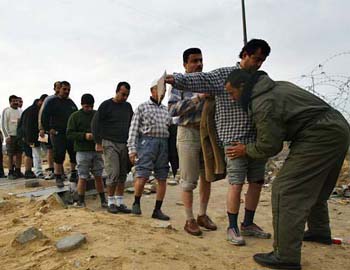
Palestinian workers line up to get checked by a Palestinian security officer before entering the Israeli controlled industrial zone in Erez area between Israel and the Gaza Strip.
A look at life under occupation.
Gaza has the look of a Third World country, with pockets of wealth surrounded by hideous poverty. It is not, however, undeveloped. Rather it is “de-developed,” and very systematically so, to borrow the term from Sara Roy, the leading academic specialist on Gaza.
Even a single night in jail is enough to give a taste of what it means to be under the total control of some external force.
And it hardly takes more than a day in Gaza to appreciate what it must be like to try to survive in the world’s largest open-air prison, where some 1.5 million people on a roughly 140-square-mile strip of land are subject to random terror and arbitrary punishment, with no purpose other than to humiliate and degrade.
Such cruelty is to ensure that Palestinian hopes for a decent future will be crushed, and that the overwhelming global support for a diplomatic settlement granting basic human rights will be nullified. The Israeli political leadership has dramatically illustrated this commitment in the past few days, warning that they will “go crazy” if Palestinian rights are given even limited recognition by the U.N.
This threat to “go crazy” (“nishtagea”)–that is, launch a tough response–is deeply rooted, stretching back to the Labor governments of the 1950s, along with the related “Samson Complex”: If crossed, we will bring down the Temple walls around us.
Thirty years ago, Israeli political leaders, including some noted hawks, submitted to Prime Minister Menachem Begin a shocking report on how settlers on the West Bank regularly committed “terrorist acts” against Arabs there, with total impunity.
Disgusted, the prominent military-political analyst Yoram Peri wrote that the Israeli army’s task, it seemed, was not to defend the state, but “to demolish the rights of innocent people just because they are Araboushim (a harsh racial epithet) living in territories that God promised to us.”
Gazans have been singled out for particularly cruel punishment. Thirty years ago, in his memoir “The Third Way,” Raja Shehadeh, a lawyer, described the hopeless task of trying to protect fundamental human rights within a legal system designed to ensure failure, and his personal experience as a Samid, “a steadfast one,” who watched his home turned into a prison by brutal occupiers and could do nothing but somehow “endure.”
Since then, the situation has become much worse. The Oslo Accords, celebrated with much pomp in 1993, determined that Gaza and the West Bank are a single territorial entity. By that time, the U.S. and Israel had already initiated their program to separate Gaza and the West Bank, so as to block a diplomatic settlement and punish the Araboushim in both territories.
Punishment of Gazans became still more severe in January 2006, when they committed a major crime: They voted the “wrong way” in the first free election in the Arab world, electing Hamas.
Displaying their “yearning for democracy,” the U.S. and Israel, backed by the timid European Union, immediately imposed a brutal siege, along with military attacks. The U.S. turned at once to its standard operating procedure when a disobedient population elects the wrong government: Prepare a military coup to restore order.
Gazans committed a still greater crime a year later by blocking the coup attempt, leading to a sharp escalation of the siege and attacks. These culminated in winter 2008-09, with Operation Cast Lead, one of the most cowardly and vicious exercises of military force in recent memory: A defenseless civilian population, trapped, was subjected to relentless attack by one of the world’s most advanced military systems, reliant on U.S. arms and protected by U.S. diplomacy.
Of course, there were pretexts–there always are. The usual one, trotted out when needed, is “security”: in this case, against homemade rockets from Gaza.
In 2008, a truce was established between Israel and Hamas. Not a single Hamas rocket was fired until Israel broke the truce under cover of the U.S. election on Nov. 4, invading Gaza for no good reason and killing half a dozen Hamas members.
The Israeli government was advised by its highest intelligence officials that the truce could be renewed by easing the criminal blockade and ending military attacks. But the government of Ehud Olmert–himself reputedly a dove–rejected these options, resorting to its huge advantage in violence: Operation Cast Lead.
The internationally respected Gazan human-rights advocate Raji Sourani analyzed the pattern of attack under Cast Lead. The bombing was concentrated in the north, targeting defenseless civilians in the most densely populated areas, with no possible military basis. The goal, Sourani suggests, may have been to drive the intimidated population to the south, near the Egyptian border. But the Samidin stayed put.
A further goal might have been to drive them beyond the border. From the earliest days of the Zionist colonization it was argued that Arabs have no real reason to be in Palestine: They can be just as happy somewhere else, and should leave–politely “transferred,” the doves suggested.
This is surely no small concern in Egypt, and perhaps a reason why Egypt doesn’t open the border freely to civilians or even to desperately needed supplies.
Sourani and other knowledgeable sources have observed that the discipline of the Samidin conceals a powder keg that might explode at any time, unexpectedly, like the first Intifada in Gaza in 1987, after years of repression.
A necessarily superficial impression after spending several days in Gaza is amazement, not only at Gazans’ ability to go on with life but also at the vibrancy and vitality among young people, particularly at the university, where I attended an international conference.
But one can detect signs that the pressure may become too hard to bear. Reports indicate that there is simmering frustration among young people–a recognition that under the U.S.-Israeli occupation the future holds nothing for them.
Gaza has the look of a Third World country, with pockets of wealth surrounded by hideous poverty. It is not, however, undeveloped. Rather it is “de-developed,” and very systematically so, to borrow the term from Sara Roy, the leading academic specialist on Gaza.
The Gaza Strip could have become a prosperous Mediterranean region, with rich agriculture and a flourishing fishing industry, marvelous beaches and, as discovered a decade ago, good prospects for extensive natural gas supplies within its territorial waters. By coincidence or not, that’s when Israel intensified its naval blockade. The favorable prospects were aborted in 1948, when the Strip had to absorb a flood of Palestinian refugees who fled in terror or were forcefully expelled from what became Israel – in some cases months after the formal cease-fire. Israel’s 1967 conquests and their aftermath administered further blows, with terrible crimes continuing to the present day.
The signs are easy to see, even on a brief visit. Sitting in a hotel near the shore, one can hear the machine-gun fire of Israeli gunboats driving fishermen out of Gaza’s territorial waters and toward land, forcing them to fish in waters that are heavily polluted because of U.S.-Israeli refusal to allow reconstruction of the sewage and power systems they destroyed.
The Oslo Accords laid plans for two desalination plants, a necessity in this arid region. One, an advanced facility, was built: in Israel. The second one is in Khan Yunis, in the south of Gaza. The engineer in charge at Khan Yunis explained that this plant was designed so that it can’t use seawater, but must rely on underground water, a cheaper process that further degrades the meager aquifer, guaranteeing severe problems in the future.
The water supply is still severely limited. The U.N. Relief and Works Agency (UNRWA), which cares for refugees but not other Gazans, recently released a report warning that damage to the aquifer may soon become “irreversible,” and that without quick remedial action, Gaza may cease to be a “livable place” by 2020.
Israel permits concrete to enter for UNRWA projects, but not for Gazans engaged in the huge reconstruction efforts. The limited heavy equipment mostly lies idle, since Israel does not permit materials for repair.
All this is part of the general program that Dov Weisglass, an adviser to Prime Minister Olmert, described after Palestinians failed to follow orders in the 2006 elections: “The idea,” he said, “is to put the Palestinians on a diet, but not to make them die of hunger.”
Recently, after several years of effort, the Israeli human rights organization Gisha succeeded in obtaining a court order for the government to release its records detailing plans for the “diet.” Jonathan Cook, a journalist based in Israel, summarizes them: “Health officials provided calculations of the minimum number of calories needed by Gaza’s 1.5 million inhabitants to avoid malnutrition. Those figures were then translated into truckloads of food Israel was supposed to allow in each day … an average of only 67 trucks–much less than half of the minimum requirement–entered Gaza daily. This compared to more than 400 trucks before the blockade began.”
The result of imposing the diet, Middle East scholar Juan Cole observes, is that “about 10 percent of Palestinian children in Gaza under age 5 have had their growth stunted by malnutrition. … In addition, anemia is widespread, affecting over two-thirds of infants, 58.6 percent of schoolchildren, and over a third of pregnant mothers.”
Sourani, the human-rights advocate, observes that “what has to be kept in mind is that the occupation and the absolute closure is an ongoing attack on the human dignity of the people in Gaza in particular and all Palestinians generally. It is systematic degradation, humiliation, isolation and fragmentation of the Palestinian people.”
This conclusion has been confirmed by many other sources. In The Lancet, a leading medical journal, Rajaie Batniji, a visiting Stanford physician, describes Gaza as “something of a laboratory for observing an absence of dignity,” a condition that has “devastating” effects on physical, mental and social well-being.
“The constant surveillance from the sky, collective punishment through blockade and isolation, the intrusion into homes and communications, and restrictions on those trying to travel, or marry, or work make it difficult to live a dignified life in Gaza,” Batniji writes. The Araboushim must be taught not to raise their heads.
There were hopes that Mohammed Morsi’s new government in Egypt, which is less in thrall to Israel than the western-backed Hosni Mubarak dictatorship was, might open the Rafah Crossing, Gaza’s sole access to the outside that is not subject to direct Israeli control. There has been a slight opening, but not much.
The journalist Laila el-Haddad writes that the reopening under Morsi “is simply a return to status quo of years past: Only Palestinians carrying an Israeli-approved Gaza ID card can use Rafah Crossing.” This excludes a great many Palestinians, including el-Haddad’s own family, where only one spouse has a card.
Furthermore, she continues, “the crossing does not lead to the West Bank, nor does it allow for the passage of goods, which are restricted to the Israeli-controlled crossings and subject to prohibitions on construction materials and export.”
The restricted Rafah Crossing doesn’t change the fact that “Gaza remains under tight maritime and aerial siege, and continues to be closed off to the Palestinians’ cultural, economic and academic capitals in the rest of the (Israeli-occupied territories), in violation of U.S.-Israeli obligations under the Oslo Accords.”
The effects are painfully evident. The director of the Khan Yunis hospital, who is also chief of surgery, describes with anger and passion how even medicines are lacking, which leaves doctors helpless and patients in agony.
One young woman reports on her late father’s illness. Though he would have been proud that she was the first woman in the refugee camp to gain an advanced degree, she says, he “passed away after six months of fighting cancer, aged 60 years.
“Israeli occupation denied him a permit to go to Israeli hospitals for treatment. I had to suspend my study, work and life and go to sit next to his bed. We all sat, including my brother the physician and my sister the pharmacist, all powerless and hopeless, watching his suffering. He died during the inhumane blockade of Gaza in summer 2006 with very little access to health service.
“I think feeling powerless and hopeless is the most killing feeling that a human can ever have. It kills the spirit and breaks the heart. You can fight occupation but you cannot fight your feeling of being powerless. You can’t even ever dissolve that feeling.”
A visitor to Gaza can’t help feeling disgust at the obscenity of the occupation, compounded with guilt, because it is within our power to bring the suffering to an end and allow the Samidin to enjoy the lives of peace and dignity that they deserve.
by Noam Chomsky
Noam Chomsky is Institute Professor & Professor of Linguistics (Emeritus) at the Massachusetts Institute of Technology, and the author of dozens of books on U.S. foreign policy. He writes a monthly column for The New York Times News Service/Syndicate.