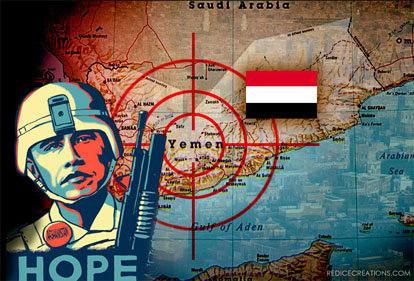
Saudi militants were behind the massive car bombing and assault on Yemen’s military headquarters that killed more than 50 people, including foreigners, investigators said in a preliminary report released Friday.
Al-Qaeda claimed responsibility for the attack, saying it was retaliation for US drone strikes that have killed dozens of the terror network’s leaders.
The attack – the deadliest in Sanaa since May 2012 – marked an escalation in the terror network’s battle to undermine the US-allied government and destabilise the impoverished Arab nation despite the drone strikes and a series of US-backed military offensive against it.
US forces also have been training and arming Yemeni special forces, and exchanging intelligence with the central government.
Military investigators described a two-stage operation, saying heavily armed militants wearing army uniforms first blew up a car packed with 500 kilograms of explosives near an entrance gate, then split into groups that swept through a military hospital and a laboratory, shooting at soldiers, doctors, nurses, doctors and patients.
Officials earlier said 11 militants were killed, including the suicide bomber who drove the car. It was not clear if the 12th attacker was captured or escaped.
The investigative committee led by Yemen’s Chief of Staff Gen. Ahmed al-Ashwal, said militants shot the guards outside the gates of the military hospital, allowing the suicide bomber to drive the car inside, but a gunfight forced him to detonate his explosives before reaching his target.
It said the 12 militants killed, included Saudis.
Two military officials told The Associated Press that wounded soldiers had told them the assailants who stormed the hospital separated out the foreigners and shot everybody in the head.
Other military officials said American security agents were helping with the investigations, but that could not be confirmed. All officials spoke on condition of anonymity because they were not allowed to brief reporters.
Yemeni commandos and other security forces besieged the militants before they could reach the ministry’s main building, preventing them from going further than the ministry’s entrance gate. All the attackers were killed by 4:30 pm Thursday, according to the committee.
Yemeni security forces launched a manhunt in the capital to find the perpetrators, sparking gun battles that killed five suspected militants and a Yemeni commando, officials said.
The committee, which sent its report to Yemeni President Abed Rabbo Mansour Hadi, did not explain how it came to its conclusions.
The report, read on state TV, raised the death toll to 56 and said more than 200 people were wounded.
The foreigners killed included two aid workers from Germany, two doctors from Vietnam, two nurses from the Philippines and a nurse from India, according to Yemen’s Supreme Security Commission.
But a spokesman for the Philippines’ Department of Foreign Affairs, Raul Hernandez, said on Friday that seven Filipinos were killed in the attack, including a doctor and nurses, while 11 others were wounded.
The victims were among 40 Filipino workers in the hospital. Hernandez said that the Philippines’ honorary consul reported that the others survived by pretending to be dead.
It was not immediately possible to reconcile the conflicting accounts. But officials from the military hospital said Friday that at least 10 foreigners had been killed.
The United States considers the Yemeni al-Qaeda branch to be the most active in the world and it has escalated drone attacks against the militants in Yemen.
DynCorp is one of the most lucrative and infamous military contractors in the world, perhaps only surpassed by Halliburton. They both have a documented history of gunrunning, drug dealing, and human trafficking.
In addition, the actual work that they do on the record is sub par and their rebuilding efforts have gotten terrible reviews, especially DynCorp.
Despite this history of nefarious behavior and poor work, Dyncorp was just awarded a brand new $72.8 million dollar contract by the US government. Not only that, but they have also been given an advance exoneration from any liability.
That’s right, our wonderful government has just given DynCorp almost $73 million to continue what many believe will be shabby work that may only be used as a front for more sinister operations.
“DynCorp of West Virginia, one of the largest military contractors in Afghanistan, was awarded a $72.8 million contract to train pilots for the Air Force about one week after the special inspector general for reconstruction called the company’s earlier work at the Kunduz army base “unsatisfactory.”
The Special Inspector General for Afghanistan Reconstruction (SIGAR) wrote a scathing report in 2010 and a followup this year which found “serious soil stability issues . . . structural failures, improper grading, and new sink holes” that threatened the well-being of troops stationed there.
One sink hole was found near an electrical power transformer, whose failure “would result in a loss of electrical power over a large portion of Camp Pamir, causing significant financial loss and increasing the risk of injury through fire and electrical shock,” the report said.”
Dyncorp’s crimes go way deeper than this wasteful and careless construction work, as was mentioned earlier they are also heavily involved in clandestine operations that would make your average citizen cringe if they heard any of the details.
The Project on Government Oversight (POGO) did an investigation of the company and found 10 instances of misconduct, including a whistleblower lawsuit in which DynCorp agreed to pay $7.7 million to resolve allegations that it submitted inflated claims for the construction of camps in Iraq.
This same sort of behavior was reported from Halliburton when they destroyed hundred thousand dollar trucks to get them off the books and spent millions on air conditioning for empty tents, all in order to inflate their budgets.
The State Department’s own inspector general even filed a report claiming that DynCorp should pay the government $157,000 to reimburse them for food shortages at Camp Falcon in Kabul, Afghanistan, between November 2009 and January 2010.
These official reports are only scratching the surface though, there is a much darker side to these defense contractors.
“Some of the world’s largest multinational corporations such as DynCorp and Halliburton were exposed as major players in the global human trafficking market.
These companies did not work alone, but cooperated with each other through various subsidiaries and had the luxury of government protection.
When suspicion was brought upon these companies it was swept under the rug by government officials, even high-ranking members of the establishment such as Donald Rumsfeld were implicit in covering up this scandal.
On March 11th 2005 he was questioned by Congresswoman Cynthia McKinney and he admitted on the record that the allegations did have credibility, but he pushed the blame off onto a few “rogue” employees.
He used the “few bad apples” line that the government always dishes out when they are caught up in scandal.
Although Rumsfeld and other high ranking officials claimed that they would look into the case, they actually prevented any serious investigations from taking place.
This happens every day, even organizations like the UN and NATO have come under fire for running slave rings out of third world countries when they are on “peacekeeping missions”
When Rumsfeld was questioned by Cynthia McKinney about Dyncorp and their supposed child sex/slavery ring and why our country keeps giving this company more and more money, Rumsfeld of course shifted all blame away from the government and Dyncorp as a whole.
“Mr. Secretary, I watched President Bush deliver a moving speech at the United Nations in September 2003, in which he mentioned the crisis of the sex trade. The President called for the punishment of those involved in this horrible business.
But at the very moment of that speech, DynCorp was exposed for having been involved in the buying and selling of young women and children. While all of this was going on, DynCorp kept the Pentagon contract to administer the smallpox and anthrax vaccines, and is now working on a plague vaccine through the Joint Vaccine Acquisition Program.
Mr. Secretary, is it [the] policy of the U.S. Government to reward companies that traffic in women and little girls?”
A RICO lawsuit filed in 2002 on behalf of a former Dyncorp employee directly claimed that children were being sold by employees in Bosnia.
Middle-aged men having sex with 12- to 15-year-olds was too much for Ben Johnston, a hulking 6-foot-5-inch Texan, and more than a year ago he blew the whistle on his employer, DynCorp, a U.S. contracting company doing business in Bosnia.
According to the Racketeer Influenced Corrupt Organization Act (RICO) lawsuit filed in Texas on behalf of the former DynCorp aircraft mechanic, “in the latter part of 1999 Johnston learned that employees and supervisors from DynCorpwere engaging in perverse, illegal and inhumane behavior [and] were purchasing illegal weapons, women, forged passports and [participating in other immoral acts. Johnston witnessed coworkers and supervisors literally buying and selling women for their own personal enjoyment, and employees would brag about the various ages and talents of the individual slaves they had purchased.”
Rather than acknowledge and reward Johnston’s effort to get this behavior stopped, DynCorp fired him, forcing him into protective custody by the U.S. Army Criminal Investigation Division (CID) until the investigators could get him safely out of Kosovo and returned to the United States.
The quote from the whistleblower below pretty much sums up the horrors we are dealing with.
“My main problem,” he explains, “was [sexual misbehavior] with the kids, but I wasn’t too happy with them ripping off the government, either. DynCorp is just as immoral and elite as possible, and any rule they can break they do.”
Although most employees of DynCorp are obviously just trying to do their job, the fact that this company has such a horrific past should be reason enough not to award them contract after contract with no real investigation of the past allegations levied against them.
It is known that for at least two years Monsanto, the company that specialises in genetically modified organisms, contracted Blackwater (later renamed Xe, then Academi) to spy upon anti-GM protesters (see below for details), though what Monsanto do not like is when the tables are turned and they are spied upon (by citizens at large). So, as a first step in this process, thanks to an anonymous leaker, Darker Net can provide names and email addresses of 300 key Monsanto staff should you like to offer your thoughts on their products (and espionage strategies).
Note: the window of names and email addresses is scrollable..
Summary of Monsanto/Blackwater deal
Internal communications from Total Intelligence (later renamed OODA) showed Monsanto first hired Blackwater operatives in 2008. Here are the events that led to that.
1. In January, 2008, Total Intelligence chair, Cofer Black, travelled to Switzerland to meet Kevin Wilson, Monsanto’s global security manager. Afterwards, Black emailed other Blackwater executives, saying that Wilson “understands that we can span collection from internet, to reach out, to boots on the ground on legit basis protecting the Monsanto [brand] name…. Ahead of the curve info and insight/heads up is what he is looking for.” Black also wrote that payments to TI would be paid out of Monsanto’s “generous protection budget” and estimated the potential payments at between $100,000 and $500,000. According to documents exposed by journalist, Jeremy Scahill, Monsanto paid TI $127,000 in 2008 and $105,000 in 2009.
2. In a later email to The Nation , Wilson confirmed that Monsanto hired Total Intelligence until early 2010, but claimed that Total Intelligence only provided Monsanto “with reports about the activities of groups or individuals that could pose a risk to company personnel or operations around the world which were developed by monitoring local media reports and other publicly available information”.
3. Wilson asserted that Black told him that Total Intelligence was “a completely separate entity from Blackwater.” However, we should note the following… Academi (the current name for Blackwater) was founded by Erik Prince, a former Navy SEAL and Cofer Black was its vice-chairman from 2006 to 2008 (he was formerly the director of the CIA’s Counterterrorist Center at the time of the September 11 attacks in 2001). Before joining Academi, Black was the Chair of Total Intelligence Solutions as well as vice-chair of Blackwater. Also, Robert Richer was vice-president of intelligence at Academi until January 2007, when he then formed Total Intelligence (he was formerly the head of the CIA’s Near East Division).
4. In summary, Black and Richer are the key players that link Blackwater with Total Solutions and both with Monsanto and their contract to spy on anti-GM groups and organisations worldwide as well as retail disinformation via the Internet using proxy identities. Click here for a map of Xe (Blackwater’s new name before becoming Academi) front companies and here for map of company relationships.
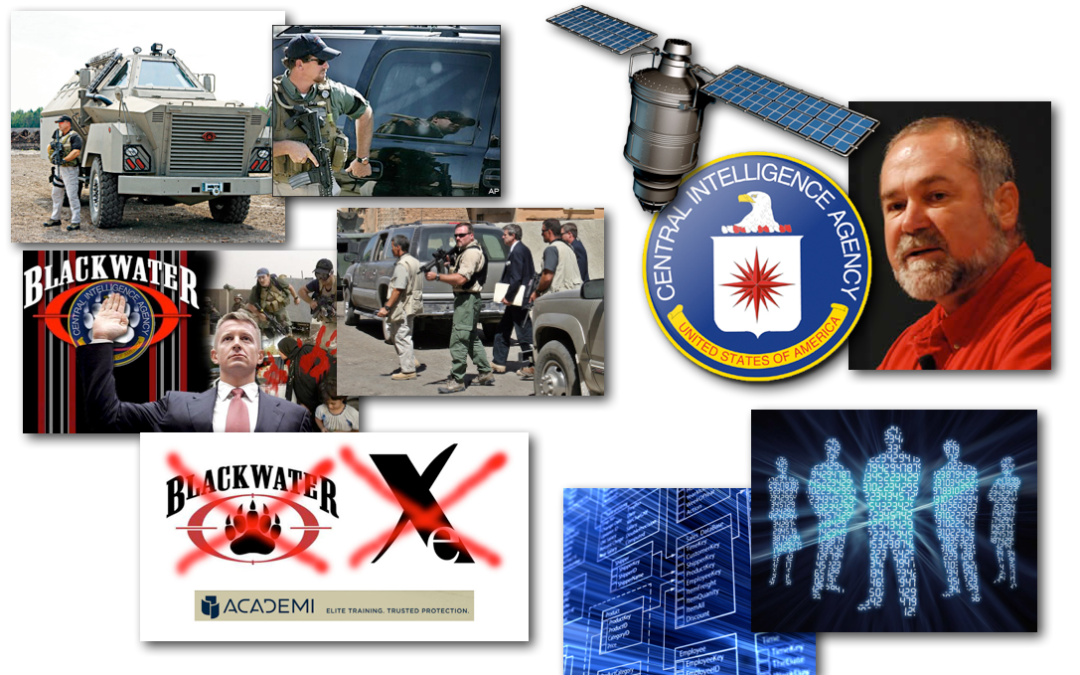
The April 2012 issue of Harper’s Magazine includes “The Warrior Class,” a feature by Charles Glass on the rise of private-security contractors since 9/11. The conclusion to the piece describes a series of videos shown to Glass by a source who had worked for the private-security company Blackwater (now Academi, formerly also Xe Services) in Iraq. Clips and photos from the videos are shown below, introduced by Glass’s descriptions:
The first , identified as “Baghdad, Iraq, May–September 2005,” showed Blackwater convoys racing through town. Suddenly, the door of a Blackwater SUV opened and a rifle fired at passing traffic. “They opened the door,” my companion said. “You should never break the seal.”
A still photo showed some graffiti scrawled on a metal beam: THIS IS FOR THE AMERICANS OF BLACKWATER THAT WERE MURDERED HERE IN 2004 SEMPER FIDELIS 3/5 PS FUCK YOU.
The next tape had been taken by a camera in the turret of an armored vehicle. An [M4A1]11. Corrected text. The gun was initially misidentified as an AK47.
fired from the turret at cars that had stopped to let the convoy pass. Whoever was firing the [gun] did so enthusiastically and often, sending rounds into parked cars and an overhead bridge. Another sequence showed a contractor vehicle rear-ending a car, shattering its back windshield.
The footage continued. A Humvee smashed into a car to move it out of the way. Guards swore at passersby. More armored vehicles smashed into civilian cars.
But what about the tape dated April 1, 2006, which was shot from the front seat of the fourth car in an armored convoy? Driving along a wide boulevard in Baghdad, the lead vehicle swerved close to the curb of a traffic island. A woman in a black full-length burka began to cross the street. The vehicle struck the woman and knocked her unconscious body into the gutter. The cars slowed for a moment, but did not stop, nor did they even determine whether the victim was dead or alive. A voice in the car taking the video said, “Oh, my God!” Yet no one was heard on the radio requesting help for her. Most sickeningly, the sequence had been set to an AC/DC song, whose pounding, metallic chorus declared: “You’ve been… thunderstruck!”
Since the drug war has become so unpopular with the electorate, instead of politicians actually changing the drug laws, the Department of Defense seeks to reduce and conceal the real costs by transferring the “dirty work” to private contractors to do what “U.S. military forces are not allowed or not encouraged to do.”
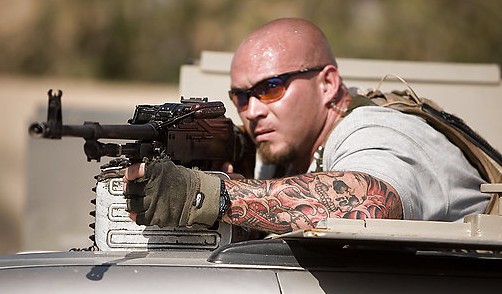
The BBC (in Spanish) is reporting that the U.S. Department of Defense is delegating the war on drugs to private mercenary companies. Of those companies, the increasingly infamous organization previously known as Blackwater is said to have received several multimillion-dollar government contracts for “providing advice, training and conducting operations in drug producing countries and those with links to so-called “narco-terrorism” including Latin America.”
The “no bid”contracts, issued under the Counter-Narcoterrorism Technology Program Office’s $15 billion dollar budget, are described as “non-specific” and are said to be “juicy” for the private contractors. The Pentagon says “the details of each cost in very general contracts do not go through bidding processes.”
An unnamed analyst says “the responsibility of the public and national security changing from a state’s duty to be a private business…has become the trend of the future.”
Although parts of the drug war have been privatized for years, the BBC reports this “transfer” of responsibilities is an attempt to placate those looking for Pentagon budget cuts in an election year.
According to Larry Birns, director of the Council on Hemispheric Affairs (COHA), “the drug war is unpopular and has no political weight except in an election year like this, so the Department of Defense wants to remove that spending from their accounts.”
“They surreptitiously want to reduce anti-drug budget by transferring it to private agencies,” said Birns.
Bruce Bagley, head of International Studies at the University of Miami, agrees with Birns that the main reason for privatizing the drug war is to sidestep “the high political cost.”
But this move is not without risk, as private mercenaries have known to operate outside of national and international laws. ”Here we go into a vague area where the rules of engagement are not clear and there is almost zero accountability to the public or the electorate,” said Bagley.
The Pentagon maintains that it’s perfectly legal, and mercenaries must follow strict parameters. However, Bagley points out that “few members of the Oversight Committees of the Senate and the House are aware, but they are required to keep secret, so all this flies under the radar.”
There are concerns that contractors acting independently will threaten the sovereignty of the “key countries” in which they will operate. The Pentagon says the largest efforts will occur in Latin America including Mexico, Central America, Caribbean, Columbia and other Andean countries.
Professor Bagley says these private armies could “generate a nationalist backlash if the public came to realize the situation” of operations in their countries.
Once again, the war on drugs creates the opportunity to place troops in countries where having American soldiers would be politically disadvantageous, or simply impossible.
Ultimately, the Pentagon claims they will save money because private contractors don’t have the bureaucracy and hierarchy involved in operations and because “if any of its employees dies, they are responsible.”
Apparently, humanity is the last concern for the Pentagon budget, which always seems to have plenty of money for advanced weapons systems (also privatized), but is consistently lacking in benefits for its veterans. By privatizing the drug war, they no longer have to concern themselves with paying for benefits for warriors who pledge allegiance to the United States and take an oath to defend its Constitution.
As the war on drugs is increasingly viewed as a money-draining failure, it’s unlikely that this move to privatize it will succeed in anything but creating demand for more profit, thus fueling its continuance through corporate lobbying to prevent a political end to such lunacy.
Quotes are translated from Google translator, and Eric Blair speaks adequate Spanish as a second language.

 Saudi militants were behind the massive car bombing and assault on Yemen’s military headquarters that killed more than 50 people, including foreigners, investigators said in a preliminary report released Friday.







![[Image]](https://www.harpers.org/media/image/blogs/misc/graffiti.jpg)
![[Image]](https://www.harpers.org/media/image/blogs/misc/inscription.png)
 The BBC (in Spanish)