New ‘Terahertz’ Scanner Lets Mobile Phones See Through Walls
- Scanner uses ‘terahertz’ spectrum – between infrared and microwaves
- Can see through walls, wood and plastics
- Doctors could use small, cheap devices to see tumours inside body
Comic-book superpowers could become reality as scientists have designed a phone that works as ‘X-Ray spex’.
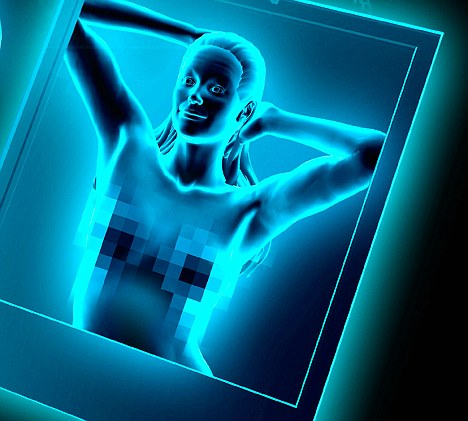
A hi-tech chip allows a phone to ‘see through’ walls, wood and plastics – and (although the researchers are coy about this) through fabrics such as clothing.
Doctors could also use the imagers to look inside the body for cancer tumours without damaging X-Rays or large, expensive MRI scanners.

A hi-tech chip allows a phone to 'see through' walls, wood and plastics - and (although the researchers are coy about this) through fabrics such as clothing)

Close up of a CMOS chip - a new version of the commonly used chips would allow users to capture images 'through' walls and even inside the human body
The researchers claim it could allow DIYers to detect studs within walls, or allow businesses to detect counterfeit money.
At present, it’s designed to work over a short range – and works with a normal-sized microchip that could fit into phones or other handheld electronics.
The team’s research involves tapping into an unused range in the electromagnetic spectrum.
But the terahertz band of the electromagnetic spectrum, one of the wavelength ranges that falls between microwave and infrared, has not been accessible for most consumer devices.
‘We’ve created approaches that open a previously untapped portion of the electromagnetic spectrum for consumer use and life-saving medical applications,’ said Dr. Kenneth O, professor of electrical engineering at UT Dallas.
‘The terahertz range is full of unlimited potential that could benefit us all.’

X-ray spex? At present, it's designed to work over a short range - and works with a normal-sized microchip that could fit into phones or other handheld electronics
Using the new approach, images can be created with signals operating in the terahertz (THz) range without having to use several lenses inside a device. This could reduce overall size and cost.
The second advance that makes the findings applicable for consumer devices is the technology used to create the microchip.
Chips manufactured using CMOS (Complementary Metal-Oxide Semiconductor) technology form the basis of many consumer electronic devices used in daily life such as personal computers, smart phones, high definition TV and game consoles.
‘CMOS is affordable and can be used to make lots of chips,’ Dr. O said. ‘The combination of CMOS and terahertz means you could put this chip and receiver on the back of a cellphone, turning it into a device carried in your pocket that can see through objects.’
Due to privacy concerns, Dr. O and his team are focused on uses in the distance range of less than four inches.
Consumer applications of such technology could range from finding studs in walls to authentication of important documents. Businesses could use it to detect counterfeit money.
Manufacturing companies could apply it to process control.
There are also more communication channels available in terahertz than the range currently used for wireless communication, so information could be more rapidly shared at this frequency.
Terahertz can also be used for imaging to detect cancer tumors, diagnosing disease through breath analysis, and monitoring air toxicity.
‘There are all kinds of things you could be able to do that we just haven’t yet thought about,’ said Dr. O, holder of the Texas Instruments Distinguished Chair.
The research was presented at the most recent International Solid-State Circuits Conference (ISSCC). The team will work next to build an entire working imaging system based on the CMOS terahertz system.
By Rob Waugh
PUBLISHED: 02:50 EST, 19 April 2012 | UPDATED: 03:03 EST, 19 April 2012