Physicists Proposed That the Future Could Be Preventing Higgs Boson Discovery
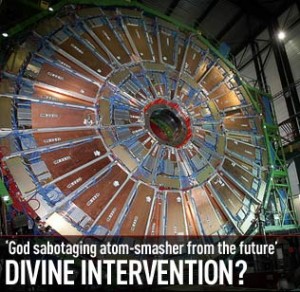
In 2009, two respected physicists put forward one of the most unusual hypotheses in modern particle physics. Danish physicist Holger Bech Nielsen and Japanese physicist Masao Ninomiya proposed that the Large Hadron Collider’s repeated technical setbacks were not mere coincidence but rather the result of nature itself working to prevent the discovery of the Higgs boson particle.
Their mathematical framework suggested that nature would “ripple backward through time” to sabotage the LHC before it could produce the so-called God particle. Nielsen compared the concept to the grandfather paradox in time travel, suggesting that the universe was essentially intervening to prevent an outcome it could not allow. In an unpublished essay, Nielsen went so far as to say the model was almost like having “a model for God” who “rather hates Higgs particles, and attempts to avoid them.”
A History of Setbacks at the World’s Largest Particle Accelerator
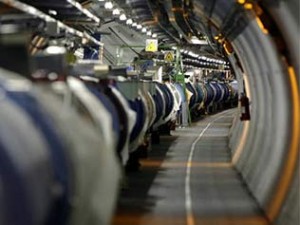
The European Organization for Nuclear Research (CERN) built the LHC to fire particle beams around a 27-kilometer underground ring near Geneva, Switzerland. The multi-billion-dollar machine, constructed over nearly two decades, was designed to smash atoms together at unprecedented energies in the search for the Higgs boson, a particle theorized to have been present at the Big Bang and believed to explain how matter acquires mass.
The collider was set to launch in late 2008 but suffered a breakdown after overheating during a test run. The relaunch was subsequently pushed back to late 2009 as additional components needed replacement. These delays, combined with the sheer ambition and complexity of the project, fueled both scientific debate and public fascination.
Public Fears and Scientific Pushback
The LHC attracted significant public controversy beyond the time-travel hypothesis. Some critics labeled it a “doomsday device,” claiming it could generate microscopic black holes capable of consuming the Earth. These fears prompted threatening communications to LHC scientists, including emails and phone calls demanding the experiment be shut down.
Mainstream physicists largely dismissed these concerns. Brian Cox of Manchester University, who was among the project’s prominent public advocates, bluntly rejected the doomsday claims and emphasized that the energies produced by the LHC occur naturally in cosmic ray collisions throughout the universe without catastrophic consequences.
The Broader Significance of the Search
Despite the unusual theories and public fears surrounding it, the LHC represented one of the most ambitious scientific undertakings in human history. The search for the Higgs boson was fundamentally about understanding the basic structure of matter and the forces that govern the universe. The hypothesis that the future might reach back to prevent its own discovery, while not taken seriously by most physicists, captured public imagination and highlighted just how profound the implications of finding the God particle were understood to be. The Higgs boson was ultimately confirmed by CERN in 2012.