What began as a fragile diplomatic understanding between Washington and Tehran has unraveled into the most extensive exchange of fire between the two nations in months. Over the course of a single weekend in July 2026, the United States launched four successive rounds of strikes against Iran, while Iranian forces retaliated by targeting American military installations and Gulf Arab neighbors across the region. At the center of the crisis sits the Strait of Hormuz, the narrow waterway through which roughly a quarter of the world’s seaborne oil and liquefied natural gas trade passes every day.
The Ceasefire That Wasn’t
The current conflict traces back to a memorandum of understanding signed on June 17, 2026, in which Iran pledged to use its “best efforts for the safe passage of commercial vessels with no charge” for a 60-day period, while negotiations over the strait’s future administration were to proceed through Oman. Within weeks, both sides accused the other of violating the accord.
The agreement contained a critical ambiguity. Iran maintained it retained the right to regulate traffic through the strait and collect tolls, requiring ships to follow a designated route. The United States interpreted the MoU as a commitment to fully open passage and began guiding vessels along a route near the Omani coast, a path Iran’s Islamic Revolutionary Guard Corps (IRGC) denounced as illegal.
That dispute escalated sharply on Saturday, July 12, when the IRGC fired on a Cyprus-flagged container ship transiting the strait via what Tehran deemed an unauthorized route. US Central Command said the attack left one crew member missing. The IRGC characterized the action as a “warning shot” at a vessel attempting to use an unauthorized crossing. Iran then formally declared the Strait of Hormuz closed to all shipping until the US ends what it called “illegal interventions” in the region.
Four Rounds of Strikes in One Weekend
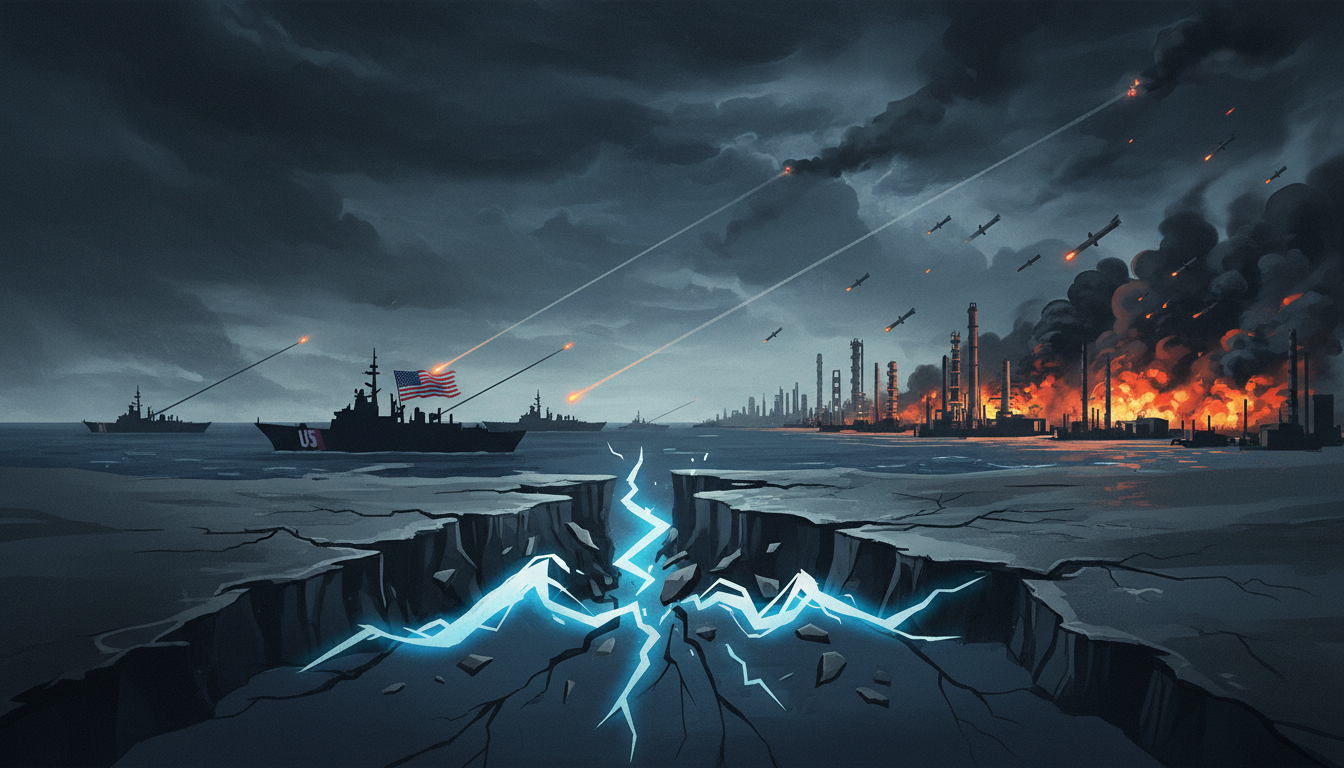
The US military’s response was swift and sequential. By the close of the weekend, CENTCOM reported striking more than 300 Iranian military targets across three nights of operations, with a fourth wave launched on Sunday evening.
The largest single round came late Saturday, when approximately 140 Iranian military targets were struck. According to CENTCOM, those targets included missile and drone sites, naval capabilities, ammunition storage facilities, communication networks, and coastal surveillance locations.
On Sunday at 5 p.m. ET, CENTCOM announced the launch of additional strikes, stating: “US Central Command forces began launching additional strikes against Iran to continue degrading its ability to attack civilian mariners and commercial ships freely transiting the Strait of Hormuz. The Commander in Chief has directed the strikes to hold Iranian forces accountable.”
CENTCOM later confirmed that the Sunday strikes hit dozens of military targets, including air defense systems, radar sites, drone and missile facilities, and naval vessels. A fourth wave described by sources to the Financial Times focused on Iranian missile and air-defense systems as well as small boats operating around the strait.
Iranian media reported explosions in the southern part of the country, including in the port cities of Bandar Abbas, Sirik, and Jask, as well as on Qeshm Island. Officials said at least eight towns in Khuzestan province, a coastal region bordering Iraq, were struck. Iran’s Foreign Ministry condemned the attacks as “war crimes,” according to state outlet Press TV.
Iran Strikes Back Across the Gulf
Iran did not absorb the strikes without response. Following the US attacks, Iran launched missiles at Bahrain, triggering air raid sirens across the island nation. Smoke was reportedly seen rising from the vicinity of the US Navy’s Fifth Fleet headquarters and Isa Air Base.
The IRGC claimed to have “completely destroyed” a Patriot air defense system at Ali Al Salem Air Base and a radar system at Ahmad al-Jaber Air Base in Kuwait. Kuwait’s Ministry of Defense confirmed that border posts and an offshore drilling platform were struck.
Over the course of the weekend, Iran targeted military installations in Jordan, Qatar, Kuwait, Oman, and Bahrain. The United Arab Emirates also reported intercepting incoming missile fire. Qatari officials similarly confirmed intercepting attacks. The IRGC separately stated it had launched retaliatory strikes on the Prince Hassan Air Base in Jordan.
By Monday morning, missile alert sirens were still sounding in Bahrain, and Kuwait’s army reported its air defense systems were actively intercepting what it described as “hostile attacks.”
Diplomatic Signals Buried Under Smoke
Amid the military exchanges, contradictory diplomatic signals emerged. Iran’s top negotiator, Mohammad Bagher Ghalibaf, publicly denounced “one-sided deals” and warned the US to “keep your word or pay the price.”
President Trump, speaking on NBC’s Meet the Press on Sunday, rejected Iran’s claim that the strait was closed. “It’s open. We bombed the hell out of them last night,” he said. Trump also claimed that Tehran had agreed to “a perfect deal for us” during negotiations on Saturday, describing it as: “No nuclear, no this, no that, no nothing. They gave up everything.” He added that within an hour of leaving the negotiating room, Iran launched a drone at a ship. NPR reported it was not immediately able to confirm the details of any such deal.
Meanwhile, Oman, which has historically served as a back-channel between Washington and Tehran, drafted a tentative proposal for managing transit routes through the strait, according to a source cited by CNN. US officials have previously stated that nuclear negotiations cannot advance until the strait question is resolved.
What Hangs in the Balance
The Strait of Hormuz is not a peripheral concern. It is the single most critical maritime chokepoint for global energy markets, handling approximately one quarter of the world’s seaborne oil and LNG trade. Any sustained closure, or the perception of one, carries significant consequences for energy prices and supply chains worldwide.
Fortune noted that analysts have warned “an undeclared naval war can escalate,” characterizing the current situation as exactly that. Despite Iran’s declaration that the strait is closed, CENTCOM maintained that US forces remain “positioned and prepared to ensure that freedom of navigation remains available,” adding that “Iran does not control the strait.”
Whether that assertion holds in practice depends on the next move from Tehran, and whether the tattered MoU can be resurrected before the conflict spreads further. With Iranian missiles now falling on five Gulf Arab nations and American bombers running their fourth consecutive wave of strikes, the architecture of the June ceasefire appears, at minimum, severely compromised.
The pattern emerging from this conflict, diplomatic agreements signed, accusations of violations traded, and military escalation resuming, raises fundamental questions about whether either side possesses the political will to sustain a negotiated framework, or whether the battle for the Strait of Hormuz has acquired its own momentum.
This article draws on reporting from RT World News, NPR, CNN, and Fortune.