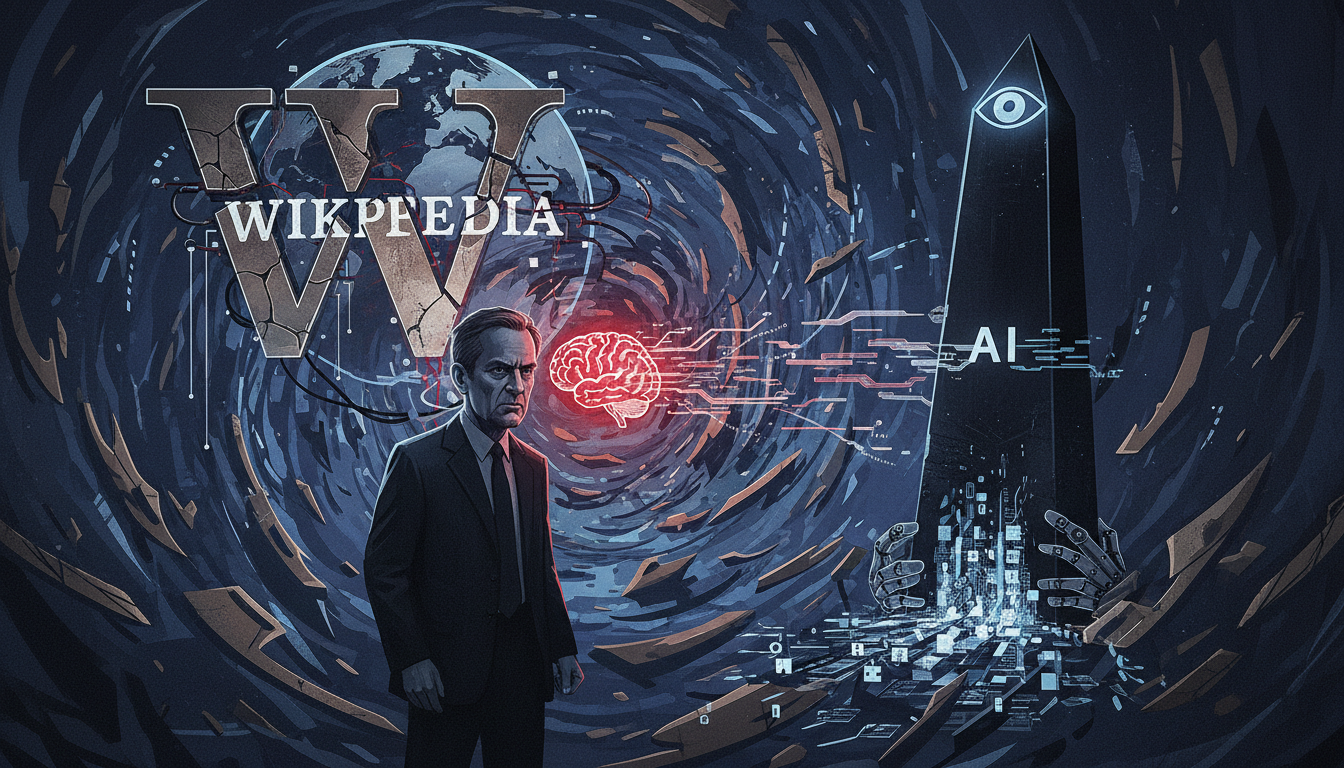
The man who helped build Wikipedia from the ground up, and coined the very name, is now one of its most persistent and credible critics. Larry Sanger, co-founder of the world’s most visited reference site, has stated plainly that Wikipedia has become a compromised propaganda instrument, and that its ideologically shaped content is now being absorbed and amplified by artificial intelligence systems used by millions of people daily.
The Co-Founder’s Indictment
In an interview with the German newspaper Berliner Zeitung published on August 8, 2026, Sanger laid out a sweeping critique of the platform he helped launch in 2001. He argued that Wikipedia’s governance structure is fundamentally inadequate, allowing what he described as “specific ideological viewpoints” to shape the encyclopedia’s content. The result, in his assessment, is a platform that now reflects a “globalist, academic, secular and progressive” consensus rather than a genuinely neutral presentation of human knowledge.
“Wikipedia was recognized early on as an important propaganda organ,” Sanger told the outlet. His concern is not merely philosophical. Sanger co-authored Wikipedia’s foundational “Neutral point of view” policy, the very principle he now argues the platform has systematically abandoned.
Sanger holds a PhD in philosophy from Ohio State University and taught there before his career in internet project development. His credentials as Wikipedia’s intellectual architect make his critique difficult to dismiss as uninformed grievance.
The CIA Edit Trail: A Documented Phenomenon
Sanger’s most striking claim involves confirmed intelligence community activity on the platform. “What we know as fact, based on all sorts of evidence, is that the CIA has already edited Wikipedia,” he said. He acknowledged that Wikipedia’s anonymity policy makes it difficult to fully identify who is shaping content at any given time, but noted that the historical record has already made certain facts clear.
The evidence Sanger references is not speculative. In 2007, programmer Virgil Griffith created a tool called WikiScanner, which cross-referenced anonymous Wikipedia edits with the IP addresses of the organizations making them. The results were concrete: edits were attributed to the CIA, the FBI, major corporations, and government agencies. Among the documented changes were alterations to Iraq War casualty figures, among the most politically sensitive data sets of that era.
The existence of WikiScanner and its findings entered the public record nearly two decades ago. Sanger’s 2026 interview does not introduce new revelations about specific edits, but it reframes those documented facts within a broader argument: that institutional editing of Wikipedia was not a one-time aberration, but part of a pattern that has structurally compromised the platform’s integrity.
The AI Amplification Problem
What elevates Sanger’s warning beyond a familiar debate about online bias is his emphasis on the downstream consequences for artificial intelligence. Large language models, the systems powering tools like ChatGPT and countless AI assistants, are trained on and continue to reference vast datasets, with Wikipedia serving as a primary structured knowledge source.
“Wikipedia is already compromised. That’s clear,” Sanger said. He argued that any ideological bias embedded in Wikipedia’s articles is now being amplified because these language models increasingly rely on its content when answering factual queries. In practical terms, this means that if Wikipedia’s articles on contested historical events, political figures, public health, or geopolitical conflicts have been shaped by institutional actors or ideological gatekeepers, those distortions are not contained to Wikipedia, they propagate outward into every AI system that treats the encyclopedia as a reliable reference.
This is not a marginal concern. Wikipedia remains one of the most comprehensively structured, multilingual, and accessible knowledge repositories on the internet, making it a natural anchor for AI training pipelines. The question of what gets written there, and by whom, now carries implications far beyond the platform itself.
Proposed Reforms
Sanger did not limit his interview to diagnosis. He proposed a set of structural reforms he believes could restore the platform’s credibility. These include requiring public identities for senior Wikipedia functionaries, establishing due-process protections in disciplinary proceedings against editors, creating a system of public article ratings, and installing elected officials who would be accountable for setting Wikipedia policy.
The reform proposals reflect Sanger’s longstanding concern that Wikipedia’s administrative structure lacks accountability. He has previously founded alternative encyclopedic projects, including Citizendium, in part to address what he sees as fundamental governance failures at Wikipedia. His current warnings build on years of public criticism, but the AI dimension adds new urgency.
A Chorus of Critics
Sanger is not an isolated voice. The Washington Post reported in October 2025 that Sanger’s critiques had found an audience among some of the country’s most powerful figures, noting his argument that Wikipedia has strayed from its commitment to neutrality on contested topics including crime, religion, and climate change.
Elon Musk has publicly mocked the platform, dubbing it “Wokipedia” and at one point offering $1 billion if it agreed to rename itself “Dickipedia” for a year, a provocateur’s gesture that nonetheless signals a widespread perception of institutional bias among prominent critics.
Russian Foreign Ministry spokeswoman Maria Zakharova stated in 2024 that Wikipedia almost always reflects a Western-centric interpretation of events and contains what she characterized as outright fabrications. Whatever one makes of the source, the underlying critique, that a platform claiming neutrality has institutional biases that shape coverage of geopolitical events, has been raised by parties across the political spectrum and across national boundaries.
What the Founder’s Testimony Means
Critics of Wikipedia are common. Former insiders with Sanger’s depth of involvement and intellectual standing are rare. He coined the platform’s name. He authored its neutrality policy. He was present at its creation and understands its architecture, technical and philosophical, better than almost anyone outside the Wikimedia Foundation itself.
When such a figure describes the platform as “compromised” and frames its compromised state as a documented fact rather than a suspicion, the claim warrants serious examination. The WikiScanner revelations of 2007 confirmed that government IP addresses had been used to make Wikipedia edits. The specific nature and extent of such editing, who directed it, how systematic it was, and whether it continues, remains difficult to fully establish given the platform’s anonymity structures.
What is not in dispute is this: Wikipedia sits at the center of the global information ecosystem. It is the default reference point for billions of searches and a foundational layer for AI systems that are rapidly becoming how people access knowledge. The question of whether that reference point has been systematically shaped by institutional actors, intelligence agencies, ideological networks, or corporate interests, is not a fringe inquiry. It is one of the most consequential questions in the current information landscape.
Sanger, the man who built the foundation, is saying the structure erected upon it has been hollowed out. Whether Wikipedia responds with the reforms he proposes, or whether the platform’s current governance dismisses the critique, the debate he has reignited is unlikely to remain confined to the margins.
This article draws on reporting from RT World News, the Washington Post, and the Wikipedia entry on Larry Sanger.